Showing posts with label Beyond the Academy. Show all posts

Tuesday, July 22, 2025

Athletics + Academics = A Balanced Life

A challenge for many of us who do science professionally is knowing when to take a break. The engrossing feeling of diving into an all consuming problem can make it hard to remember to come up for air. But scientists are human beings too and we need other interests, connection and to take care of our physical bodies as much as anyone else. This week, our newest lab member Isabelle Marincic writes about how she strives to achieve that balance in her research career.

by Isabelle Marincic

Hello Lab Blog! My name is Izzy, and I’ve just joined the PVL as an MSc student in May 2025. I am so excited to be a part of this amazing group of scientists. I technically began working for Professor Moores in January as an RA, so I have been with the group for around 6 months. Within these first few months, I’ve begun working on projects related mainly to astrobiology (my favourite subject), including biological methane production on Mars and the feasibility of bacteria inhabiting Martian penitentes. I have also begun TA’ing which has been a new and exciting experience that I honestly have really enjoyed. On top of all of this, I am currently writing my first paper with the lab that will hopefully be submitted by the end of the summer! 
 
The reason for sharing all of this is not only to introduce myself, but to lead into the main topic of this blog post. I am an athletically motivated individual, and I strongly believe in a work-life balance. While I deeply enjoy academics and am grateful to be in the position I am, I always make sure to have an outlet that is separate from academia. After the long days of writing and reading papers, all I want to do is get on my feet and go do something that uses mainly my body rather than my brain. Ever since I was young, I’ve always been really athletic. I played soccer, volleyball, ran track and field and cross country, and just enjoyed being active in general. Now that I am a busy adult, finding time to be active is difficult, but it makes my quality of life so much better that I make sure to find time most days of the week to do something that moves my body. For a few years now I have been into weightlifting, which I aim to do three days a week. When I am not lifting in the gym, I am in the climbing gym 3x a week! I have been climbing for just over two years, and I am so thankful I found this sport. Climbing is fun and relaxing but also has such a strong community that I really enjoy being a part of. I have been able to meet so many people and make so many friends because of this sport, and it is extremely important to me to have spaces to meet people as it becomes increasingly difficult as an adult to do so as I get older. Human connection is something I seriously value in my life, and I can foster this through the athletic activities I participate in. 
 
For some reason, people in the climbing community constantly recruit their non-climbing friends to join climbing. I am one of those people. Since joining PVL I was repeatedly asking my lab-mates to come climbing with me. Some of them were eager to climb, while others I eventually wore down <3. This marked the first official PVL climbing outing. Those from the group able to make it out to Basecamp in downtown Toronto got to experience a fun evening of climbing, specifically bouldering! Bouldering is a style of climbing that does not involve ropes or harnesses where routes are set around 15 ft off the ground at their highest point. Mats cover the floor to break your fall, but proper falling technique is still a must-know before getting on the wall! Routes are organized by level of difficulty and use a V-grading system. Often, V0 is the easiest climb, with climbs getting progressively more difficult as the number increases. My lab mates absolutely rocked (pun intended) at our climbing session! While climbing obviously involves strength and endurance, it is 100% a mental sport as well. I have had to overcome mental blocks when attempting a problem which has only made me a stronger climber, and a more confident person. 
 
Getting to enjoy my favourite sport with my new lab mates was a really fulfilling experience as it allowed me to share something I love, and I had the opportunity to build stronger relationships with people I work alongside every day! Please enjoy the group picture from the evening above :)

Monday, November 11, 2024

Au Revoir and Until Next Time, my Fellow PVLers

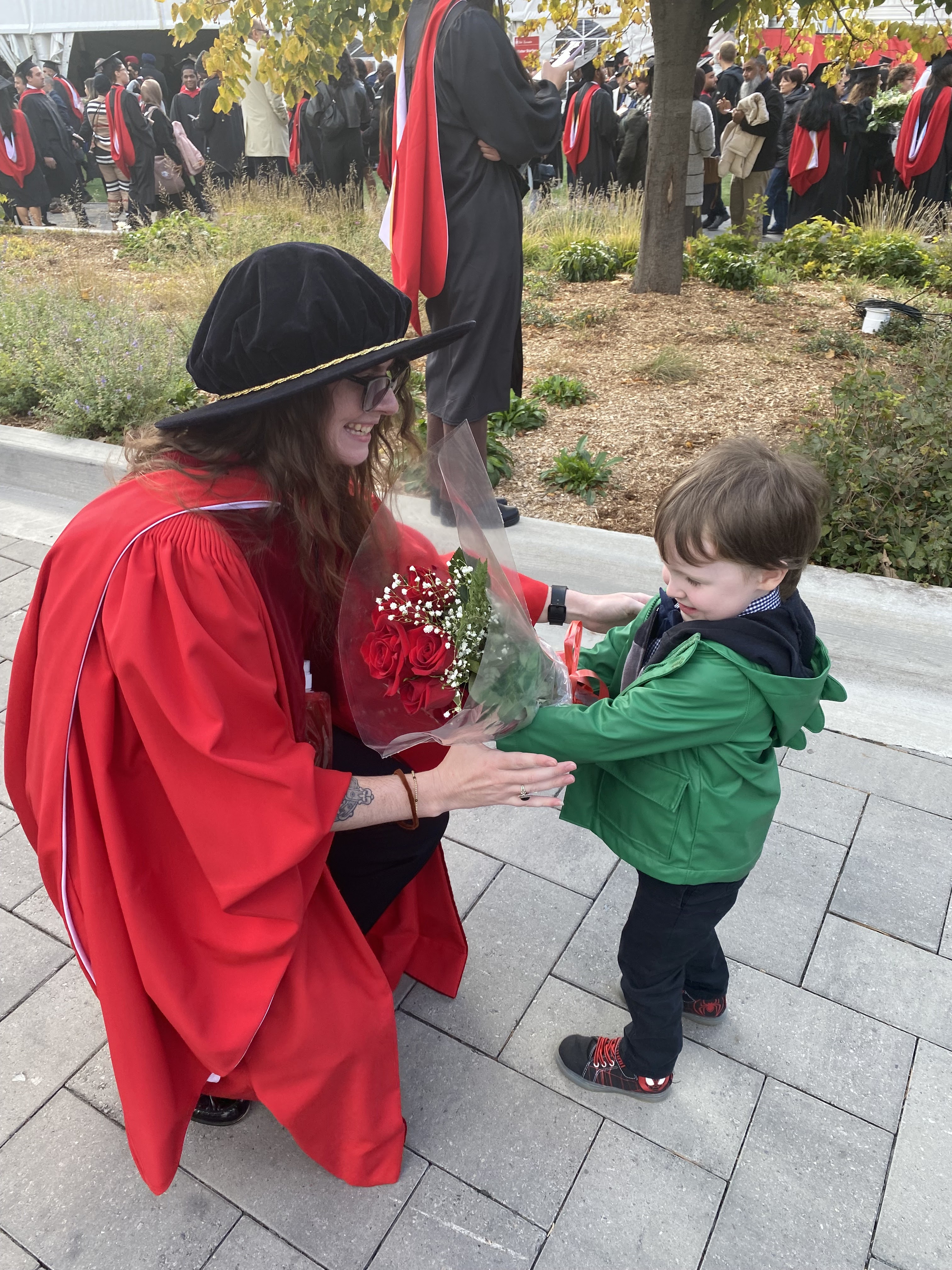
 Dr. Charissa Campbell, at York University's fall convocation with a member of the PVL class of 2050.

by Dr. Charissa Campbell

Well, after many years with the PVL team where I completed both my MSc and PhD, it is time to say goodbye. I just finished my walk across the stage at convocation in mid-October. Even though I may not be there in-person any longer, I don’t feel like my time is fully done with the PVL crew as I’ve made amazing friendships and collaborations. I’ve learned a lot about myself during these times and I am grateful for the opportunity to pursue my degrees with the group and how that work granted me my dream job where I live now, Maryland, USA. I’ve been fortunate enough to land a postdoctoral research position at the NASA Goddard Space Flight Centre continuing work on the Martian atmosphere. But here, I am looking at a unique type of dust storm rather than the clouds I studied at York.


Recently I was asked about my favourite memory with the PVL group and to be honest there were just too many to pick one. My work with the Curiosity team helping to manage environmental operations was high on the list (see: So Long and Thanks for All the Clouds)  but so was developing an outreach event for the Ontario Science Centre (see: The Rover Exploration Challenge). All the travel I got to do to places like Geneva, Switzerland; Paris, France amid others was where the real networking happened so I could feel like a true Martian with other scientists while also practicing my public speaking skills. I also got the amazing opportunity to visit the Canadian Light Source in Saskatoon Saskatchewan and not only do lab experiments at this amazing facility, but got to brave the -40 C weather that I grew up with and do not miss (see: The Continuing Adventures At the Canadian Light Source). I managed to use all this traveling to complete an item on my bucket list; visiting every Canadian province. I completed this when my colleague, Grace, and I traveled to Newfoundland to complete field experiments for the MAPLE instrument (see: There and Back Again, A MAPLE Tale ). Lastly, my time working on an internship at the Canadian Space Agency was also a big highlight and a dream of mine that I am still in shock in came true (see: Completing an Internship at the Canadian Space Agency).  I could go on and on about the amazing experiments and experiences I’ve had with this group. I’ve had an amazing 20s and now I am ready for my 30s and my career.


Even though I walked the stage in mid-October for my PhD, I actually left Toronto for Maryland back in November 2023. I was able to complete my dissertation revisions while also doing work here at NASA Goddard so that I could ensure a good salary for my family and a new opportunity for them to explore life here in the USA. My son is now in Pre-K in a wonderful school (oh how the time flies by!) in the Annapolis Maryland area and we’ve also gotten lucky at being able to afford a wonderful house with a big backyard with lots of birds and trees. Some of my best work here in Maryland is sitting outside in the backyard with my laptop and enjoying the fresh air. The climate here in Maryland is a lot warmer than what I grew up with in Edmonton, Alberta but I am grateful for experiencing the weather of Ontario to prep me for what we are experiencing here in Maryland. From May till August temperatures were hot and humid like a swamp. However, now in October/November it is very mild with wonderful colours in the tree for Autumn. Last winter was quite mild in comparison to Canadian winters, which felt like a nice change. The one tidbit about Maryland winters that made me laugh is that elementary kids don’t have recess when the temperatures go below 0 degrees Celsius. That is basically all of Canada’s winters, especially where I grew up in Edmonton, so Arthur has gotten lucky! My year here in Maryland has been great and I am hoping to turn it into our long-term home so that I can find some stability for my son and our family while exploring my career.


I feel like I've come a long way in not only being a scientist, but as a person and I’ve learned a lot of lessons and knowledge that I will take with me into the future, all thanks to my time with PVL. Luckily, I am able to keep my postdoctoral position for a longer term if I can keep putting through proposals to convince scientific committees to fund my salary to do research. It can be a bit daunting to have to constantly ask for funding for work but at the same time it allows me to be an individual scientist and try proposing my own ideas. Through learning how to develop experiments, instruments, writing papers, or mentoring others I feel very prepared after my time with PVL to become a true scientist here at NASA Goddard.


Once again, I want to thank the PVL crew (past and present) for the amazing memories and our leader John Moores for creating the opportunities for us so that we can learn and thrive in our individual scientific way. Toronto has been a unique experience for me after having grown up on the prairies in a smaller city, but I am glad I was able to conquer Toronto and the horrendous traffic. I wish everyone the best at the PVL team and I’m sure I will see y’all at the next conference where I will accidentally hang out with you as I feel like I will always be a PVLer.

Thursday, September 26, 2024

Exploring the Unknown: My First Steps into Planetary Science Research at the PVL

Every summer, we host undergraduates in the lab at the PVL and during the year we bring in volunteers to experience what professional research looks like. Today Ella, one of those undergrads, tells the story of their research journey so far!

by Ruella Ordinaria

Last summer, one of York’s monthly email updates featured an article on Dr. Haley Sapers’ expedition to Nunavut to test Mars rover simulations. The words, ‘astrobiology’ and ‘Mars’ immediately caught my attention. Seeing that Dr Sapers was part of the Planetary Volatiles Lab (PVL), I emailed Dr. Moores for potential opportunities to contribute to his lab. I exchanged an exciting conversation with Dr. John Moores and in the fall, I was assigned to help a PhD student, Grace Bischof, with her research on developing a Mars Microbial Survival (MMS) model. Fast forward, I completed eight months as an undergraduate volunteer at PVL and this summer, I received the NSERC USRA from NSERC and the Lassonde School of Engineering. 

Now, what’s the actual science I’m working on, you may ask? The MMS Model estimates the bioburden reduction on Mars spacecraft during the cruise phase and on the surface. The MMS model calculates the quantity of terrestrial microorganisms remaining on a spacecraft's surface as it is exposed to the effects of the most deleterious space conditions. These include high vacuum, extreme temperatures, solar UV radiation, and ionizing radiation such as solar wind particles (SWPs). This is important because when we send spacecraft to celestial bodies like Mars, we want to prevent forward contamination as it can impact future exploration of extra-terrestrial life on Mars.

My enriching, fulfilling experience while doing research at the PVL, along with the challenges that came with it, has allowed me to grow both academically and professionally. The first challenge I faced was my limited background in space and planetary science. When I joined the PVL, I was entering my second year as a Biochemistry major and I barely knew anything about biochemistry, let alone planetary science. Although I still struggle with this knowledge gap, it has become easier to address by learning through literature searches. In addition, I also struggled significantly with programming. Grace’s project, the MMS Model, uses Python for calculations and graphing. While I had previous experience with HTML / CSS and Python through hackathons and self-learning, I had never worked with numerical modeling or data processing before. Familiarizing myself with these concepts was a challenge, and I essentially had to learn from scratch—from graphing to using various Python libraries for modeling. Google and Stack Overflow became my go-to resources. Fortunately, I am surrounded by passionate Mars experts with many years of research experience who are always willing to answer my questions.

Not only did I learn about all the exciting things about microbial survival, Mars, clouds, and the atmosphere, but I’ve also developed many technical and soft skills such as coding, writing, data collection, collaboration, problem-solving, and critical thinking, just to name a few. This invaluable knowledge and skill are something that I would have never formally gained from my degree alone. Engaging in research early on in my academic career has also allowed me to apply the knowledge I’ve learned in the classroom to real, practical research. My interactions with lab members have given me insight into the workload, the highs and lows, and the overall culture in academia, which has helped clarify my career goals and deepened my passion for planetary science and research.

Most importantly, I learned that research is not instantaneous – it is a journey composed of both productive and unproductive days. I learned that some days you might read 10 papers, write pages of words, and run many lines of code, while on other days, you might spend hours just sitting, thinking, writing then scratching and writing again. Although there have been times when I felt unmotivated, I still look forward to coming to the office every day with the same excitement I had when I first visited Dr. Moores’ office.

And of course, one of the best parts about doing research is the people! My interest in research comes from my aspiration to be part of a community that shares a profound passion for exploring the intricacies of the world and a dedication to immersing themselves in their questions – I found that community in the PVL. Some of my favourite memories are getting last place during bowling, dilly-dallying at Toronto Island, and eating lunch at the Petrie courtyard under the legendary Newton tree (manifesting a Nature paper!). I owe all of my positive research experience to my role models – Grace, Dr. Moores, and all the PVL members. Their support has been incredibly helpful in navigating my research challenges and has kept me curious about the world.

So, what’s next? Tomorrow, the next day, and throughout the rest of the school year, I’ll be heading to the Petrie building to continue my exciting planetary science research! Stay tuned ;)!

Friday, April 28, 2023

Coffee Cupping for the Novice


Ahh, coffee! It's practically a religion in science. Cups often fuel a late night working on a proposal or finishing a paper. Carafes are never far at research seminars and conferences. Chances are good that when you last made a new collaborator they were holding it in their hands. While some aren't picky about what they drink, others have very defined preparations and purveyors. For this week's post, PhD student Elisa Dong decided to take a deeper dive and reports back on a coffee cupping event that she recently attended. (see the bottom of the post for a description of the image above)

by Elisa Dong

The best description I have for the act and event that is coffee cupping, is to align it with the better known wine tasting. One sips at the drink at specific temperatures in standardized vessels, makes notes, and repeats this task to compare with another offering. Techniques vary a bit from taster to taster, but for coffee cupping, it is normal to have a shallow spoon that dips into the coffee, and suck it in quickly to aerate the liquid.

I went to my first (and to date, only) coffee cupping event some weeks back. The event details were forwarded from a friend of mine that I had introduced to pour-overs (a way to make coffee) some years ago. I reached out on my dusty instagram account (that definitely has a suspicious sounding fake name) asking to attend, and was informed that I was welcome. So, I showed up to a coffee machine distributor's workplace in the middle of the day and work week somewhere in the east end of Toronto. It took a few minutes to find my way through the building, which was partially office, partially showroom, and partially restaurant. There were maybe 25 of us, including the hosts of the event.

It became apparent very quickly that I was the only one who hadn't "cupped" before, so there was a brief explanation of the general process and what the plans for the day where. Here's what I got out of the process.

Prep:
-        there are 14 coffees on the table in similar sized and shaped vessels
-        each of the coffees had been ground minutes before, with the same mass and grind size

Sniff round:
-        we went around sniffing the freshly ground coffee and agitating the grains within the cups to get a deeper sniff 

Bloom:
-        each of the coffees was bloomed at the same temperature, and agitated with the same manner
-      the foamy surface was removed and we were left with coffee immersing in water, settling to the bottom of the cup
-        a water wash cup was available at each coffee to rinse off the sample spoon
 
Cupping:
-        we did three rounds of tastings.
-        The first was blind, shortly after the bloom (higher temperature),
-        round two/three took place when the coffees cooled to just above room temperature,
-      and after we were informed about what it was we were tasting (country, farm, origin, processing, extra details) 

Figure 1. Me with a spoon. Circles show placement of coffee cups on a very long table.

My takes:
-    I enjoyed samples 1-2 the most from sniffing the pre-soaked grounds, they had a "classic" coffee profile that I enjoy. Chocolatey and nutty
-    samples 3-5 smelled like tea and were barely distinguishable from the background
-    samples 8-14 smelled like various things, but generally fruity and floral, some more full bodied than others
-    unsurprisingly, the chocolatey smelling coffees fell a bit flat on tasting. The complex body and richness went away in the brew
-    sample 5 or 6 didn't remind me of cotton candy, as it did to another person, but it was bright and pungent
-    samples 7 and 8 tasted extremely similar, one more rounded out than the other in mouth feel. Both more dynamic and berry like
-    samples 9 through 12 were all variations on florals and stone fruits, one with a strawberry kick, and another with white florals
-    sample 13 was a more muted floral coffee
-    our wildhorse, sample 14, was predominantly silt by the time I got to it, but it was quite possibly the most flavourful coffee that wasn't a punch of acid in the mouth

Information (from memory):
-    samples 1-2 were Brazilian coffees from a large scale grower. These were grown and processed with the intent of being crowd pleasers. For purchasing purposes, they were the cheapest of the lots
-    samples 3-5 were from Rwanda (this was a surprise to many at the event). We received a brief political story discussing the origins of taking back parts of the coffee production from the government
-    samples 6 and 7 I have forgotten the origins of, but they were coffees that had undergone various types of microbial treatment as part of someone's PhD thesis. They might have been from Ethiopia
-    samples 8 and 9 were coffees from Mexico (another gasp) that had also received inoculation of sorts for various lengths of time
-    samples 10-13 were Geishas (alt: Gesha) from various regions in the world. Floral and fruity indeed. I confirmed I didn't see the hype, though I could see the appeal drinking in the range of coffee from time to time
-    sample 13 was sourced from Taiwan. The most expensive cup there due to the lack of desire to sell outside of the country
-    sample 14 was a guest brought coffee, allegedly from some producer that only sells to one roaster per country, and said roaster has to fly in to pick up the coffee (in Canada, it's Monogram). Regrettably, I cannot remember what farm it was (Elida perhaps, I'm sure someone can correct me)

I highly recommend giving cupping a go! Whether it's for coffee or for something else. Having two cups of liquid brewed under similar conditions and throughout cooling is a fun way to train the palate and perhaps your appreciation for various tasting notes. I, for one, am still on the hunt for the perfect chocolate/nutty/toffee combo that actually tastes like it smells. One day. I left the event only slightly caffeinated and with a list of shops to check out to reduce disappointment in the Toronto coffee scene. We also pulled shots of an experimental espresso that tasted like battery acid + mango. Good stuff. Perhaps unsurprisingly, I also found that some of the individuals there shared similar hobbies and had the same complaints about coffee. Spontaneously attending free events that sound fun is not as difficult as I thought it would be, though it does seem that they are mostly run through social media.

Shout-out to Stealth Coffee Systems and Forward Coffee for running the tasting! And all the nice roasters/buyers/hobbyists that were real friendly and happy to share their thoughts. For a future blog post, I might dig up an ancient report I made on coffee shops and their Yelp rating validity throughout San Francisco that I submitted as my work term report that year. A more detailed version of this post may be available later on my own blog at abstract-ED.me.

___

Caption for the image at the top of this article: In slightly unrelated content, I went coffee-hopping with someone I met at the event the next day. Look at this teeny tiny little Hario setup (can be seen at The Library on Dundas St.)! For scale, the carafe is less than 1 inch tall. Apparently you can buy these via gacha machine, or opened on ebay/etsy. If anyone is looking to send me gifts, you know where to go!

Sunday, May 29, 2022

Science is for all of us!


 This week on the PVL Blog Post, MSc student Ankita talks about citizen science, a way by which anyone can participate in scientific research and discovery.
Image Above: YorkU Galaxified Generate your own text at: http://writing.galaxyzoo.org/

By Ankita Das

Being someone who developed a keen interest in science at a very early age I was always looking for new ways to learn and contribute to the science happening in the world. By the time I was in my early teens, citizen science projects were my favorite way to spend time when I was not involved in academic work. I spent my winter of 2010 sending my friends and family a personalized season’s greetings. Except, there was something special about these messages – the text was “galaxified” using GalaxyZoo’s special tool where each letter was a galaxy from the Sloan Digital Sky Survey (SDSS). These were the little ways I would incorporate space into my daily life. But my love for science at that age went beyond generating cute galaxified texts.


Citizen science is often someone’s first introduction to hands-on science. Personally, my first citizen science projects were in Galaxy Zoo and Planet Hunters by Zooniverse. The Galaxy Zoo project involved classifying galaxies into categories by looking at its shape - something even a child can do but holds valuable science behind the activity. A lot can be revealed about a galaxy just from its shape. For example, an elliptical galaxy is usually an old galaxy where no active star formation takes place and spiral arms in a galaxy imply a rotating disk of stars. The shape classification were according to Hubble’s classification scheme shown in image 2.


Image 2: Hubble’s Classification Scheme for galaxies (Source: Wikipedia Commons)

Apart from classifying galaxies imaged by SDSS, my other favorite go-to project involved looking at light curves from distant exoplanets being discovered by Kepler. Kepler’s launch in 2009 marked the beginning of some very exciting exoplanetary science which continues till date. The task at hand was again simple: to look at the brightness of a star over time and determine if there are any periodic dips in the brightness indicating the possible presence of an exoplanet around the star. The excitement I felt as a young teenager “analyzing” data from a telescope launched just a year before, possibly discovering new alien worlds was unparalleled. Participating in citizen science initiatives back then gave me a sense that I was doing something important for the scientific community even as a kid. 


Image 3: Example of Planet Hunters task
(Source: https://www.zooniverse.org/projects/nora-dot-eisner/planet-hunters-tess)

Citizen science has become an important facet of research in the scientific community today with it having evolved into more creative and interesting projects as new troves of data are generated. Citizen science projects can range from activities as simple as locating constellations with your naked eye monitoring light pollution (Globe at Night) to projects that involve amateur astronomers, photographers, and programmers equipped with certain level of hardware or skill to carry out the science. In this way, citizen science involves diverse groups from our society ranging from kids to amateurs to take part in various citizen science initiatives. For the younger section of the public, citizen science projects can become their introduction to scientific projects whereas it can be a leisure activity for the relatively senior members of our society. To me, citizen science initiatives are a powerful and effective tool for scientific outreach. Not only do members of the public learn about the science that is being carried out, they also actively contribute to it, developing a deeper interest over the years in such projects. Irrespective of the diversity in participation, one thing remains the same, all these groups contribute to our growing scientific knowledge about the world around us. 

But can the general public really contribute to the cutting-edge fields in science from their homes or backyards? Yes of course! Over the years, citizen science has churned out an interesting list of discoveries which have made it to scientific journals after being reviewed by scientists. One of the most notable discoveries in the field of space science which comes to mind is the discovery KIC 8462852 or more colloquially known as Boyajian’s star (named after Tabetha Boyajian, other names include Tabby’s star and WTF star). In 2015, citizen scientists who were part of Planet Hunters came across a star exhibiting odd levels of dimming (22%). Upon closer inspection by astronomers, the object’s odd behavior continued to baffle them leading to many people calling it by its nickname – the WTF star which is apparently a reference to the paper’s subtitle: “where’s the flux” (very misleading nickname, I know!). Scientists came up with various hypotheses to explain the star’s observed light curve which included possibilities of obstructions around the star occurring from a ring, planetary debris, or dust clouds. More farfetched hypotheses included the presence of large-scale artificial structures around the star being responsible for the unnatural dimming of the star’s brightness, hinting at the existence of intelligent civilizations. Scientists continue in their attempts to fully understand this bizarre star and hence Boyajian’s star is still being studied and monitored by subsequent telescopes and projects. 

I think most of us would agree science has changed a lot since ancient times. Science which started off as independent endeavors taken up by philosophers centuries ago today presents a different picture. The days of sitting under a tree and pondering on the mysteries of the universe and scribbling down equations are long gone. Most science carried out today is in large groups, relying on observed and measured data retrieved from instruments such as telescopes, particle accelerators, and robotic spacecraft. Hence, a huge amount of data is generated and will continue to be generated as next generation telescopes come into operation. Citizen science initiatives are a fantastic way of tackling this big data problem astronomy and space science is to expected to face soon. Thus, citizen science is not only valuable for outreach but also valuable in processing huge chunks of data and making meaningful contributions to the scientific community. A complete list of active and inactive citizen science projects in all scientific fields can be found at: https://en.wikipedia.org/wiki/List_of_citizen_science_projects

Read more at:
https://www.zooniverse.org/projects/zookeeper/galaxy-zoo
https://www.zooniverse.org/projects/nora-dot-eisner/planet-hunters-tess
https://www.darksky.org/globe-at-night-2021/
https://science.nasa.gov/get-involved/citizenscience/five-extraordinary-citizen-science-discoveries
Boyajian’s star discovery paper: Planet Hunters X. KIC 8462852 - Where's the Flux? Available at https://arxiv.org/abs/1509.03622

Friday, September 3, 2021

Pizza in the Park – The Socially Distant Version


 Each year, I* host two social gatherings for PVL that set aside work and science and allow us all to interact with one another in a more informal context. The summer version has come to be known as "Dr. John's Pizza Party in the Park" due to the many excellent pizza places located in Toronto. The 2020 edition was held virtually, but in 2021 we decided to go with a socially distanced in-person event. Rents being what they are in Toronto and with everyone working from home, the group is spread across a large geographic region. As a result, we elected to move this year's event to a more central location for the group - Rouge Beach in Scarborough. Here's a water-side photo from the event.
(*in case you didn't know, dear reader, all these short intros to the PVL articles are written by the lab director)

by Charissa Campbell

A few weeks ago, our research group decided to take a big step and have an outdoor socially distant gathering. In some cases, some members of our group have never met each other in person, seen campus or even know the height of our supervisor. The pandemic has changed so much in our daily lives, but now with basically all of us fully vaccinated, we figured it was a good first step to finally meet each other in person.

We decided to go to Rouge National Urban Park, which is a rather large park but has a great section right on the lake with lots of trails, views and even a boardwalk through a swampy area. The area we were specifically interested in was Rouge Beach, right on the lake. One convenience about this part of the park is the nearby GO train station that connects to multiple cities. They are double decker trains traveling between Toronto (Union) and Oshawa on that particular line. It definitely makes visiting that park ideal because of the ability to access it directly off the train. 

Trains have always been an interest of mine and I have many memories of watching the trains go by wondering if there was a caboose or not at the end. A caboose was placed at the end of the train and were a manned railway car. The crew were able to monitor the train from the back and apply emergency brakes if necessary. However, with the rise of technology an alternative was created called the end-of-train device that is a suitcase-sized box that attaches to the last car. It relays air-brake pressure measurements and the velocity at the end of the train, all to the engineer at the front (https://www.chicagotribune.com/news/ct-xpm-1995-02-02-9502020309-story.html). This smaller, more portable version eventually replaced the caboose and in 1989 the first cabooseless train made its first trip between Winnipeg and Thunder Bay (https://www.cbc.ca/archives/entry/1989-railways-reduce-caboose-use). By the time I was a kid watching the trains go by, a caboose was rather rare but occasionally you’d see one which was worth the wait. Unfortunately, the Go trains do not have a caboose, but the double decker feature makes for great views of the lake.

A caboose on display at the Toronto Railway Historical Association

Once we all arrived at the park, we spent some time at some conveniently placed rocks. They were right on the water and was a great spot to get an updated lab photo. Several people have left the group since our last big group adventure, such as PDFs Christina Smith and Paul Godin, but we’ve also gained several valuable members to our team (Haley, Grace, Conor, Justin). Over time our group will change here and there as people graduate and, hopefully, we will be able to keep up with lab photos to see more of the progression from year to year.

Next, we moved to a grassier area that allowed us to sit in a good socially distant manner. We engaged in frisbee and volleyball and simply took the time to get to know each other. Pizza is the typical food we eat for group outings, so we shared some pizza, sat on the grass and chatted about whatever came on our mind. It was really great to be back in a situation where you can see people face to face. To do this, it is very important to go get your vaccine so you too can start making the progression back to the life we used to remember.

It’s been quite some time since life was all maskless events. I have a picture frame in my office that still says “coming soon…” for my son, Arthur, and yet he just turned 14 months. Now that I have been fully vaccinated, I have applied for lab access so I can slowly start returning to my office and start working on a big lab-based project I am leading. The only way this is possible is to get vaccinated so that not only you can be protected, but so that it doesn’t spread to children who cannot get a vaccine yet. This is still a concern of mine as unfortunately my son won’t be able to get the vaccine for a while still. Therefore, there is still a chance he could still catch covid, unless more people get vaccinated. Things may not go back to what we remember them to be, but I know myself and my family will be better off now that we’ve got our vaccines.

Friday, February 19, 2021

SpaceX, Starlink, and the Commercialization of Space

This week, masters student Conor Hayes tackles a thorny issue: how to balance the expansion of private actors in space and the benefits their work can have for those of us on earth with the needs of astronomical research. It's not inconceivable that such an expansion could change the night sky forever, not just for scientists working with sensitive instruments, but also for most of the world's city-bound population for whom a starry sky could be replaced by criss-crossing lights. Must we give up wonder to achieve a better life for each another? Image: 19 Starlink satellites unintentionally imaged by the Blanco Telescope at the Cerro Tololo Inter-American Observatory. (CC BY 4.0, NOIARL/CTIO/AURA/DELVE, https://nationalastro.org/news/starlink-satellites-imaged-from-ctio/)

by Conor Hayes

One of the consequences of the way that our economic systems are structured is an ongoing competition between public and private interests to exploit various resources. This competition rolled through astronomical Twitter like a bowling ball through a set of pins in November 2019, when the image above first made its way onto the internet.

Taken using the Victor M. Blanco 4-metre telescope at the Cerro Tololo Inter-American Observatory in Chile, it shows 19 bright streaks caused by a train of Starlink satellites passing through the telescope’s field of view. Unsurprisingly, this greatly reduced the quality of the data, leading to widespread concern about the long-term impact of Starlink on astronomical observations.

The mere fact that Starlink satellites are visible in telescope imagery isn’t the problem. Outside contamination of CCD images is nearly inevitable with a long-enough exposure time. If you ever get a chance to look at raw data from a telescope, you will probably see similar, though shorter, bright streaks caused by cosmic rays impacting the detector. Furthermore, artificial satellites have been occasionally ruining images for as long as there have been a significant number of them in orbit. So what is the problem then?

Part of what concerns astronomers about the Starlink constellation is the sheer number of satellites involved. SpaceX currently has authorization to launch 12,000 (!) Starlink satellites, and has submitted paperwork to approve another 30,000 (!!). For comparison, the United Nations Office for Outer Space Affairs currently lists about 10,400 objects launched into space since 1957. When the constellation is completed, the number of visible Starlink satellites may even outnumber visible stars in heavily light-polluted areas like Toronto. Given that the constellation is intended to surround the Earth at many different orbital planes, having a small handful of Starlink satellites streak across your telescope’s field of view may become a regular occurrence.

In addition to antagonizing astronomers who work in the optical, the development of Starlink has also worried radio astronomers. Ground-based radio astronomy is already hard enough thanks to the fact that many of our modern-day technological conveniences are constantly blasting radio waves into the environment. Consequently, much like how optical telescopes are located in dark areas away from major population centers, radio telescopes are often surrounded by “radio quiet zones”, large swaths of land where radio emissions are strictly regulated. But when those radio sources are passing overhead, as the Starlink satellites will be, those radio quiet zones may become significantly louder.

If nothing else, the conflict over Starlink shows how vital it will be for the scientific community and private businesses to communicate with each other to find a mutually beneficial way forward. Though SpaceX is now looking into ways to make their satellites less bright, including darker paint, sunshields, and shutting off transmissions when passing over radio quiet zones, these kinds of after-the-fact adjustments are not sustainable in the long term. Though I personally find the commercialization of space somewhat distasteful, I also recognize that as the barrier to entry gets lower, thanks in large part to the innovations championed by companies like SpaceX, it is almost inevitable that commercial interests will want to spread outward. Because astronomers have held a near-total monopoly on space for so long, learning to let other people in will be a difficult process, one that will require sustained, genuine cooperation from all interested parties.

I didn’t start writing this post with the intent to argue for the termination of the Starlink program. It’s a difficult needle for me to thread because on one hand, I am an astronomy grad student whose future career could be hindered by a poorly-managed privatization of space. On the other hand, I recognize that SpaceX’s goal with Starlink is an admirable one. The past year has demonstrated how global access to reliable, high-speed internet is now more of a necessity than a luxury, and demanding that Starlink be shut down just because of the challenges it presents for astronomy would be irresponsible and short-sighted. This goes both ways, of course. It was incredibly disheartening to scroll through some of the replies to the original tweet and see how many people were calling ground-based astronomy little more than a vanity project with no real worth to humanity (Elon’s tweets dismissing astronomers’ concerns out of hand and telling them that they were overreacting certainly didn’t help, either).

Though I don’t have any concrete solutions right now, it seems increasingly likely that, as is the case in so many other areas of our society, the responsibility for dealing with the monumental shifts in the way that the private and public spheres interact with each other beyond Earth will ultimately fall upon the next generation of astronomers currently working their way through their undergraduate and graduate educations. I do believe that we can eventually strike the right balance, but I hope that time comes before unregulated, antagonistic competition severely damages our ability to look up at the sky and wonder what lies beyond our home.

Tuesday, February 2, 2021

Continuing my PhD Life with a Baby

 
Charissa Campbell, one of our PhD students here in PVL, returns to work this week from an extended leave to care for the new addition to her family. She asked to share her experience here in this post, which provides a great bookend to her pre-leave discussion, which can be found here. 
 
by Charissa Campbell

Well January has arrived, and it is time to return to work from maternity leave. It has been a turbulent but amazing past 8 months that I am glad I got to have off. I am proud to introduce my son, Arthur, who has been nothing but a blessing on our life. He came into this world on June 1st with less than 2 hours of labour, which I am very thankful for!

Due to York counting leave by semesters, I was able to take the last month of my pregnancy off which helped me relax as labour was probably the scariest part for me. If you recall in my previous post right before my leave (http://york-pvl.blogspot.com/2020/05/deciding-to-start-family-while-being.html), I mentioned that Arthur was due near the end of May but decided he was too cozy in the belly. By 8 days after my due date, the midwives suggested a stress test to see how the baby was doing as they recommend inducing labour 10 days after your due date. By the time of my stress test, I was ready to meet Arthur and get the scary part out of the way. I was relieved when they told me I was already in labour when I took the stress test and that I wouldn’t be leaving the hospital that day. It was so sudden that it was hard for me to process and get panicked. However, the stress test did reveal that whenever I had a contraction, my stomach would squeeze Arthur to the point where his heart slowed down significantly. This was nerve-wracking in itself. After this was monitored and then found that the umbilical cord was wrapped around his feet, the doctors decided an emergency c-section was necessary as his heart had fully stopped for a moment. My water broke at 2:30 PM and Arthur was born at 4:15 PM. I’ve read that labour can be hours to days for some women so for it to be that quick was relieving for me. Even though I didn’t give birth the “normal” way, it was normal for me or my baby would have died. The stress and emotions on that day are something that I will remember for the rest of my life and I hug Arthur hard every day knowing that.

I was quite blessed that York offered paid maternity leave as these past 8 months were definitely needed to figure out how to live a life with a baby. The worst part of it is probably the first 6-8 weeks when Arthur is trying to figure out how to be a human and you are trying to judge how to handle your newborn. I was also in recovery for 6 full weeks, with the first 2 almost confined to a rocking chair or bed due to my surgery. It was painful to walk anywhere, but I was lucky that my partner was home 24/7 to help. Slowly your entire house gets filled with baby stuff, including things that you either never use or he grows out of so quickly. We barely touched the 3-6 month clothes as Arthur grew tall so fast that by 4 months, he was the height of a 6-7 month old. I am quite short myself, so those genes definitely didn’t come from me! He is currently 8 months on February 1st and still tall and a good weight with blonde hair and blue eyes. He can sit up, loves food and is just an overall happy baby. We are so excited that we decided to take this path and not let my PhD studies get in the way.

Even though I was on leave, there was one important item that needed to get done. Right before I left, I submitted a paper that I co-wrote with a group at Curtin University in Australia about our Machine Learning project. I got an email indicating the first round of revisions were ready. I looked over them quickly and noticed that the majority of the questions were better suited for the Curtin group so I decided to do the revisions while on leave. I asked for an extension as they gave 2 weeks. Unfortunately, Arthur was 4 months at the time and still needed tons of Mom attention. Either way, my partner and I worked out a schedule so I could have time to work and I was able to get my revisions in on time. Just before Christmas I got another email expecting a second round, however, it turns out there were no more revisions needed and it was ready to be published. I am very proud that I was able to write a scientific paper while pregnant and get it published while still on leave. Feel free to check it out here: https://www.sciencedirect.com/science/article/pii/S0094576520307736

Now that I am back at work, I have found that I don’t have the same energy I used to. Some mornings Arthur wakes early so I am more exhausted that day than others. The pandemic has also made it a bit harder to work from home as I can hear Arthur downstairs. Whenever he cries it triggers a reaction that I must pick up my baby. However, by frequently going to see your baby when you are trying to leave them for the day makes it harder on the baby as you are constantly coming and going. I’ve been trying to mediate that by wearing headphones or playing music out loud to drown out the sound downstairs. I am currently in the midst of trying to figure out a good ideal schedule that can balance work and home without getting too overwhelmed. Even then, I am ready and excited to get back into work!

Overall, Arthur has been adjusting well to me being at work and even goes to bed without me on nights that I have to moderate a lab session as part of my Teaching Assistant section of my PhD. As time goes on, both Arthur and I will get used to the new schedule and I will become a full-time working Mom. It is a hard job trying to be a mother and doing PhD studies, but it will be worth it once I get my degree and can provide a good life for my family.

Saturday, May 16, 2020

Deciding to Start a Family While Being a STEM Graduate Student


A few weeks ago, PhD Candidate Charissa Campbell began a leave from the lab. From all of us at the PVL - we wish her well in her time away and look forward to her return next year!

by Charissa Campbell

Being a woman in STEM can come with certain challenges, including deciding if you want to start your family or not. Since women have to carry and be the primary caregiver for the first year it can be a difficult decision whether to put off starting that next step in your life. Luckily, there are a lot more benefits available to women who want to start their family while also being a graduate student. Knowing this, my partner and I decided to make the decision to start our own family after getting the surprise that I was expecting.

Monday, May 11, 2020

Green Shoots, Space Gardens

It's snowing in Toronto this morning. Seriously. But irrespective of what I see outside my window, I know spring to be near at hand. Many of us have experienced the therapeutic power of caring for and raising plants and are looking forward to getting out into our gardens. I for one need to have some greenery around my office and home, which marks me as a bit unusual. In space, however, plants may eventually serve a more vital role. This week Alex examines the first green shoots researchers are cultivating along that pathway. Above, a zucchini plant is pictured on the ISS. 

by Alex Innanen

Spring is arriving in fits and starts in Toronto, and that means it’s time to start this year’s seeds and get out in the garden. It would also normally be time to visit a nursery (or five) but this year is a bit different, and my gardening routine has been disrupted by isolation. Which got me thinking about growing plants in an even more isolated location – that’s right, it’s time for space plants!

I know that taking care of my plants, spending time in the garden, can be very relaxing and grounding. The same is true for astronauts. But we haven’t been growing plants in space just because they’re nice to work with. One big reason to grow plants in space is for food. On the ISS, it’s relatively simple to resupply the astronauts with fresh food but think back to early explorers spending months at sea and getting scurvy. If only they had had a grow light and some arugula! Plants have also been suggested as a from of life support – we know that plants recycle carbon dioxide into oxygen, the kind of reverse of what happens in animals where we breathe in oxygen and exhale carbon dioxide. In addition, wastewater can be used to grow plants, and the same plants then transpire, or release, clean water vapour, which can be condensed and used again.

Thursday, February 27, 2020

The Worst Thing on Mars is Powdered Milk


Hemani Kalucha (bottom of image above) recently became the second member of our group to put in a tour of service at the Mars Desert Research Station in Utah, USA (the other being former PVL MSc Eric Shear). She shares her experience and some great photos below.

by Hemani Kalucha

Sitting on top of the North Ridge at 3 pm on a Saturday, I experienced, for the first time, a real “deafening silence”. I was 200 metres above the Utah desert, and I could see nothing but miles of reddish sand until the horizon in every direction. It was a peaceful moment that marked the end of our two week rotation at the Mars Desert Research Station (MDRS), an analogue facility in the middle of the Utah desert. Our crew was made up of six members – Maria Grulich (Commander), Luis Monge (Engineer), Jess Todd (Greenhab Officer), Me (Journalist), Rawan Alshammari (Doctor), and Ghanim Aloitabi (Astronomer). Together, it was our job to live and work as astronauts on Mars. 

Friday, August 2, 2019

50th Anniversary of the Moon Landing Blog Post

This week, PVL Undergraduate Researcher Ariella Sapers reflects on a significant anniversary for space exploration: the 50th anniversary of the Apollo Moon landings. Above, a photo of a plaque like the one left on the lunar surface by Apollo 11. And yes, folks, that is Richard Nixon's signature on the bottom (to my knowledge the only politician whose name is written on a monument off the Earth) - it took the efforts of three different administrations to pull off this event.

By Ariella Sapers

With the 50th anniversary of the Moon landing just passing, I thought it was only appropriate to dedicate a blog all about the event and the celebrations that occurred here at York University!

On July 20th 1969, three brave men, Neil Armstrong, Edwin “Buzz’’ Aldrin, and Michael Collins took a leap of faith as part of NASA’s Apollo 11 lunar mission and headed to the moon. The Apollo Lunar Module, The Eagle, landed on the moon at 20:17 UTC in which Neil Armstrong became the first person to walk on the surface of the moon on July 21st at 02:56 UTC. With this walk, human beings had officially walked on the surface of a planetary body that wasn’t Earth. 

Tuesday, October 16, 2018

When you tweet and the Universe tweets back...

Engagement with the public is an important activity for us here at PVL. Many would think about this largely as a one-way street with scientists preparing materials for public consumption, such as a presentation, a documentary or a book. But it's always a richer experience when you're having a two-way conversation, as Christina describes in this week's Blog post. Sometimes the level of engagement displayed by that response can be surprising! Note that the photo above is a word cloud she made from some of the jobs respondents are currently doing (sizes randomly assigned).

By Dr. Christina L. Smith
 
One of the things I think is important as a scientist is making sure that not only the scientific community knows of your work (and general existance) but also that the wider public is able to engage with you and your research, when appropriate of course. As my previous posts (i.e. poetry in science and the Rover Exploration Challenge) show I particularly enjoy getting involved in public engagement in a variety of formats!

A couple of months ago, I was invited to give a presentation at a “Future Women in STEM” (STEM = Science, Technology, Engineering and Mathematics) day held at York University, talking about my personal experience as a woman in STEM. I realised that, although there were a large number of very interesting presentations and activities on the agenda, mine was the only one revolving around someone’s personal experience in a science field. I’m also very aware that STEM careers are far, far broader than my own personal experience.