Showing posts with label Mechanics of Academia. Show all posts

Wednesday, December 31, 2025

Cleaning up the lab… finally!

 
 Whenever you are doing research, it's important to control the chaos. That could be keeping notes and reference papers organized, keeping track of simulations and parameters or the physical items that accumulate in any lab. This week, Kevin describes a major cleanup in our lab to keep entropy at bay for a little while longer.

by Kevin Axelrod

December 20, 2025 was finally the day. 

I have been at the PVL for over 2 years now, and while projects and some people have come and gone, one thing has always remained constant: our PVL lab room has looked like my bedroom when I was 7. Because we work in planetary sciences, we have a wide variety of equipment – from optical equipment to vacuum chamber components to flow tubing to spectrometers to regolith simulant to various chemicals. And that is before we get to all the non-science items in the lab, like books and files, as well as that big Venus globe! 

Keeping all these things organized is difficult, with so many different projects in and out of the lab. And at times, motivation to clean can ebb and flow, both for me and a lot of other people. But, on the week of December 15, just one week before I planned to leave town for the winter holiday, I decided that it was finally time to get down on it. 

It started when we needed to pack up our Martian Atmospheric Gas Evolution (MAGE) experimental breadboard spectrometer and send it back to our industrial partner, ABB. Abby and I had collected a pallet and ordered some bubble wrap and shrink film a few weeks prior, and on December 16 we put those materials to use (below). Shipping it out via LTL freight, which happened on December 19, only 2 days before I left for the holiday, was a significant step towards making the lab genuinely clean. This was not just because it had been sitting in there for a few weeks and was crowding our lab, but also in the process of shipping it out, we cleaned the lab upstairs (which belonged to a different group and was where we conducted most of our experimentation with this spectrometer).

Sending it out freed up a little bit of space on our optical table. Nonetheless, there was still a significant amount of optical equipment and other things lying out - tools strewn everywhere, old boxes/cardboard, tubing pieces from the spectrometer setup, etc. Even our chiller still contained ethylene glycol-based antifreeze from a project that occurred several months ago.  

It seemed like such a massive task that maybe we were beginning to accept the constant state of clutter. However, in many cases, constant clutter in a laboratory is a safety hazard, because it impedes the ability to conduct experiments in an organized fashion, and introduces issues like tripping and spilling hazards. So, on December 20, with my flight out of Toronto less than 24 hours away, I drank a cup of coffee, put in my earbuds, and somehow just got into the zone. I went through the lab putting away tools, taking apart optical equipment, wiping down counters, and throwing away scraps. I officially started a “Sharps” disposal box for our lab (we were starting to use glass pipettes on a regular basis) and also started and labeled waste disposal containers for the ethylene glycol. I also started a “Misc/I don’t know” box. This box is for all the things that are probably optical components, but I am not completely certain of exactly what they are or how they are used in optical setups. “Misc” is a Swiss-army knife of a lousy excuse for a box label, isn’t it? 

The lab is far from perfect so far. We still have 2 desks in the back of the room that are filled with miscellaneous computer equipment, the corner next to the door is overflowing with old poster tubes, and the floor could use a sweeping. But, when cleaning a lab, just like in conducting scientific experiments, progress is always incremental. I forgot to take a “Before” picture, but the “After” picture is at the top of this post. It will keep getting better, too.

Two final thoughts:
  1. For what feels like the millionth time, our lab’s tape measure has gone missing. It might be time for another trip to our local hardware store.
  2. During this day, I listened to a lot of what I would call “indie EDM” and a lot of the songs made me think of outer space.  We need to start making a PVL playlist/mixtape.

Thursday, December 18, 2025

[Insert Title Here]

Writing is a key part of being a researcher of any kind. It's not enough to do the work, take the data or make the discovery. It's not science until it is shared. This week, Alex reflects on their writing journey.

By Alex Innanen

I like to think of myself as a pretty good writer. Very young me harboured the wish to be a famous novelist when I grew up, and I probably still have old notebooks hidden somewhere in my parents’ house full of stories and attempted novels. There’s a lot about writing I like. I like putting words together in interesting and clever ways (I am a big fan of puns), I like figuring out how best to say something, and I really like the rules of language which feel a bit like a puzzle. In first year engineering we had a Technical Writing for Engineers course that many of my classmates groaned about but for me I was thrilled to have a whole class full of grammar quizzes. 

Moderate bragging aside, there’s one thing I struggle with time and again when I’m writing and that is choosing a title. Several of the posts I’ve written for this very blog have been sent to John with something like ‘I can’t think of a good title, HELP!’ at the top. I also write blog posts about once a month for the Curiosity Rover’s mission updates page, and there’s many a time I’ll have the whole post written, sitting in my inbox ready to be sent for approval and struggling to think of a title. 

It's not just blog titles either – short stories, journal articles, even my dissertation. And all these different kinds of writing need different sorts of titles! But this post is not just for me to complain about how hard titles are though. Having toiled in the title mines for as long as I have, I’ve developed some tricks and observations about choosing a good title. 

The job of your title is to give your audience somewhat of an idea of what they’re getting into, or at least to interest them enough that they might want to read what you’ve written. For something like a blog post, I try to keep it relatively short and clear. The title of this post, for instance, pokes fun at not being able to come up with a title while also giving an idea of what the post may be about. When I’m writing mission updates for Curiosity I tend to go one of two ways: some wordplay or reference to a well known phrase (for example, “New Year, New Clouds”), or succinctly describing something important from the plan (like “On Top of the Ridge” – three guesses where we were). 

Writing a title for a paper is a bit different. You can assume that whoever is reading your title has a bit more familiarity with the subject so you can be a bit more specific. Sometimes this leads to marathon-length titles. The title of my first research note, for example, “Minimum Mars Climate Sounder Retrieval Altitudes Reveal Cloud Altitudes at Aphelion and Stranded High-altitude Dust Following the MY34 Global Dust Storm on Mars” is twenty three entire words. This may seem a bit excessive, but you cannot deny that it tells you exactly what’s in the note. We’re also big fans of the humble colon in academia. My master’s thesis was titled “Aphelion Cloud Formation and Swiss Cheese Sublimation: Martian Atmospheric Water Vapour Processes”. The first bit of the title tells you the two subjects of my thesis, the second part ties them together. Sometimes, Journals will have guidelines for paper titles. Acta Astronautica, for example, has a 15 word limit. My research note above wouldn’t fly, and in fact the title I proposed for the paper I submitted there (which I posted about here) was too long and I had to figure out how to fit what I wanted to say in their word limit (I think I changed ‘Canadian Arctic’ to ‘Arctic’). 

So maybe I actually do know a bit more about this title thing than I thought when I started writing this blog post. In fact, I feel confident enough to offer some things to think about when you’re coming up with a title: 

  1. Consider your audience. Will they recognise what Aphelion means? Will they enjoy a good pop culture reference? 
  2. What is/are the main takeaway(s) of your piece? Are there different subjects you need to link?
  3. Is there a word limit? Should there be a word limit? How can you be more concise?
  4. How are you going to get people excited to read what you’ve written? 

As with most things, though, practice helps. The more I write, the more titles I need to think of and the less daunting it gets each time.  

Tuesday, October 28, 2025

Say Yes to the Lab Group

It's an interesting exercise to look back from time to time. Can you make out the pathway that brought you to where you are today? No matter whether the decision at any particular juncture was good or ill in retrospect, as the song (and Mary Schmich column) goes: "your choices are half chance." But why not improve those odds? Today, MSc student Milena Markovich offers some advice for those thinking about returning to university for graduate school.

By Milena Markovich 

In December of 2023 I found myself with that annoying, undeniable and incurable itch. The itch to go back to school. Only six months after graduating from five arduous years of an engineering undergraduate program, complete with all-nighters, co-op terms and oceans of coffee, I had vowed that industry was the place for me. I wanted a break – a simple 9-to-5, no working on weekends (most weeks at least), no worrying about assignments or exams.  However, after only a couple months as a full-time engineer, I knew that this was not what I wanted my future career to look like. I had always paved my path through engineering with the goal of one day working in the space industry – and, after all, what was I waiting for? I decided “one day” had to become “today”. Now that I had made up my mind to pursue graduate school, I began the hunt every little scientist dreams of – the hunt for the perfect lab group.
 

Here we get to the crux of this blog post: an easy (in theory) how-to guide for finding the perfect grad school program for you. Step number one: “thank you, next” – meaning, establish your dealbreakers. For myself, the past 5 years of my life had been spent laboring over an engineering degree, and I was hesitant to throw that all away. I wanted my MSc program to be a low-stakes introduction to the world of research. From this principal objective, I could establish two requirements. First, the program or research must have some relation to engineering, whether it be with engineering courses or instrument-based research. Second, I needed to graduate from this program debt-free, such that I could later choose whether to remain in academia or return to industry, without the pressure of financial stressors. This led me to limit my search to graduate programs within Canada, both for the proximity to friends and family and to avoid hefty international tuition fees.


Step number two: “so tell me what you want, what you really, really want” – or, set your core values. Seriously answer the dreaded question from every behavioural interview: “where do you see yourself five years from now?”. No one stays in grad school forever (at least I hope not), and as such you need to tailor your graduate program to the career you want. No doubt priorities shift, interests evolve, and you can finish grad school with an entirely different goal. But based on your aspirations right now, you can start your hunt for a supervisor. For myself, I knew I wanted to retain the engineering mindset I had built from my undergraduate program. I also knew I valued the novel approach of my program – integrated engineering at UBC, which allowed me to learn multiple disciplines of engineering, informing a systems-based approach. These values were what initially made Dr. Moores’ career, and the Planetary Volatiles Laboratory, stand out to me. Having completed an undergraduate degree in engineering science at U of T, John has built his career bridging engineering and science interests in space exploration missions.


Step number three: “you’ve gotta have faith”. When it comes to grad school applications, a myriad of factors play into a supervisor’s ability to accept you as a student. When I first reached out to John, I initially received the dreaded “sorry, no vacancy”. However, as I continued connecting with various supervisors across Canada, a couple months later I opened my inbox to find a follow-up response. As luck would have it, a spot had opened up and I was able to meet with John to talk about potential thesis projects.


Step number four: “how deep is your love?” – I fear I must age myself and establish that this refers to the Bee Gees song, not Calvin Harris. Of equal importance as a supervisor or program, is your thesis project – namely, how much you can commit to this project. This is what will “take over” your life for the next, at minimum, two years. As such, you want to make sure that this project aligns with your goals beyond grad school. Imagine yourself sitting in an interview, discussing your work over the past couple years. Will this project help you impress your dream company and land the dream job? Will it help you take steps towards the path you want in academia? Is the project feasible to tackle with your skill set? Does it help you build a new skill set which you need to be a competitive candidate? When I first spoke to John, we discussed a modelling-based project which had me very hesitant to join the lab. I was steadfast in finding a project that would suit my engineering skills and which I could use to market myself to future employers in industry. Once again, in another blind stroke of luck, only a couple weeks after re-connecting with John he attended a conference which kickstarted renewed interest in a Lyman-alpha camera he has been working on for lunar ice prospecting from within permanently shadowed regions. Instrument-based? Check. Relevant to space industry interests? Also check. With this project aligning better with my goals, I was nearly sold on the Planetary Volatiles Lab.


Step number five: “I’m pickin’ up good vibrations”. If you are like me and have relocated for grad school, this step is likely of equal importance to everything else. Living in a new city, trying to make new friends while overwhelmed with the workload of research, taking courses and teaching assistantships can feel impossible. You want to establish what the lab culture is before you make this big jump. Ensure that the lab aligns with your personal expectations outside of research – a social, welcoming and warm atmosphere can help ease the transition to a new city. John happily connected me with Alex and Grace, both of whom helped confirm my decision for me. As numerous blog posts have detailed before, our lab makes time for social activities throughout the year and during conferences, facilitating a friendly environment. Establishing a support system within the lab has been the biggest factor in my success in moving to Toronto and starting graduate school. Research can be difficult in its own right, choosing a lab where you never feel alone helps to brighten both the tough times and the celebrations.


“Goodbye, everybody, I've got to go” – and that’s all folks. Following your own values, goals and passions will result in a foolproof strategy for picking the right lab group. These decisions are not one-size fits all, and at the end of the day only you can make this decision. So, think about these steps, write some pro’s-and-con’s lists and take the leap into the wacky world of graduate school. Whether this guide leads you to us at the Planetary Volatiles Lab or elsewhere, I wish you luck in your new adventure. 

Sunday, June 8, 2025

Poster Sessions and All That

An image (Figure 1, courtesy of Elisa) of one of the many buildings which housed the 2024 American Geophysical Union Conference in December of last year. The conference is massive, overwhelming even! Yet, it provides a venue where even disciplines with small numbers of scientists can meet and discuss their science. From Elisa: "There was no mistaking this was the place. So many poster tubes and people piled up waiting for the light to change."

 by Elisa Dong

Going to conferences… is fun! 

The attendance at conferences is a significant part of a graduate student experience. These are the places where we showcase our work, get feedback, and check out what’s up and coming in the field. Sometimes, conferences take place at exotic locales, and sometimes, they may be as mundane as “the place near the airport that is extremely inconvenient to take public transport to.” AGU 2024 fell somewhere in between, in Washington D.C., capital of the United States of America.

Given that the flight time and drive time were not too dissimilar, my boyfriend and I opted to drive down to save on costs, a very real consideration for going to conferences! While unplanned, we drove through some fascinating geological features going through Pennsylvania, dotted with various electoral signs on the way down. We stopped at a fairly mediocre cash-only brunch place, and saw snow and horses for most of the way down. Entering the city, the traffic went from a quiet one lane drive to cars changing lanes without signals, and mysterious roundabouts with confusing signage. Once at our hotel, we spent half an hour figuring out the parking situation, grabbed some food downstairs (with the best free bread we had ever had), then promptly went to bed. 

AGU is about a 5 day conference (see Day 1 in Figure 1!), and I had a poster on the first day and a presentation on the third. My presentation went well, and I was able to touch base with a coauthor of mine to confirm a few key concepts for a paper I was writing (I did this by tapping his shoulder to say hello). I had thought I would have the entire last day off to wander the city. As it turns out, there was an entire session dedicated to planetary defense and impactors that I had missed in my schedule, so I slunk back into the conference center to hear about the modelling work that was ongoing (Figure 2 shows once of the very few photos I took at the museum). 

Figure 2. Ducks at the museum! I also took photos of many many rock displays, but the local fowl section was also very cool!

It’s worth noting I met up with several other colleagues who do similar things – checking on some scientific concepts that were their specialties, sharing ideas for future works, and generally touching base. Despite running around to sessions, visiting random posters, picking up free ducky keycaps, the networking and chatting with more distant coworkers and future collaborators is one of the best things about a conference for me. Getting on a zoom call or sending an email is just not the same. 

The collaborative and productive nature of conferences was really highlighted by the poster I had up. I made the questionable choice of wearing heels that first day, anticipating being able to sit and walk around. Unlike some other conferences I had attended in the past, this poster session was huge. Having mine on the first day, I didn’t realize just how well attended it would be! 

So instead of being able to kick back and look at other posters during my session, I was glued at my poster well past the closing time and completely missed seeing an old colleague just a few posters down the aisle. I received a large amount of feedback, including kind critiques and thoughtful questions that have lingered as I consider the limitations of my work. Folks stopped by to offer resources and model simulations, encouraged me to bring up my work to a larger group (this has happened! I gave a presentation and received more positive feedback and further suggestions), and all the good stuff. I met many new people, whose names I wish I had taken down, including some who might be future reviewers of my work that gently pointed out the critical questions that I might want to consider as I continued working on the project. I explained a few concepts to a child attending the conference with family, and shared in their excitement over the awesomeness - that modelling that can help us explain our real-world observations. 

I was also happy to meet up with my previous supervisor and bring him up to speed on what I was working on, and to hear his assessment of the current state of his field and view of the conference.
Some cool things I got out of AGU 2024:

  • An invitation to ask about a summer internship position (this didn’t end up working out, but it definitely expanded my thoughts)
  • Meeting undergraduate students! It’s always a delight to see what cool things they’re working on, and we’ve spoken again since about work related matters
  • A suggestion to present my work at an internal MSL meeting despite not working on data from the team directly
  • The potential for writing a paper for a special edition (this also didn’t work out, but the procedure has been established and might be something to touch up again in the future)
  • A visit to NASA Goddard! I’ve never been to a NASA Centre before, and I was able to plan it with one of my coworkers based out of there and get approvals just in time! It was great to see what folks are doing behind the scenes, the huge clean rooms with possibly over a hundred HEPA filters installed (Fig. 3), and the old-fashioned, yet extremely functional, measuring tools they used
  • A late night ice-cream hangout with an online friend who forewarned me about the roundabouts
  • More ice-cream and a super toasty paper fill menu on a busy Friday night when every other place was packed
  • An experience (and the post-experience) at Coffee Republic. I have never enjoyed ads in my inbox so much before. The food was delightfully greasy, the coffee solid, and it was fun to hear the workers chat about their relationships candidly
  • Going to the Christmas market! Two of them even!
  • Barrel and Chuck, the two plushies I picked up on the way back at a Cracker Barrel. (Barrel is the lab’s new emotional support capybara, and has a lavender scented heat pack inside him! All of us in the office where he lives happen to like lavender, so it works out great. He occasionally moves from desk to desk to provide extra support)
  • And, an incredible amount of useful feedback for my own work + inspiration from other projects in the future!

Figure 3. The HEPA filter wall. Incredible. What else can you spot in the room?

AGU is one of the stranger conferences out there. It is a huge conglomeration of what is really 30+ conferences that are distantly related all mashed into one location. While it makes it easy to pop into a session about say, climate change or quantum physics, it’s not necessarily planned out in a way that potentially related sessions don’t interfere. Add on thousands of attendees, and you might be feeling a bit claustrophobic and getting more exercise than planned as you trek from one building to another. Something to keep in mind. It may be better for some folks to target more niche conferences to get the same return.

We drove back as well. My eyes are still recovering from being blasted with 8 hours of dry air.

Friday, April 25, 2025

The Art of Collaboration

I can't emphasize this enough: Science is a team sport! Collaborations are key to all that we accomplish at PVL. Often, the effort of trying to develop a better understanding of our solar system can be difficult or frustrating. Working with others not only makes this more fun and social, but those connections can often get you unstuck or send you down a path of discovery you didn't even know existed. All it takes is the right conversation to spark something new! Above: A view from the Nydeggbrücke, a 19th century bridge over the Aare that connects the old and new parts of Bern.

by Conor Hayes

I’ve now been with the PVL for almost five years. In that time, I’ve really come to appreciate the power of a collaboration, particularly with people outside of the lab. I first got a taste of this following the annual meeting of the Division for Planetary Sciences (DPS) in 2022. There, I was presenting some of the work that I had been doing as part of my Master’s thesis. In that work, I was examining how small-scale terrain may influence surface temperatures in the Moon’s permanently-shadowed regions (PSRs) in ways that we can’t currently observe from orbit. To do so, I was using a “Gaussian rough surface” to represent the interior of a PSR. While Gaussian roughness is a decent model for planetary surfaces over smaller regions, it’s a simplified model as it ignores larger structures like craters.

After my presentation, I got a DM on the conference’s Slack workspace from David Minton, an Associate Professor in the Department of Earth, Atmospheric, and Planetary Sciences at Purdue University. In his message, he told me that he had been developing a Cratered Terrain Evolution Model (CTEM) that can create realistic lunar terrains at small scales, and asked if I would be interested in collaborating. Over the next several months, we merged his CTEM outputs with my illumination and temperature models to create a paper that was significantly better than the version that was in my Master’s thesis.

This past February, another collaboration offered a new experience to me. During my PhD, I’ve been spending a lot of time looking at the transport of volatile molecules like water across the lunar surface. One of the more popular models for doing so assumes that molecules undergo a series of thermally-driven jumps across the surface until they are either destroyed or trapped by cold temperatures. The temperature required for one of these jumps to begin is determined by a parameter known as the “desorption activation energy.” It is arguably the most important component of the model, but its value is not well understood, particularly if you want to look at molecules other than water.

There are several ways that one can attempt to determine the value of a molecule’s activation energies, but nobody at PVL has the expertise or the equipment necessary to do so. We could just use the values in the literature while making note of their limitations, but I didn’t feel like that was the right approach. Instead, we’ve been working with Liam Morrissey and his team at Memorial University on molecular dynamics (MD) simulations of desorption, which can be used to estimate the activation energies for various molecules on different surfaces without having to put together a complex experimental setup.

As part of this collaboration, I was invited to participate in a workshop at the International Space Science Institute (ISSI) in Bern, Switzerland. This workshop was the first meeting of ISSI’s Multi-Scale Understanding of Surface-Exosphere Connections (MUSEC) International Team. At this point in my graduate career, I’ve been to many conferences, so I thought that I knew what I was getting into. It didn’t take long for my expectations to be proven entirely incorrect.

What rapidly became apparent was that a workshop is a much more collaborative environment than a conference. Rather than a rigid schedule of short talks and even shorter Q&A sessions, each presentation was more like a conversation between all the attendees. About half an hour was given to each person, not because they were expected to speak for that long, but to give ample time for discussion during and after each talk.

I had been worried because I was coming in without many actual results. Instead, the presentation I had prepared was mostly a listing of open questions that I would like to address in the final version of my model. Not exactly the kind of content that would attract much attention at a conference, but I had been assured that it was appropriate for a more informal venue such as this one. Still, I was haunted by the ever-present specter of imposter syndrome, particularly as a last-minute addition to a group of people who were already familiar with each other.

After the week’s agenda had been updated to include me, I noticed that 45 minutes had been allocated for me. Before I began, I joked that I we would definitely be taking our afternoon coffee break early, as I couldn’t imagine a world in which my set of questions could possibly consume that amount of time. As it turns out, if you start listing unanswered questions in a room full of people with the expertise to answer those questions, it inspires a lot of discussion. I was told afterwords that my presentation was exactly the kind of content that this workshop had been designed to focus on, which was very reassuring to hear given my initial uncertainty about whether I should be there at all.

Outside of the workshop itself, the MUSEC leadership made an effort to foster a sense of community with group lunch and dinner outings, which allowed everyone to get to know each other outside of our work. It didn’t take more than a day or so before I stopped feeling like an outsider. Bern itself is a beautiful city, and I hope to be able to explore it more during the next in-person MUSEC workshop next year (if writing my dissertation isn’t consuming too much of my time by then!). 

 The aftermath of a successful workshop: a completely inscrutable whiteboard.


Sunday, March 2, 2025

A Niche Conference?


 Being at a conference is like being thrown in the deep end; it's like drinking from a fire-hose; it's so unlike anything else in academia that water-based analogies just don't describe it accurately! It's an even more impactful experience if we're talking about your first scientific conference or your first time diving into a new field where unexpected connections can be made (e.g. discovering a new kind of Phoenix!). This week, Kevin shares his experience of attending a planetary science conference with a narrow scope: the 10th Mars Conference.

by Dr. Kevin Axelrod

Back in July of this past year (which is 2024, for those of you reading this in the future), the Planetary Volatiles Laboratory of York University traveled to Pasadena, California to attend and present at the 10th Mars Conference, hosted by Cal Tech and organized by USRA. This conference is not held every year, usually just once or twice a decade and therefore had some big-shot attendees from NASA’s Jet Propulsion Laboratory and elsewhere. In total there were nearly a thousand participants.  Given that it talks about the study of a single non-Earth planet in the universe, I considered it to be niche - something that is highly specialized, highly technical, and extremely important to some but obscure to many.

So, coming from an Earth-oriented atmospheric sciences background (I got my Ph.D. in atmospheric sciences, and my research focused on bioaerosols) at first, I found it very difficult to fit in.  In just about every single conversation, (including with graduate students, who are supposedly “less experienced” than a postdoc) I found myself to be the least experienced participant. Typically, the other person did 99% of the talking, and, when responding to someone, I would just say stuff like “Okay”, “Hmm… interesting”, “I see”, “Alright, sounds good”, and “Cool”. I had difficulty contributing meaningful thoughts to conversations because I simply did not know enough.

I immediately noticed something in an opening plenary given by one of the keynote speakers, someone highly experienced that I would think of as a “big-shot.” In his presentation, he discussed a measurement technique and the missions that have performed these measurements. Then, in the question session, a member of the audience playfully ridiculed him for not including a shout-out of the Phoenix lander for a similar measurement that it had performed.  He genuinely apologized, stated that he is a “big fan” of the Phoenix lander, and that its exclusion was an oversight.

Meanwhile, I sat there thinking: “Hmmm… Phoenix.  To me, Phoenix is a city in Arizona, a bird in Harry Potter, and the mascot of a professional ultimate frisbee team based in Philadelphia (above).” Don’t ask me how I somehow know that third one. 

This was one of many instances where I felt like I should have signed up to be the guy filling the water coolers instead of an actual presenter. Other scientists there seemed to know every single Mars mission like the back of their hand – something that I should study more.  People there knew all the important (and more obscure) studies, both legacy and recent.  

Niche conferences are nothing new to me: back in 2023 I attended a conference called the International Conference on Carbonaceous Particles in the Atmosphere, at Berkeley. There perhaps 150 participants (given its small size, John might call this a “workshop”, not a conference), and the title said it all.  Carbonaceous Particles in the Atmosphere was the only topic discussed.  I did my Ph.D. on bioaerosols, so my research fit in perfectly with this conference, and there were many other scientists there who were also doing work on bioaerosols.  

I talked with these people like we were equals: I knew what they were talking about and vice versa.  But, even in a “niche” conference like this, with relatively few attendees and a narrow range of subject material, there were also several presentations that struck me as completely new – things I have not researched before, worked on, heard of, or imagined.  While I vibed with a good number of presentations, there also were many presentations that were so new to me that I was completely lost by the second slide in the slide show – giving me the feeling that I was having at 10th Mars in Pasadena. Even in a conference where I have a good grasp of much of the research, there was still plenty of research that made me feel like a “newbie”.

Remembering this conference, I now realize that there may not exist a conference that is too niche. Even when narrowing down the range of topics, science is still extremely broad, and even more extremely detailed.  Because of this, I find it difficult to call myself an “expert” in a broad field like atmospheric sciences, even though I have a Ph.D in this topic.

So, 10th Mars reminded me of something critical: the most important skill in a scientific career isn’t knowing everything there is to know in a field. It is the ability to push outside of your comfort zone and learn new things. Even though you may have a Ph.D, you can never stop being a student. Even though 10th Mars was perhaps a bit uncomfortable for me (because of my relative lack of experience in the field compared to other participants), I learned more material in those four days than maybe I ever had before in a four-day span.

The message of this blog post is this: I would highly recommend all early-career scientists to not just attend conferences in your field of expertise, but conferences that are slightly (or more than slightly) outside of your area of expertise. And to be honest, middle- and late-career scientists should probably be doing the same as well. It will challenge you to learn new things, meet new collaborators, and in doing so conceptualize new ideas for research that you may never have had if you had just stayed in your typical lane – the one that you were trained in when you did your M.S. or Ph.D.  

A few final thoughts:
1.    I need to find a way to drag some other members of the PVL out to a conference with more Earth-based atmospheric sciences!  I guess the American Geophysical Union Annual Meeting in Washington DC is a good place to start (three of us were there last year!).
2.    “Phoenix” now includes the name of a NASA Mars lander from 2008 as a definition in my brain-dictionary!

Friday, January 19, 2024

The Crunch


There comes a point when working on any large project when you can run into roadblocks or motivation can flag. This is almost guaranteed with something as long and as challenging as a PhD. Indeed, statistics suggest that in Canada about a quarter of science and engineering PhD students do not complete their degrees within 9 years (as of 2013). Sometimes, the greatest challenge can arise just before the end in "The Crunch" to finish, as Dr. Kevin Axelrod, our new Postdoctoral Fellow attests in this week's very personal post below. But if you find yourself in this situation, don't loose hope!  As the saying goes, it's often darkest just before the dawn.

(Photo above courtesy of Dr. Axelrod: "The view from the roof of the main building of the Desert Research Institute.  I spent a lot of time up here over five years, all four seasons.  It’s that nice.")

by Dr. Kevin Axelrod

So, it’s been a pretty crazy 12 months.  In January of 2023 (one calendar year before this blog is being posted), I was lying on the couch for two straight weeks in my shared house in Reno, Nevada, recovering from leg surgery, high on hydrocodone, and needing my housemates to get food from the kitchen for me (thanks, Heather and Brie).  Not appearing in the lab at the Desert Research Institute for two full weeks, I still had not completed the experimentation for my second publication of my Ph.D. research at the University of Nevada at Reno.  I still did not have a set date for when I would defend my dissertation and graduate from school, and quite frankly I did not yet know where my life was going.  And, believe it or not, I had never heard of York University.  

I had spent the last year and a half worrying about where my research was headed and how it was going to help me take the next step in life after graduation (if I even graduated).  At this point, I was supposed to be in “the crunch” - the last year of a Ph.D. tenure in which a student is supposed to devote their life, body, mind, spirit, overall being, consciousness, life-force, qi, etc. to their research and nothing else.  Instead, for two weeks, I watched Clarkson’s Farm on Amazon Prime (not sponsored, by the way) while eating chocolate pudding.  Not exactly the demeanor of someone who had spent the last 4.5 years of their life in graduate school and was now supposed to be in the crunch.  Of course, I could not walk and thus could not come into lab to work on my experiments, and I struggled to write anything because most of the time, I could not even sit up.  I felt stuck – I was seriously questioning whether I could graduate in August of 2023, which was a date delayed from a previous goal of May 2023, which was a date delayed from my original goal of December 2022 that I laid out in my prospectus defense.  

This was just 12 months ago.  And now, I am writing a blog for the Planetary Volatiles Laboratory, supervised by Dr. John Moores, at YorkU in Ontario.  Back in January, I would not have guessed that I would be here now. 

So, this blog is not about how cool my Ph.D. research is, a summary of an important meeting or event, or a case study of a planetary atmosphere.  This blog is about Ph.D. students in “the crunch”, who are anxious, unsure of their future, feeling consistently unprepared or inadequate, and always being very busy while still feeling like they get nothing done.    

Hopefully, that is not the case for most Ph.D. students who read this.  Hopefully, most Ph.D. students are constantly ecstatic about their research, enjoying all the once-in-a-lifetime experiences that they had dreamed about since childhood when they first watched Bill Nye the Science Guy or Mythbusters.  That was not me, however, and I know I am not the only one.  I had been working on this one singular project (bioaerosol chemistry, and more specifically pollen chemistry) for 4.5 years, and though it came with a lot of intrigue and enjoyment, I had also made many mistakes, suffered setbacks, and was disappointed with what I viewed to be a low level of progress. As a result, I was feeling very stressed and burned out – I just wanted to finally complete it and move onto new things.

After I got to the point where I could walk again, I returned to the lab with a new motivation - to get my life together.  And that involved two tasks: finishing my research on the volatility of bioaerosol constituents in the atmosphere, and also looking past my Ph.D. and finding a place where I could continue my passion for scientific research on a new project which would allow me to expand my knowledge further.  And I ended up finding such an opportunity with the PVL via a flyer that Dr. Moores posted on the American Geophysical Union website’s career listings.  

Upon my first interview with Dr. Moores, I knew right away that I wanted to join the lab – I was completely overwhelmed when he extended the offer to join.  I accepted.  It would be an exciting change of pace - a new project on the development of a functioning methane spectrometer for the Martian atmosphere (and so far, it has been a very exciting change of pace).  But, in March 2023 when I first interviewed, in the back (and front) of my head was a lingering doubt – would I actually be able to finish my Ph.D. research in time to move to Toronto and start research at YorkU in September 2023?

One thing was for certain – the pressure was on like never before.  Pressure not just to produce manuscripts, but to start a new chapter in life.  To self-improve, if you will.  In my opinion, that was the subject of my dissertation writing, even though self-improvement is never mentioned in it.  

And, for the most part, that pressure was good for me.  It made me more focused and motivated towards my bioaerosol research.  And as my leg improved, so did the state of my dissertation.  By the end of March, I completed the experimentation for my second publication and was busy writing the manuscript for it, while simultaneously taking care of in-lab work for my third research chapter in my dissertation.  By May, I had finished the writing of the publication and was wrapping up the in-lab research.  And by July 10, I was holding my dissertation defense.

Granted, the defense was far from perfect (almost nothing ever is in academia).  The night before was my most disturbed night of “sleep” ever. The morning of, I woke up at 4:30 AM and was instantly wide awake – something that had only happened one other time in my life, which was the morning of my prospectus defense two years earlier.  I held off on coffee that morning because it would have had no effect.  My jitteriness was already at a maximum due to the nervous energy surging through me. 
I was in a state of extreme anxiety.  But, I took solace in the fact that I had given the past year, “the crunch”, my best effort – motivated by my desire to make it to my postdoctoral fellowship.  And if my best effort was not enough, then oh well.    

The defense was an absolute fever dream – I don’t even remember most of it.  But it went well, and after two and a half hours I walked out of the presentation room with the blessings of my committee.  After living in Reno for five years, I was finally going to start a new chapter in life.  Provided, of course, that I take care of a few other things before I left, such as updating some of my writing and attempting to gather some results via a secondary analysis of some of my aerosol samples because one of my previous experiments failed.

But before any of that, I had another immediate task: attending my first in-person conference as a graduate student (no thanks to you, COVID), at the International Conference for Carbonaceous Particles in the Atmosphere (ICCPA) in Berkeley, California.  After my defense, my next task was to drive for four hours (on two hours of sleep) to California.  Though I was driving at night and did not arrive at the conference hotel until 2AM, it was one of the most euphoric drives of my life.  

The next day, I finally got to enjoy an in-person conference, as a reward for passing the defense.  It was a great time – I presented a poster on my research, sat in on an absurd number of exciting platform presentation sessions, met several new people and research groups, and certainly did not skimp on the catered wine.  By all estimates, it was one of the most enjoyable excursions of my time as a graduate student.

And one month later, I stuffed all my belongings into my sedan and left Reno, driving them back to my parents’ house before jumping onto a plane two weeks later.  

I will miss Reno.  I will miss the incredible natural landscapes around Lake Tahoe.  I will miss the excitement that I had back when I first moved there in 2018 as a grad student, realizing that I was about to take part in cutting-edge research for the first time.  And I will also miss a lot of the time I spent in lab over those 5 years.  I am forever grateful that I had a great advisor, a great program director, and great co-researchers and classmates, without all of whom I would not have graduated.  I will forever cherish the research topics that I was able to take part in while at the Desert Research Institute.  But there were certainly things that I will not miss: the many times that I made mistakes in my experimentation, the many re-do’s that needed to be done, the eternal frustration of trial and error, followed by finally obtaining a set of results that I thought were interesting enough to be published (and then writing about them for several months), only to have the manuscript murdered by some very truculent reviewers.  This cycle of frustration made it feel like I was stagnating – that I was not moving forward in research or in life.  It made bioaerosol research, a topic that I intrinsically enjoy, into something that stressed me out.  It’s the part of the scientific method that they do not show on Mythbusters.

So, to any current Ph.D. student who feels the same way right now, I would say: try to think about what you want to do after your graduation, even though it can be difficult to think about.  A visualization of your “next chapter” will get you over the hump.  Scientific research has both excitement and disappointment.  A Ph.D. may sometimes seem like it has more disappointment than excitement.  But after completion, you will feel just like the Mythbusters right after they blow something up: total ecstasy.  And that feeling will fuel my motivation for further research here at YorkU - hopefully I can keep it going for a while.    

Wednesday, October 19, 2022

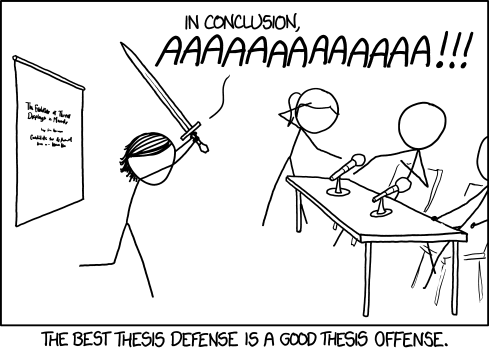
Completing the Thesis Defence: The Final Boss of a Graduate Degree


This past summer, several of the students in PVL had the opportunity to go through the timeless ritual that all us academics undergo in order to earn our MSc and PhD degrees: the oral defense of our research. I can report that everyone made it through with flying colours! Of course, a defence is also a transition for the student who may be moving from an MSc into a PhD, from a PhD into a Postdoc or from their MSc into the working world, amongst other paths. If you are considering getting a higher degree and want to know what this hurdle looks like, or are starting to think about your own defense, Grace has some helpful insight below. 
(Image above from XKCD Comics: https://xkcd.com/1403/)

 by Grace Bischof

The end of the summer marked a busy time in the Planetary Volatiles Lab. Conor, Giang and I were each nervously preparing for our upcoming thesis defences, where we would learn if we were to pass and obtain our degrees, or fail and be very, very sad. Giang, reaching the end of his PhD in August, defended first, setting the tone for the rest of us by passing! Conor and I followed, defending on September 7th and 8th (apologies to our shared committee members who had to sit in back-to-back defences). Conor and I were also successful in defending our theses, meaning we both obtained our master’s degrees. It was a very exciting end to the summer.

So, what is a thesis defence and why is it so nerve-wracking? In a research-based degree, the findings of the research you complete over several years get written up into a document – at York, this is a thesis for a master’s and a dissertation for a PhD, which is a more robust document than a thesis. This document represents years of hard work, and hopefully, makes an original contribution to the field in which you’re studying. That, in and of itself, is a nerve-wracking process. But before the university can award you your degree for all the painstaking effort you have put into your thesis, they first must test you on the contents in the form of an oral examination.

The oral examination usually begins with a public talk, where your research is presented in a 20 minute to hour long (depending on the degree) presentation. Typically, anyone can join this portion of the defence, and for me, it was fun having my friends and family watch my presentation so they could finally stop asking what it is I actually work on. Once the public talk is over, everyone else leaves the room, so it is just you and your committee. One-by-one, the committee members take turns dissecting your thesis, asking questions, and making suggestions about the contents to facilitate discussion on your work. This process can last several hours, especially for a PhD defence which is more involved. Once the committee has run out of questions to ask, you are kicked out of the room while they deliberate. Sitting outside the room while a small number of people decide the fate on the culmination of your work is horrifying. Then you are finally called back to the room to receive to your verdict…

The good news: the thesis defence is largely a formality. That is, if your research supervisor is doing their job, you will not walk into the thesis defence if you are not going to pass. The purpose of the defence is simply to ensure the student understands their work and the literature in which it is situated. Not knowing the answer to an examiner’s question does not mean you will fail the defence. In fact, the examiners want to see you reason through their questions, applying your knowledge even when you do not have the exact answer. There was one point in my defence when I answered a question completely incorrectly but realized my error once I thought more about it. I told the committee that the answer I gave was incorrect and walked them through my thought process to answer the question correctly. The committee was more interested in seeing my reasoning in getting to the answer than they were worried about the initial mistake I made.

So, now that you know what a thesis defence is, let’s briefly walk through some tips for the defence:

  1. Start preparing early. The amount of time needed to prepare is going to depend on the degree being obtained – i.e., PhD students will likely need to start earlier than master’s student. Three weeks out before my defence I began to seriously prepare. I started by compiling a list of the most important references in my thesis. I read a handful of these a day, highlighting and jotting down notes on important aspects of each paper. At this time, I was also walking through the basics of the field – sure, it might impress your committee to describe in detail all the aspects of radiative transfer in the atmosphere, but that might diminish if you forget Mars is the 4th planet from the sun.

  2. Anticipate questions. About 1.5 weeks from the defence date, I began combing through my thesis line by line. I had a PDF version of my thesis which I used to highlight and make notes in the margins. I wrote down anything that came to mind when reading my work and how the committee might interpret it. Some common questions that are asked in defences are: “How does your work fit into the existing literature”; “Describe your work in a few short questions”; “In what ways can this work be expanded?”; “What limitations did you experience in this work?”. Funnily enough, I prepared for all these questions and did not get asked any of them. However, preparing for them helped me to pick apart my work more carefully, meaning I could answer the questions they did give me.

  3. Try to relax as much as possible. It’s easier said than done. An important tip that I read online before defending my thesis was to make sure that in your state of nervousness, you don’t consistently interrupt the examiners while they are asking questions in an attempt to quickly prove you know the answer. When an examiner is speaking, it’s a perfect time to collect your thoughts and let them talk (it eats up more time this way too!). But, like I said, the defence is largely a formality. If you’ve done the work, then you know your stuff and you will crush it! You are allowed to sit and think about your answer before speaking, drink some water or have a snack, and take a break during the defence if needed. After the first 30 minutes of the defence, the rest breezes by.

Your thesis defence will probably be the only time you will ever have a discussion with people who have ever read the full contents of your thesis. That itself is a pretty cool opportunity, so try to enjoy it as much as you can! Hopefully in four years’ time, when I’m preparing for my PhD defence, I can come back to this blog post and try to take my own advice.  

Sunday, May 1, 2022

I know what you did last summer: Grad School Edition

With May having just begun, undergraduate students are looking forward to the summer, but the situation is different for Professors and graduate students. Though few grad students take courses during this time of the year, it is nevertheless one of the busiest times of the year. Below, MSc student Justin Kerr explains why and describes some of the rhythms of graduate student life.

By Justin Kerr

“So, you are a student right? When does your summer break start?” It’s only April, and I’ve already been asked this question dreaded by graduate students everywhere three times. At least it’s not as bad as when I was on the hunt for an apartment! When you first become a grad student, you quickly realize that most people outside the realm of academia don’t understand what research based graduate school in the sciences entails. In reality, we are typically enrolled in few if any classes and most certainly do not get a multi-month vacation in the summer months. Course-based graduate programs do exist, but are much less common in the sciences and are typically excluded from receiving most of the normal funding. So, what do research-based grad students in physics actually do?

While grad students do take some courses, they typically make up the smallest portion of our time commitments throughout the degree. Here in the Physics and Astronomy program at York University, Master of Science students have the choice of pursuing a degree by thesis or a research project. In the case of a research project, students are required to take five one-semester courses throughout their two-year program. This type of degree is more common in physics programs for students looking to pursue a PhD at the same university in order to reduce course load during their PhD. It gives more variety in topics studied but allows less time for research. By the end of the degree, students are expected to have completed an original research project presented in the form of a large written document (although often somewhat shorter than a thesis). This type of degree is more common in some specific fields than others; for example, it is almost always used in particle physics, but is a rare choice in our own lab group. Personally, this is the option which I chose in order to expand my expertise in different areas of physics to support my future goals in academia. While this is the high course load option, it still means taking very few courses – the equivalent of a single semester in undergrad over two years, at least without compensating for enhanced difficulty of the material.

The thesis option instead requires only three courses be taken over the same two-year period. This allows students more time for research and development of a more intensive project. A thesis is typically longer than a research project and may involve more multiple smaller projects rather than the single one described in a master’s research project submission. Theses are also presented in a formal defense process instead of a simple submission to a supervisory committee. Completing a thesis gives a more complete research experience to students, which is more heavily valued in certain fields. In straight physics degrees, this can also be used as an option for students who are not intending on continuing in academia to provide a more complete education prior to moving to industry. Some universities other than York have very strict preferences for which type of degree is completed for moving forward in a PhD program, such as physics programs at the University of Toronto. When completing a PhD, the only option available is a thesis, and it will be much more intense than the MSc version. At York, a physics PhD requires the completion of six graduate courses, including any taken during the MSc – meaning a student who used the thesis option will take three courses throughout their four-year degree, and research project students will only need to take one. This means that thesis and PhD students are often not taking any courses at all in a given semester, and usually only one at a time if they are.

The main goal of a graduate degree in the sciences is to perform the research that will become the research project or thesis. To properly do this, we need to first perform literature searches and read many scientific papers pursuant to our planned project. We also keep up with relevant new research in our fields by reading new publications, with most graduate students often reading through several scientific publications per week. The bulk of our work is to perform our research tasks. In physics, this usually means coding, lab experiments, or some combination of the two. This is the portion of our responsibilities that means we don’t have a summer vacation! When other responsibilities do not get in the way, we are working on our research. Producing publications is also an important aspect of graduate education, which when combined with thesis requirements ensures that a good portion of our time is spent writing. We are generally expected to work roughly full-time hours (although deadlines often have something else to say about that!), with research and the associated writing taking up most of that.

The final portion of a graduate student’s responsibilities is teaching assistant duties. As part of our admission agreement and making up about half of our yearly funding are contracts to be teaching assistants for courses offered by our department or that of Natural Science, which covers science electives for non-majors. These can include grading assignments, teaching/demonstrating in a lab course, or leading tutorial sessions in undergraduate classes. The standard requirement for TAing is 270 hours per year, which usually averages out to about 10 hours per week during the Fall and Winter semesters while leaving the summer free to focus on research. In reality, much of that often ends up being concentrated into a few very busy weeks around midterm and exam grading time.

While a good portion of our funding comes from the relatively small portion of our work that is TAing, the truth is that the vast majority of our time spent on research is in fact still work. Since any of the few courses we do take usually occur during the Fall and Winter semesters along with our TAing, our summers are left free not for a summer vacation as it might for undergraduate students, but instead for a large focus on our research work. This is particularly important for those of us graduating in August such as myself who are likely to have some of the busiest months of our degrees ahead of us while we try to perfect our research projects and theses ahead of submission deadlines and defenses. The start of the summer is no better, with the start of May meaning research evaluations for all of us; these are where we must present our current work and future plans to our supervisory committee in a form of oral exam. The next time you are chatting with a grad student, make sure not to assume that they are looking forward to their nice summer vacation to take a break from the courses that they are likely not even taking!

Tuesday, November 30, 2021

Applied CS & Space Science Research: An Undergraduate Perspective

 
One of my favourite parts of working in a research group is the opportunity to bring together a diverse set of students. Such a group has a tendency towards creative thinking that generates unexpected insights which propel our work forward. Not to mention the shear fun of working in this kind of an environment. In the past, we've had space engineers, geologists, physicists, atmospheric scientists and former history, political science, music and photography majors. Recently, Vennesa Weedmark, a Computer Science undergraduate here in Lassonde joined our lab. Read about their reflections on the experience below.
(Image via: https://www.csecoalition.org/what-is-the-typical-computer-science-curriculum/ )
 
by Vennesa Weedmark

As an undergraduate computer science student, the push to get an internship and/or co-op has always seemed paramount – partially because experience is “everything” in the industry and partially because an alternative avenue, a position working on a project in a research lab, for example, is rarely discussed. While I don’t deny the practicality of gaining experience in a corporate setting, a scholarly approach provides different kinds of challenges that in turn may allow broadening of a student’s horizons – an opportunity for creativity and a different take on problem-solving skills. 

Having started very recently in PVL, I was surprised at the reaction of many of my fellow CS students, who didn’t even realize that working on projects under the supervision of our professors was possible. Making the revelation even more fascinating was that my pursuit of a research assistant position was in a field outside our collective major discipline.

In a field as diverse as computer science, where we are constantly assured that the possibilities are endless, it would seem almost unremarkable for an adventurous CS student to pursue a scientific area in which they are interested under the umbrella of a research lab. The case for research assistant positions as an internship/co-op type of work experience is further strengthened by the science breadth requirement baked into our degrees; the possibility of working in a lab may encourage students who might otherwise see those courses as unnecessary to the industry. Taking my experience as an example: I have always been interested in programming in a scientific context but taking physics courses as part of my science-breadth requirement encouraged me to gain a deeper understanding of the type of field in which I might be interesting in working. As I’ve progressed through the years, I realized my curiosity went beyond the data-analysis discussions I've had in a classroom setting, which in turn led me to search for a way to pursue a deeper involvement in astrophysics-flavoured data analysis. 

These kinds of positions give an entirely different perspective when learning and applying computer science – creativity, responsibility, and communication skills (all valuable points on a resume) are given equal weight alongside coding ability and language skills. My current role at PVL is an excellent example of this: by analyzing a series of photos (read data) taken of the Martian surface, we hope to find evidence of triboelectricity. To do this, I am writing scripts to mask sources of light which can then be applied to the images; thus, allowing only those points of light relevant to the analysis to shine through. The creativity part comes in the use of 3rd party libraries: since only the end goal is known, and there is no guarantee that the supplementary code we are relying on will work in this case, errors become even more mysterious – were they the result of an error in the code itself, or in one of the many imports that are being used? How do you go about understanding code that may be based on incomplete or incompatible libraries? In applying our knowledge to our schoolwork as undergraduates, many examples of very similar problems are easily found online – in research, that foundation upon which to fall back, if it exists at all, is significantly reduced.

I in no way mean to diminish the importance of the concepts and methodologies we are taught to manipulate at the undergraduate level; these are just as necessary for the problem-solving process that is at the core of research. The elation of solving a problem is further heightened when there is no one on the other end with the answer and those intuitive leaps that are nigh impossible to teach in a classroom setting are, in my limited experience, the core of learning to code in the context of scientific analysis.

Wednesday, July 14, 2021

Adventures in Exploring the Planetary Science Data Archives


This week, Conor discusses that wonderful repository of US-generated planetary science data: the Planetary Data System. This data, provided for free on the web at https://pds.nasa.gov/  allows any researcher - no matter whether they are professional or amateur - to benefit from the space missions that have been funded by US taxpayer money. Sometimes, this means that discoveries made by a mission can arrive decades after that mission has ended in studies led by researchers who may not have even been alive when that mission was dispatched!

by Conor Hayes

One of my favourite occurrences in astronomy (and in science in general) is when someone manages to pull new information out of old data. For example, data collected by the Galileo spacecraft in 1997 were used in a 2018 paper (https://www.nature.com/articles/s41550-018-0450-z) to argue that Europa might have plumes of water similar to those seen on Enceladus. Of course, in order for discoveries like these to be made, old data has to be archived in a way that is easily accessible to someone who may not have intimate knowledge of how the data were originally gathered.

In an attempt to solve this problem, NASA’s Planetary Science Division founded the Planetary Data System (PDS) in 1989. The PDS was not NASA’s first attempt at an archive for its planetary missions. During the 1960s and 1970s, mission data were primarily archived at the National Space Science Data Center and the Regional Planetary Image Facilities. However, these archives were not always the most robust, focusing primarily on data storage rather than organization and documentation.

The PDS, by contrast, was designed not just to archive data, but also to present it to future researchers in a standardized format that wouldn’t require highly specialized knowledge to use. To this end, the PDS archiving standards were developed. The standards are painfully specific and in-depth (the “basic concepts” document is nearly 50 pages long, and the core reference manuals total to over 650 pages), so I won’t even attempt to explain them in full here. Instead, let’s look at an archived data project from my research to see how the standards are actually implemented.

The basic premise of the PDS archiving standards is that the data have to be accessible to any plausible future researcher. This means that the data absolutely cannot be archived in a proprietary format. Any time that you write a NumPy array to disk as a NPY file, save an image as a PNG, or export a document as a PDF, you are assuming that the technology to read those files will continue to exist. If those formats are depreciated at some point down the line and the general knowledge about how to use them is lost, then the data contained within are, for all intents and purposes, gone forever.

Of course, you have to make some assumptions somewhere, otherwise developing a standard will be nearly impossible. In this case, the PDS decided to assume that future researchers would be accessing their data using computers that could understand ASCII characters. Given that the ASCII standard itself has been a fundamental part of every computer since its creation in the 1960s, this seems like a pretty safe assumption to make.


Figure 1 : Some of the information you would find in a PDS label file.

Now, let’s take a look at an actual PDS data product. This product is one frame of an MSL suprahorizon movie (described elsewhere in this blog), and is archived on the PDS Cartography and Imaging Sciences Node. (The other science nodes, if you were curious, are Atmospheres, Geosciences, Planetary Plasma Interactions, Ring-Moon Systems, and Small Bodies). Each product comes in two parts: the label and the actual data. The label (seen in Figure 1) contains information about the format of the data, such as the number of bytes it contains, which byte the image data begins on, the image shape, the bit depth, and the number of bands in the image. It also lists information about the instrument used to collect the data, like the azimuth and elevation that the camera was pointed at, where on the planet the rover was located when the image was taken, and other useful information like the time of day the image was taken and the units associated with the data.

Unlike the label, which is presented in a plaintext format, the image data cannot be understood just by looking at it. If you open it in a text editor, you’ll probably get something that just looks like an incomprehensible mess of random characters (see Figure 2). That’s probably not surprising though. You wouldn’t try to open a PNG in a text editor, so why would this be any different? Well, if you try to open it in your favourite image viewing application, you likely won’t have much luck there either. 

Figure 2 : Opening a PDS image file in a text editor – a bunch of nonsense!

As it happens, both the label and the image data are presented as binary files containing no information that would help an application interpret them. A text editor assumes that you’re trying to open a text file, so the label, which is a text file, opens just fine. (This is also the reason why opening the image file in a text editor displays a bunch of random letters and symbols - the editor is interpreting the image data as ASCII characters.) But displaying an image is much more complex than plaintext, so without the guidance that your typical PNG or JPG includes, it’s unlikely that any mainstream application would be able to open a PDS image file.

This is the downside of the PDS archiving standard. Because it has to make as few assumptions as possible about the application being used to open it, the data are presented in such a general format that most common applications, used to being presented with highly structured files, have no idea what to do with them. The upside is that because the standards are so well-documented, it’s not exceptionally difficult to write your own code to read PDS files. In the interest of time, I ultimately decided to use code someone else had already written (the planetaryimage package distributed by the PlanetaryPy Project - it can be downloaded from their GitHub at https://github.com/planetarypy/planetaryimage, if you’re interested), but it could be a fun challenge to create an image viewer yourself in your language of choice.


Figure 3 : The results of opening a PDS image file with a tool designed specifically for the task – a beautiful image from the surface of Mars!

The PDS data archiving standards might not be as intuitive or out-of-the-box easy to use as other file formats that we might be used to, but it’s for a good cause. By standardizing our data archives, we are ensuring that future researchers will continue to have access to the vast volumes of information we have collected about our Solar System, information that may be hiding discoveries awaiting reanalysis by some scientist who might not even be born yet.

Sunday, May 30, 2021

Testing a new desktop’s computational power with a video game

With each passing year, we depend more and more upon computational simulations for our research work at PVL. Recently, we decided to acquire a new workstation to increase our capacity. This week, Charissa Campbell writes about her efforts to test-drive the new machine using a piece of software that would challenge its simulation capabilities: the video game Stellaris.

by Charissa Campbell

Now that I am fully back to work, several projects have come up that may test the capabilities of the current laptop that I’m using. To help,  I was able to request a PC desktop with lots of processing powers that should be able to handle anything. As a grad student, money is tight in most situations so getting a brand new piece of hardware is a luxury. I was quite excited to see how well this computer performed and decided to look into a suitable test.

My partner and I have had our gaming computers for several years so they are getting on the slower side. We had the idea to test a specific game with the new desktop that is notorious for being slow to run on average gaming PCs because of the nature of the game. The chosen game, Stellaris, is a 4X RTS (Real Time Strategy) grand strategy game where you guide your customizable civilization in a randomized galaxy. It is also notorious for creating a universe so populated it slows to a crawl on the old hardware when nearing the end of the game due to the heavy CPU load.

Stellaris is set in a galaxy that is populated with hundreds of star systems with their own planets. Each empire has a unique species and has a randomly placed starting star system where the goal is to explore the nearby cosmos. You are free to expand your empire while also researching new technology or ancient alien artifacts. This also includes colonizing any habitable planets you come across, assuming you get there first. You can make new friends or enemies across the galaxy with the ultimate goal of surviving an extra-galactic invasion that happens near the end of the game.

To play the game, you can choose and/or design any type of civilization with whatever traits you’d like. Species range from humans to plants to robots and more. You can customize even further by choosing specific traits such as Adaptive (habitability +10%), Strong (army damage + 20%, worker output +5%), Industrious (minerals +15%), and many more. Certain traits can be useful depending on how you want to play the game: do you want to explore, complete science objectives or try taking over the entire galaxy?

At the beginning of the game, each empire has one planet with a handful of "Pops," the unit of people. Over time, as each empire expands, more and more people populate habitable planets and eventually space-borne habitats and ring-worlds. Each Pop is assigned a job based on planetary building to produce the resources needed for their empire. Each job output is affected by a multitude of modifiers from either the job type itself or the Pop working it. Since each modifier needs to be checked first before it can calculate the actual output, it means that there are a lot of calculations going on behind the scenes every month in game. Since these calculations need to be done for each individual Pop, the time it takes the computer to do this adds up. This can make average PCs slow down significantly between the start and end of the game. The gaming PCs we have in our house add several minutes to the computation time once the end game nears. However, this computer has more RAM and a much better processor and video card so it should be able to handle these tasks more quickly. 

The game we set up has 1000 stars in our galaxy, each with their own set of planets. You can also adjust how many habitable planets you encounter. We maxed it to 5x to encourage a higher population to really test the computer. For this run, we went with the United Nations of Earth. They are a peaceful, democratic civilization with the goal of making friends and building a community that can be beneficial to all.


Starting in our own solar system on Earth, you can expand further by terraforming Mars or by being bold and colonizing a nearby star system. Alpha Centauri is nearby with the possibility of habitable planets so it seemed like a suitable choice. In order to colonize, you must send a science ship to survey the nearby system to find any habitable planets, resources or any alien anomalies. Depending on your civilization you may want to concentrate on exploiting mining resources or studying the science from various anomalies detected by your science ship. Once a habitable planet was found within Alpha Centauri’s system, a colony ship was sent to claim it for the United Nations of Earth (see image below).

After this point you are free to keep exploring and claiming more star systems for yourself but you must also consider your own population. With few exceptions, the majority of all resources are produced by your Pops; Therefore you always want to get as many as you can working where you want to fuel your empire. So to keep expanding means to grow the number of Pops in your empire and have worlds for them to live on. While this is manageable for most computers when you have only a couple dozen in each empire, by the endgame your own empire can reach numbers in the thousands, let alone all the other empires of similar sizes in the galaxy.

To determine how well the new computer runs Stellaris, we ran the same game on both machines and timed how long a month would take over the course of the game. We started at year 2200 and timed a month every 20 years until end game at 2400. We expected the new computer to outperform the old one and when compared to each other in the figure below, the new (white) computer has a better processor and significantly more RAM compared to the old (black) computer.

Shown in the figure below, the results were graphed with each other to easily compare computational power. At the start of the game (year 2200), both computers had similar timing for one in-game month. Since the majority of the civilizations were still in the beginning stage, population was low so minimal computational power is needed. Over time, population grew, and more computational power was needed. The two computers diverge significantly with the duration of one in-game month at year 2400 was doubled. Compared to the beginning of the game, the old computer sees a difference of 13 seconds while the new computer only has a difference of 4 seconds. Such a short difference must mean the new computer can definitely handle the majority, if not all of what I’ll throw at it during the rest of my PhD. A before and after of the game has been included at the bottom. 

Figure: Graph of the computational time for one in-game month between the start and end game. Blue shows the old computer, which has a large difference of 13 seconds. Orange shows the new computer and only differs by 4 seconds because of its better processor and more RAM. This is promising for any heavy computational research our group will perform.

Before: The galaxy at the starting stage of our game. The different colours represent different civilizations and you can see all the star systems which are represented by the white dots connected by blue hyperlanes. Any dots not in the coloured blobs are free to be claimed by nearby civilizations. Our civilization, the United Nations of Earth, is located near the top shown by a red arrow. 

After: This is what our galaxy looks like at the end stage of our game. The civilizations have greatly expanded with most star systems claimed. You can see the United Nations of Earth still at the top but they have significantly expanded (red circle).