Showing posts with label Research Directions. Show all posts

Thursday, November 13, 2025

Baby’s First Conference Talk

Public speaking: it's a critical part of communicating your science. But, apocryphally, most people would rather do almost anything else, even something unpleasant. I can tell you that even for me, the anxiety is real. It's there, any time I'm giving a talk or delivering a lecture. That can be a good thing, pushing you to refine your technique and your content. Some can even harness the nervous energy in their delivery! Fortunately, I've found most audiences to be understanding - our colleagues remember feeling that way too. Below, MSc student Abby discusses her first experience delivering a scientific presentation at a conference.

by Abigail Newton

To be perfectly clear before we begin: I am not a public speaker. I don’t consider myself to be good at presentations, I certainly haven’t had much practice with large crowds, and my brain stops working the moment I open my mouth. For all these reasons, I signed up for a 12-minute oral presentation at the International Meeting for Planetary Missions 6 (IPM) conference. The moment I saw the email pop-up in my inbox indicating that I received a presentation slot, I regretted all my previous decisions. But it was too late – I had no choice but to get prepared. Though I couldn’t have expected it, this presentation ended up being one of the best decisions I could have made.

The topic of my presentation was a cloud sensor, designed to turn on a camera when it detects Martian clouds are overhead. However, mere weeks before the conference, my sensor prototype was still unfinished, and I had another presentation at a different conference a month after IPM. It was a busy summer to say the least. Gathering my results just 5 days before my presentation – at a time when wildfire smoke concentrations were at the highest level they would be all summer – I found that my sensor could separate smoke from clouds. This was an unexpected, but welcome discovery. IPM itself is unique in that it’s attended by primarily engineers and was completely instrument-focused – completely up my alley.


Once I had gathered my results and wrapped my mind around the implications for my instrument concept, I decided to tackle the presentation itself. I practiced – wrote and rewrote, stumbled through a rocky presentation within the department, redid the presentation, got a class-A lecture from my airplane seat-mate on how I should “just relax”, practiced some more, anxiously sat through presentation after presentation on instruments with MILLIONS of dollars in funding, all before it was finally my turn. I wanted to vomit.

After 12 minutes of complete blackout, I found myself back in my seat. I came to and realized: it went well! I got a laugh out of the audience at the very beginning that allowed me to loosen up and relax through the rest of it. Did I make some small mistakes while speaking? Yes. Was I perfectly engaging every corner of the room? No.

Unfortunately, my worst fear came true.  I got stumped by a question that was perhaps less than relevant to my presentation in front of a room full of world-class scientists I was desperate to impress. I did not give an answer that could in any way be described as coherent, but the moderator stepped in and shut it down. 

Seasoned scientists and engineers continued to ask interesting questions about my presentation for the rest of the conference – the kindest people, treating me as a peer. My results showing the detection of amounts of wildfire smoke significant enough to override the thick cloud cover above caught attention and brought questions about making a similar version of the sensor for dust – something I had already been considering. Even better, my presentation was on the first day, so I was able to take a deep breath and enjoy the rest of the conference stress-free. 

Lots of hiking and learning was done in beautiful Boulder over the rest of the week. I was inspired by both presentations on the future of instrumentation and the gorgeous landscape. I would massively recommend giving conference presentations to any grad student terrified of public speaking – exposure therapy is the way to go.   

Wednesday, September 24, 2025

Another Summer at PVL!

 Ahh, summertime! You'd be surprised by the number of people who think us academics just get four months of vacation. Instead, it's the busiest time of the year as we turn to focus almost exclusively on our research. But for those early career academics just stepping into research, it can be a formative experience. It's not just the work, but also the environment, the people and the excitement of having your own project in the midst of a talented and supportive group. I still remember my summer undergraduate research from back in the day. In this week's post, Ella shares her experience during her second summer with us. (Image Above: Kate, Brock and Ella canoeing at Sunnyside, the smallest ice-cream sizes at Kawartha, and the pizza party!)

 By Ella Ordinaria 

Hello PVL Blog! It’s me, Ella, the PVL undergrad! I wrote my first blog last summer, and here I am again – full circle!

This summer, I once again received the NSERC Undergraduate Student Research Award, which allowed me to work in the lab full-time. My work focused on revising the Cruise Phase Microbial Survival (CPMS) model that Moores and Schuerger developed in 2020. The original CPMS model calculated the bioburden reduction on the Europa Clipper (EC) spacecraft under a direct and Venus-Earth-Earth Gravity Assist (VEEGA) trajectory. However, when EC launched in October of last year, it followed a Mars-Earth Gravity Assist (MEGA) trajectory instead. So, we revised the CPMS model to reflect the MEGA trajectory.

I started working on this project in early 2025, but things didn’t really pick up until summer. After all the modeling work, our goal was to produce a 2,500-word research note – which brought me my greatest challenge: writing. I was overwhelmed by the messy notes I’d written throughout the year, and the constant revisions made the words jumble together. As many of you know, scientific writing often feels like a never-ending cycle of writing, erasing, and rewriting.

Ultimately, we published the paper in Research Notes of the American Astronomical Society (RNAAS). Seeing the work out there was so rewarding! I’m very grateful for the opportunity to write a first-author paper and for Dr. John Moores’s trust in entrusting this project to me. This would also not be possible without Dr. Moores, Dr. Schuerger, and PhD student Grace Bischoff, the co-authors of the paper. Their support and revisions have helped me grow immensely as a writer. I’m honored to receive guidance from the people I look up to! I also presented this work at the Lassonde Undergraduate Research Conference and did an interview on the AAS YouTube channel with Frank Timmins, the AAS Journals Deputy Editor-in-Chief. 

With the CPMS work crossed off my list, I spent the rest of the summer working on the Orbiting Sample (OS) container project. As with the CPMS model, we’re interested in bioburden reductions on the OS container, one of the key components of the Mars Sample Return (MSR) mission. Since the MSR mission is one of the most ambitious planetary missions ever developed, the concept of “breaking the chain” of contact between Mars and Earth is a critical component. Coming from a biochemistry background, my main challenge on this project was the math and physics required to modify the original model to incorporate the energy balance during the cooling and heating phases of the OS container. I’m currently in the writing phase of this project which is a part of the process I do enjoy, though it’s also something I’d love to get better at. That said, most of my work at PVL has centered on modeling bioburden reductions on spacecraft, which happens to be one of my favorite concepts in astrobiology. Planetary protection excites me because it is an important consideration for forward and backward contamination, protecting Earth from foreign materials while ensuring the integrity of space exploration.

Work aside, this has probably been the most dynamic and eventful four months at PVL! With new students joining the lab, this summer was packed with fun socials and plenty of laughs. Some of our activities included rock climbing at Basecamp, trekking downtown to tackle the humongous ice cream portions at Kawartha Dairy, the annual summer pizza party, grabbing an iced matcha latte with Kate every morning (which we called the DOTD – drink of the day) and my personal favorite, the ultimate undergraduate adventure: canoeing at Sunnyside Beach. 

John and I at the Lassonde Summer Undergraduate Research Conference! 

Although summer has come to an end, thankfully my time at PVL has not. I’ll be taking the fall and winter semesters off for an internship, but I’ll still be involved with PVL to continue the OS project. Once a PVLer, always a PVLer!

Wednesday, July 2, 2025

Swapping Mars for Exoplanets: My Time at Harvard University

Providing graduate students with a range of experiences is a key part of helping them figure out what they want to do and where they want to do it once they have completed their degrees. Sometimes that means visiting another university lab, or working for a government agency or finding out what it means to join a team in the industrial sector. For much of the year, PhD student Grace Bischof has been investigating these questions in the lab of Robin Wordsworth at Harvard University.

by Grace Bischof 

Last summer, I received an email telling me that I was eligible to apply to the Michael Smith Foreign Study Supplement, funded through the Natural Sciences and Engineering Research Council of Canada (NSERC). This supplement designates money for graduate students to partake in research internships at institutions abroad to help build global connections. Immediately after receiving the email, I excitedly emailed John to ask if we could talk about possible researchers that I could reach out to about this opportunity to see if they would be interested in having me in their lab for a few months.

At the top of the list of researchers I was interested in connecting with was Dr. Robin Wordsworth at Harvard University. During my time interning at JPL, one of Robin’s papers formed part of the basis for the work I was doing there, so I became familiar with some of his research. About a year later, I saw Robin give two fantastic talks about the environment of Mars at LPSC and the 10th International Conference on Mars. Ironically, though the two talks I’d seen by Robin had been about Mars, and my research at York for the past ~5 years has been about Mars, Robin does not primarily do research on the Martian atmosphere. Though Mars makes up a portion of his research, he also works extensively on modelling the atmospheres of exoplanets. So, for the first time, I wrote and submitted a proposal for research outside of the solar system, characterizing the atmospheres of rocky exoplanets through Lyman-alpha transit spectroscopy.

I learned in late December that my proposal was successful and by the first week of February I was on a plane, flying to Boston, Massachusetts. Unlike the winter of 2023 that I spent in sunny Pasadena happily skipping the cold Toronto winter, Boston has a similar climate to home. Upon landing, I was greeted with below zero temperatures and several inches of snow on the ground. I took a cab to my new home in Cambridge (where Harvard is located), which is just across the Charles River from Boston, feeling equal parts excited and anxious about the next few months ahead of me.

Luckily, I soon learned that I had I little to be anxious about. Though I had never researched atmospheres other than Mars’, I loved the project I was working on (and will write a blog post detailing it later on!). At the beginning of the internship, it felt like I had a mountain of literature to read and understand to even grasp the basics of the project, but I chipped away at it slowly, finding a new love for exoplanetary science. Everyone in Robin’s group was extremely friendly and thoughtful – I learned a lot listening to them talk about their research. Going into this experience, I didn’t think I could enjoy an area of research as much as I love Mars, but I am very pleased to have discovered something new that I find so fascinating. 

One of the best things about working at Harvard is the stunning campus, with its gorgeous centuries-old buildings. A favourite location of mine on campus was the Harvard Museum of Natural History, which also encompasses the Geological and Mineralogical Museum, the Museum of Comparative Zoology, the Harvard University Herbaria, as well as the Peabody Museum of Archaeology and Ethnology. My office was on the upper floor of the Geological Museum, so I was greeted by walls of gorgeous rocks and minerals every day. With a student ID, I was able to get in for free and roam around the floors of these museums. I took lots of pictures of the dinosaur fossils and bones for my 3-year-old nephew, Tate, who is a dinosaur fanatic. My favourite part of the museum was the comparative zoology section, where there are taxidermized animals of every kind you can imagine from all over the world – I kept finding it so fascinating to think that people in Australia would think seeing a kangaroo is as mundane as we find seeing a squirrel in Toronto. 


Under the bones of a Steller’s sea cow, while admiring the giraffe on my right

Since it was my first time in Massachusetts, I spent some time exploring the Boston area with friends and family who came to visit. We walked the Freedom Trail, visiting historic Boston sites like the Paul Revere House, Granary Cemetery where some of the American Founding Fathers are buried, and boarded the U.S.S Constitution, which is the world’s oldest commissioned warship that is still afloat. When my dad visited, we rented a car and spent a morning wandering the streets of Salem, learning more of the Witch Trials that plagued the town in the 1600s. That afternoon, we drove to Concord and visited the Orchard House, where Louisa May Alcott wrote and set the novel Little Women. The 2019 film adaption of Little Women is one of my favourite movies of all time, so exploring the home that inspired the novel was an experience I won’t forget!


 Outside of the Orchard House where Louisa May Alcott wrote Little Women 

Before I knew it, it was June 1st, and I was packing my bags to fly back home to Toronto after four incredible months at Harvard. One thing to know about my academic journey while reading this blog is that getting to grad school was not necessarily the easiest for me. Though I loved the content of my undergraduate degree in physics and I worked hard at it, my grades were certainly not the best. When John accepted me into PVL in 2020, he was taking a real chance on me. All that to say: I never thought I would spend any time at an institution as prestigious as Harvard, let alone feel like I belonged there and was proud of the work I was doing. This internship helped me grow confidence in myself both personally and professionally. Five years ago, when I started grad school, I wouldn’t have believed I would gain that confidence, so I am beyond lucky and grateful for this experience – and especially for my experience in PVL which got me here in the first place.

Monday, June 9, 2025

Unravelling Martian Methane Mysteries in the Canadian Arctic

An image of our ABB methane detector deployed at Gypsum Hill on Axel-Heiberg Island in Nunavut. Alex's work here showed that the variability in a measured methane signal might be able to tell us more about our distance from the source than the total amount of methane does. This is important for how we might prospect for methane seeps on Mars. 

Oh, and look at that view!
Sometimes it's not just the results of our investigations that take our breath away.

by Alex Innanen

Almost three years ago now (and wow, time really flies) I spent three weeks in Nunavut, which you can read all about here. I talked a little in that post about why I went up and what sort of work I was doing there. But the work did not end when I landed back in Ottawa (or got back to Toronto after an extended weekend at the cottage). No, I then spent the next several months going “I guess I need to write this up in a paper somehow.” This was complicated by a few things – the fact I hadn’t ever written a paper based on fieldwork (nor read many), the fact that the results were not super clear cut, and some good old fashioned procrastination. But I ended up presenting the work a few times, including at my yearly research evaluation meetings and at a couple conferences, and it started to come together into some kind of story.
 
When I took methane measurements, I let the instrument ingest the air passing over for ten minutes, and the instrument took a measurement every second over this time period. This meant I ended up with what I took to calling a ‘spiky plot’ of hundreds of methane measurements over that ten-minute period. I noticed two things in these ‘spiky plots’. The first was that I could find the average methane concentration over that period, and that the average methane concentration tended to be highest right next to the source of the methane and drop off as I moved away downwind – typically the way you expect methane (or any gas) to work, which if nothing else meant the instrument was working. The other thing I noticed was that the variation in how spiky the spiky plot was was also higher right next to the methane source. That is to say, the methane signal varied over a much larger range when I was closest to the source, and had a much smaller range further away or upwind of the source. You can see this in the three graphs below which I took at one of the springs.

Three spiky plots. You can see that the upwind measurement has not only a lower average concentration (dashed line) but also is much, much less spiky (solid line) than the other two. Note that the y-axis is much larger on the 'Inside Wolf Spring' measurement because I saw such huge spikes of methane!

I saw this same phenomenon with the variability getting higher closer to the source even when I wasn’t moving in the exact same direction as the wind. At Wolf Spring I only moved in a (mostly) straight line in the wind direction, but at Gypsum Hill I took two sets of measurements – one along the wind direction, and one at a diagonal to the wind direction. This second set of measurements suggested that getting more data at various locations around the methane source could give us a clearer understanding of how methane behaves in a two-dimensional grid around such a source.

To that end, I sent the instrument back up to the arctic last summer in the company of an MSc student from McMaster with detailed instructions to get me a grid of measurements around Wolf Spring. My procrastination had achieved one thing – I was able to add this new dataset into my paper. And I’m glad I was! From the 2024 measurements I was able to see to impact both distance from the source and the angular distance I was from the wind direction had on the methane signal. (I’ve visualised the geometry simply below in case it’s not clear what I mean, where θ is that angular distance from the wind direction.)


Now, in 2022 I did not have any way of accurately measuring the wind direction. Instead I used a technique which is actually similar to how the Phoenix Lander did it, wherein I held up a roll of flagging tape and watched which way the wind blew it. In 2024 we were a bit more high-tech: the master’s student had access to a small weather station which gave me actual numbers for my wind direction. Knowing the position of the instrument at each measurement and the wind direction at the time of the measurement, I was able to get the distance from the source (d) and the angle of the instrument to the wind direction (θ) and combine these (d/cos(θ)) and compare this value to the average methane concentration and the variability in the measurements. I found that both fell off with increasing d/cos(θ) (or distance from the center of the methane plume), but that the variability actually fell off in a slightly more predictable way.  

Okay, you may be thinking, this is all mildly interesting but what does this have to do with planetary science? Well, as has been discussed on this blog before, there’s a lot we don’t know about martian methane. One of the unanswered questions is where it’s coming from – both in the sense of what is producing it, but of more interest to this work, the actual location from which it is being emitted. We know that we see methane plumes on Mars, but we don’t know how long they last, how the behave or, again, where they’re coming from. If we did send an instrument to Mars to investigate this, we could use what I learned in the arctic to determine what that instrument should look like and also how we should use it to find the source of these methane plumes.

I learned that the variability is a better indicator of how close we are to a methane source. The variability I saw in my spiky plots is over very short timescales, thus our hypothetical instrument should be able to make high frequency measurements to capture changes over these short timescales. I also learned that knowing the wind direction is pretty important, so our instrument should be combined with some kind of wind sensor. My measurements were taken from various locations around the methane source, so having our instrument on something that can move like a rover (or even a drone!) may be more useful than if the instrument just stands still.

There’s more I could say about this, but I don’t entirely want to spoil my paper (coming soon to an Acta Astronautica near you!). Even though it took nearly three years, it turns out there was quite a bit to learn from a few slap-dash methane measurements in the very distant north. 

To read the paper, visit: https://www.sciencedirect.com/science/article/pii/S0094576525003212

Friday, April 25, 2025

The Art of Collaboration

I can't emphasize this enough: Science is a team sport! Collaborations are key to all that we accomplish at PVL. Often, the effort of trying to develop a better understanding of our solar system can be difficult or frustrating. Working with others not only makes this more fun and social, but those connections can often get you unstuck or send you down a path of discovery you didn't even know existed. All it takes is the right conversation to spark something new! Above: A view from the Nydeggbrücke, a 19th century bridge over the Aare that connects the old and new parts of Bern.

by Conor Hayes

I’ve now been with the PVL for almost five years. In that time, I’ve really come to appreciate the power of a collaboration, particularly with people outside of the lab. I first got a taste of this following the annual meeting of the Division for Planetary Sciences (DPS) in 2022. There, I was presenting some of the work that I had been doing as part of my Master’s thesis. In that work, I was examining how small-scale terrain may influence surface temperatures in the Moon’s permanently-shadowed regions (PSRs) in ways that we can’t currently observe from orbit. To do so, I was using a “Gaussian rough surface” to represent the interior of a PSR. While Gaussian roughness is a decent model for planetary surfaces over smaller regions, it’s a simplified model as it ignores larger structures like craters.

After my presentation, I got a DM on the conference’s Slack workspace from David Minton, an Associate Professor in the Department of Earth, Atmospheric, and Planetary Sciences at Purdue University. In his message, he told me that he had been developing a Cratered Terrain Evolution Model (CTEM) that can create realistic lunar terrains at small scales, and asked if I would be interested in collaborating. Over the next several months, we merged his CTEM outputs with my illumination and temperature models to create a paper that was significantly better than the version that was in my Master’s thesis.

This past February, another collaboration offered a new experience to me. During my PhD, I’ve been spending a lot of time looking at the transport of volatile molecules like water across the lunar surface. One of the more popular models for doing so assumes that molecules undergo a series of thermally-driven jumps across the surface until they are either destroyed or trapped by cold temperatures. The temperature required for one of these jumps to begin is determined by a parameter known as the “desorption activation energy.” It is arguably the most important component of the model, but its value is not well understood, particularly if you want to look at molecules other than water.

There are several ways that one can attempt to determine the value of a molecule’s activation energies, but nobody at PVL has the expertise or the equipment necessary to do so. We could just use the values in the literature while making note of their limitations, but I didn’t feel like that was the right approach. Instead, we’ve been working with Liam Morrissey and his team at Memorial University on molecular dynamics (MD) simulations of desorption, which can be used to estimate the activation energies for various molecules on different surfaces without having to put together a complex experimental setup.

As part of this collaboration, I was invited to participate in a workshop at the International Space Science Institute (ISSI) in Bern, Switzerland. This workshop was the first meeting of ISSI’s Multi-Scale Understanding of Surface-Exosphere Connections (MUSEC) International Team. At this point in my graduate career, I’ve been to many conferences, so I thought that I knew what I was getting into. It didn’t take long for my expectations to be proven entirely incorrect.

What rapidly became apparent was that a workshop is a much more collaborative environment than a conference. Rather than a rigid schedule of short talks and even shorter Q&A sessions, each presentation was more like a conversation between all the attendees. About half an hour was given to each person, not because they were expected to speak for that long, but to give ample time for discussion during and after each talk.

I had been worried because I was coming in without many actual results. Instead, the presentation I had prepared was mostly a listing of open questions that I would like to address in the final version of my model. Not exactly the kind of content that would attract much attention at a conference, but I had been assured that it was appropriate for a more informal venue such as this one. Still, I was haunted by the ever-present specter of imposter syndrome, particularly as a last-minute addition to a group of people who were already familiar with each other.

After the week’s agenda had been updated to include me, I noticed that 45 minutes had been allocated for me. Before I began, I joked that I we would definitely be taking our afternoon coffee break early, as I couldn’t imagine a world in which my set of questions could possibly consume that amount of time. As it turns out, if you start listing unanswered questions in a room full of people with the expertise to answer those questions, it inspires a lot of discussion. I was told afterwords that my presentation was exactly the kind of content that this workshop had been designed to focus on, which was very reassuring to hear given my initial uncertainty about whether I should be there at all.

Outside of the workshop itself, the MUSEC leadership made an effort to foster a sense of community with group lunch and dinner outings, which allowed everyone to get to know each other outside of our work. It didn’t take more than a day or so before I stopped feeling like an outsider. Bern itself is a beautiful city, and I hope to be able to explore it more during the next in-person MUSEC workshop next year (if writing my dissertation isn’t consuming too much of my time by then!). 

 The aftermath of a successful workshop: a completely inscrutable whiteboard.


Thursday, September 26, 2024

Exploring the Unknown: My First Steps into Planetary Science Research at the PVL

Every summer, we host undergraduates in the lab at the PVL and during the year we bring in volunteers to experience what professional research looks like. Today Ella, one of those undergrads, tells the story of their research journey so far!

by Ruella Ordinaria

Last summer, one of York’s monthly email updates featured an article on Dr. Haley Sapers’ expedition to Nunavut to test Mars rover simulations. The words, ‘astrobiology’ and ‘Mars’ immediately caught my attention. Seeing that Dr Sapers was part of the Planetary Volatiles Lab (PVL), I emailed Dr. Moores for potential opportunities to contribute to his lab. I exchanged an exciting conversation with Dr. John Moores and in the fall, I was assigned to help a PhD student, Grace Bischof, with her research on developing a Mars Microbial Survival (MMS) model. Fast forward, I completed eight months as an undergraduate volunteer at PVL and this summer, I received the NSERC USRA from NSERC and the Lassonde School of Engineering. 

Now, what’s the actual science I’m working on, you may ask? The MMS Model estimates the bioburden reduction on Mars spacecraft during the cruise phase and on the surface. The MMS model calculates the quantity of terrestrial microorganisms remaining on a spacecraft's surface as it is exposed to the effects of the most deleterious space conditions. These include high vacuum, extreme temperatures, solar UV radiation, and ionizing radiation such as solar wind particles (SWPs). This is important because when we send spacecraft to celestial bodies like Mars, we want to prevent forward contamination as it can impact future exploration of extra-terrestrial life on Mars.

My enriching, fulfilling experience while doing research at the PVL, along with the challenges that came with it, has allowed me to grow both academically and professionally. The first challenge I faced was my limited background in space and planetary science. When I joined the PVL, I was entering my second year as a Biochemistry major and I barely knew anything about biochemistry, let alone planetary science. Although I still struggle with this knowledge gap, it has become easier to address by learning through literature searches. In addition, I also struggled significantly with programming. Grace’s project, the MMS Model, uses Python for calculations and graphing. While I had previous experience with HTML / CSS and Python through hackathons and self-learning, I had never worked with numerical modeling or data processing before. Familiarizing myself with these concepts was a challenge, and I essentially had to learn from scratch—from graphing to using various Python libraries for modeling. Google and Stack Overflow became my go-to resources. Fortunately, I am surrounded by passionate Mars experts with many years of research experience who are always willing to answer my questions.

Not only did I learn about all the exciting things about microbial survival, Mars, clouds, and the atmosphere, but I’ve also developed many technical and soft skills such as coding, writing, data collection, collaboration, problem-solving, and critical thinking, just to name a few. This invaluable knowledge and skill are something that I would have never formally gained from my degree alone. Engaging in research early on in my academic career has also allowed me to apply the knowledge I’ve learned in the classroom to real, practical research. My interactions with lab members have given me insight into the workload, the highs and lows, and the overall culture in academia, which has helped clarify my career goals and deepened my passion for planetary science and research.

Most importantly, I learned that research is not instantaneous – it is a journey composed of both productive and unproductive days. I learned that some days you might read 10 papers, write pages of words, and run many lines of code, while on other days, you might spend hours just sitting, thinking, writing then scratching and writing again. Although there have been times when I felt unmotivated, I still look forward to coming to the office every day with the same excitement I had when I first visited Dr. Moores’ office.

And of course, one of the best parts about doing research is the people! My interest in research comes from my aspiration to be part of a community that shares a profound passion for exploring the intricacies of the world and a dedication to immersing themselves in their questions – I found that community in the PVL. Some of my favourite memories are getting last place during bowling, dilly-dallying at Toronto Island, and eating lunch at the Petrie courtyard under the legendary Newton tree (manifesting a Nature paper!). I owe all of my positive research experience to my role models – Grace, Dr. Moores, and all the PVL members. Their support has been incredibly helpful in navigating my research challenges and has kept me curious about the world.

So, what’s next? Tomorrow, the next day, and throughout the rest of the school year, I’ll be heading to the Petrie building to continue my exciting planetary science research! Stay tuned ;)!

Wednesday, November 29, 2023

The Center of the Universe – My Experience Interning at the Jet Propulsion Laboratory

We often encounter kids in our outreach work who can't wait to be astronauts when they grow up. Somehow this didn't have the same pull for me. Instead, I was mesmerized by the robotic spacecraft  exploring the distant reaches of the solar system. One facility came up over and over again in watching documentary after documentary on PBS about those probes: NASA's Jet Propulsion Laboratory in Pasadena, California. It was a thrill to visit while I was in graduate school. I still don't think I'm completely recovered from having a badge and a parking pass during the 90-sol prime mission of MSL while I was a postdoc!! Because of that, it's always a joy when one of our own here at PVL gets to experience this place for themselves. First there was Raymond, then Emily and, later on, Brittney. Recently, one of our PhD students, Grace Bischof (pictured above), had the opportunity to spend the winter working projects on-lab. She relates her experience below.

By Grace Bischof

In late 2020, I submitted a scientific proposal to the Technologies for Exo-Planetary Science (TEPS) program, with hopes of becoming a TEPS trainee. Upon a successful application, I was able browse through a list of TEPS collaborators with whom I could carry out a four-month long internship (assuming they accepted my inquiry to work with them). There was quite an appealing list of places to intern with – from national collaborators at Canadian universities and within industry, to international collaborators in institutions as far as Japan. There was one collaborator, however, that immediately jumped out of the page for me: Michael Mischna, who is a researcher at the Jet Propulsion Laboratory.

I had seen Michael’s name previously through a former PVL member – Brittney Cooper – who carried out an internship at JPL a couple years before I had arrived in the lab, and whose internship project with Michael inspired the bulk of my master’s thesis. Not only that, but as a member of the Mars Science Laboratory team since 2020, JPL was a place of legends to me, as JPL is the section of NASA that manages planetary robotic missions including the Curiosity rover. The idea of working there myself was something of a dream. In the summer of 2021, John reached out to Michael on my behalf to inquire if there was a place for me to carry out my internship with him, and luckily there was! Not only would I have the opportunity of working with Michael, but I would also be working with Leslie Tamppari, who had been project scientist on the Phoenix mission. 

After a year’s worth of delays due to the lingering pandemic, in January 2023, I packed two giant suitcases and flew down to Pasadena, California to start my adventure. After hopping off the plane at LAX (haha!), I was immediately greeted to views of the San Gabriel mountains, palm trees, and warm weather. I made my way to the house I was renting with four strangers, which luckily was not an internet scam, and spent the first couple of days unpacking and settling into my new home. 


(The first picture I took upon arrival in Pasadena. I couldn’t get over the palm trees.)

Although I had somehow found myself in LA during SoCal’s rainiest winter in a couple decades, nothing could rain on my parade that first day at JPL. Even the 5:30 am wake up call to ensure I was on-time for the first day’s onboarding activities felt exciting. I can clearly remember sitting on the LA city-bus as it approached the JPL gates and feeling awe at the opportunity ahead of me. The first day was spent filling in forms, giving my fingerprints, and taking a photo for my new JPL badge. Afterward, I met with Leslie and Michael to discuss the work I would be completing over the next few months, and then I was given a tour of the 168-acre lab by Michael. At JPL, you often need to have your walking shoes on to get from building to building.

Now, I should probably mention the actual science I did while I was at JPL before returning to the fun stuff. The plan was to work on two projects: the first was polishing some work I did in my master’s, using a radiative transfer model to determine the water-ice opacities at the Phoenix mission landing site. The second was to use the Mars Weather, Research, and Forecasting (MarsWRF) general circulation model to simulate the atmospheres of planets around stars with different stellar type, with future plans to expand this work to investigate the effect this would have on land-ocean distribution.

As science so often goes, the first project encountered many issues. A bug was found in the radiative transfer model which resulted in spending much of my time compiling and re-compiling, running and rerunning the model to determine the source of the issue. The MarsWRF work, however, went much more smoothly. I first spent a couple weeks becoming comfortable using the model. MarsWRF is a giant model, with many moving parts. I was set up with a NASA Supercomputing account so that I could run the model with relative quickness (often, this still took hours to days). Once I had the hang of using the model, I ran some cases simulating the ancient Martian environment to send to a team at Rice University who would use the inputs I provided for a Paleo-Mars lake model. Then, I got to work on the stellar-type investigation. I learned how to make changes to the source code of the model (which could be quite a task – altering several files to ensure that all the correct inputs were feeding into the correct scripts). Once I edited MarsWRF such that the user can define the temperature of the star they wish to simulate around, I ran the model for a Mars-like planet with a thin atmosphere around F-, G-, K-, and M-type stars. From this, we determined that, for the atmosphere that was set up, hotter stars will have more shortwave flux reach the surface of such a planet. This work was the first step in understanding exoplanet atmospheres around different stellar type and will eventually be applied more widely to understand the habitability of exoplanets based on star-type. Working on these projects with Leslie and Michael was such a delight, as they were incredibly supportive during this work.

Not only was the work I was doing at JPL extremely cool, but also the lab itself is one of the most incredible places to work. I was fortunate enough to have an office in the Science building (yes, there was big sign atop the front door reading Science). Although the office was very small and windowless, it got the job done, and I had two great office-mates. There was also ample seating around lab when I was craving a change of scenery. Sometimes I would work in the main cafeteria to be around the buzz of people conversing over their morning coffee, but my favourite place to work was the JPL mall. The mall is a big open area near the front of lab, which had plenty of tables set out to work or eat lunch outside in the fresh air. Working all day on the mall was how I managed to get a sunburn in February – a phenomenon I am not used to during Februarys in Canada. 

At JPL, cool things are happening all the time. In the main cleanroom, High Bay 1, they were assembling the Europa Clipper spacecraft when I was there. How amazing it was to look upon the brilliant people putting together a spacecraft that will one day be orbiting the moon of another planet so far out in the solar system. As cool as it is, this was one of the buildings I was only able to access if I brought an American with me. As a foreign national, there were several areas of lab that were off limits without an American escort – they take security very seriously at JPL.


The main cleanroom where the Europa Clipper Spacecraft was being assembled. If you look closely, you can see the workers in their bunny suits. Don’t be fooled by the worker at the front left of the picture – that’s a mannequin known as High Bay Bob, who is often moved around to appear to be carrying out various tasks. Currently, Europa Clipper has been removed from the cleanroom for testing, but a livestream of the cleanroom can typically be found on YouTube: https://www.youtube.com/watch?v=yKDA6smS9_k

One of the most memorable days for me was when I was able to visit the Mars Yard to watch the Perseverance Rover’s twin, OPTIMISM (Operational Perseverance Twin for Integration of Mechanisms and Instruments Sent to Mars) out into the yard completing some mobility testing. The Mars Yard is a big, sandy yard that is used to mimic the terrain of Mars. Here, OPTIMISM and MAGGIE (Mars Automated Giant Gizmo for Integrated Engineering – also known as Curiosity’s twin), are brought out for a multitude of testing purposes, including mobility and instrument testing, sample collection, or testing new autonomous algorithms. This day, I was also able to go into the garage to see MAGGIE, which was so incredible after working with the Curiosity rover for the past 3 years.

(Top: Outside in the Mars Yard with OPTIMISM as it completes mobility testing. Bottom: Inside the garage with MAGGIE)

Now, why is the blogpost titled, “The Center of the Universe”? Well, within the Space Flight Operations Facility on lab is the Mission Control Center. Here is where the data from the Deep Space Network antennas in Canberra (Australia), Goldstone (California), and Madrid (Spain) are managed. These giant dishes talk to the spacecraft that are currently exploring the solar system (and beyond for the Voyagers), and that communication is all funneled through the mission control room at JPL. This is also the room from which spacecraft, such as the Curiosity and Perseverance rovers, were landed on the surface of Mars. The story goes that former-JPL director, Charles Elachi, upon thinking about how all the information from the solar system comes into this room once said, “This must be the center of the universe!" There is now a big plaque in the floor in this room declaring it as the Center of the Universe. The JPL mission control center has someone within it, monitoring data around the clock to ensure there are no issues. In fact, since Southern California is so Earthquake-prone, Space Flight Operation Facility was built to be Earthquake-proof to protect the precious control center inside.

(Top: The Mission Control Center, where you can watch the DSN dishes communicating with spacecraft all over the solar system and beyond. Bottom: There is a superstition at JPL that peanuts must be passed around to ensure that launches and landings are successful, dating back to the 1960s. The lucky peanuts were eaten for Curiosity and Perseverance’s landings, among many others)

From my first day, the other interns who I met were incredibly kind and open. The JPL researchers and staff were all supportive and encouraging. I was lucky to experience only friendly and inviting people. The interns I met came to JPL from all over the world – Singapore, Australia, Italy, and Iceland, to name only a few – and were all open to having the most fulfilling experience at JPL, and in Southern California, as possible. I felt satisfied with not only the work I was doing at JPL, but also felt enriched by the experiences and memories I was making with my fellow colleagues.

Top: A hike up Echo Mountain trail which begins just north of Pasadena. This hike was organized by the Australian interns who had heard there was snow at the top of the hike. By the time we got there, one singular patch of snow about 0.25 square meters in size remained. They still made a few snowballs out of it to throw. Bottom: The view of the sunset from Joshua Tree National. My first time in the desert! We spent two nights camping in Joshua Tree, filling the days with hiking and rock-climbing (which I observed from the ground….).

The month of May came quicker than I could’ve imagined, and soon I was flying back to Toronto to continue my PhD back at York. While it was great to be back seeing my family, friends, and pets, my experience at JPL is one I will cherish forever. I feel incredibly grateful to have spent four months at such an amazing place, working with people who have such a hunger to explore what is out there in the universe. I will take the lessons I learned there with me through the rest of my degree – and hey, maybe in 2.5-years’ time when I’ve graduated with my PhD, JPL will have not seen the last of me (wink, wink, someone hire me!!).

Monday, February 28, 2022

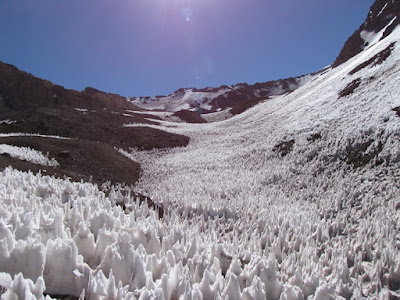
Penitentes: What’s Hidden In The Ice?

This week, one of our first year MSc students, Madeline Walters, considers the recent discovery that penitentes (pictured above) extend the altitude range of habitable environments for terrestrial bacteria. What implications could this have for other planetary environments within our solar system on the cusp of habitability?
[ Image Credit: dreamX ]

By Madeline Walters

One way to look for life beyond Earth is to see in which extreme conditions life already exists. Spread over the high altitude, extremely cold and arid wilderness of the Atacama Desert in Chile, are strange ice formations which may be important for future investigations of life beyond our planet. A study led by researchers from the University of Colorado Boulder found that these spire-like formations, called penitentes, act as a home to microbial life forms. This discovery is important for astrobiological research and implies that life may be able to form elsewhere in the solar system in similar extreme conditions.

Snow algae is commonly found in icy areas in the cryosphere, however, not so commonly at extreme elevations in hyper-arid environments. The harshness of these environments show life can form in extreme temperatures and altitudes, environments which are similar to areas on other planets in the solar system. Structures similar to penitentes found on Earth have been identified on Pluto, and perhaps on Jupiter’s moon Europa (currently a heavy debate), which points out the possibility they could exist elsewhere in the Solar System as well. In order to see if we can find similar formations on planets such as Mars, where similar extreme conditions exist, we have to understand how penitentes form.

Incoming solar radiation hits areas of lower density snow, which causes melting and sublimation-the process in which a solid directly transitions to a gas without passing through a liquid state. Once the sublimating areas begin to form, these bowl-shaped depressions which are made of very reflective ices concentrate the incoming light at the center of the depression, self-illuminating and deepening the depressions. It is within these formations that life can be found hiding from the sun.

In March 2016, Steve Schmidt, a microbial ecologist at the University of Colorado Boulder, and his team discovered red smudges on meter-tall penitentes at an elevation of around 5,300 meters. After analyzing DNA sequences of these red smudges, it turned out the samples matched that of snow algae Chlamydomonas nivalis, which was previously found living in extreme conditions on Mount Kilimanjaro, the Swiss Alps, and Antarctica.

This algae was found to be red due to the color acting as a protective barrier for the organisms-it helps to reflect some of the incoming radiation, which is re-emitted and warms the surrounding area around the algae creating liquid water. The discovery of this life living in such an extreme environment poses an important question- does this mean life can form in similar conditions off-planet? Knowing the limits and extremities in which this kind of life can exist is important for answering that question. How much radiation can this algae withstand, and to which altitude and temperatures can they survive? Although penitentes have not been conclusively found on Mars, we can model their formation on the planet using what we know about how and where they form, as well as our knowledge of Mars’ atmosphere and climate and its dust and ice interactions to perhaps one day conclusively find these structures, and perhaps more, beyond Earth.

To learn more:


UC Boulder study article:
https://eos.org/articles/microbes-spotted-on-blades-of-ice-high-in-the-andes 

Europa Debate:

Reply to: Penitente formation is unlikely on Europa | Nature Geoscience

Tuesday, November 30, 2021

Applied CS & Space Science Research: An Undergraduate Perspective

 
One of my favourite parts of working in a research group is the opportunity to bring together a diverse set of students. Such a group has a tendency towards creative thinking that generates unexpected insights which propel our work forward. Not to mention the shear fun of working in this kind of an environment. In the past, we've had space engineers, geologists, physicists, atmospheric scientists and former history, political science, music and photography majors. Recently, Vennesa Weedmark, a Computer Science undergraduate here in Lassonde joined our lab. Read about their reflections on the experience below.
(Image via: https://www.csecoalition.org/what-is-the-typical-computer-science-curriculum/ )
 
by Vennesa Weedmark

As an undergraduate computer science student, the push to get an internship and/or co-op has always seemed paramount – partially because experience is “everything” in the industry and partially because an alternative avenue, a position working on a project in a research lab, for example, is rarely discussed. While I don’t deny the practicality of gaining experience in a corporate setting, a scholarly approach provides different kinds of challenges that in turn may allow broadening of a student’s horizons – an opportunity for creativity and a different take on problem-solving skills. 

Having started very recently in PVL, I was surprised at the reaction of many of my fellow CS students, who didn’t even realize that working on projects under the supervision of our professors was possible. Making the revelation even more fascinating was that my pursuit of a research assistant position was in a field outside our collective major discipline.

In a field as diverse as computer science, where we are constantly assured that the possibilities are endless, it would seem almost unremarkable for an adventurous CS student to pursue a scientific area in which they are interested under the umbrella of a research lab. The case for research assistant positions as an internship/co-op type of work experience is further strengthened by the science breadth requirement baked into our degrees; the possibility of working in a lab may encourage students who might otherwise see those courses as unnecessary to the industry. Taking my experience as an example: I have always been interested in programming in a scientific context but taking physics courses as part of my science-breadth requirement encouraged me to gain a deeper understanding of the type of field in which I might be interesting in working. As I’ve progressed through the years, I realized my curiosity went beyond the data-analysis discussions I've had in a classroom setting, which in turn led me to search for a way to pursue a deeper involvement in astrophysics-flavoured data analysis. 

These kinds of positions give an entirely different perspective when learning and applying computer science – creativity, responsibility, and communication skills (all valuable points on a resume) are given equal weight alongside coding ability and language skills. My current role at PVL is an excellent example of this: by analyzing a series of photos (read data) taken of the Martian surface, we hope to find evidence of triboelectricity. To do this, I am writing scripts to mask sources of light which can then be applied to the images; thus, allowing only those points of light relevant to the analysis to shine through. The creativity part comes in the use of 3rd party libraries: since only the end goal is known, and there is no guarantee that the supplementary code we are relying on will work in this case, errors become even more mysterious – were they the result of an error in the code itself, or in one of the many imports that are being used? How do you go about understanding code that may be based on incomplete or incompatible libraries? In applying our knowledge to our schoolwork as undergraduates, many examples of very similar problems are easily found online – in research, that foundation upon which to fall back, if it exists at all, is significantly reduced.

I in no way mean to diminish the importance of the concepts and methodologies we are taught to manipulate at the undergraduate level; these are just as necessary for the problem-solving process that is at the core of research. The elation of solving a problem is further heightened when there is no one on the other end with the answer and those intuitive leaps that are nigh impossible to teach in a classroom setting are, in my limited experience, the core of learning to code in the context of scientific analysis.

Tuesday, September 7, 2021

Head in the Martian Clouds: a Research Update

 
As Conor mentioned a few posts ago, just because a mission ended in the past doesn't mean that all the useful science from that mission has been extracted. This week, Grace tells us about some research she has been completing applying new models to old data in order to make new discoveries. I have a particular affinity for this kind of science. Truly, it justifies the investment made to keep a record of all data returned from other planets and to make that data available to anyone with a theory to test. In a way, it reminds me of the curation of returned samples, only a fraction of which are consumed by the planned laboratory testing once they are returned to Earth. A portion of each sample is held back, waiting for future questions, theories and experimental techniques to be invented that will unlock mysteries unknown to present-day planetary science. The Image above of the Phoenix Lander at Green Valley, Mars is credited to Corby Waste (NASA/JPL). This image was created prior to landing and therefore is missing the periglacial features that were seen at the actual landing site. It's based off a famous image from a previous rover.
 
By Grace Bischof 

Over the past couple of weeks, I have been wracking my brain to come up with a good topic to write about for my round of the blog post. I realized I am now just shy of my first-year anniversary as a PVL member (where did the time go!?). With a little experience under my belt, I figured it would be a good time to finally give an update on the research I’ve been doing over the last year – and especially the past 8 months. Since I had no classes to worry about, I could dedicate the majority of my working hours to my project. 

The project I’ve been working on was originally assigned to me with a need for a project to work on from home. My initial project – MAGE – which I briefly talked about in my introductory blog post last year, is all lab-based. Obviously, with multiple lock-downs and very limited access to campus, I have not been able to work on MAGE. Thus, the Phoenix project was born. 

To start, the Martian atmosphere is very thin, and has a weak greenhouse effect compared to Earth. The daily temperature on Mars is essentially mediated by visible-band radiation coming in from the sun, where it is absorbed by the surface, then re-radiated back into space as thermal radiation. Aerosols in the atmosphere – in the form of dust or water-ice particles – can produce a secondary effect on the temperature. Water-ice particles scatter a portion of the incoming solar flux and, importantly to this project, absorb and reflect outgoing longwave flux. This increases the thermal radiation at the surface, which can increase warming.

This work is dubbed “the Phoenix project” because it is based on the Phoenix mission, which landed on Mars in 2008. The Phoenix lander was, and still is, the most northern-based lander on Mars, where it was equipped with instruments to study the local meteorology and water cycle in the Martian polar region. Phoenix operated for 150 sols, beginning at the end of northern Spring, and carrying through summer solstice into the mid-summer. During its mission, Phoenix made many detections of water-ice clouds, fog, and made the first observation of water-ice precipitation on Mars.

So, how does this all relate? Well, while the LIDAR and camera onboard the lander captured important information about the clouds near Phoenix, these instruments could only operate for a small fraction of the entire mission length. On the other hand, the temperature sensors on the lander made near-continuous observations for the entire mission, measuring the atmospheric temperature every 2 seconds. Since we know that clouds can have an effect on the temperature, by modelling the atmospheric temperature at the Phoenix site, we can create a full record of the cloud activity.

Building the cloud record involves using a surface energy balance at the location of the lander. This includes all energy flux components that will influence the temperature, such as radiative effects of dust in the atmosphere. The energy balance contains one parameter, R, which is solely attributed to the flux reflected by water-ice clouds. The ground temperature is modelled using a subsurface conduction scheme involving various regolith properties, and the atmospheric temperature is found by an equation involving the ground temperature and the sensible heat flux. R is then determined by comparing the modeled air temperature to the air temperature collected by the temperature sensor aboard Phoenix. If the temperatures are a perfect match, R = 0 over the entire run, and it is assumed no clouds are present. Otherwise, the temperatures are matched by varying R on 2-hour intervals within the model. 

Completing this analysis for every sol of the mission builds up a continuous picture of the reflected flux throughout the mission. The reflected flux can be related to cloud properties such as optical depth and ice-particle radius. This is the portion of the project I am currently working on. I believe this project has helped strengthen my research skills, as the methods went through several iterations in the beginning and we had to work through many problems that were occurring. While this isn’t the project I was given initially, I have really enjoyed the time I’ve spent working on the Phoenix project and my enthusiasm for Martian meteorology has really grown.

Tuesday, June 22, 2021

Mars is made of Swiss cheese


If the Moon is made of Green Cheese, then what cultured dairy confection makes up Mars? Why Swiss Cheese, of course! This week, Alex takes us on a tour of the pitted south polar terrain of Mars whose interplay of sunlight, water and carbon dioxide ices result in something that looks visibly similar to Swiss Cheese. Naming planetary terrains after food is not new, nor is it limited to the inner solar system. If you were putting together a platter of hors d'oeuvres, Cantaloupe makes an excellent accompaniment to Swiss Cheese. Perhaps we will have to take a closer look at Neptune's moon Triton in the future...

By Alex Innanen

Long-time PVL blog enthusiasts may recall that my planetary journey began at the Martian north pole looking at many, many HiRISE images. Over the past year I’ve returned to the Martian poles – the south pole this time.

Both poles have layered deposits of mostly water ice and dust, and residual water ice caps left behind when the winter layer of CO
2
ice sublimates in the summer. The south polar residual cap (or SPRC for the acronym fans) is mostly made up of carbon dioxide ice as well, overlying water-ice. The terrain of the SPRC is as varied as the North pole, but has some features that are unique to it. One of these are circular or circular-ish pits with steep sides and flat bottoms. The terrain they carve out is similar to a piece of Swiss cheese, giving the features their nickname. 

The distinctive pits of Swiss cheese terrain, from the HiRISE instrument.
[NASA/JPL/University of Arizona]

In Swiss cheese – the kind you can eat – the distinctive holes are formed by carbon dioxide bubbles that are released by the cheese-making bacteria. The Swiss cheese features of the SPRC are much larger than the ‘eyes’ in a piece of cheese – on the order of tens to a few hundreds of metres in diameter. No bacteria are forming these holes, instead they’re likely formed from fractures in the residual cap, which are widened into pits through sublimation from their walls. In the southern spring and summer, the steep, dark sides of the pits get more sunlight than the flat floors, causing the walls to sublimate and grow outwards by a few metres per year.

If the pits grow large enough, they can even grow into each other, creating intricate, branching features that can cover large swaths of the residual cap, like you can see in the HiRISE image here. It’s been suggested that based on this rate of growth, every century or so the entire SPRC could be entirely carved out by Swiss cheese features, causing a total resurfacing. 

[NASA/JPL/University of Arizona]

The Swiss cheese features occasionally show more ephemeral features such as bright, surrounding halos or dark fans emanating from higher standing areas. There’s a fairly clear halo around the feature shown at the top of this post – sometimes nicknamed the ‘Happy Face’. It looks almost like the feature is glowing, but what we’re really seeing is a localized region of higher albedo (i.e. more white) surrounding the Swiss cheese feature. These halos have only been observed during the Southern summer of Mars year 28 (2007, for Earthlings), and their appearance happened to follow a global dust storm. It’s likely, though, that these halos aren’t actually a ring of material getting lighter, but rather the SPRC as a whole getting darker from settling dust, except in the areas close to the pit walls. The mechanism that was proposed to explain this in a 2014 paper, is that the sublimation from the pit walls that I discussed above raises the amount of CO2 in the atmosphere and pushes the settling dust from the storm away from the edges of the pits. Lower rates of sublimation on flat areas allow the dust to settle normally.

The dark fans are much smaller and harder to pick out of even HiRISE images – on the scale of 1-10 m². They tend to appear at the edges of high-standing areas, ‘fanning’ into the lower areas. They appear in the southern spring, and unlike the halos they have been seen over multiple Mars years. Moving into the summer, as CO
2
ice sublimates, the terrain around the fans darkens until the fans disappear. Their formation is also much more exciting – they’re formed when jets of gas rupture through the CO
2
ice layer, lifting dust and depositing it outward in the fan shape. Dust can then get trapped in layers of ice, making it darker, absorbing more sunlight, and leading to more sublimation, creating more trapped gas to explode out and create more fans.

Until now I’ve been talking about CO
2
ice which makes up the majority of the SPRC. But what about water ice? The polar layered deposits are composed mostly of water ice and dust, and in the Southern summer the SPRC shrinks and exposes some of the water ice of the south polar layered deposits. It is possible that the flat floors of Swiss cheese pits also expose water ice in the summer. There have been detections of water vapour associated with the pits, but this could also be from their walls, which could be layers of CO
2
and water ice. In either event, the work I’ve been doing looks as if it is possible for the water ice in the Swiss cheese pits to have any appreciable contribution to atmospheric water vapour. The polar caps are the major source of surface water ice, and the yearly formation and retreat of overlying CO
2
ice, exposing water ice, drives Mars’ water cycle. I’m interested in finding out how much, if any, water vapour could be released from the Swiss cheese pits, and in the event of most or all of the SPRC being removed by Swiss cheese pits, whether this could have a significant impact on the amount of atmospheric water vapour.

Sunday, June 13, 2021

Modelling the atmosphere of K2-141b: June update


A model of a planetary environment doesn't spring forth in all of its detail. Typically we start with the simplest model that captures the essential physics, but which also leaves out important details. Sometimes the description of such a model even fits on the back of an envelope! We then build in the complexity piece by piece. This is a process that PhD student Giang has been pursuing over the past couple of years as his models of K2-141b becomes ever more sophisticated. At each stage, we learn something new as we proceed from a solution accurate to a particular order of magnitude, to a 10% level solution to a 1% level solution. There is benefit in the complexity - but it's important not to outrun the data by too much. If we make a prediction or add a minor process that cannot be verified through the data, we run the risk of inventing stories about these worlds that are mere delusions.

By Giang Nguyen

In my previous post, I showed what happened when I introduce UV radiation absorption to K2-141b’s atmosphere. The results from the model went bizarre as the atmosphere kept heating up to essentially become plasma. Although numerically sound within our mathematical construct, this ultra-hot atmosphere simply isn’t realistic as that would make the atmosphere on the planet even hotter than its star.

As I suspected, there was an issue with how I dealt with radiative cooling. The original way for the atmosphere to cool would be exclusively through infrared emissions. Although most of the energy does radiate in the infrared wavelengths, the emissivity of silicon monoxide in that spectral range is very small compared to UV light. Therefore, there is some UV emission that is unaccounted for that would significantly cools the atmosphere.

The solution to this problem is to separately calculate the blackbody radiation of the atmosphere in both infrared and UV. This is done by integrating the Planck function over the desired wavelength range and multiply it with the corresponding emissivity. Here’s the thing with blackbody radiation, especially for hot temperatures of thousands of kelvins. Most of the radiance comes from a very small sliver of wavelengths, and it is pretty much negligible in comparison at every other wavelength. Therefore, when you have low spectral resolution, the estimate of the radiance becomes very inaccurate once you do your integration.

My next step was to do the Planck integration separately solely as a function of temperature with adequate spectral resolution and then to fit that integration to a polynomial. As the integration process now becomes a single line of calculations instead of a bunch of for loops, we’re back to our old speedy model. However, we are at the mercy of our fit coefficients and it seems that our temperature range is too large for a polynomial fit to be accurate; note that our temperature can range from 0 – 3000 K.

All hope seemed to be lost. I was going to have to run the slow model which I estimate will take weeks to pump out a solution, which might not even be correct solution. Thankfully, some scientists in the 1970s ran into the same problem and were able to solve it themselves. When you integrate the Planck function by parts, you end up with an infinite sum (a little bit of math identities is needed here as well). Computing this infinite sum is much faster than the classic way as this sum converges much faster. Finally, with the Planck finite integral taken care of, we can deal with radiative cooling.

As expected, UV emissions capped the temperature of the atmosphere – but it was still hot. The temperature hovers around 2900K across the dayside almost uniformly. Because UV emission only becomes significant when the atmosphere is hot, it never forces the temperature to drop further at low temperatures. When UV absorption and emission cancel each other out at a specific temperature, a very stable sort of radiative balance occurs. This turns out to be important as the atmosphere becomes too thin for IR radiation to take effect.

A warm SiO atmosphere is expected, but for it to be so horizontally consistent and warmer than the surface is a surprise. A welcoming surprise. For emission spectra, a warmer atmosphere means a brighter signal. Using SiO spectral features, we could ultimately see K2-141b’s atmosphere instead of the ground beneath it. Also, the scale height is thicker, even near the terminator (where on the planet you would see the star on the horizon). This means that during a transit, the planet’s atmosphere is optically thick enough to absorb the star’s light that travels through that atmosphere on the way to Earth. With supersonic winds, this might induce an observable Doppler shift when measuring K2-141b’s transmission spectra.

Ultimately, when considering UV absorption and emission, the atmosphere on K2-141b is easier to detect, for either low-resolution and high-resolution spectral instruments. This is very good news as K2-141b is slotted for observation time with the James Webb Space Telescope (JWST). Along with possible future observations from ground-based telescopes, we may definitively detect and characterize K2-141b’s atmosphere - a first for terrestrial exoplanets.

This concludes my update for my current research project. Using a convenient numerical method to evaluate definite Planck integrals, we solved the problem of dealing with K2-141b’s atmospheric radiative cooling. The resultant atmosphere with the full radiative transfer is almost uniformly hot across the planet’s dayside. This suggests that K2-141b’s atmosphere is a lot easier to detect than anticipated. This is exciting as K2-141b is a high valued target for observation, and it might be the first terrestrial exoplanet where we have observed an atmosphere. Although a small step, it is still a step towards finding habitable worlds and life beyond the solar system.