Showing posts with label Public Outreach. Show all posts

Sunday, October 8, 2023

Two Weeks in Killarney

Outreach is a key component of what we do at the PVL. So when PhD student Conor got the chance to serve as the Astronomer in Residence in Killarney Provincial Park they jumped at the opportunity.
Above: The Sun setting over the Killarney Provincial Park observatory.

by Conor Hayes


Earlier this summer, I spent two weeks at Killarney Provincial Park, located four hours north of Toronto, as part of the Astronomer in Residence (AIR) program run by the York Observatory. The AIR program is very new, having started just last year. I had considered applying last year, but ultimately decided against it given that I was very busy writing up my Master’s thesis at the time.  With that not being a concern this summer, I submitted an application to the program that was successfully approved. I had originally planned to head up to Killarney at the beginning of the summer, but that plan was foiled by me catching COVID for the second time three days before I had planned to leave. Although I felt normal by the time I was supposed to start, we decided to delay my term as AIR out of an abundance of caution.

My actual responsibilities as the AIR were not very heavy. Over the two week period, I was expected to help the park staff run six events: two public talks, two solar observing sessions, and two nighttime observing sessions. This schedule meant that I had a lot of free time to explore the park and the town of Killarney itself, which is about a 15 minute drive from the park. I got a lot of hiking in, which is something that I haven’t been able to do much of since moving to Toronto in 2020. The trails in the park were a bit more challenging than those I was used to, as they involved a lot of climbing up and down steep rock formations. The challenge was always worth it though, as I’d get stunning views of the surrounding area, including Georgian Bay and the La Cloche Mountains.

[Figure 1: Looking out over Georgian Bay from the Chikanishing Trail.]


Heading into the program, I was expecting that the public talks would be the most straightforward part of my time there, since I’ve given several in the three years that I’ve been here at York. The observing sessions were a little more intimidating because I haven’t done much visual astronomy recently and I wasn’t certain how well I’d be able to talk about the sky itself and point people around at interesting objects that they can see just by looking up. Instead, it very much ended up being the opposite.

Part of the reason for the difference between my expectations and reality may have been the fact that this was the first time (other than my Master’s defence) that I was giving talks in-person, rather than online. The mood of the audience can really make or break your confidence, and I was really challenged during my first talk (on our Curiosity cloud observation campaign) by the fact that it began at 8 PM, well after the Sun had set. This meant that I couldn’t actually see the audience at all, so it felt like I was just speaking into a void. The second talk, about the history of the search for lunar water, was almost derailed by a thunderous downpour that broke open the skies about five minutes after I started, but we gathered everyone under the roof of the amphitheatre stage, which turned it into a more intimate classroom-style presentation rather than a public talk given to a large space full of people.

The observing sessions were very different than the public talks. Obviously I did point out things on the sky like various constellations as well as Jupiter and Saturn, but they were more of an opportunity for people to ask me questions about whatever astronomy-related topics they were interested in. I had been expecting this,  but I will admit that I was a little worried that three years of focusing on a very small and specific set of subjects for my Master’s and the first year of my PhD had degraded my general astronomy knowledge. However, this didn’t seem to be the case, and the several hours I spent both weeks talking to visitors about any astronomy-related topics that they had on their minds were honestly probably the best parts of my AIR tenure.

While I did enjoy all of my interactions with the visitors and park staff, the real reason why the AIR program is hosted in Killarney is that it is a certified dark sky site, far away from any major population centres (something that you become acutely aware of when you realize that the nearest large grocery store is an hour away in Sudbury). Although I had been to some fairly dark sites (e.g. the Green Bank Observatory in West Virginia), I had never seen the night sky look like it did in Killarney. The familiar constellations, which are about all you can really see in Toronto, were drowned out by the sheer number of other stars. On several occasions, I just had to lie down on the ground and stare up at the Milky Way stretching itself across the sky. One thing that really surprised me was the number of satellites I could see during the night. In Toronto, it’s easy to see the ISS, but you’ll never really see any more than that. In Killarney, I would see one steadily marching across the sky about once every ten minutes for an hour or so after sunset.

[Figure 2: Close-ups of the Moon as seen through the Killarney 16-inch telescope, named Kchi Waasa Debaabing, Anishinaabemowin for “Seeing very far (as the eye can see).”


At night, when I wasn’t either staring up at the sky in awe or holding public observing sessions, I was engaging in astrophotography using the on-site 16-inch telescope. The weather during my time as AIR was phenomenal with only two nights clouded out, so I was out at the observatory every night, often until 2 or 3 AM. I came in with exactly zero astrophotography experience other than occasionally taking a photo with my phone’s camera through a telescope’s eyepiece. With 6+ hours of practice almost every night for two weeks (plus more than a few phone calls with Bruce Waters, the father of the AIR program), I improved quite dramatically, as can be seen below.

[Figure 3: Top row – views of Saturn and Jupiter at the start of my time in Killarney. Bottom row – Saturn and Jupiter again, now with two weeks of astrophotography practice.]


Having been back in Toronto for about a month now, there are some conveniences that I definitely missed up in Killarney, like cheap(er) groceries that I can walk to and cell service that’s better than a single bar of 3G connectivities. However, the sky here now looks depressingly bright and empty at night. If the AIR program continues into its third year, I will almost certainly be headed back to Killarney in the summer of 2024.

If you want to see more of the photos I took in Killarney, check out the AIR blog at https://www.yorku.ca/science/observatory/air/astronomer-in-residence-blog/

Sunday, May 29, 2022

Science is for all of us!


 This week on the PVL Blog Post, MSc student Ankita talks about citizen science, a way by which anyone can participate in scientific research and discovery.
Image Above: YorkU Galaxified Generate your own text at: http://writing.galaxyzoo.org/

By Ankita Das

Being someone who developed a keen interest in science at a very early age I was always looking for new ways to learn and contribute to the science happening in the world. By the time I was in my early teens, citizen science projects were my favorite way to spend time when I was not involved in academic work. I spent my winter of 2010 sending my friends and family a personalized season’s greetings. Except, there was something special about these messages – the text was “galaxified” using GalaxyZoo’s special tool where each letter was a galaxy from the Sloan Digital Sky Survey (SDSS). These were the little ways I would incorporate space into my daily life. But my love for science at that age went beyond generating cute galaxified texts.


Citizen science is often someone’s first introduction to hands-on science. Personally, my first citizen science projects were in Galaxy Zoo and Planet Hunters by Zooniverse. The Galaxy Zoo project involved classifying galaxies into categories by looking at its shape - something even a child can do but holds valuable science behind the activity. A lot can be revealed about a galaxy just from its shape. For example, an elliptical galaxy is usually an old galaxy where no active star formation takes place and spiral arms in a galaxy imply a rotating disk of stars. The shape classification were according to Hubble’s classification scheme shown in image 2.


Image 2: Hubble’s Classification Scheme for galaxies (Source: Wikipedia Commons)

Apart from classifying galaxies imaged by SDSS, my other favorite go-to project involved looking at light curves from distant exoplanets being discovered by Kepler. Kepler’s launch in 2009 marked the beginning of some very exciting exoplanetary science which continues till date. The task at hand was again simple: to look at the brightness of a star over time and determine if there are any periodic dips in the brightness indicating the possible presence of an exoplanet around the star. The excitement I felt as a young teenager “analyzing” data from a telescope launched just a year before, possibly discovering new alien worlds was unparalleled. Participating in citizen science initiatives back then gave me a sense that I was doing something important for the scientific community even as a kid. 


Image 3: Example of Planet Hunters task
(Source: https://www.zooniverse.org/projects/nora-dot-eisner/planet-hunters-tess)

Citizen science has become an important facet of research in the scientific community today with it having evolved into more creative and interesting projects as new troves of data are generated. Citizen science projects can range from activities as simple as locating constellations with your naked eye monitoring light pollution (Globe at Night) to projects that involve amateur astronomers, photographers, and programmers equipped with certain level of hardware or skill to carry out the science. In this way, citizen science involves diverse groups from our society ranging from kids to amateurs to take part in various citizen science initiatives. For the younger section of the public, citizen science projects can become their introduction to scientific projects whereas it can be a leisure activity for the relatively senior members of our society. To me, citizen science initiatives are a powerful and effective tool for scientific outreach. Not only do members of the public learn about the science that is being carried out, they also actively contribute to it, developing a deeper interest over the years in such projects. Irrespective of the diversity in participation, one thing remains the same, all these groups contribute to our growing scientific knowledge about the world around us. 

But can the general public really contribute to the cutting-edge fields in science from their homes or backyards? Yes of course! Over the years, citizen science has churned out an interesting list of discoveries which have made it to scientific journals after being reviewed by scientists. One of the most notable discoveries in the field of space science which comes to mind is the discovery KIC 8462852 or more colloquially known as Boyajian’s star (named after Tabetha Boyajian, other names include Tabby’s star and WTF star). In 2015, citizen scientists who were part of Planet Hunters came across a star exhibiting odd levels of dimming (22%). Upon closer inspection by astronomers, the object’s odd behavior continued to baffle them leading to many people calling it by its nickname – the WTF star which is apparently a reference to the paper’s subtitle: “where’s the flux” (very misleading nickname, I know!). Scientists came up with various hypotheses to explain the star’s observed light curve which included possibilities of obstructions around the star occurring from a ring, planetary debris, or dust clouds. More farfetched hypotheses included the presence of large-scale artificial structures around the star being responsible for the unnatural dimming of the star’s brightness, hinting at the existence of intelligent civilizations. Scientists continue in their attempts to fully understand this bizarre star and hence Boyajian’s star is still being studied and monitored by subsequent telescopes and projects. 

I think most of us would agree science has changed a lot since ancient times. Science which started off as independent endeavors taken up by philosophers centuries ago today presents a different picture. The days of sitting under a tree and pondering on the mysteries of the universe and scribbling down equations are long gone. Most science carried out today is in large groups, relying on observed and measured data retrieved from instruments such as telescopes, particle accelerators, and robotic spacecraft. Hence, a huge amount of data is generated and will continue to be generated as next generation telescopes come into operation. Citizen science initiatives are a fantastic way of tackling this big data problem astronomy and space science is to expected to face soon. Thus, citizen science is not only valuable for outreach but also valuable in processing huge chunks of data and making meaningful contributions to the scientific community. A complete list of active and inactive citizen science projects in all scientific fields can be found at: https://en.wikipedia.org/wiki/List_of_citizen_science_projects

Read more at:
https://www.zooniverse.org/projects/zookeeper/galaxy-zoo
https://www.zooniverse.org/projects/nora-dot-eisner/planet-hunters-tess
https://www.darksky.org/globe-at-night-2021/
https://science.nasa.gov/get-involved/citizenscience/five-extraordinary-citizen-science-discoveries
Boyajian’s star discovery paper: Planet Hunters X. KIC 8462852 - Where's the Flux? Available at https://arxiv.org/abs/1509.03622

Wednesday, March 9, 2022

So Long and Thanks for All the Clouds


As the saying goes, everything that has a beginning has an end. Many students in my lab have had the opportunity to work on the Curiosity mission over the last ten years and it has been one of the great joys of my career to see those students grow into capable and confident colleagues trusted by their peers the world over who work with them on the mission. But, inevitably, students complete their degrees or move on to other projects and opportunities. For Charissa Campbell, a PhD student who has been working on the mission since 2016 she has an opportunity to lead the science case for an instrument called MAPLE that could contribute to Environmental Science in a future planetary mission.
(Animation Above: the sun sets at Gale Crater on Sol 312 of the mission)

By Charissa Campbell 

Over the past 5 years, I’ve been a part of the Mars Science Laboratory (MSL, Curiosity) team, specifically the Environmental working group (ENV). The ENV team is responsible for managing any environmental observations which includes any cloud or dust devil imaging. During my time with the group I got the opportunity to help plan several sols (Martian day) of operations. This includes advocating for different ENV observations that are used to characterize the environment around Curiosity’s location, Gale Crater.

Our research group helps maintain different ENV observations that use the Navigation Cameras (Navcams) to observe atmospheric aerosols. This includes the Zenith Movie (ZM, an eight frame movie observing movement directly above the rover), Supra-horizon Movie (SHM, an eight frame movie looking above the horizon), Line of Sight (LOS, a single image capturing the crater rim), Phase Function Sky Survey (PFSS, 9 three frame movies observing aerosols at a variety of pointings) and Cloud Altitude Observation (CAO, 2 eight frame movies intending to capture cloud and shadow motion). The first three (ZM, SHM, LOS) have been a part of the mission for several Mars Years (MYs) and are great for monitoring cloud and dust over the course of a MY. The PFSS and CAO are on the newer side and are only performed in the cloudy season. The most recent cloudy season just finished and now we are preparing for the dust season which brings increased dust and dust-devils in the crater.

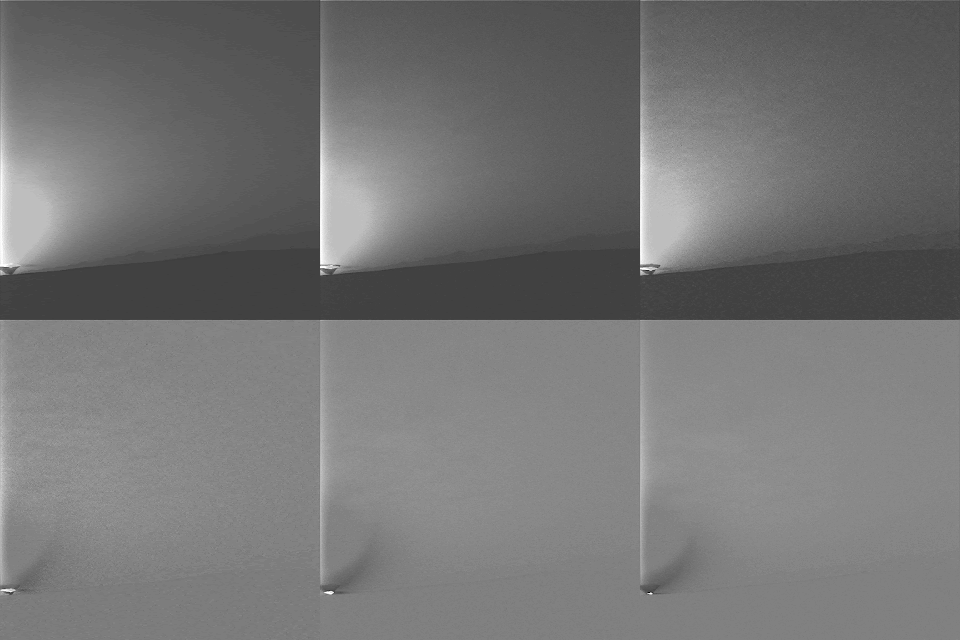
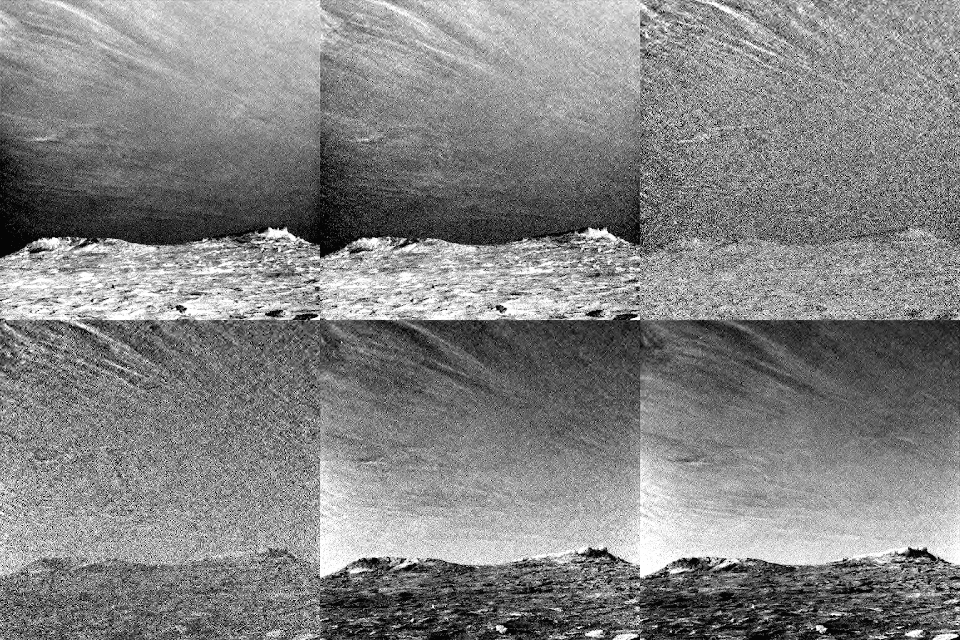
When I first started on the mission, I helped maintain the cadence of the ZM and SHM. This includes advocating their cadence (every 2-3 sols) and keeping an eye out for any aerosol activity. The cloudy season on Mars is very consistent year to year so it is relatively easy to predict when we’d expect to see more activity. Coming up to my first cloudy season, I found a pair of early morning movies that captured wispy clouds like Mares’ Tails seen here on Earth (shown below). The uniqueness and beauty of these clouds earned a press release (https://mars.nasa.gov/resources/8866/clouds-sailing-overhead-on-mars-enhanced/?site=msl). Since I was still fresh on the mission, I was excited and anxious for the opportunity. It received plenty of press and I enjoyed reading the various comments left by the public.


Over the next few years I continued to advocate for ENV observations but I was also given the opportunity to help develop a new observation. On sol 1787 a Dust-Devil Movie (DDM) was aimed at Mt. Sharp (Aeolis Mons) and instead of capturing dust-devils, it observed shadows moving across the mountain. This was caused by clouds moving overhead which was confirmed by the ZM that followed. A DDM pointed at Mt. Sharp posed a unique opportunity to measure the direct velocity and altitude of the overhead clouds by determining how fast the shadows move with respect to the mountain. Digital Terrain Models (DTMs) have been created for Mars which provide an x, y, z coordinate for every point in Gale Crater. By noting where on the mountain the shadow starts and ends between the first and last frames, a velocity can be calculated. When a paired ZM is used to calculate the angular spacing and velocity of the clouds above, we can get the velocity and altitude of the clouds. Typically, this parameter is found using a lidar which was demonstrated by the Phoenix lander (https://www.nasa.gov/mission_pages/phoenix/images/press/Lidar_Fall_Streaks_SD_001.html). However, Curiosity isn’t equipped with a lidar so we must use alternative approaches to calculate altitude.

Taking what we learned about the DDM and ZM combination, we went ahead and created the CAO. Within this parent observation is the Cloud Shadow Movie (CSM) and ZM. The CSM would be the DDM but optimized to bring out shadows. This includes increasing the frame size for more mountain coverage. This frame size was also applied to the ZM. Once the CAO was optimized , it was tested on Curiosity before becoming an official observation that the ENV team can plan. As of today, we have officially completed 3 MY worth of CAO data.

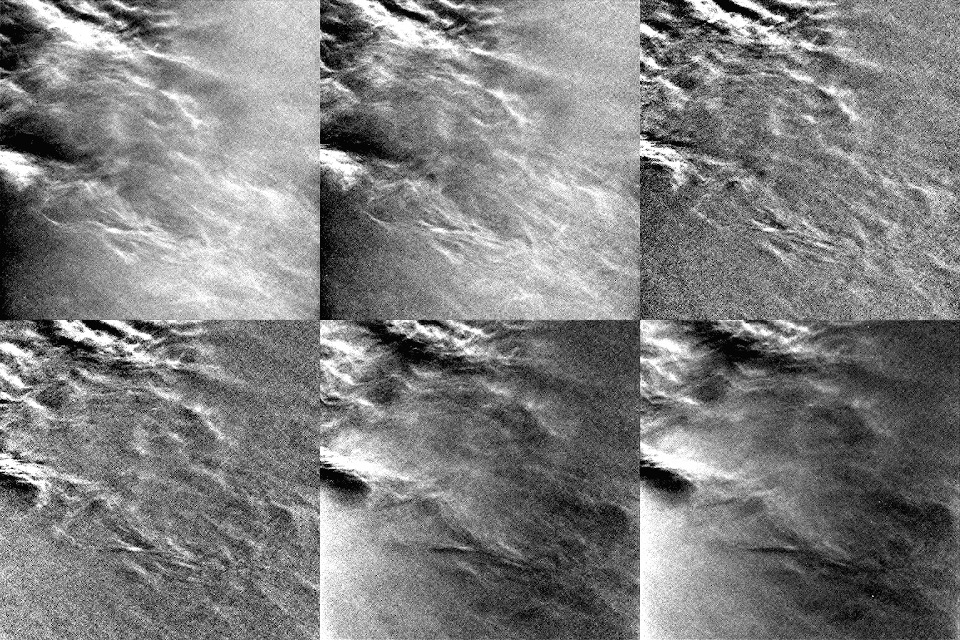
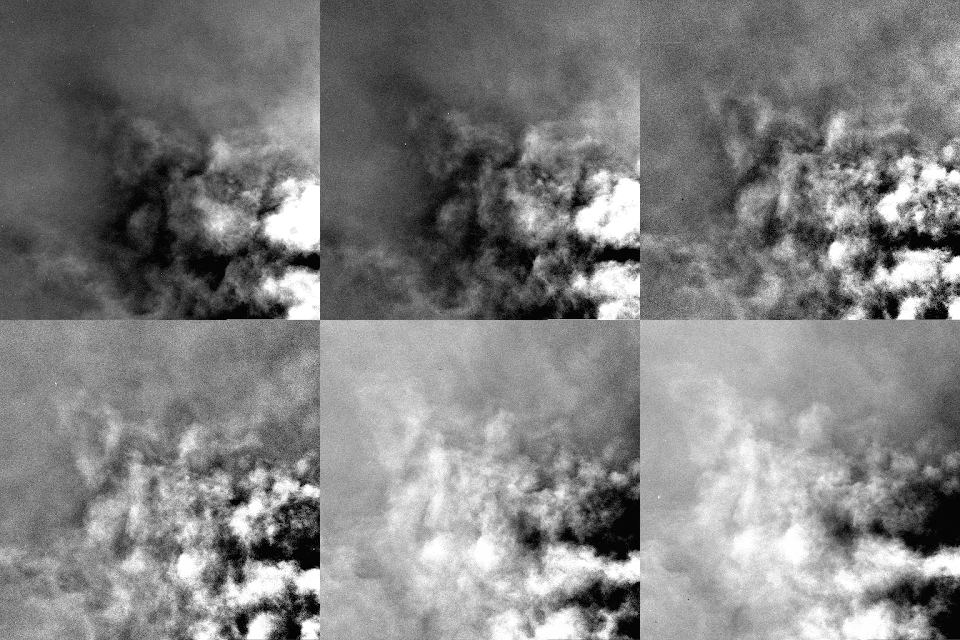
Analyzing the most recent set showed a unique pair of shadow and clouds that were not seen before in a CAO. Shown below, both movies show turbulent clouds with large shadows that pass over the rover before going up the mountain. I decided to showcase this set at the most recent Curiosity team meeting where I showed my cloud altitude results. The movies seemed to be a hit that they became a press release  (https://mars.nasa.gov/resources/26557/curiosity-captures-drifting-clouds-on-dec-12-2021/?site=msl). It made me extremely happy to have another set of movies released by JPL. I will be leaving the Curiosity team in the next few months to focus on my other PhD projects, so it is bittersweet to start and end my time on the mission with a press release.


It’s been a great honour to work with Curiosity data and especially help develop an observation that will continue to be captured in future cloud seasons. I want to thank the Curiosity team and all the current and past PVL members that have helped me. Good luck Curiosity! I hope you have many more cloudy seasons on the horizon. 

Friday, February 19, 2021

SpaceX, Starlink, and the Commercialization of Space

This week, masters student Conor Hayes tackles a thorny issue: how to balance the expansion of private actors in space and the benefits their work can have for those of us on earth with the needs of astronomical research. It's not inconceivable that such an expansion could change the night sky forever, not just for scientists working with sensitive instruments, but also for most of the world's city-bound population for whom a starry sky could be replaced by criss-crossing lights. Must we give up wonder to achieve a better life for each another? Image: 19 Starlink satellites unintentionally imaged by the Blanco Telescope at the Cerro Tololo Inter-American Observatory. (CC BY 4.0, NOIARL/CTIO/AURA/DELVE, https://nationalastro.org/news/starlink-satellites-imaged-from-ctio/)

by Conor Hayes

One of the consequences of the way that our economic systems are structured is an ongoing competition between public and private interests to exploit various resources. This competition rolled through astronomical Twitter like a bowling ball through a set of pins in November 2019, when the image above first made its way onto the internet.

Taken using the Victor M. Blanco 4-metre telescope at the Cerro Tololo Inter-American Observatory in Chile, it shows 19 bright streaks caused by a train of Starlink satellites passing through the telescope’s field of view. Unsurprisingly, this greatly reduced the quality of the data, leading to widespread concern about the long-term impact of Starlink on astronomical observations.

The mere fact that Starlink satellites are visible in telescope imagery isn’t the problem. Outside contamination of CCD images is nearly inevitable with a long-enough exposure time. If you ever get a chance to look at raw data from a telescope, you will probably see similar, though shorter, bright streaks caused by cosmic rays impacting the detector. Furthermore, artificial satellites have been occasionally ruining images for as long as there have been a significant number of them in orbit. So what is the problem then?

Part of what concerns astronomers about the Starlink constellation is the sheer number of satellites involved. SpaceX currently has authorization to launch 12,000 (!) Starlink satellites, and has submitted paperwork to approve another 30,000 (!!). For comparison, the United Nations Office for Outer Space Affairs currently lists about 10,400 objects launched into space since 1957. When the constellation is completed, the number of visible Starlink satellites may even outnumber visible stars in heavily light-polluted areas like Toronto. Given that the constellation is intended to surround the Earth at many different orbital planes, having a small handful of Starlink satellites streak across your telescope’s field of view may become a regular occurrence.

In addition to antagonizing astronomers who work in the optical, the development of Starlink has also worried radio astronomers. Ground-based radio astronomy is already hard enough thanks to the fact that many of our modern-day technological conveniences are constantly blasting radio waves into the environment. Consequently, much like how optical telescopes are located in dark areas away from major population centers, radio telescopes are often surrounded by “radio quiet zones”, large swaths of land where radio emissions are strictly regulated. But when those radio sources are passing overhead, as the Starlink satellites will be, those radio quiet zones may become significantly louder.

If nothing else, the conflict over Starlink shows how vital it will be for the scientific community and private businesses to communicate with each other to find a mutually beneficial way forward. Though SpaceX is now looking into ways to make their satellites less bright, including darker paint, sunshields, and shutting off transmissions when passing over radio quiet zones, these kinds of after-the-fact adjustments are not sustainable in the long term. Though I personally find the commercialization of space somewhat distasteful, I also recognize that as the barrier to entry gets lower, thanks in large part to the innovations championed by companies like SpaceX, it is almost inevitable that commercial interests will want to spread outward. Because astronomers have held a near-total monopoly on space for so long, learning to let other people in will be a difficult process, one that will require sustained, genuine cooperation from all interested parties.

I didn’t start writing this post with the intent to argue for the termination of the Starlink program. It’s a difficult needle for me to thread because on one hand, I am an astronomy grad student whose future career could be hindered by a poorly-managed privatization of space. On the other hand, I recognize that SpaceX’s goal with Starlink is an admirable one. The past year has demonstrated how global access to reliable, high-speed internet is now more of a necessity than a luxury, and demanding that Starlink be shut down just because of the challenges it presents for astronomy would be irresponsible and short-sighted. This goes both ways, of course. It was incredibly disheartening to scroll through some of the replies to the original tweet and see how many people were calling ground-based astronomy little more than a vanity project with no real worth to humanity (Elon’s tweets dismissing astronomers’ concerns out of hand and telling them that they were overreacting certainly didn’t help, either).

Though I don’t have any concrete solutions right now, it seems increasingly likely that, as is the case in so many other areas of our society, the responsibility for dealing with the monumental shifts in the way that the private and public spheres interact with each other beyond Earth will ultimately fall upon the next generation of astronomers currently working their way through their undergraduate and graduate educations. I do believe that we can eventually strike the right balance, but I hope that time comes before unregulated, antagonistic competition severely damages our ability to look up at the sky and wonder what lies beyond our home.

Friday, November 27, 2020

Mars’ Family of Rovers

In this week's post, Grace discusses the different rovers that have been to Mars in response to a query from her sister. One of the most important things we can do as scientists is to translate the excitement and meaning of what we do for the public. (above) Image credit NASA/JPL-Caltech.

By Grace Bischof

A few days ago, I received a text message from my sister asking for a fun space fact to tell the 5-year-olds she teaches who are “super into space”. I thought about all of the interesting things I’ve learned since joining PVL, from both my own and other lab members’ work, but was pretty certain that the seasonal variation of methane on Mars might not be very interesting to young children. Having just finished shadowing my first MSL shift, I had the Curiosity rover on my mind. I realized that Curiosity has been roaming the Martian surface for longer than the kids in her class have been alive. I told my sister to explain to the students that Curiosity is older than them; they might not have found it a very fun fact, but I sure did.


So what other rovers are there on Mars, and how old are they? Let’s work from youngest to oldest.


Assuming the landing goes to plan, the Perseverance rover should touch down in Jezero Crater on February 18th of 2021 as part of the Mars 2020 mission. If the age of the rover starts at landing, Perseverance might still be considered a zygote rover. Regardless of its infant age, Perseverance is set to be the largest rover to touch down on the Martian surface. Weighing in at 2260 lbs, Perseverance is approximately the size of an SUV. Perseverance is equipped with 7 instruments and has the ultimate goal of searching for signs of past or present life on MArs.


Curiosity is the second youngest rover that is currently on Mars. Landing on the red planet in 2012, Curiosity is set to reach its 3000th sol in early 2021. Curiosity resides in Gale Crater and has traveled more than 21 km in its 8 years of operation. The MSL mission had 8 main objectives, which largely centered around determining if Mars was ever hospitable to life. The rover is equipped with 10 instruments, including the Rover Environmental Monitoring System and the Sample Analysis at Mars, which help to understand the meteorology and atmospheric gases on Mars, respectively. Curiosity’s many cameras have captured interesting Martian features, such as the major dust storm in Martian Year 34. In its 8 years on the planet, Curiosity has been an indispensable asset to understanding the habitability of Mars.


Leaping back 17 years, the twin rovers, Spirit and Opportunity, landed at separate locations on Mars in January 2003. Smaller than Perseverance and Curiosity, the twins are about the size of a golf cart. Spirit and Opportunity are the fastest rovers to roam mars, moving at a neck-breaking speed of 0.16 km/hour. Primarily, Spirit and Opportunity were to identify rocks and soil from the Martian surface. Though originally planned as a 90-sol mission, Spirit traveled the dusty plains of Mars until May 2009, when it became stuck in soft soil. Attempts to free Spirit from the soil were carried out for 9 months, but were eventually abandoned. Spirit acted as a stationary instrument until it lost connection to Earth in March 2010. Opportunity stayed active until June 2018, losing its signal to Earth after its solar panels were covered in dust from the MY 34 dust storm. Opportunity holds the record for most distance traveled on a non-Earth world, having driven a total of 42.2 km during its 11 active years. 


Opportunity: Planetary Marathoner. The Opportunity rover has covered more ground than any other rover on an extraterrestrial surface.
Credit: NASA/JPL-Caltech - https://mars.nasa.gov/resources/6471/driving-distances-on-mars-and-the-moon/


The oldest rover to land on Mars is called Sojourner, and landed on the planet in July 1997 (which makes Sojourner older than me by one year). Sojourner is much smaller than its younger siblings, resembling a microwave-oven in size. Carrying only 2 instruments, Sojourner took hundreds of pictures of the Martian surface, and sampled Martian rocks and dirt. Sojourner operated for 83 sols, surpassing its original mission by 53 sols. By the end of its lifetime, Sojourner had traveled 100 m.


The family of Mars rovers has been growing since 1997 and is set to become a family of 5 once Perseverance arrives early next year. Through incredible science and engineering feats, we have been able to explore the surface of an entirely different planet from Earth for the past 23 years. I, for one, am excited for the next 23 years of Mars exploration – and maybe by then I can think of a cooler space fact to tell a bunch of 5-year-olds.


For more interesting information on the rovers, see: https://spaceplace.nasa.gov/mars-rovers

Sunday, February 16, 2020

Question Time (Part 2)

Something us scientists love to do is to take questions from the public about the work that we do and the topics that we study. I know that when I give a public talk, the Q&A is almost always my favorite part. This week, Christina holds another such session after the success of her previous post on this topic.

by Dr. Christina Smith

A few months ago (or maybe longer than a few…) I did a post called “Answer me these questions… five?” where I answered questions that people had asked me on social media. Its my turn again to do a post and I thought why not reprise this topic as it was quite fun the first time!

So, without further ado…


Friday, November 29, 2019

Black holes don’t suck!

One of the advantages I feel we have to offer at the PVL is the diversity of experience of our individual members. I purposely recruit Astronomers, Engineers, Geologists, Physicists, Atmospheric Scientists or really anyone who has the interest and is holding a piece of the puzzle we call planetary science. Last weekend, Christina Smith spent some time going back to her roots as part of a panel hosted by a good friend of the lab, Jesse Rogerson of the Ingenium in Ottawa.

By Dr. Christina Smith

I may or may not have mentioned this in a previous blog post, but prior to joining the Planetary Volatiles Laboratory at YorkU, my research was in stellar astrophysics (my PhD and a short post-doc), primarily studying what small dying stars were made of and surrounded by (they have a tendency to shed bits of themselves all over the place). In fact prior to that, I dabbled in theoretical particle physics for a while (my undergraduate Masters’ project – simulating interactions of top quarks at the Large Hadron Collider to try and infer something about the physics of extra dimensions) but that’s a story for another day...

Anyway, a few weeks ago I was approached to be part of a Royal Canadian Institute of Science panel discussing back holes, which though not related to what I do now, is something I am familiar with in the grand scheme of stellar evolution from my PhD and short post-doc. Specifically, they wanted someone nerdy enough to talk about black holes as they are portrayed in popular culture. I am definitely nerdy enough and this was a really cool and interesting topic to talk about (and gave an excellent excuse for a lot of evenings spent in front of my TV binge watching sci-fi movies and TV shows).

I also figured this was a good topic to chat about – a tad outside the norm but I figured that was ok. So, before I delve into the world of black holes in popular culture, I’m going to digress a little into Black Holes 101.

Monday, November 18, 2019

The Rover Exploration Challenge Outreach Program – Want to participate?

Over the past two summers, the PVL has run a youth outreach event at the Ontario Science Centre as part of our work with the Government of Ontario's Ministry of Research, Innovation and Science (now part of the Ministry of Economic Development, Job Creation and Trade). Leading the charge has been PhD Candidate, Charissa Campbell. Today we make those materials broadly available, as we had previously done with the associated board game.

By Charissa Campbell

Every summer our research group demonstrates the Rover Exploration Challenge at the Ontario Science Centre. Over the course of a day, participants plan observations for a simulated rover to achieve certain goals for their respective science group. With the plentiful experience in mission operations within our lab we were able to successfully create this outreach program to educate anyone on the true conditions needed to maintain and do science with a rover on another planet.

A new opportunity rose this year for the Challenge when we were invited to showcase it at the Space Educators Institute (SEI) at Western University. SEI educates Ontario science teachers on astronomy related topics. This was the perfect opportunity for us to take our Challenge further and apply it in classrooms. We were able to modify the program so teachers could take the Challenge back to the class and educate their students on rover mission operations. Since this package has been set-up to be shared easily, we wanted to try to extend the offer to anyone that is interested. This blog post will explain how you could run the Rover Exploration Challenge for friends, families or in a classroom.

Friday, September 27, 2019

Rover Exploration Challenge: The Boardgame for Outreach

As part of our work under my Early Career Researcher Award grant from the Ontario Ministry of Research, Innovation and Science, we have been developing outreach materials to share the excitement of space exploration with the public. We've previously run two events at the Ontario Science Centre and now we have created a home version. While you won't find this board game in stores, we've made the game freely available to all. Just download the template, print it out, assemble and enjoy.

by Dr. Christina Smith

So as you may have already read, we here at the PVL have put on an event known as the Rover Exploration Challenge, where members of the public take the role of scientists on a rover mission to the  unknown planet of “Arduinna”, using the “rover” to explore the planet to find out whether it is habitable. If you want to find more about the Rover Exploration Challenge event, take a look at Charissa’s blog post http://york-pvl.blogspot.com/2018/10/a-successful-rover-exploration-challenge.html

After successfully doing this challenge a few times and for a range of audiences, John posed the question of whether there was any way we could package it into something people could take home and play themselves, like a board game. I grew up playing board games with my family and friends (everything from standard kids board games all the way up to seriously long games – and yes I used to lose those a lot) so I took the lead on the conversion.

Friday, August 2, 2019

50th Anniversary of the Moon Landing Blog Post

This week, PVL Undergraduate Researcher Ariella Sapers reflects on a significant anniversary for space exploration: the 50th anniversary of the Apollo Moon landings. Above, a photo of a plaque like the one left on the lunar surface by Apollo 11. And yes, folks, that is Richard Nixon's signature on the bottom (to my knowledge the only politician whose name is written on a monument off the Earth) - it took the efforts of three different administrations to pull off this event.

By Ariella Sapers

With the 50th anniversary of the Moon landing just passing, I thought it was only appropriate to dedicate a blog all about the event and the celebrations that occurred here at York University!

On July 20th 1969, three brave men, Neil Armstrong, Edwin “Buzz’’ Aldrin, and Michael Collins took a leap of faith as part of NASA’s Apollo 11 lunar mission and headed to the moon. The Apollo Lunar Module, The Eagle, landed on the moon at 20:17 UTC in which Neil Armstrong became the first person to walk on the surface of the moon on July 21st at 02:56 UTC. With this walk, human beings had officially walked on the surface of a planetary body that wasn’t Earth. 

Monday, July 29, 2019

The Wonderful Life as Interim Observatory Director of the Allan I. Carswell Observatory

This past year while I was in Australia, PVL PhD student Indiana Jones (I mean, Charissa Campbell - see the photo below the cut below) took on a very unusual TAing assignment in the Department of Physics. But she handled the assignment with grace, growing into the role. She returns to the lab with a new skill-set that I have no doubt will help her reach her graduate student goals.

By Charissa Campbell  
From January till July 2019 I had the great honour of being the Interim Observatory Director of the campus observatory, known as the Allan I. Carswell Observatory. The great Paul Delaney was on sabbatical for 6 months and needed a temporary replacement to maintain the observatory while he was gone. I immediately jumped on the idea when Paul asked me as not only would I gain valuable outreach and leadership experience, but it would allow me the ability to work with telescopes, always a passion of mine.

The observatory houses two telescopes, a 40 cm and 60 cm. This size describes the diameter of the primary mirror in the telescope. The bigger the mirror, the brighter are the objects that you observe, allowing you to see dimmer things that are often farther away. We’ve been lucky enough to be able to get a new telescope with a 1 m mirror, the largest on a Canadian campus (https://www.cbc.ca/news/technology/university-new-telescope-research-1.4287794). It was supposed to be installed December 2018 (before Paul left on sabbatical), but was unfortunately delayed. This is common with important piece of equipment, especially of the astronomy related kind. I will admit that I was a little relieved that the 1 m was delayed until Paul got back as I would have been significantly busier as the telescope would have been in high demand for tours, media, etc. Keep an eye out for when the new telescope is ready! For more information on the different events the observatory does, feel free to check out their website: http://observatory.info.yorku.ca

Sunday, March 3, 2019

Answer me, these questions... five?

I can tell you that as Scientists, we get plenty of questions from all over, in fact learning how to field such questions and to get someone an answer (even if you don't already know!) is a big part of the job. This week, Christina, pictured above, takes some time away from her mission control work to answer some common questions in this space.

By Dr. Christina Smith

This time for my blog post, I thought I’d try a slightly different tack to usual. I often find that I get questions when in social situations about science-y or space-y or astronomy-y... things. So, I thought I’d open up the floor on social media to Solar System questions which I would then answer (or attempt to answer) in this blog post. And here we go!

P.S. In the discussion below, I have taken lots of information from papers and sources rather than pulling the information out of my own brain so the references are there in brackets and refer to the full links at the end in case you want to take a gander!

P.P.S. this was quite fun to do and I might do it again, so if you have any questions add them in the comments :)

Tuesday, October 16, 2018

When you tweet and the Universe tweets back...

Engagement with the public is an important activity for us here at PVL. Many would think about this largely as a one-way street with scientists preparing materials for public consumption, such as a presentation, a documentary or a book. But it's always a richer experience when you're having a two-way conversation, as Christina describes in this week's Blog post. Sometimes the level of engagement displayed by that response can be surprising! Note that the photo above is a word cloud she made from some of the jobs respondents are currently doing (sizes randomly assigned).

By Dr. Christina L. Smith
 
One of the things I think is important as a scientist is making sure that not only the scientific community knows of your work (and general existance) but also that the wider public is able to engage with you and your research, when appropriate of course. As my previous posts (i.e. poetry in science and the Rover Exploration Challenge) show I particularly enjoy getting involved in public engagement in a variety of formats!

A couple of months ago, I was invited to give a presentation at a “Future Women in STEM” (STEM = Science, Technology, Engineering and Mathematics) day held at York University, talking about my personal experience as a woman in STEM. I realised that, although there were a large number of very interesting presentations and activities on the agenda, mine was the only one revolving around someone’s personal experience in a science field. I’m also very aware that STEM careers are far, far broader than my own personal experience.

Saturday, October 6, 2018

A Successful Rover Exploration Challenge

In late July, PVL's "Rover Exploration Challenge*" came to the Ontario Science Center. There we shared a little bit of what we do in planetary space exploration with 400 members of the public over two days. Charissa (center of photograph), along with Christina, worked tirelessly to ensure the success of this event and we're already talking about repeating it next year! Look for our DPS abstract in a few weeks time which will describe what we learned from all of you in the course of designing and carrying out this simulation. And on a timely note, congrats to Charissa on the successful defense of her MSc thesis. I have updated her tag in this article accordingly.

By Charissa Campbell


Another day, another successful run of our outreach program for rover operations. With now four completed runs, we can successfully say that we have explored multiple styles of outreach. Our most recent run in late July (see Christina’s blog post: http://york-pvl.blogspot.com/2018/07/rover-exploration-challenge-at-ontario.html) was labelled the Rover Exploration Challenge and was significantly different from previous runs. Located at the Ontario Science Centre, participants were visitors that were free to drop into the program during the start of every iteration or planning day. Multiple planning days were carried out, building off the previous iteration. This allowed multiple measurements to be taken throughout the rover’s traverse path. Both Saturday and Sunday’s runs had the same traverse path, but measurements differed based on the participants planning. 

Tuesday, July 24, 2018

Rover Exploration Challenge at the Ontario Science Centre (July 28th and 29th 2018)

PVL is running a rover mission control simulation at the Ontario Science Center on July 28th and 29th. Everyone is invited to come, visit and participate as we explore a mystery planet! For more information, over to Dr. Christina Smith.
(Image taken from: https://spaceplace.nasa.gov/mars-curiosity/en/ )

by Dr. Christina L. Smith


You may (or may not) have noticed that Mars is looking a little brighter than usual at the moment. And from July 27th-30th it will actually be the brightest it has been since 2003! Mars is currently approaching opposition where the Sun, the Earth, and Mars are all in alignment. This happens roughly every 26 months and this one will happen on July 27th. Closely related to this is the closest approach of Mars to Earth – this time it happens four days later on July 31st. To celebrate Mars’ proximity and opposition, a number of events are happening around Toronto (and beyond) this week to let you observe and learn about Mars and just generally bask in the glory of The Red Planet’s awesomeness.

As part of this, some members of the Planetary Volatiles Laboratory are putting on an event at the Ontario Science Centre this coming weekend (July 28th and 29th) called the Rover Exploration Challenge. This is a drop in event where participants can experience what it’s like to be part of a team trying to explore another planet. They’ll be divided up into three science groups, each of whom have a different set of science goals to achieve in a limited amount of Rover Science Time. Every Rover Day, lasting about half an hour, a different team will come in and will be given a Mission Briefing to show them what kind of science they can do. Afterwards, Science Leads will take them through everything we know so far relating to their science goals – what we know, what we don’t know, what they can do to help complete the mission.

The first decision the Mission Team will need to make is whether they want the rover to drive. Each drive allows the rover to explore a new area, but the rover can’t go back to explore a place it’s already been so they have to make sure they have done everything they might want to do before moving on!  Different Science Groups have different goals, which may influence whether or not they want to drive and in this team, democracy rules so if the majority says a drive is “Go!” then that’s what will happen. So if one group needs to stay put or needs to drive, they need to persuade the other science teams that that’s what they should vote for.

After the drive decision, the different Science Groups need to decide what they want to study and when during the Rover Day. There’s atmospheric measurements, water tests, ground tests, and imaging available to take with the rover, and different sites could be very different from one another so it’s important to test these at different locations along the Rover’s Exploration Path. After they’ve decided what they want the rover to do and put it into the Rover Plan, it’s time to check the plan, upload it to the rover, and wait for the results to come back. But there’s always an element of risk when using the rover: observations could fail, drives could fault, or the whole rover could shut down...

Friday, March 30, 2018

2000 Sols on Mars: What Goes Into Documenting Another World?

The second in our two-part series on Curiosity's 2000th Sol on Mars. In this article Brittney takes a look at the public reaction to the day and reflects on choosing that perfect image to commemorate the occasion, in this case from an observation she herself designed, planned and ran on Mars! What goes into producing that top line image? Read on to find out. You can read the first article, written by Charissa Campbell and talking about operations, by clicking on this link.

By Brittney Cooper

Mars Science Laboratory (MSL), better known as Curiosity Rover, celebrated its historic 2000th sol on Mars last week. 2000 Martian days equates to roughly 3 Martian years, which has allowed the rover a great deal of time to traverse Gale Crater. Along the way, the science team has used MSL to analyze Mars’ geology, all the while monitoring the atmosphere and its processes as the seasons change each year.
To celebrate this historic occasion, the BBC published an article featuring a collection of images captured by the rover throughout its journey. It turned out that a triptych of images taken as part of an observation I proposed were selected to be included in the article. It was really cool to see them alongside others in such a large outlet. An unexpected (but positive) result of those images being published came in the form of discussions with friends and family about what my actual role was in the capture of those images.

Tuesday, January 23, 2018

Getting the Amazing Opportunity to do Outreach with the Ontario Science Center

As part of our work on the Ontario Ministry of Research, Innovation and Science's ERA program, we've been developing innovative ways to communicate rover operations to the public. Earlier this month we tried out a test of one of our events at the Ontario Science Center. Leading the charge was PVL MSc Charissa Campbell.

by Charissa Campbell


In my opinion, science outreach is one of the most important aspects of any public program. You get to teach people of all ages and can even encourage them to pursue science as a career. So, when our research group first discussed putting together an outreach program for high school students that would be like mission operations for a Martian rover, I was immediately on-board. Some of us are currently members of Curiosity’s mission operations team (including myself) so it was great to take that knowledge and adapt it. I’ve personally engaged in outreach programs in the past and still do on a regular basis with my young siblings, so I was excited to also be a part of this, especially in more of a leadership role. 

If you are curious about our May 2017 outreach program, you can check out Brittney’s great blog post: http://york-pvl.blogspot.ca/2017/05/analog-rover-missions-more-than-just.html. This was only the first of two successful runs in 2017 with varying levels of complexity. We knew changes had to be made from the first run, so we decided to broaden the roles and meetings to ensure participants didn’t get lost in the complexity. This did not, however, fix all of the issues from the first run.  Instead, we now had the opposite problem: the roles had become too broad. In the end, we identified the major problems with the program and made edits averaging the first and second run. Now in 2018, we have successfully completed a third run with volunteers at the Ontario Science Centre.

Sunday, July 2, 2017

The Exploration of Eboracum Planitia


This week, PVL Postdoc Christina Smith reflects on the youth outreach activity we completed in late may as part of our Ministry of Research, Innovation and Science Early Career Researcher Award. Both we and our guests had a great time and it's never too early to start thinking about next year! Image taken from: https://spaceplace.nasa.gov/mars-curiosity/en/ .

By Christina Smith

On May 27th, as per Brittney's blogpost, we at the Planetary Volatile Laboratory held an analog mission day for upper high school and undergraduate students. Missions like this, aimed primarily at education and outreach as opposed to technological proof-of-concepts, simultaneously give students a taste of what being part of a science operations team for a real-life rover mission is like as well as being fun for those involved. I had never participated in a rover analog mission, but when I was in high school in the UK, I had the chance to be part of a “Voyage to Mars," where we took the place of a crew traveling to Mars and I still remember it vividly (and fondly) to this day – especially the part where the oxygen tank sprung a leak and yours truly was in charge of life support for the mission... I hoped that the students coming to participate would enjoy their time on their first mission as much as I did on mine.

Wednesday, May 24, 2017

Analog Rover Missions: More Than Just Acting Out Your Childhood Dreams

 
PVL Undergraduate Student Brittney Cooper (right) driving the MESR Rover (left) in the Canadian Space Agency (CSA) Mars Yard following the end of a 2 week long analog mission put on by the Centre for Planetary Science and Exploration (CPSX) at Western, in conjunction with CSA, in 2014.   This weekend, students from the Toronto area will get their own opportunity to participate in a model or 'analogue' space mission.

By Brittney Cooper

      In just under a week, PVL plans to host its first analog rover mission on May 27th. It’s a one-day event for upper year high-school students, and I will be the acting “rover”. Don’t laugh, this is not my first analog mission but it is however my first one acting in the role of a robot. While each mission has its own unique goals and desired outcomes, the overarching reason for conducting this type of exercise lies in education, training and outreach.
      Acting on a real-life mission is a unique experience, and it is not easy to know what to expect based upon the experiences you’ve had in previous jobs or in other areas of your life. Analog missions serve as a great tool to train and provide examples of the operation processes, hierarchy and protocol. You get the opportunity to understand how important science decisions are made and rationalized against data and power constraints of your rover or spacecraft. It’s a unique opportunity to gain insight on how hundreds of people are able to work together to design a mission from the beginning. This includes formulating the science outcomes and payloads, and then actually acting out the structured long-term and tactical planning that is carried out regularly, to achieve those outcomes. 

Friday, May 19, 2017

Public outreach reminds scientists of the bigger picture

PhD Student Casey Moore prepares to give an hour-long public presentation at a meeting of the Toronto-Center Royal Astronomical Society (RASC). He is now the third member of the lab to do one of these talks in this venue!

by Casey Moore

A few months ago I was asked to give a public lecture to an audience of amateur astronomers – noting that they would probably enjoy hearing about my work with the Mars Science Laboratory (MSL). I agreed – hesitantly, as I have never given such a talk. The event went off without a hitch and was a nice introduction to giving a talk to the broader community where not everyone is a specialist in planetary science.

For those interested, a brief summary of what I discussed can be found at: http://rascto.ca/content/speakers-night-speaker-announced-2 , as well as a rather unflattering outdated photograph of myself.