Friday, April 25, 2025

The Art of Collaboration

I can't emphasize this enough: Science is a team sport! Collaborations are key to all that we accomplish at PVL. Often, the effort of trying to develop a better understanding of our solar system can be difficult or frustrating. Working with others not only makes this more fun and social, but those connections can often get you unstuck or send you down a path of discovery you didn't even know existed. All it takes is the right conversation to spark something new! Above: A view from the Nydeggbrücke, a 19th century bridge over the Aare that connects the old and new parts of Bern.

by Conor Hayes

I’ve now been with the PVL for almost five years. In that time, I’ve really come to appreciate the power of a collaboration, particularly with people outside of the lab. I first got a taste of this following the annual meeting of the Division for Planetary Sciences (DPS) in 2022. There, I was presenting some of the work that I had been doing as part of my Master’s thesis. In that work, I was examining how small-scale terrain may influence surface temperatures in the Moon’s permanently-shadowed regions (PSRs) in ways that we can’t currently observe from orbit. To do so, I was using a “Gaussian rough surface” to represent the interior of a PSR. While Gaussian roughness is a decent model for planetary surfaces over smaller regions, it’s a simplified model as it ignores larger structures like craters.

After my presentation, I got a DM on the conference’s Slack workspace from David Minton, an Associate Professor in the Department of Earth, Atmospheric, and Planetary Sciences at Purdue University. In his message, he told me that he had been developing a Cratered Terrain Evolution Model (CTEM) that can create realistic lunar terrains at small scales, and asked if I would be interested in collaborating. Over the next several months, we merged his CTEM outputs with my illumination and temperature models to create a paper that was significantly better than the version that was in my Master’s thesis.

This past February, another collaboration offered a new experience to me. During my PhD, I’ve been spending a lot of time looking at the transport of volatile molecules like water across the lunar surface. One of the more popular models for doing so assumes that molecules undergo a series of thermally-driven jumps across the surface until they are either destroyed or trapped by cold temperatures. The temperature required for one of these jumps to begin is determined by a parameter known as the “desorption activation energy.” It is arguably the most important component of the model, but its value is not well understood, particularly if you want to look at molecules other than water.

There are several ways that one can attempt to determine the value of a molecule’s activation energies, but nobody at PVL has the expertise or the equipment necessary to do so. We could just use the values in the literature while making note of their limitations, but I didn’t feel like that was the right approach. Instead, we’ve been working with Liam Morrissey and his team at Memorial University on molecular dynamics (MD) simulations of desorption, which can be used to estimate the activation energies for various molecules on different surfaces without having to put together a complex experimental setup.

As part of this collaboration, I was invited to participate in a workshop at the International Space Science Institute (ISSI) in Bern, Switzerland. This workshop was the first meeting of ISSI’s Multi-Scale Understanding of Surface-Exosphere Connections (MUSEC) International Team. At this point in my graduate career, I’ve been to many conferences, so I thought that I knew what I was getting into. It didn’t take long for my expectations to be proven entirely incorrect.

What rapidly became apparent was that a workshop is a much more collaborative environment than a conference. Rather than a rigid schedule of short talks and even shorter Q&A sessions, each presentation was more like a conversation between all the attendees. About half an hour was given to each person, not because they were expected to speak for that long, but to give ample time for discussion during and after each talk.

I had been worried because I was coming in without many actual results. Instead, the presentation I had prepared was mostly a listing of open questions that I would like to address in the final version of my model. Not exactly the kind of content that would attract much attention at a conference, but I had been assured that it was appropriate for a more informal venue such as this one. Still, I was haunted by the ever-present specter of imposter syndrome, particularly as a last-minute addition to a group of people who were already familiar with each other.

After the week’s agenda had been updated to include me, I noticed that 45 minutes had been allocated for me. Before I began, I joked that I we would definitely be taking our afternoon coffee break early, as I couldn’t imagine a world in which my set of questions could possibly consume that amount of time. As it turns out, if you start listing unanswered questions in a room full of people with the expertise to answer those questions, it inspires a lot of discussion. I was told afterwords that my presentation was exactly the kind of content that this workshop had been designed to focus on, which was very reassuring to hear given my initial uncertainty about whether I should be there at all.

Outside of the workshop itself, the MUSEC leadership made an effort to foster a sense of community with group lunch and dinner outings, which allowed everyone to get to know each other outside of our work. It didn’t take more than a day or so before I stopped feeling like an outsider. Bern itself is a beautiful city, and I hope to be able to explore it more during the next in-person MUSEC workshop next year (if writing my dissertation isn’t consuming too much of my time by then!). 

 The aftermath of a successful workshop: a completely inscrutable whiteboard.


Thursday, April 17, 2025

Rodeos and Regolith: A Week at LPSC 2025

The PVL crew at LPSC 2025 in The Woodlands, Texas. From left to right, we have MSc students Milena and Abby followed by PhD students Conor and Alex. There's nothing like your first scientific conference! (I still remember LPSC 2004 fondly.) Below, Milena Markovich, one of our new MSc students reflects on their experience this past March.

 by Milena Markovich

Running through Toronto Pearson Airport a punctual three hours before my flight, I could hardly focus on where I was going. Making my way through security, I placed all my items and luggage on the conveyor belt, running on autopilot. My mind was racing with anticipation, a perfect storm of excitement and anxiety. When I finally arrived at my gate, I double checked the display by the desk – destination: Houston, Texas. I settled into my seat and began some last-minute marking before I would eventually arrive at the Lunar and Planetary Science Conference. 

Once Abby arrived at the gate, we began discussing the conference in an excited flurry. What would it be like? Would our poster sessions go well? Which sessions and speakers were we most excited for? In a coincidence which perfectly exemplifies the small world of planetary science, sitting across from us was a former colleague of our supervisor: Dr. Livio Tornabene. After some friendly conversation, I asked Dr. Tornabene if he had any advice for a first-time conference goer like myself. His advice echoed in my mind for the entire week ahead – remember to take breaks, there’s so much going on that you can’t possibly “do it all”.

Although this was fantastic advice, after my first day at LPSC 2025 I realized I would certainly have a problem following this piece of advice. Sitting in on sessions exploring the icy moons of Jupiter, the minerology of Mars and astrobiology, I knew this was a learning opportunity of which I could not miss a single second. What followed was a week of 7AM mornings, quick jogs across the Macy’s parking lot to make it to the first session of the day, and long evenings spent meeting other graduate students, exploring The Woodlands and even Houston.  

The welcoming nature of everyone I met was a warm embrace into the planetary science community. In Texas of all places, so far from home and campus, I encountered other graduate students from York University. Through quick chats between sessions and social bar nights with loud “cheers!” going around, I gained a deeper sense of community. I met other students and scientists from across the world – offering friendly conversation at lunches, fascinating discussions about their research and helpful doses of career advice and mentorship.

In between the lecture presentations, bonus workshops and poster sessions I spent many hours walking the canal by the conference hotel with lab-mates, exploring local restaurants (failing miserably to order a sufficient amount of barbecue for three people), even managing an excursion to the Houston rodeo. From experiencing Cracker Barrel for the first time or exploring the wacky food booths at the Houston rodeo with my newfound friends, I gained so many wonderful memories outside the conference hall. This attitude of never saying “no” to a restaurant, extra session, or fun field trip allowed me to develop friendships with York students I had hardly seen around campus, and with other scientists from across the country, continent and world.

Thus, it seems I went directly against Dr. Tornabene’s advice. That is certainly not to say that his advice was not perfectly sound – however, as a first-year graduate student surrounded by the passionate, excited and welcoming nature of this community for the first time, this advice seemed equally impossible for me to follow.

Following discussions of LPSC 2025 being the last LPSC conference in this capacity, I knew I had done the right thing by trying to soak up as much of the experience as I possibly could. While career paths can be winding – starting and stopping at different destinations than we may expect – my time spent immersed in the planetary science community has been both professionally fulfilling and has provided me with many treasured moments with friends. I am so grateful that I had the opportunity to participate in this conference, both by presenting my research at the poster session and absorbing all the fantastic work being done in planetary science, while building meaningful relationships and connections within the community. 

Throughout my week at LPSC 2025 I learned much more than I could have hoped. From presentations on the geophysics of Mars and icy moons to lunar volatiles and minerology. Of equal value, I learned what a country steak is, had fried okra for the first time and experienced the epic highs and lows of a Texan rodeo. At the end of the day, there are indeed times when we all make the mistake of not following perfectly good advice. Returning home from Houston exhausted, yet full of knowledge, inspiration and fond memories, I’m glad I made that mistake.

Sunday, March 2, 2025

A Niche Conference?


 Being at a conference is like being thrown in the deep end; it's like drinking from a fire-hose; it's so unlike anything else in academia that water-based analogies just don't describe it accurately! It's an even more impactful experience if we're talking about your first scientific conference or your first time diving into a new field where unexpected connections can be made (e.g. discovering a new kind of Phoenix!). This week, Kevin shares his experience of attending a planetary science conference with a narrow scope: the 10th Mars Conference.

by Dr. Kevin Axelrod

Back in July of this past year (which is 2024, for those of you reading this in the future), the Planetary Volatiles Laboratory of York University traveled to Pasadena, California to attend and present at the 10th Mars Conference, hosted by Cal Tech and organized by USRA. This conference is not held every year, usually just once or twice a decade and therefore had some big-shot attendees from NASA’s Jet Propulsion Laboratory and elsewhere. In total there were nearly a thousand participants.  Given that it talks about the study of a single non-Earth planet in the universe, I considered it to be niche - something that is highly specialized, highly technical, and extremely important to some but obscure to many.

So, coming from an Earth-oriented atmospheric sciences background (I got my Ph.D. in atmospheric sciences, and my research focused on bioaerosols) at first, I found it very difficult to fit in.  In just about every single conversation, (including with graduate students, who are supposedly “less experienced” than a postdoc) I found myself to be the least experienced participant. Typically, the other person did 99% of the talking, and, when responding to someone, I would just say stuff like “Okay”, “Hmm… interesting”, “I see”, “Alright, sounds good”, and “Cool”. I had difficulty contributing meaningful thoughts to conversations because I simply did not know enough.

I immediately noticed something in an opening plenary given by one of the keynote speakers, someone highly experienced that I would think of as a “big-shot.” In his presentation, he discussed a measurement technique and the missions that have performed these measurements. Then, in the question session, a member of the audience playfully ridiculed him for not including a shout-out of the Phoenix lander for a similar measurement that it had performed.  He genuinely apologized, stated that he is a “big fan” of the Phoenix lander, and that its exclusion was an oversight.

Meanwhile, I sat there thinking: “Hmmm… Phoenix.  To me, Phoenix is a city in Arizona, a bird in Harry Potter, and the mascot of a professional ultimate frisbee team based in Philadelphia (above).” Don’t ask me how I somehow know that third one. 

This was one of many instances where I felt like I should have signed up to be the guy filling the water coolers instead of an actual presenter. Other scientists there seemed to know every single Mars mission like the back of their hand – something that I should study more.  People there knew all the important (and more obscure) studies, both legacy and recent.  

Niche conferences are nothing new to me: back in 2023 I attended a conference called the International Conference on Carbonaceous Particles in the Atmosphere, at Berkeley. There perhaps 150 participants (given its small size, John might call this a “workshop”, not a conference), and the title said it all.  Carbonaceous Particles in the Atmosphere was the only topic discussed.  I did my Ph.D. on bioaerosols, so my research fit in perfectly with this conference, and there were many other scientists there who were also doing work on bioaerosols.  

I talked with these people like we were equals: I knew what they were talking about and vice versa.  But, even in a “niche” conference like this, with relatively few attendees and a narrow range of subject material, there were also several presentations that struck me as completely new – things I have not researched before, worked on, heard of, or imagined.  While I vibed with a good number of presentations, there also were many presentations that were so new to me that I was completely lost by the second slide in the slide show – giving me the feeling that I was having at 10th Mars in Pasadena. Even in a conference where I have a good grasp of much of the research, there was still plenty of research that made me feel like a “newbie”.

Remembering this conference, I now realize that there may not exist a conference that is too niche. Even when narrowing down the range of topics, science is still extremely broad, and even more extremely detailed.  Because of this, I find it difficult to call myself an “expert” in a broad field like atmospheric sciences, even though I have a Ph.D in this topic.

So, 10th Mars reminded me of something critical: the most important skill in a scientific career isn’t knowing everything there is to know in a field. It is the ability to push outside of your comfort zone and learn new things. Even though you may have a Ph.D, you can never stop being a student. Even though 10th Mars was perhaps a bit uncomfortable for me (because of my relative lack of experience in the field compared to other participants), I learned more material in those four days than maybe I ever had before in a four-day span.

The message of this blog post is this: I would highly recommend all early-career scientists to not just attend conferences in your field of expertise, but conferences that are slightly (or more than slightly) outside of your area of expertise. And to be honest, middle- and late-career scientists should probably be doing the same as well. It will challenge you to learn new things, meet new collaborators, and in doing so conceptualize new ideas for research that you may never have had if you had just stayed in your typical lane – the one that you were trained in when you did your M.S. or Ph.D.  

A few final thoughts:
1.    I need to find a way to drag some other members of the PVL out to a conference with more Earth-based atmospheric sciences!  I guess the American Geophysical Union Annual Meeting in Washington DC is a good place to start (three of us were there last year!).
2.    “Phoenix” now includes the name of a NASA Mars lander from 2008 as a definition in my brain-dictionary!

Monday, November 11, 2024

Au Revoir and Until Next Time, my Fellow PVLers

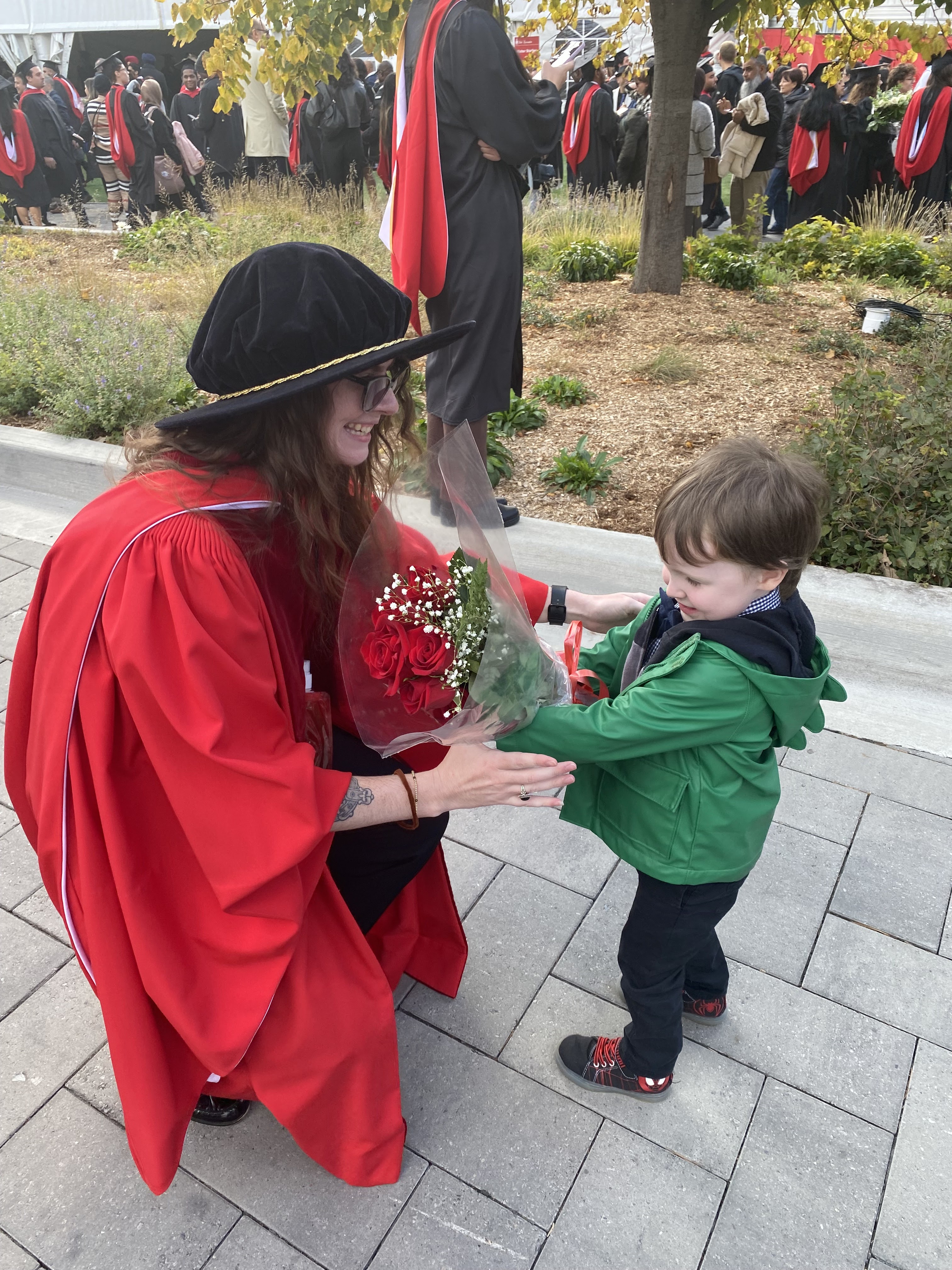
 Dr. Charissa Campbell, at York University's fall convocation with a member of the PVL class of 2050.

by Dr. Charissa Campbell

Well, after many years with the PVL team where I completed both my MSc and PhD, it is time to say goodbye. I just finished my walk across the stage at convocation in mid-October. Even though I may not be there in-person any longer, I don’t feel like my time is fully done with the PVL crew as I’ve made amazing friendships and collaborations. I’ve learned a lot about myself during these times and I am grateful for the opportunity to pursue my degrees with the group and how that work granted me my dream job where I live now, Maryland, USA. I’ve been fortunate enough to land a postdoctoral research position at the NASA Goddard Space Flight Centre continuing work on the Martian atmosphere. But here, I am looking at a unique type of dust storm rather than the clouds I studied at York.


Recently I was asked about my favourite memory with the PVL group and to be honest there were just too many to pick one. My work with the Curiosity team helping to manage environmental operations was high on the list (see: So Long and Thanks for All the Clouds)  but so was developing an outreach event for the Ontario Science Centre (see: The Rover Exploration Challenge). All the travel I got to do to places like Geneva, Switzerland; Paris, France amid others was where the real networking happened so I could feel like a true Martian with other scientists while also practicing my public speaking skills. I also got the amazing opportunity to visit the Canadian Light Source in Saskatoon Saskatchewan and not only do lab experiments at this amazing facility, but got to brave the -40 C weather that I grew up with and do not miss (see: The Continuing Adventures At the Canadian Light Source). I managed to use all this traveling to complete an item on my bucket list; visiting every Canadian province. I completed this when my colleague, Grace, and I traveled to Newfoundland to complete field experiments for the MAPLE instrument (see: There and Back Again, A MAPLE Tale ). Lastly, my time working on an internship at the Canadian Space Agency was also a big highlight and a dream of mine that I am still in shock in came true (see: Completing an Internship at the Canadian Space Agency).  I could go on and on about the amazing experiments and experiences I’ve had with this group. I’ve had an amazing 20s and now I am ready for my 30s and my career.


Even though I walked the stage in mid-October for my PhD, I actually left Toronto for Maryland back in November 2023. I was able to complete my dissertation revisions while also doing work here at NASA Goddard so that I could ensure a good salary for my family and a new opportunity for them to explore life here in the USA. My son is now in Pre-K in a wonderful school (oh how the time flies by!) in the Annapolis Maryland area and we’ve also gotten lucky at being able to afford a wonderful house with a big backyard with lots of birds and trees. Some of my best work here in Maryland is sitting outside in the backyard with my laptop and enjoying the fresh air. The climate here in Maryland is a lot warmer than what I grew up with in Edmonton, Alberta but I am grateful for experiencing the weather of Ontario to prep me for what we are experiencing here in Maryland. From May till August temperatures were hot and humid like a swamp. However, now in October/November it is very mild with wonderful colours in the tree for Autumn. Last winter was quite mild in comparison to Canadian winters, which felt like a nice change. The one tidbit about Maryland winters that made me laugh is that elementary kids don’t have recess when the temperatures go below 0 degrees Celsius. That is basically all of Canada’s winters, especially where I grew up in Edmonton, so Arthur has gotten lucky! My year here in Maryland has been great and I am hoping to turn it into our long-term home so that I can find some stability for my son and our family while exploring my career.


I feel like I've come a long way in not only being a scientist, but as a person and I’ve learned a lot of lessons and knowledge that I will take with me into the future, all thanks to my time with PVL. Luckily, I am able to keep my postdoctoral position for a longer term if I can keep putting through proposals to convince scientific committees to fund my salary to do research. It can be a bit daunting to have to constantly ask for funding for work but at the same time it allows me to be an individual scientist and try proposing my own ideas. Through learning how to develop experiments, instruments, writing papers, or mentoring others I feel very prepared after my time with PVL to become a true scientist here at NASA Goddard.


Once again, I want to thank the PVL crew (past and present) for the amazing memories and our leader John Moores for creating the opportunities for us so that we can learn and thrive in our individual scientific way. Toronto has been a unique experience for me after having grown up on the prairies in a smaller city, but I am glad I was able to conquer Toronto and the horrendous traffic. I wish everyone the best at the PVL team and I’m sure I will see y’all at the next conference where I will accidentally hang out with you as I feel like I will always be a PVLer.

Thursday, September 26, 2024

Exploring the Unknown: My First Steps into Planetary Science Research at the PVL

Every summer, we host undergraduates in the lab at the PVL and during the year we bring in volunteers to experience what professional research looks like. Today Ella, one of those undergrads, tells the story of their research journey so far!

by Ruella Ordinaria

Last summer, one of York’s monthly email updates featured an article on Dr. Haley Sapers’ expedition to Nunavut to test Mars rover simulations. The words, ‘astrobiology’ and ‘Mars’ immediately caught my attention. Seeing that Dr Sapers was part of the Planetary Volatiles Lab (PVL), I emailed Dr. Moores for potential opportunities to contribute to his lab. I exchanged an exciting conversation with Dr. John Moores and in the fall, I was assigned to help a PhD student, Grace Bischof, with her research on developing a Mars Microbial Survival (MMS) model. Fast forward, I completed eight months as an undergraduate volunteer at PVL and this summer, I received the NSERC USRA from NSERC and the Lassonde School of Engineering. 

Now, what’s the actual science I’m working on, you may ask? The MMS Model estimates the bioburden reduction on Mars spacecraft during the cruise phase and on the surface. The MMS model calculates the quantity of terrestrial microorganisms remaining on a spacecraft's surface as it is exposed to the effects of the most deleterious space conditions. These include high vacuum, extreme temperatures, solar UV radiation, and ionizing radiation such as solar wind particles (SWPs). This is important because when we send spacecraft to celestial bodies like Mars, we want to prevent forward contamination as it can impact future exploration of extra-terrestrial life on Mars.

My enriching, fulfilling experience while doing research at the PVL, along with the challenges that came with it, has allowed me to grow both academically and professionally. The first challenge I faced was my limited background in space and planetary science. When I joined the PVL, I was entering my second year as a Biochemistry major and I barely knew anything about biochemistry, let alone planetary science. Although I still struggle with this knowledge gap, it has become easier to address by learning through literature searches. In addition, I also struggled significantly with programming. Grace’s project, the MMS Model, uses Python for calculations and graphing. While I had previous experience with HTML / CSS and Python through hackathons and self-learning, I had never worked with numerical modeling or data processing before. Familiarizing myself with these concepts was a challenge, and I essentially had to learn from scratch—from graphing to using various Python libraries for modeling. Google and Stack Overflow became my go-to resources. Fortunately, I am surrounded by passionate Mars experts with many years of research experience who are always willing to answer my questions.

Not only did I learn about all the exciting things about microbial survival, Mars, clouds, and the atmosphere, but I’ve also developed many technical and soft skills such as coding, writing, data collection, collaboration, problem-solving, and critical thinking, just to name a few. This invaluable knowledge and skill are something that I would have never formally gained from my degree alone. Engaging in research early on in my academic career has also allowed me to apply the knowledge I’ve learned in the classroom to real, practical research. My interactions with lab members have given me insight into the workload, the highs and lows, and the overall culture in academia, which has helped clarify my career goals and deepened my passion for planetary science and research.

Most importantly, I learned that research is not instantaneous – it is a journey composed of both productive and unproductive days. I learned that some days you might read 10 papers, write pages of words, and run many lines of code, while on other days, you might spend hours just sitting, thinking, writing then scratching and writing again. Although there have been times when I felt unmotivated, I still look forward to coming to the office every day with the same excitement I had when I first visited Dr. Moores’ office.

And of course, one of the best parts about doing research is the people! My interest in research comes from my aspiration to be part of a community that shares a profound passion for exploring the intricacies of the world and a dedication to immersing themselves in their questions – I found that community in the PVL. Some of my favourite memories are getting last place during bowling, dilly-dallying at Toronto Island, and eating lunch at the Petrie courtyard under the legendary Newton tree (manifesting a Nature paper!). I owe all of my positive research experience to my role models – Grace, Dr. Moores, and all the PVL members. Their support has been incredibly helpful in navigating my research challenges and has kept me curious about the world.

So, what’s next? Tomorrow, the next day, and throughout the rest of the school year, I’ll be heading to the Petrie building to continue my exciting planetary science research! Stay tuned ;)!

Tuesday, June 4, 2024

When the Dust has Settled: A PhD Research Update

Just another dusty day on Mars! This week's PVL blogpost discusses what we can learn about the atmosphere of Mars from images like this one.

 by Grace Bischof

In 2021, I gave a research update about the project I was working on for my MSc involving modelling water-ice cloud thermal emissions at the Phoenix landing site. At that time, I was just shy of my one-year anniversary at PVL. Now nearly two years into my PhD, and only a few short months away from my 4-year PVL anniversary, I figured it was time to give another research update. 

Over the last couple of years, I have moved away from the Martian arctic where Phoenix operated down to the equatorial region of Mars, where the Curiosity Rover is exploring Gale Crater. To shake things up further, instead of studying water-ice clouds like at the Phoenix landing site, I switched gears and am now focussing on the temporal and spatial variability of dust in Gale Crater.

Now, why is it important to constrain the behaviour of dust on Mars? Dust is ubiquitous in the atmosphere of Mars and is largely responsible for giving Mars its nickname of “the Red Planet”. Dust particles are suspended in the atmosphere at all times of year and at all locations on Mars, though the specific amount of dust in the atmosphere varies on a repeatable, yearly cycle. The thermal composition of the atmosphere is strongly driven by radiative interactions with airborne dust – in fact, before including dust in their calculations, scientists were unable to reproduce temperatures seen on Mars because they were missing a vital component of Mars’ heat budget.  

To put the importance of studying dust into a broader perspective, we can imagine a human-led mission to Mars attempting to land on the surface. One of the most challenging aspects of landing spacecraft on the surface of Mars is navigating the spacecraft through the atmosphere, where uncertainties in the thermal structure and turbulence pose a threat to spacecraft reaching the surface.  Additionally, planet-encircling dust storms, which are still not well understood, can prevent landings. Once landed, statically charged dust can coat electronics, as well as decrease the efficiency of solar panels by reducing sunlight. With all these hazards, having a strong understanding of the behaviour of dust is not just important for understanding the climate and meteorology of the planet, but it is also crucial for humans who will one day land on the surface.

So, back to my research. While my work will not solve every problem posed to human-led missions, this work helps to characterize the behaviour of dust in Gale Crater, which aids in better understanding the dust cycle as a whole. For this project, I have been using Navcam images taken by the Curiosity rover. These images are single-framed, north-pointing images that capture the sky, the ground, and Gale’s northern crater rim. By analyzing the radiances of each of the three sections, we can calculate the amount of dust in the air between the rover and the crater rim, also known as the optical depth. By dividing the optical depth by the distance to the crater (since the distance changes after each time the rover drives), we get a value of dust extinction in the crater along a line-of-sight (LOS).

The LOS extinction has been previously studied by prior members of PVL, Casey Moore and Christina Smith, through sol 2500 of the mission. I have since updated the record of the LOS extinction to sol 3663, which is through the end of Mars Year 37. In contrast to previous LOS studies, we used images captured throughout the entire day to discover a diurnal cycle in the dust extinction at Gale. In the past, only images taken between 10 am and 2 pm were used because the analytical method to calculate the extinction made assumptions that did not hold outside of that timeframe. In my work, we updated our analysis method to factor in the location of the sun in the sky throughout the day, allowing us to use all of the images which contain the ground, the crater rim and the sky (typically captured between 6 am and 6 pm).

The diurnal trend in the LOS extinction shows that the amount of dust in Gale Crater changes throughout the day. The dustiness is lower in the morning and increases into the midday. At noon, the dustiness reaches a maximum, and then decreases into the evening. The diurnal variation also includes a seasonal component – that is, in the winter, the change over the day is smaller than in the summer, when there is a large difference in dust loading between morning/evening and noon. Diurnal and seasonal trends in surface dust-lifting caused by wind-stress and convective vortices aligns with what is seen in the LOS extinction, suggesting that much of the change in dust loading in Gale Crater is due to dust-lifting from the surface.

I wrote up these findings and submitted to a journal. Currently that manuscript is in the review process. I presented this work at LPSC in March and will soon be presenting it at the 10th International Conference on Mars in Pasadena in July. In addition to the pattern in dust extinction, there are a couple other interesting things that we found and we will have things to say regarding geographic variability in the dust extinction. But I don’t want to give too many spoilers, so you can read all about it once the paper is published, or come to my talk in Pasadena!

Tuesday, March 26, 2024

De-mystifying Martian Clouds


 Two of the lab's PhD students have just published analysis on how Martian clouds interact with sunlight in companion papers over in the Planetary Science Journal! The results represent work on thousands of images of the sky taken by the Curiosity Rover over more than ten (Earth) years and describe the thickness of the clouds we saw and give information on the crystals that make up those clouds. How can you use pictures of clouds to figure out what they are like on the scale of less than a thousandth of a cm? Read on to learn more!

by Alex Innanen & Conor Hayes

Here at PVL, we’re a big fan of Martian clouds. For over eleven (Earth) years, we’ve tasked our favourite PVL-er, the Mars Science Laboratory (MSL) Curiosity rover, with staring up at the sky for a handful of minutes every few sols to capture the clouds drifting over its home in Gale Crater. Recently, we had two papers accepted that discuss some of these cloud observations. Our papers are very similar – both look at how light interacts with water-ice clouds during the same time of year (the Aphelion Cloud Belt, or ACB, season) using the same cameras (Curiosity’s Navigation Cameras, or Navcams). Between our papers we have 33 figures and over 15 000 words. Reading through that much material can be a daunting proposition! So, presented below for the cloud-curious is a brief and hopefully engaging summary.

Over the years, clouds have made frequent appearances on this blog, but as a quick refresher, yes, there are clouds on Mars! Some are made of dust, some are made of carbon dioxide, and some are made of water-ice. The water-ice ones are the ones we’re interested in, particularly those that form as part of the ACB. Every year, when Mars approaches its furthest point from the sun, it sees an increase in water-ice cloud formation around the equator. Gale Crater, where Curiosity lives, is just five degrees south of the equator, so it sees the southern edge of this belt of clouds. This is really great for those of us on the environmental science team – we get an opportunity every year to study these clouds and look for patterns in their behaviour from year-to-year. 

ACB clouds above Gale crater tend to be fairly tenuous – think of those wispy cirrus clouds you might see on Earth (shown above). Like cirrus clouds, they’re made of tiny crystals of water ice. (On Earth we don’t tend to specify what kind of ice, but on Mars the atmosphere can be cold enough for both water and carbon dioxide to freeze, so it’s helpful to differentiate between the two.) These crystals form when water vapour in the atmosphere condenses on some kind of nucleus – usually dust particles.

On Earth, atmospheric water vapour tends to freeze into a certain set of shapes depending on the specific conditions present when the ice crystals are forming.  These shapes have been catalogued thanks to the fact that we can actually fly into and directly sample our clouds taking close-up pictures of the ice crystals. While it may be possible that the ice crystals in Martian clouds have similar shapes to those in terrestrial clouds, we unfortunately cannot (yet) directly image them like we can here on Earth. Instead, we have to rely on some physics tricks. One of these tricks is looking at how light interacts with the clouds. These light interactions can produce a myriad of cool optical effects, but more importantly can give us information about the size and shape of these particles. This information is captured by what’s called a ‘phase function’. The phase function is a mathematical description of how much light is scattered by some particle at different angles from 0 to 180°, visually represented by a curve. The exact shape of that curve depends on the shape and size of the ice crystals in the clouds, so we can attempt to determine the nature of martian ice crystals by comparing our phase function measurements to those that have been made for ice crystals on Earth.

To see how light is scattered by the clouds across different angles, former PVL member Brittney Cooper came up with the phase function sky survey: Curiosity takes a series of 9 small cloud movies looking in different directions all around the rover, like you can see in the gif below.

From this we get information about how sunlight is scattered by the clouds at different locations around the rover and put together an average phase function for the clouds we observe throughout the cloudy season at Gale Crater. We’ve been doing this observation through four Mars years so far, which means that we can compare different Mars years to see if there’s any change in the phase function. The ACB is a very stable feature – it doesn’t change much from year to year. Likewise, the average phase function at Gale doesn’t change much either. Nor does it show much difference between morning and afternoon observations. So, what does that tell us? Mostly it’s just that – the phase function doesn’t change much from year to year, or from morning to afternoon. But this could also suggest that the water-ice crystals that make up the clouds aren’t changing.

Which brings us back to the question of what those crystals look like. This problem has been tackled a number of ways in the past, often by comparing an observed phase function with one for a known ice crystal shape. Brittney took this approach, as did Alex in their Master’s work. However, we found that none of the modeled ice crystal shapes fit our curves very well. This could be for a couple reasons – the particles Brittney looked at were much bigger than the water-ice particles that we tend to see on Mars. It’s also likely that the water-ice crystals are not forming the same shapes they do on earth.

In the phase function paper, instead of forging along directly comparing our curves to known water-ice crystal shapes, we took a slightly different approach. It turns out you can make a simple approximation of a phase function mathematically using what’s called a Henyey-Greenstein (or HG) function. There are two values that go into making an HG function – the creatively named ‘b’ and ‘c’.  Helpfully for our purposes, the b and c values also give information about the particle shape. If we look at the b and c values we see in the Gale Crater phase functions, they’re close to b and c values for rough, irregularly shaped particles – not those relatively simpler geometries we see in Earth clouds. It’s not as exciting as actually having a picture of what a martian water-ice crystal looks like, but it is still a solid starting point.

The phase function is important not just because it gives us information about the shapes and sizes of the ice crystals in the clouds, but also because it is a critical input into various models. These include Martian global climate models (GCMs), which must include the effects of clouds on the amount of light that is transmitted through the atmosphere. It is also important for the topic of our second paper: the opacity of the ACB.

A cloud’s opacity basically describes how thick it is. An opacity (or “tau”) of zero means that there are no clouds and all light passes through.  As tau increases, more and more light is blocked, either through absorption or reflection into new directions (also called elastic scattering). In theory, tau can be arbitrarily high, but at a certain point so much light is blocked that it can barely be measured. During the Mars Year 34 global dust storm in 2018, Curiosity measured a tau as high as 8.5, meaning that about 99.98% of the Sun’s light was blocked by atmospheric dust (hence why the solar-powered Opportunity rover did not survive the storm).

We use a fairly simple model to determine the opacity of water-ice clouds. The math is not particularly exciting, but in essence it takes the amount of sunlight reaching Mars at the top of its atmosphere and determines how much “stuff” there has to be between the top of the atmosphere and the ground to explain the amount of light that Curiosity measures. The phase function is important here because it tells us how much of that light is being indirectly scattered towards the rover by the clouds.

The opacity of ACB clouds has been the topic of a number of PVL papers before this one, most recently by former member Jake Kloos in 2018. That paper covered the first two Mars Years of measurements. When we began writing this paper, we had just passed five Mars Years at Gale, so we were very much due for an update! We had initially hoped that this would be a fairly straightforward paper to put together. Because our model had already been well-established in our previous papers, we thought it would just be a matter of running the new data through the old model. Unfortunately, once we did so, the results pretty obviously made no sense. As previously noted, the ACB doesn’t change much from one year to the next, so we’d expect that the opacities would stay pretty much the same from year-to-year. Instead, the opacities output by our model for the new data were all over the place! They were neither consistent with each other nor with the old data, so we had to go hunting for a reason why.

It didn’t take much digging to find the cause. When we plotted the opacities as a function of each measurement’s distance from the Sun on the sky, there was a sharp increase as we got closer to the Sun. There’s no physical reason why clouds near the Sun should be thicker than those elsewhere, so our model was clearly breaking down in this area. The culprit, as it turned out, was the phase function. All of our previous opacity papers had assumed that the phase function was flat, taking on a single value of 1/15 at all angles. The results from the phase function sky survey have shown that this is very much not the case near the Sun, where the value of the phase function rapidly increases.

By assuming that the cloud opacities shouldn’t change very much over the ACB season, we were able to derive another phase function for ACB clouds, one that is reasonably similar to the one found using the phase function sky survey (which is good since we're all looking at the same clouds using the same cameras on the same rover!). After adding this new phase function into our opacity model, we were finally able to take a proper look at how ACB opacities have changed over five Mars Years.

In short, much like the phase function itself, they don’t really change at all, which makes sense given the consistency of the ACB between years. Notably, these new results invalidated one of the findings of Jake’s 2018 paper: that ACB clouds in the morning tend to be thicker than those in the afternoon. Although thicker clouds do appear more frequently in the morning in our new data, it doesn’t seem that this is the case generally. In fact, we found that observations in the morning tend to be taken closer to the Sun than those in the afternoon, which was artificially increasing their opacity values when using a flat phase function. Why didn't Jake include this in his paper? Without access to as much data as we have now, he simply didn't know that martian clouds behaved this way! (no one did) Therefore, while it can feel a little awkward calling out a former labmate’s paper as incomplete, science ultimately moves forward through incremental methodological improvements.

Just for fun, we also compared our opacity measurements with those taken by two cameras orbiting Mars: the MARs Colour Imager (MARCI) onboard the Mars Reconnaissance Orbiter (MRO), and the Emirates Exploration Imager (EXI) onboard the Emirates Mars Mission (EMM) Hope probe. Our methods did feel a little cyclical (assume the opacities don’t change much to derive a phase function, then use that phase function to conclude that the opacities don’t change much), so if we can match our ground-based measurements with those taken from orbit, we can have more confidence in our results.

Happily, the agreement between the MSL and MARCI/EXI measurements ended up being excellent, matching almost exactly with a few differences that can generally be explained by regional dust storm events that aren’t accounted for in the orbital data’s models. Thus, we can confidently say that our results reflect reality and probably aren’t a consequence of any assumptions that we made.

And don't forget to check out the papers themselves, available open-access at

Hayes et al. (2024)
Five Mars Years of Cloud Observations at Gale Crater: Opacities, Variability, and Ice Crystal Habits
&
Innanen et al. (2024)
Three Years of ACB Phase Function Observations from the Mars Science Laboratory: Interannual and Diurnal Variability and Constraints on Ice Crystal Habit