Thursday, April 28, 2022

What Has the James Webb Space Telescope Been Up To?

PVL MSc student Madeline Walters has been following the launch and deployment of the James Webb Space Telescope with bated breath. This observatory will be a boon not only to the astronomical community, but also to the planetary science community. Above: the telescope's alignment evaluation image catches not only the target star, but myriad faint galaxies in the background.

by Madeline Walters

Since my last post about the James Webb Space Telescope (JWST), the telescope has reached its observing point and made some initial observations. The Webb is currently in orbit around L2, the second sun-Earth Lagrange point which is a gravitationally stable point about 1.5 million kilometers away from us. Since its launch, the spacecraft has gone through a few metamorphoses in preparation for its eventual observations. From testing a key antenna, to deploying its sunshield, each movement and maneuver has been integral to the telescope’s success. After successfully deploying the structure that binds the Webb’s two halves together, there was enough room to begin unfurling the massive sunshield that protects the telescope from harsh radiation. 

Soon after the sunshield was fully unfolded, the Webb deployed its two sunshield mid-booms, which stretched the sunshield out to its full length. This process requires the membranes to stretch to their proper tension, taking up to two days to tighten the sunshield. "As photons of sunlight hit the large sunshield surface, they will exert pressure on the sunshield, and if not properly balanced, this solar pressure would cause rotations of the observatory that must be accommodated by its reaction wheels," writes NASA public affairs specialist Alise Fisher in a blog post on December 30 after the launch. "The aft momentum flap will sail on the pressure of these photons, balancing the sunshield and keeping the observatory steady." It is a lot of very intricate and detailed steps that are necessary for every step of the operation-and for good reason. Every part of the unfolding must work in order to get the Webb to start observing. 

The next crucial part of the mission was the mirrors. On January 5, the telescope deployed its secondary mirror, unfolding a series of booms that hold the mirror out in front of the main mirror. This secondary mirror allows light to be collected and focused into a beam, which is then pushed down through the center of the telescope to a third mirror and other smaller ‘fine-steering’ mirrors which allow light to be properly allocated into the scientific instruments. 

Several days after the secondary mirror was deployed, the main mirror’s side panels were deployed, gearing up for the alignment of all 18 individual mirrors that make up the entire main mirror. And if you don’t think the word ‘mirror’ has been said enough so far - the observatory team spent about ten days working to move each mirror segment out of their preliminary launch alignments, and a lot longer for more precise alignment after that. However, for an instrument that will bring us observations for perhaps up to 20 years, a few months of alignment is worth it. 

Now at its destination for its science mission, the Webb has woken up, turned its instruments on, and has looked out into space to provide us with its first images. Its first telescope alignment evaluation image, made to only focus on the bright star in the center for alignment evaluation, shows background stars and galaxies due to the telescope’s optical sensitivity. Although there are still many months left before the JWST delivers its first full view of the cosmos, the telescope has already gone through an incredible journey made possible by an incredibly patient group of engineers and scientists.

Wednesday, April 13, 2022

How to tell time on Mars

This week, PhD Candidate Alex Innanen takes on a topic that has challenged planetary scientists and science fiction writers for decades: how do you tell time on a planet that has similarities in its revolutions to the Earth but some pesky differences? Often you'll hear of researchers working on Mars time because the length of its day is so similar to the Earth's. However, the match isn't perfect and can lead to unpleasant physiological effects for some and impractical, though hilarious, fixes. There is no 'Venus Time' or 'Jupiter Time' because their days are so different from ours that it makes no sense to try. But what to do with the extra 39 minutes in the martian day? Or the extra months needed in the martian year? 
(Image above from LMD's "Martian Seasons and Solar Longitude")

by Alex Innanen

One of my favourite things to read about are different calendars and methods of timekeeping. Here on Earth, there are all sorts of different calendars – the Gregorian, which you’re likely familiar with, the Julian calendar, and various lunar, solar or combination calendars. We also keep time within a single day in different ways – the standard now is a 24-hour clock, but at various times people have tried to introduce decimal time, where each day might have ten hours divided into 100 minutes. And this is just on our own planet, where generally the apparent movement of the sun and moon in the sky can give you a sense of when things are occurring.

Unsurprisingly, when you move to different planets things start to get more complicated.

Let’s take Mars for instance. Mars’ day (called a sol) is about 40 minutes longer than an earth day. If you want to use a 24 hour clock you either have to have a sneaky not-quite-an-hour-long 25th hour, or you have to make every hour a bit longer. Which is what the Mars clock that’s used for mission planning does. But wait, does that mean each hour has more than 60 minutes? Well, not really, if you make each minute a bit longer than an earth minute, and you can do that, not by adding extra seconds, but by making each ‘Mars second’ a bit longer than an Earth second. This way you can still use a familiar 24 hour clock.

This doesn’t mean that there’s some intrinsic ‘Martian second’ that is longer than an Earth second. While the second is an SI unit, it’s fairly arbitrary, as is splitting up a day into 24 hours. It’s just what we’re used to a second being.

One thing about round planets is that local noon – when the sun is directly overhead – happens at different times in different places. This is the reason that people on Earth invented time zones, so that local noon could line up – more or less – with noon on the clock. In reality, there’s a fair amount of variation even within a time zone. For example, there is about a 20 minute of difference between local noon in Toronto and Montreal just because of their difference in longitude, even though they use the same time zone.

There are no official time zones on Mars and missions tend to use local mean solar time (LMST), which is based on the average­ length of the sol, split into 24 hours. (There’s also local true solar time [LTST], which is referenced around the local noon, but drifts from 12:00 LMST throughout the year.) There is a generally accepted time standard for Mars, called Airy Mean Time (AMT) or Coordinated Mars Time (MTC) (comparable to Earth’s Greenwich Mean Time (GMT)/Coordinated Universal Time (UTC)) which refer to the mean solar time at Mars’ prime meridian, the crater Airy-1.

The other thing about Mars is its year is almost twice as long as an Earth year, about 668 sols or 687 Earth days. There is some familiarity, though, because Mars, like earth, has seasons! But Mars’ orbit is more eccentric than earth’s – that is to say, the path it travels around the sun is slightly more oblong. Earth also travels in an ellipse, and we do see the effects of not orbiting in a perfect circle on Earth seasons – the northern summer is about 94 days long, while the northern winter is only around 89 days – but not to so great an extent as on Mars. There the northern spring is 194 sols while the northern autumn is only 142 sols, a difference of 52 sols.

So what if we want to know what time of year it is? We can actually use the position of Mars (or any planet) in its orbit to tell this – specifically a parameter called solar longitude, shortened as Ls. We can start the year at a Ls of 0 degrees, the northern vernal equinox (the start of northern spring). Each subsequent season then starts at intervals of 90 degrees for a full 360 degree orbit. This convention is used in most scientific contexts because it can fairly easily tell you if events are occurring at around the same time year after year. It also avoids having to deal with things like leap years or leap seconds, because Mars’ orbit will always be 360 degrees – that’s just how geometry works.

All of this is what’s used currently to orient ourselves in time on Mars, but there have also been a number of attempts to create calendars and timekeeping systems that could be used by people living on Mars itself by everyone from scientists to fiction writers. The calendars divide the Martian year into months – which vary in their length, and in how many months there are in a year – and weeks – again, varying in length and quantity. Some calendars use familiar names for months and days of the week, and some make up new names, or new versions of the earth names. Getting into them all would probably take a whole series of blogposts, but it is a very fun rabbit hole to disappear down.

Wednesday, April 6, 2022

Lunar Cycles, Tides, and the Changing World

For those located near the coasts, it's impossible to miss the influence of planetary bodies (including the moon) upon the Earth. Twice a day, the sea level rises and falls. In some places, such as Canada's east coast Bay of Fundy, those changes can be quite dramatic. Here, liquid flowing on a spherical Earth, moving under a changing gravitational potential combines with the shallowness of the sea-floor to create a low-tide line kilometers from the high-tide line. As consistent as the system may seem, this "moon-driven [...] timeless circuit of invasion and retreat" may soon combine with longer-term effects of our changing climate, as PhD Candidate Giang Nguyen describes below.

By Giang Nguyen

Our lives are defined by astronomical cycles. How fast the Earth spins about its axis dictates our daily cycle. The angle between Earth’s spin axis with respect to its orbital plane tilts either the North Pole or South Pole towards the sun. How fast the tilt alternates between the North and the South directs our habits from season to season, year to year. These effects are the most apparent manifestations of astronomical forcing in our lives, but there are weaker forces at play that affect us in more subtle ways.
 
The Moon has its own cycles as well. The phases of the moon have often been used to keep track of time and many cultures use lunar calendars to this day. However, neither the Earth’s rotation nor the Moon’s orbit are in sync with the Earth’s orbit around the sun; we have to subtract and add days year to year to keep dates consistent with the seasons. The moon with its crescent shape is an important icon for many people across the world and indeed it does have its astronomical effect on us.
 
The moon’s gravity, along with the sun’s, exert tidal forces on Earth. These tidal forces shift water in our oceans from one place to another. You can imagine water sloshing back and forth in a bathtub and this is essentially what is happening in our ocean between the continental coasts. The movement of water will resemble standing waves where each node (point that experiences minimal amplitude change) is called an amphidromic point. Tidal forcing, along with the Coriolis effect, create huge hydrodynamical systems around these amphidromic points making them very important when trying to understand tides.
 
Seas that are somewhat enclosed by land such as the Gulf of Mexico and the Mediterranean Sea experience small tides. Regions that experience strong tides include northern Québec in Canada and France’s Bay of Biscay. These are the places where tides play a significant role in day to day lives, all resulting from how the moon orbits around Earth. Tidal effects are even strong enough to affect large climate systems [1].
 
The moon’s orbital plane around Earth does not line up with the Earth’s orbital plane around the sun. The wobble in the Moon’s orbit follows an 18.6 year cycle, called lunar standstills, and can translate to significant tidal effects. High-tide floods are already a reoccurring problem in many coastal regions. During periods in the cycle where tides are amplified, the risk of tide floods are predicted to be higher than ever. The next period of amplified tides is expected to arrive in the mid-2030s [2]. When this time comes, the Earth is predicted to be warmer and sea levels higher. Therefore, it is now more important than ever to continue to study the moon and tides and see how they affect the climate and weather around us.
 
Although our lives are mainly shaped around the sun, the moon still has its own special effects on Earth. The slight deviation in the moon’s declination as seen on Earth reveals a decade long oscillation that has significant implications on tidal forcing. This, in turn, may lead to climatic feedback that may redefine our everyday lives. Astronomical cycles remain a subject of great interest and I hope we get to learn more about it resultant from our relentless exploration of Space.

References:

[1] Lin, J., & Qian, T. (2019). Switch between el nino and la nina is caused by subsurface ocean waves likely driven by lunar tidal forcing. Scientific reports, 9(1), 1-10.

[2] Rasmussen, C. (2021). Study Projects a Surge in Coastal Flooding, Starting in 2030s. NASA JPL, https://www.nasa.gov/feature/jpl/study-projects-a-surge-in-coastal-flooding-starting-in-2030s

Tuesday, March 29, 2022

Exploring Active Planetary Defense & the DART Mission

One strong motivation for learning more about asteroids is to understand their potential for colliding with the earth. In this week's post, MSc student Ankita Das considers the Double-Asteroid Redirect Test, or DART, Mission. (Above: Asteroid Didymos and its moonlet Dimorphos taken by the Arecibo telescope is radar taken in 2003 Source: Arecibo Observatory/NASA)

by Ankita Das

With the launch of the Double Asteroid Redirection Test (DART) mission, the age of active planetary defense has formally begun. The DART mission is the first interplanetary spacecraft testing an asteroid redirection method to better prepare humankind for a potential mass extinction event due to the impact from a planetary body or asteroid fragment [1]. The spacecraft, launched in November 2021, is intended to crash into Dimorphos, a moonlet of asteroid Didymos, in September 2022, to see how much the speed and path of the moonlet can be altered.

Although this is the first dedicated spacecraft to be sent to an asteroid to study planetary defense techniques, ideas of such a mission have been around for decades.  In 1977, at NASA Ames Summer Study on Space Settlements, Dr. Brian O׳Leary, a former NASA astronaut candidate, proposed using mass drivers to move Earth-approaching Apollo and Amor asteroids to Earth’s vicinity during opportunities when the required velocity change to redirect them was low [2]. A critical development in this area occurred when a 2010 NASA study proposed the Asteroid Redirect Robotic Mission (ARRM) to use high-power solar electric propulsion technology to capture, and return an entire, very small (~10,000 kg), near Earth asteroid to the International Space Station [3]. In this article we reflect on how active planetary defense missions can safeguard us from a catastrophic impact events and if it is worthwhile to invest in a defense procedure.

The idea of protecting the planet from asteroid or cometary impacts emerged when researchers gained more knowledge about the small bodies of the solar system and investigated the impact history of the Earth. Upon investigation, scientists found multiple impacts from the Earth’s past, which have now been masked by erosion, geologic activities, and vegetation. The early discussions on planetary defense started once it was found that asteroid impacts most likely led to the mass extinction event that wiped out the dinosaurs. In the meantime, we also gained more knowledge about the small bodies of the solar system, informing scientists about the likelihood and frequency of potentially catastrophic impacts on the Earth. These studies also helped identify how past events from the Earth’s history could be linked to impacts from outer bodies [4].

For example, the infamous Tunguska event of 1908 involved an explosion equivalent 12 megatons of TNT, attributed to a meteor air burst, where a stony meteoroid of more than 50 m in diameter entered the Earth’s atmosphere at a speed of about 27 km/s and disintegrated near the Tunguska river in a sparsely populated region of Siberia in Russia. It was estimated that about 80 million trees over an area of 2150 sq. km. perished due to the impact [5]. More recently, an event that occurred in the city of Chelyabinsk, Russia in 2013 drew attention from the scientific community where a small asteroid - about the size of a six-story building - broke up over the city of Chelyabinsk. The asteroid, about 17 m in diameter and weighing approximately 10,000 metric tons, hit the Earth’s atmosphere at about 18 km/s. The energy of the resulting explosion exceeded 470 kilotons of TNT. The blast was so strong that it triggered detections from monitoring stations as far away as Antarctica [6].

Assessing Potential Threats

The Earth Impact Database [7], maintained by the University of New Brunswick, currently identifies as many as 190 confirmed impact structures on Earth’s surface. They range from small (tens to hundreds of meters in diameter) impact craters to large ones like Vredefort in South Africa measuring 160 km in diameter, dating back to 2023 million years. It is also true that not all impacts from outer bodies would result in terrestrial craters (i.e., they could explode in the atmosphere causing only air burst like the one at Tunguska), not all impact structures on the Earth’s surface have been identified [8]. Therefore, we may consider that these events are common and frequent on geologic timescales and the fact that our awareness of the population of potential impactors in the Solar System has been improving, how much of a threat do asteroids and comets really pose? 

Imagine the possibility of an asteroid with a diameter of more than 300 m heading towards a critical infrastructure like a nuclear plant. While the probabilities of such an event may be extremely low, it is essential that we develop our understanding of the risk associated with the entry of planetary bodies, considering the potential damage even a smaller asteroid (with diameter of less than 300 m) may cause to our civilization. Potentially hazardous asteroids and comets are categorized by NASA [9] and researchers [10]. The threat and potential of an impact primarily depend on the size and composition of the object, the surface being impacted, and the angle of impact. As of today, more than 28 000 near-Earth asteroids (NEAs) have been identified with majority of them having diameters in the range 30 – 100 m [11]. Smaller objects burn up in the atmosphere harmlessly as they approached the Earth. Larger objects, even if they burn up before hitting the ground, cause air burst or explosion, leading to severe damage.

To assess the potential damage and probability of impact, first, we need to detect these objects, and then we need to monitor their orbits. This is done from ground-based and space telescopes. By applying Newton’s laws and N-body simulations (i.e., modeling equations of motions for N objects interacting gravitationally), the orbits of most of these objects are predictable for at least 100 years into the future. Only the asteroids whose orbits cross that of the Earth are potentially dangerous. However, as mentioned earlier, not all asteroids are of the same size, and the larger the object, the higher is the threat. At the same time larger objects are rarer. Events like the Tunguska and Chelyabinsk were caused by smaller bodies compared to the events that caused the mass extinction approximately 66 million years ago due to an impact from as asteroid of diameter of about 10 km [12].

Thus, although the Solar System is populated with small bodies like asteroids and comets, only a fraction of these objects are of sizes that can be damaging and can potentially go on a trajectory that will coincide with the Earth to cause an impact. Asteroids that follow orbital trajectories within Earth's "neighborhood" (i.e., within 7.5 million km of Earth's orbit) around the Sun and that are more than 140 m in diameter are potential hazard to Earth and identified as Potential Hazardous Asteroids (PHAs) [13]. Ongoing research has enabled us to come up with a special classification of asteroids and objects which are closer to Earth’s orbit [14]. Not all near-Earth objects (NEOs) will impact the Earth at some point, but it is more likely that if an impact does happen, it will be an NEO.

Our Options for Defense

So, what are our options for defense as a species if an asteroid were to head our way? There are a few popular ideas. The first one is sending a spacecraft to the asteroid that can fragment the asteroid into smaller pieces. This idea sounds great but is not practical since the smaller fragments can also cause harm to the planet. Think of it as breaking down a big problem into 100 tiny chunks and having to deal with these 100 tiny chunks of the same problem. An alternate and favored line of action currently being investigated by the scientific community is deflecting the asteroid into a new orbit so that it misses the Earth completely. This can be achieved in a few ways. One would be to crash a spacecraft into the asteroid itself to gently nudge the asteroid into a newer orbit. This is what the DART mission is set to test on the asteroid Dimorphos, a small (160 m diameter) asteroid  in orbit around a larger orbit of the asteroid Didymos (780 m diameter). DART’s LICIACube spacecraft will crash on Dimorphos to create a kinetic impact that will change the orbit of Dimorphos around Didymos.

Image: Schematic of LICIACube attempting to change the orbit of Dimorphos
Image Source: Johns Hopkins Applied Physics Laboratory /NASA

Although Didymos is not a threat to Earth, this will be a demonstration of how effective the kinetic impactor method is when it comes to changing the course of an asteroid, called redirection.

Another idea involves the gravity tractor method that exploits the gravitational attraction of a spacecraft with the asteroid to cause continuous minuscule changes in the orbit, which would, cumulatively, over time result in a more visible change of the trajectory of the asteroid. The only downside to this method is it is a long process that involve several years [15], and hence we will need to know about the asteroid well in advance from the date of potential impact. This brings us to the question, what happens if we discover an asteroid heading our way and we do not have sufficient time to send a spacecraft to the asteroid to deflect it? Such a scenario will call for a damage control strategy where the trajectory of the asteroid is monitored, the potential places on the Earth where the asteroid is expected to impact is calculated, and measures are taken to minimize the damage that could be caused to life or infrastructure.

To conclude, planetary defense is an exciting field of study which is necessary for the safekeeping of the planet. In 2016 NASA established the Planetary Defense Coordination Office (PDCO) to manage its ongoing mission of planetary defense. NEOs and NEAs need to be monitored constantly, in addition to the continued identification and discovery of additional potential impactors capable of significant damage so that we can prepare for a potentially catastrophic impact event. The DART mission is a critical mission that will be our first step in equipping ourselves better in the event of a hazardous asteroid coming Earth’s way.

___

Sources:

[1]  https://www.nasa.gov/specials/pdco/index.html 
[2] Mazanek, D. D., Merrill, R. G., Brophy, J. R., & Mueller, R. P. (2015). Asteroid redirect mission concept: a bold approach for utilizing space resources. Acta Astronautica, 117, 163-171.
[3] https://authors.library.caltech.edu/86061/1/Asteroid_Redirect_Robotic_Mission.pdf
[4]  Sleep, N. H., Zahnle, K. J., Kasting, J. F., & Morowitz, H. J. (1989). Annihilation of ecosystems by large asteroid impacts on the early Earth. Nature, 342(6246), 139-142.
[5] https://www.sciencedirect.com/science/article/abs/pii/S0019103518305104?via%3Dihub
[6]  https://www.space.com/33623-chelyabinsk-meteor-wake-up-call-for-earth.html
[7]  http://www.passc.net/EarthImpactDatabase/New%20website_05-2018/World.html
[8]  https://www.boulder.swri.edu/~cchapman/crcepsl.pdf
[9]  https://cneos.jpl.nasa.gov/about/neo_groups.html
[10]  http://www.boundarycondition.com/NEOwp_Chapman-Durda-Gold.pdf
[11]  https://cneos.jpl.nasa.gov/stats/size.html
[12]  https://agupubs.onlinelibrary.wiley.com/doi/pdf/10.1029/97JE01743
[13]  https://solarstory.net/asteroids/near-earth-asteroids
[14]  https://space.nss.org/national-space-society-planetary-defense-library/
[15]  https://iaaspace.org/wp-content/uploads/iaa/Scientific%20Activity/conf/pdc2015/IAA-PDC-15-04-11.pdf 

Monday, March 14, 2022

Water Discovered on Mars! (Again.)

It's a bit of a running joke amongst planetary scientists that any research discussing water (in any form) on Mars will get reported in the press with a breathless headline. Year after year, somehow the 'discovery' of water on Mars persists as a topic of great interest. One of our MSc students digs into this phenomenon below. Luckily, she isn't working on astrobiology topics - that often leads to headlines about aliens.
(Image above: Jezero crater, as it might have appeared when filled with water in the past)

By Grace Bischof

Recently, fellow PVL member Charissa Campbell was involved in a JPL press release detailing the Martian clouds she captured in her Cloud Altitude Observation. The images consisted of beautiful clouds drifting across the Martian sky, likely composed of CO2-ice due to their high altitude in the atmosphere. I spent some time reading the replies to the press release on social media, many of which pose questions about the composition of the clouds on Mars. “Clouds means water?” writes one of the commenters. Meanwhile, “What are the clouds made of? [because] there ain’t no water vapour floating around on Mars, right?” inquires another.  

Well, I have some good news for everyone: there is water on Mars! But before you call your local newspaper to report the exciting revelation, I have some explaining to do. The presence of water on Mars has been confirmed since the late 1960s, when water vapour lines were detected in spectra of Mars observed with an Earth-based telescope. Since then, water has been “discovered” on Mars over and over and over again (see: any Daily Mail article about Martian water). So, let’s clear this up. Water exists on Mars in both vapour and ice form. The confusion arises when we consider the way we talk about water in day-to-day life. In regular conversation, we say “water” when we mean liquid H2O, and “ice” when we mean solid H2O. This verbiage doesn’t hold in planetary science settings because “ice” to refers to any solid form of a condensable species: for example, CO2-ice or H2O-ice. Because of this confusion, the lack of liquid water leaves people believing there is no water whatsoever.

So, let’s take a closer look at the water on Mars. Mars’ atmosphere is much thinner and has much less water vapour than Earth’s atmosphere. However, the amount of water vapour is sufficient to condense to form water-ice clouds in the atmosphere. Each Mars Year, when the planet is at its aphelion position (the furthest point from the sun) a belt of water-ice clouds forms in the equatorial region of the planet, called the Aphelion Cloud Belt. These clouds have been observed by orbiters around Mars and cameras on the surface, notably by the Curiosity rover. Water-ice clouds exist in other regions, as well, such as in the Martian Arctic. The Phoenix mission captures images of fluffy clouds drifting past its landing site during the second half of the mission. The Surface Stereo Imager and lidar onboard the lander were used together to find evidence of water-ice fog near the surface of the lander. The Phoenix mission was also the first mission to capture precipitation (snow) falling from the clouds.

The other common place to find water on Mars is as water-ice in the subsurface. The Phoenix lander was equipped with a robotic arm to dig into the Martian soil. They were able to find ice in the area around the lander at many depths, ranging down to 14 cm. At both the north and south poles you can find a large polar cap primarily composed of water-ice covered by a layer of CO2-ice. Areas of the south polar cap resemble Swiss Cheese, where pits in the CO2-ice layer expose water-ice beneath. PVL member, Alex Innanen, has examined the Swiss Cheese pits to determine if the water vapour sublimated from the Swiss Cheese contributes substantially to the overall global water vapour abundance. 

So, what about that coveted liquid water? Well, it’s complicated. Presently, no bodies of liquid water can exist on the surface of Mars. The atmosphere is so thin that exposed water-ice sublimates straight to water vapour when heated and deposits back to ice when cooled. Geomorphic evidence, such as river deltas, show us that Mars had liquid water on the surface in its past. In 2018, radar analysis of Mars’ south pole saw evidence of a subsurface liquid-water lake. It was theorized the lakes would be extremely salty, bringing the freezing temperature down and allowing the water to stay liquid. In 2021, a York U professor, Dr. Isaac Smith, released a paper explaining that the radar observations are better described by hydrated and cold clay-rich deposits (https://doi.org/10.1029/2021GL093618), rather than salty lakes. 

Liquid water on Mars is an exciting notion because it leads to many questions about the habitability of the planet, both past and present. But liquid water is not the only interesting phase of water – it is clear we really love the clouds here at PVL. Nonetheless, if liquid water is ever found, you can sure expect to see a bold headline declaring “Water Discovered on Mars!”, in which case, you can refer back to this blog post. 

Wednesday, March 9, 2022

So Long and Thanks for All the Clouds


As the saying goes, everything that has a beginning has an end. Many students in my lab have had the opportunity to work on the Curiosity mission over the last ten years and it has been one of the great joys of my career to see those students grow into capable and confident colleagues trusted by their peers the world over who work with them on the mission. But, inevitably, students complete their degrees or move on to other projects and opportunities. For Charissa Campbell, a PhD student who has been working on the mission since 2016 she has an opportunity to lead the science case for an instrument called MAPLE that could contribute to Environmental Science in a future planetary mission.
(Animation Above: the sun sets at Gale Crater on Sol 312 of the mission)

By Charissa Campbell 

Over the past 5 years, I’ve been a part of the Mars Science Laboratory (MSL, Curiosity) team, specifically the Environmental working group (ENV). The ENV team is responsible for managing any environmental observations which includes any cloud or dust devil imaging. During my time with the group I got the opportunity to help plan several sols (Martian day) of operations. This includes advocating for different ENV observations that are used to characterize the environment around Curiosity’s location, Gale Crater.

Our research group helps maintain different ENV observations that use the Navigation Cameras (Navcams) to observe atmospheric aerosols. This includes the Zenith Movie (ZM, an eight frame movie observing movement directly above the rover), Supra-horizon Movie (SHM, an eight frame movie looking above the horizon), Line of Sight (LOS, a single image capturing the crater rim), Phase Function Sky Survey (PFSS, 9 three frame movies observing aerosols at a variety of pointings) and Cloud Altitude Observation (CAO, 2 eight frame movies intending to capture cloud and shadow motion). The first three (ZM, SHM, LOS) have been a part of the mission for several Mars Years (MYs) and are great for monitoring cloud and dust over the course of a MY. The PFSS and CAO are on the newer side and are only performed in the cloudy season. The most recent cloudy season just finished and now we are preparing for the dust season which brings increased dust and dust-devils in the crater.

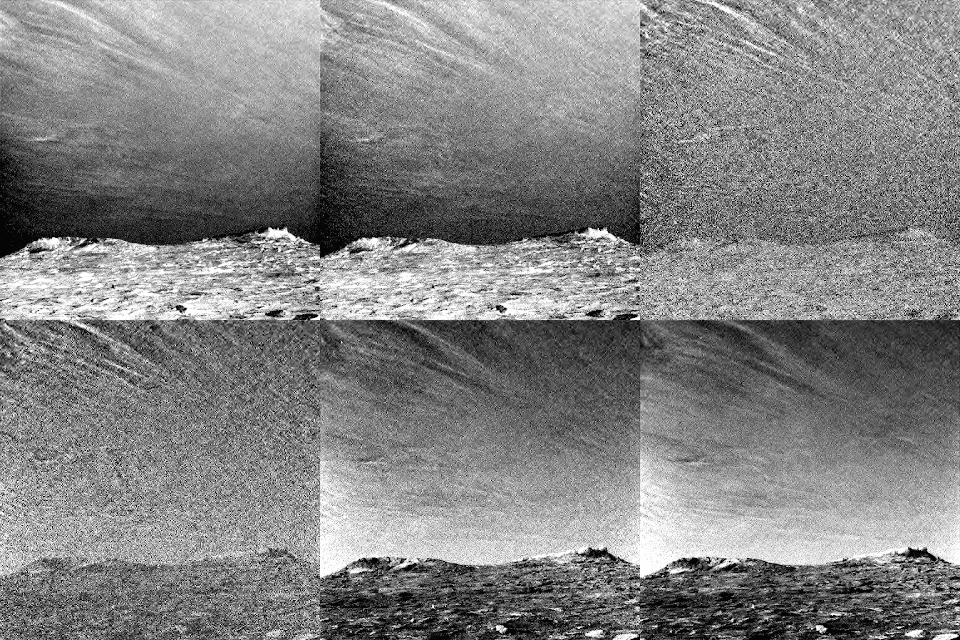
When I first started on the mission, I helped maintain the cadence of the ZM and SHM. This includes advocating their cadence (every 2-3 sols) and keeping an eye out for any aerosol activity. The cloudy season on Mars is very consistent year to year so it is relatively easy to predict when we’d expect to see more activity. Coming up to my first cloudy season, I found a pair of early morning movies that captured wispy clouds like Mares’ Tails seen here on Earth (shown below). The uniqueness and beauty of these clouds earned a press release (https://mars.nasa.gov/resources/8866/clouds-sailing-overhead-on-mars-enhanced/?site=msl). Since I was still fresh on the mission, I was excited and anxious for the opportunity. It received plenty of press and I enjoyed reading the various comments left by the public.


Over the next few years I continued to advocate for ENV observations but I was also given the opportunity to help develop a new observation. On sol 1787 a Dust-Devil Movie (DDM) was aimed at Mt. Sharp (Aeolis Mons) and instead of capturing dust-devils, it observed shadows moving across the mountain. This was caused by clouds moving overhead which was confirmed by the ZM that followed. A DDM pointed at Mt. Sharp posed a unique opportunity to measure the direct velocity and altitude of the overhead clouds by determining how fast the shadows move with respect to the mountain. Digital Terrain Models (DTMs) have been created for Mars which provide an x, y, z coordinate for every point in Gale Crater. By noting where on the mountain the shadow starts and ends between the first and last frames, a velocity can be calculated. When a paired ZM is used to calculate the angular spacing and velocity of the clouds above, we can get the velocity and altitude of the clouds. Typically, this parameter is found using a lidar which was demonstrated by the Phoenix lander (https://www.nasa.gov/mission_pages/phoenix/images/press/Lidar_Fall_Streaks_SD_001.html). However, Curiosity isn’t equipped with a lidar so we must use alternative approaches to calculate altitude.

Taking what we learned about the DDM and ZM combination, we went ahead and created the CAO. Within this parent observation is the Cloud Shadow Movie (CSM) and ZM. The CSM would be the DDM but optimized to bring out shadows. This includes increasing the frame size for more mountain coverage. This frame size was also applied to the ZM. Once the CAO was optimized , it was tested on Curiosity before becoming an official observation that the ENV team can plan. As of today, we have officially completed 3 MY worth of CAO data.

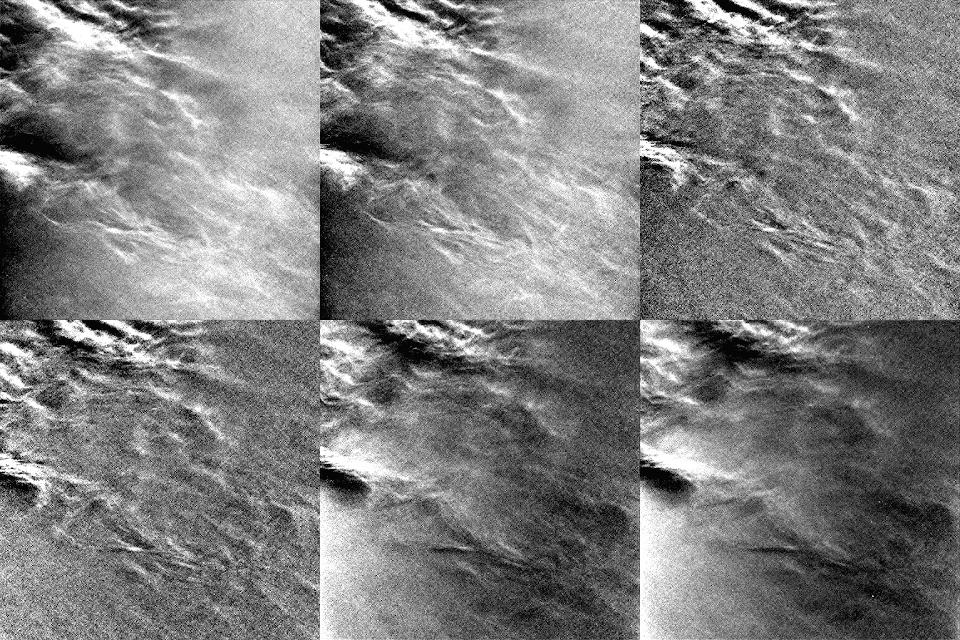
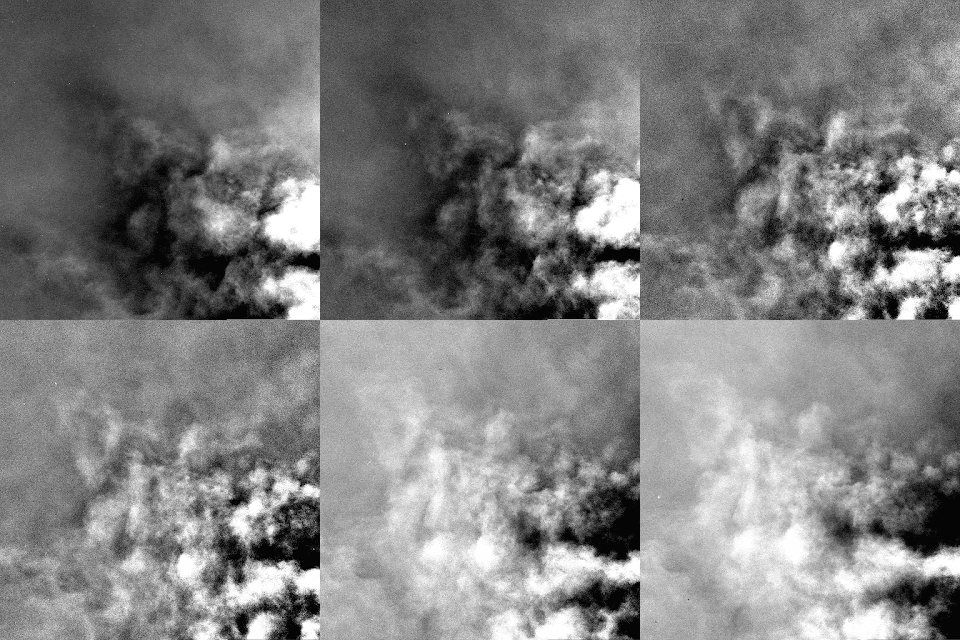
Analyzing the most recent set showed a unique pair of shadow and clouds that were not seen before in a CAO. Shown below, both movies show turbulent clouds with large shadows that pass over the rover before going up the mountain. I decided to showcase this set at the most recent Curiosity team meeting where I showed my cloud altitude results. The movies seemed to be a hit that they became a press release  (https://mars.nasa.gov/resources/26557/curiosity-captures-drifting-clouds-on-dec-12-2021/?site=msl). It made me extremely happy to have another set of movies released by JPL. I will be leaving the Curiosity team in the next few months to focus on my other PhD projects, so it is bittersweet to start and end my time on the mission with a press release.


It’s been a great honour to work with Curiosity data and especially help develop an observation that will continue to be captured in future cloud seasons. I want to thank the Curiosity team and all the current and past PVL members that have helped me. Good luck Curiosity! I hope you have many more cloudy seasons on the horizon. 

Thursday, March 3, 2022

I, Robot – InSight’s Struggle to Keep the Lights On

Our spacecraft are more than just our robotic avatars on other planets. They carry our culture with them, sometimes literally as with the Voyager golden record. But they also have an effect on those who remain back here at home. This can take the form of becoming the topic of memes, of having fan fiction written about them or being completely anthropomorphized. This week, undergraduate student Vennesa Weedmark considers the Opportunity Rover, InSight lander and their ultimate fate.
Image above: InSight's first selfie.

By Vennesa Weedmark

For as long as humans have been launching things into space, we’ve been anthropomorphizing them as extensions of our global self, bravely venturing into the void. These little (or sometimes very large) friends are given nicknames, celebrated, and eventually, mourned. Opportunity, a robotic rover that lived 55 times longer than its planned 90 sol lifetime, drove over 45 kilometers, knew its own birthday, gained a massive online following, and became a symbol of perseverance in the face of overwhelming odds. When NASA finally confirmed its death on February 13th, 2019, and its last message was translated as “My battery is low and it's getting dark”, there was an upwelling of condolences and life-celebrating responses across the internet.

I may have shed more than one tear.

Now, the end seems nigh for InSight aka. Interior Exploration using Seismic Investigations, Geodesy and Heat Transport. Designed to study the interior of the red planet and determine the rate of Martian tectonic activity and impacts, the planets “vital signs”, it launched in 2018 and has been active on Mars for over 1100 sols, slightly beyond its planned mission duration.

Since landing, it has recorded the first sounds of Martian winds, attempted to dig into the surface of Mars, detected marsquakes, found fluctuations in the magnetic field at the landing site, and provided invaluable information about soil at the landing site and the possible methods for drilling into Mars, and successfully emerged from an emergency hibernation caused when its solar panels became covered with dust. Since that first storm, InSight has been trying to clear the sand from its panels using saltation. By using its robotic arms to sprinkle sand near its solar panel, the sand would blow away, touching the solar panels and taking some of the dust with it as it left the solar panel. This, luckily, resulted in a temporary boost in power.

Then, because the bad luck of previous years isn’t done with us yet, January 2022 brought another drop in sunlight due to a regional dust storm, causing InSight to re-enter safe mode. The storm that shuttered InSight was only about 18% as strong as that which brought about the demise of Opportunity, and its safe mode ended again with no lasting signs of damage.

The overarching problem is what will become of InSight as its access to life-giving sun continues to decline, and what working on reduced power will do to the experiments and tests that it has yet to complete. As power drops, it’s saltation cleaning method will also become more difficult to perform.
Opportunity’s arrays were cleaned regularly by atmospheric activity, but InSight has continued to accumulate dust, and its outlook is looking increasingly dim (pun fully intended). Obviously, efforts to clean the Solar panels continue, but short of a “cleaning event”, it is likely that we’ll be mourning another brave explorer in the next year.

Like Oppy, InSight is active on social media and has a sizeable following, tweeting “Skies seem to be clearing overhead, so I’m out of safe mode and back to more normal operations”, as it emerged from its most recent slumber. Hopefully I won’t cry as much when InSight sends its final tweet. 

Note: while two members of PVL (Charissa Campbell and John Moores) are collaborators of the InSight Team, this post is completely independent of our work on that mission and was written by a member of our lab who is not affiliated with the InSight mission.