Tuesday, December 6, 2022

Hitching a Ride to the Moon (and Beyond!)

 Above, a series of ten 6-U cubesats can be seen attached to the ring which interfaces between the top of the Space Launch System (SLS) rocket and the payload fairing. It's not unusual these days for spacecraft to use extra mass allowances for these sorts of ride-along launches. It would be very difficult to arrange a special launch just for those spacecraft, so these larger launches provide a vehicle to considerably increase the science return from a space launch and to provide access to (deep) space to others. Here at PVL, we're very excited about the coming small-space era in Planetary Science!

By Conor Hayes

The launch of Artemis I on November 16, 2022 was a highly-publicized event, and for good reason. It has been 50 years since the last time we left the Moon, and although the first crewed landing of the Artemis program is not expected to take place until 2025, Artemis I is still an exciting step towards our return to the Moon.

Much less well-advertised was the fact that the Orion Multi-Purpose Crew Vehicle was not the only spacecraft riding the SLS rocket to space that night. Accompanying Orion were ten CubeSat microsatellites. The CubeSat standard was established in 1999 and has primarily been used for technology demonstrations and other missions whose higher risks make larger, more expensive satellites challenging to justify. Of course, this means that CubeSats are almost never launched on their own, instead needing to hitch a ride along with some other mission.

The ten CubeSats launched along with Artemis I were all in a 6U configuration, meaning that they each consisted of six CubeSat “units” joined together. A CubeSat unit is a box approximately ten centimetres along each edge with a mass of no more than two kilograms. This extremely small volume means that CubeSats have a very limited ability to propel themselves, so they are typically launched along with a mission that has the same target object. In the case for the Artemis CubeSats, this means that five of the ten microsatellites are aiming for the Moon as well.

So, what were the ten CubeSats that Artemis I carried into space?

ArgoMoon
ArgoMoon is a collaboration between the Italian Space Agency and Argotec, an Italian aerospace engineering company. Its primary mission is to take images of the Interim Cryogenic Propulsion Stage – where all of the CubeSats are stored – and to confirm that the other CubeSats successfully deploy. This mission will demonstrate the ability to use a microsatellite to autonomously inspect and maneuver around another spacecraft. Once deployment of the other CubeSats is complete, ArgoMoon will test the resiliency of its communications equipment in the harsh radiation environment outside of Earth’s magnetic field.


BioSentinel
The BioSentinel CubeSat mission was created by NASA Ames to examine the effects on DNA of long-term exposure to the deep space radiation environment. This is critically important information to have as we prepare for extended missions to the Moon and Mars so that we can develop methods of mitigating DNA damage to reduce the likelihood of astronauts developing various cancers and other threats to their health. BioSentinel will use two different strains of yeast as an analogue for human cells. The health of the yeast cells during the 18 month mission will be assessed by monitoring their growth and metabolic activity and comparing it to the radiation doses measured by sensors onboard the spacecraft. The results will then be compared to three identical copies of the BioSentinel experiment, one of which will be exposed to the low Earth orbit radiation environment onboard the International Space Station.


CuSP
The CubeSat for Solar Particles (CuSP) is a technology demonstration mission developed by the Southwest Research Institute. It contains three science instruments designed to count the number of energetic particles ejected by the Sun, as well as to measure the strength and direction of the interplanetary solar magnetic field. If all goes well, CuSP could justify the creation of a fleet of similar small satellites positioned throughout the Solar System to form a space weather monitoring system. 


EQUULEUS
The EQUilibriUm Lunar-Earth point 6U Spacecraft (EQUULEUS) is one of two Artemis CubeSats provided by the Japan Aerospace Exploration Agency (JAXA). Despite its small size, much science has been packed into it. EQUULEUS carries three science instruments as well as an experimental propulsion system. Two of the instruments are designed to detect the presence of dust and micro-asteroids in the space between Earth and the Moon, while the third will characterize the near-Earth plasma environment. Rather than traditional rocket fuel-powered propulsion, EQUULEUS will use water thrusters to propel itself into a halo orbit at the Earth-Moon L2 Lagrangian point and to fly-by any micro-asteroids that it discovers.


LunaH-Map
The Lunar Polar Hydrogen Mapper (LunaH-Map) was provided by Arizona State University to map water ice at the Moon’s poles. It will use a neutron spectrometer to measure the flux of high-energy neutrons leaving the lunar surface. These neutrons are suppressed by the presence of hydrogen atoms, so areas where LunaH-Map measures fewer neutrons are likely enhanced in hydrogen-bearing molecules like water. This mission will build on results from the Lunar Exploration Neutron Detector (LEND) onboard the Lunar Reconnaissance Orbiter (LRO), building higher-resolution maps thanks to its lower-altitude orbit (5 km for LunaH-Map versus 20 km for LRO). Unfortunately, the satellite experienced a problem with its propulsion system shortly after deployment, meaning that it was unable to insert itself into lunar orbit. However, there are still several months left to diagnose the problem before its current trajectory will make the mission unrecoverable. If the LunaH-Map is able to diagnose and fix the problem and get the spacecraft into orbit, the mission is planned to last for 96 days, after which it will be launched into a polar crater. 


Lunar IceCube
As its name suggests, Lunar IceCube is another mission to search for ice on the Moon, developed by Morehead State University in collaboration with the Busek Company, the Catholic University of America, and NASA Goddard. It will hunt for water ice and other volatile molecules at the Moon’s poles from a 100 km orbit using an infrared spectrometer. 


LunIR
LunIR (formerly known as SkyFire), designed by Lockheed Martin Space, is another lunar mapping mission. Its primary mission objective is to test a low-cost thermal imager that could be used to characterize future landing sites on the Moon and Mars. It will also test the use of an electrospray thruster, in which electrically-charged liquid is expelled to provide thrust, for small orbital adjustments. The LunIR team have not provided updates on the spacecraft’s status post-launch, so it is currently unclear whether or not it is operating as expected. 


NEA Scout
The Near-Earth Asteroid Scout (NEA Scout) is a NASA mission that will use a solar sail to propel itself to 2020 GE, a near-Earth asteroid approximately 18 metres across. Because it is extremely difficult to identify and track objects of this size, not much is known about them, leaving a critical gap in planetary protection plans. This mission carries a single instrument – a camera that will be used to take high-resolution imagery of 2020 GE. Unfortunately, NEA Scout failed to make contact with the Deep Space Network after deployment, so the team is currently attempting to recover the spacecraft.


OMOTENASHI
The Outstanding MOon exploration TEchnologies demonstrated by NAno Semi-Hard Impactor (OMOTENASHI; some very creative acronym work!) is the second of JAXA’s contributions to the Artemis I CubeSat collection. It was designed to be a semi-hard lunar lander, using a combination of rockets and airbags to impact the lunar surface at 20–30 m/s. It would then use an onboard radiation detector to study the radiation environment at the surface. Shortly after deployment, communication with OMOTENASHI was lost. After five days of recovery efforts, the team concluded that the spacecraft’s solar panels had failed to find the Sun, leading to an unrecoverable shutdown of the spacecraft following battery depletion.


Team Miles
The final of the ten CubeSats is Team Miles, a technology demonstration mission by Fluid and Reason, LLC. Team Miles was developed to test new propulsion and communications technologies. It will fly past the Moon towards Mars, with a goal to travel at least four million km and possibly up to 96 million km.
These will certainly not be the last CubeSats launched towards the Moon as we enter the Artemis era of lunar exploration. Indeed, there are already three more prepared for launch that just missed the Artemis I integration deadline: Cislunar Explorers, Earth Escape Explorer, and Lunar Flashlight. Although they may not nearly be as flashy as larger missions like the main Artemis flights, the proliferation of microsatellites has provided excellent opportunities for groups with less available funding to get good science done without having to compete for space onboard a more expensive mission, making off-Earth research more accessible for everyone.

Sunday, November 20, 2022

What’s going on with methane on Mars?

This week, Madeline discusses a critical component of her research into how methane is vertically distributed in the martian atmosphere. Read on for some details about the present state of the ongoing debate about Methane on Mars.
(Image source: https://mars.nasa.gov/system/feature_items/images/6037_msl_banner.jpg)

by Madeline Walters

On Earth, we’ve often heard of methane being produced as a result of living beings-microbes that help with livestock digestion. Though when we found methane on Mars, we were puzzled by its origins. Are there microbes helping the digestion of Martian cattle? Most signs point to no, however, we are still unsure of what may be producing the gas on Mars. Besides biogenic sources, methane can also be produced by geological processes, so being able to identify the sources of methane is a tricky yet interesting problem.

The issue with identifying the sources of methane is finding the methane in the first place. Since landing in Gale Crater in 2012, the Tunable Laser Spectrometer (TLS) instrument onboard NASA’s Curiosity rover detected background levels and a few higher spikes of methane from the surface, however, ESA’s ExoMars Trace Gas Orbiter (TGO) wasn’t able to detect any methane from higher up in the sunlit atmosphere. 

TLS lead scientist Chris Webster [1] comments: "When the Trace Gas Orbiter came on board in 2016, I was fully expecting the orbiter team to report that there's a small amount of methane everywhere on Mars, but when the European team announced that it saw no methane, I was definitely shocked." 

The results were certainly unexpected after other detections of methane from other instruments, leading to new questions about whether the detections from TLS perhaps originated from the rover itself. Some scientists suggested the rover detected methane after crushing rocks, or perhaps wheel degradation, not willing to rule out any possibilities. However, the Planetary Fourier Spectrometer onboard the Mars Express (MEx) spacecraft observed higher levels of methane in 2013, after Curiosity also reported a methane spike, bringing back the question of how to make sense of these detections.

So why are some instruments reporting methane while others aren’t? This is something that is puzzling scientists almost as much as the source of the gas itself. Because of the conflicting reports of detection from different instruments, the key is observing how methane diffuses through the atmosphere at different times of day and through different seasons to see if perhaps the reports of methane from different instruments can still make sense.

Moores et al. [2] suggests a small amount of methane seeps out of the ground continuously such that during the day, it mixes well with the atmosphere, which results in very low levels of methane further up. Meanwhile at night, the methane can build up near the surface from the lack of convection. From this approach, we can make sense of both the ExoMars and Curiosity observations. While this could explain the discrepancies in methane detection from different instruments, we still have yet to determine the origin of the gas itself and if that origin perhaps can explain how the gas is being destroyed much quicker than it should. Because solar radiation and oxidation should be destroying the produced methane after a lengthy 300 years, the excess methane buildup should be detectable by TGO. This points to some destruction or sequestration mechanism that is getting rid of the methane quicker than expected such that the detected amounts make sense. 

"We need to determine whether there's a faster destruction mechanism than normal to fully reconcile the data sets from the rover and the orbiter," says Webster. 

One possible explanation for this is the gas’ reaction with the surface components. A chemical compound called perchlorate, which has been detected by Mars landers, may be acting as a sink for methane due to oxidation reactions [3]. When exposed to ultraviolet radiation from the sun, perchlorate accelerates the destruction of methane-from over 300 years to just days or hours. However, scientists are still exploring this possibility and as of right now, there’s still no way to be sure this is the reaction responsible for the gas’ quick destruction. While there are still many questions surrounding Martian methane, we are getting closer to explaining the mysteries of the gas.

___

References:

[1] https://www.jpl.nasa.gov/news/first-you-see-it-then-you-dont-scientists-closer-to-explaining-mars -methane-mystery
[2] Moores, J. E., King, P. L., Smith, C. L., Martinez, G. M., Newman, C. E., Guzewich, S. D., et al. (2019). The methane diurnal variation and microseepage flux at Gale crater, Mars as constrained by the ExoMars Trace Gas Orbiter and Curiosity observations. Geophysical Research Letters, 46, 9430– 9438. https://doi.org/10.1029/2019GL083800

[3] Zhang, Xu & Berkinsky, David & Markus, Charles & Chitturi, Sathya & Grieman, Fred & Okumura, Mitchio & Luo, Yangcheng & Yung, Yuk & Sander, Stanley. (2021). Reaction of Methane and UV-activated Perchlorate: Relevance to Heterogeneous Loss of Methane in the Atmosphere of Mars. Icarus. 376. 114832. http://dx.doi.org/10.1016/j.icarus.2021.114832.

Tuesday, November 1, 2022

More conference talk. Suddenly stuck at home? Make the best of it!

We had all hoped to be in person at this year's DPS, however, the hybrid nature of the conference meant that any students who had last minute disruptions could still attend virtually. It's really nice to be able to accommodate these sorts of situations and, while the online experience is not the same as the in-person experience, it means that someone who has made arrangements and already paid their registration can still get some value out of the conference, perhaps even more value than they had expected as our new PhD student Elisa Dong attests below. For more on the picture above, see the Caption at the bottom of the article.

 by Elisa Dong

New PhD student (Elisa) checking in with the usual readers of this blog. This week I've been invited to discuss whatever I so desire on the blog. I happened to be writing something for my own blog on attending conferences. Here are a series of mostly serious tips for attending conferences remotely, when the format is hybrid and all your friends are attending in person. The backdrop for this conference was DPS, on which Conor has recently posted. A lot of these tips have been test-run during the pandemic where I attended AGU online.

Tips for attending a scientific conference (when you're remotely at a hybrid event):
1.     Identify your favourite conference snacks and drinks
2.     Purchase, make, or make student-budget friendly versions of said snacks and drinks
3.     Plan chores that require at most 1 hour of your time. Preferably a bunch of 10-15 minute chores
4.     Acquire bluetooth headphones
5.     Identify some clothes for dressing up (or down)
6.     Pick a few "key" sessions you want to be awake for and some interesting ones to pad out the rest of your time.
7.     Chat with your lab mates on your preferred communication method of choice.

Let's break these down a bit. Say you were really looking forward to attending the conference in person and had already planned for those days to be away. However, you've fallen sick or some event has taken place that prevents you from attending. You might as well try to get part of the conference experience at home! While there will be significantly less mingling with others and networking opportunities will be, at best, awkward and stilted you can still delight in the little snack breaks while reflecting on the state of the field.

This brings us to tip number 1. If you've been to a conference before, what snacks did you enjoy during the breaks? Personally I like that there are usually several tea options, and sometimes the coffee is palatable. The previous conference I had attended online (planned), I had the time to order some coffee samples and pick up a variety of snacks from the asian supermarket. This time I was stuck in quarantine, so I made sure I had a kettle and a massive stock of tea bags. This covers tip number 2 as well. It doesn't have to be fancy, but having the ability to make hot drinks on demand is quite nice. It's reminiscent of downing drinks to soothe your throat in the dry, conference room air.

Tip number 3 and 4 involve keeping yourself busy. Unlike an in-person conference, there are very few things you can look at that you are unfamiliar with. You likely won't have access to the attendees (no camera facing that way, zoom only shows the speakers) so figuring out who else is at that session is out unless they speak up during Q&A. Instead, you could be getting some mundane tasks done! I personally can't look at a screen continuously, so laundry, cleaning the kitchen, organizing bookshelves, watering/trimming plants, etc. all give me breaks away from the screen, but I'm not doing anything so critical that I can't check what's on the screen if it's particularly important. Tip 4 gives you the flexibility to move around without fear of wires tangling or blasting the audio (less of an issue if you don't have roommates, but still a nice option). Earphones are also an option, but I find headphones to be a bit better with universal fitting. Also, you now have the wonderful ability to choose to go to the bathroom while still listening to the sessions.

It's all good to be perfectly cozy while stuck at home (or if you're so inclined, going outside while still plugged into the conference). A big part of the conference experience is being present though. For me, that means dressing in a slightly snappier manner than I normally might. Regardless, I would want to have a change of pace for "conference time", much like when working from home, it's helpful for me to dress up for "work hours". Dressing down could be a fun alternative to this though. After all, no one can see that you're in the goofiest of onesies. Similarly, no one will know (other than your housemates) that you attended in a full ballgown and mask. So that's tip 5.

Tip 6 is applicable to any conference you attend. There is only so much time in a day, so pick your favourite events to go to. Figure out what's relevant to your interests. Not much more to say about this one. Tip 7 is similarly applicable always. Should you find yourself longing for some company, or wanting to experience the social aspect of the conference, checking in with your lab mates or anyone else at the conference can be nice. If you're all together (remote or in person), it can be nice to schedule some hangout time outside of the planned events.

Lastly, it's always a good idea to tap out whenever you're feeling tired. No point attending a conference in your brain is on the fritz. A copy of these tips can be found on my personal blog (soon), abstract-ed.me, where I will likely keep posting silly little pseudo-articles on science and whatever catches my interest at the time.

___

As an aside, for all potential incoming grads, here are the things that have happened in the last 2 months:
-        started taking my singular mandatory course (yay for transfer credits!)
-        met up the rest of the lab at an outdoors event and found out we're all equally bad at playing frisbee
-        confirmed that housing is as tricky as I thought it would be
-        ran into an old friend at the university!
-        had an impromptu zoom call with the founder of a company whose instruments I'm hoping to use in the near future (no spoilers!)
-        learned how to plug things into a breadboard and string things together with different communication protocols
-        moved some plants into the office, including my favourite "it's time to go home plant" (Fig. 1)
 

Figure 1 Caption. Here is my plant before I moved it to the office. The "it's time to go home plant" is an Oxalis triangularis. This purplish plant has a few relatives, but they are also referred to as "false shamrocks" when they are of the green variety. The sets of three leaves close up when the light begins to dim. This is usually my sign that I've been at work for too long during the summer months, and a reminder to start packing up during winter. I have been tricked in the past, as the leaves remain open with artificial lighting as well. They're generally pretty happy office/house plants, require moderate temperatures, nothing special in terms of humidity, and enjoy filtered light. They do grow rapidly outdoors, so don't plant them outside!

Wednesday, October 19, 2022

Completing the Thesis Defence: The Final Boss of a Graduate Degree


This past summer, several of the students in PVL had the opportunity to go through the timeless ritual that all us academics undergo in order to earn our MSc and PhD degrees: the oral defense of our research. I can report that everyone made it through with flying colours! Of course, a defence is also a transition for the student who may be moving from an MSc into a PhD, from a PhD into a Postdoc or from their MSc into the working world, amongst other paths. If you are considering getting a higher degree and want to know what this hurdle looks like, or are starting to think about your own defense, Grace has some helpful insight below. 
(Image above from XKCD Comics: https://xkcd.com/1403/)

 by Grace Bischof

The end of the summer marked a busy time in the Planetary Volatiles Lab. Conor, Giang and I were each nervously preparing for our upcoming thesis defences, where we would learn if we were to pass and obtain our degrees, or fail and be very, very sad. Giang, reaching the end of his PhD in August, defended first, setting the tone for the rest of us by passing! Conor and I followed, defending on September 7th and 8th (apologies to our shared committee members who had to sit in back-to-back defences). Conor and I were also successful in defending our theses, meaning we both obtained our master’s degrees. It was a very exciting end to the summer.

So, what is a thesis defence and why is it so nerve-wracking? In a research-based degree, the findings of the research you complete over several years get written up into a document – at York, this is a thesis for a master’s and a dissertation for a PhD, which is a more robust document than a thesis. This document represents years of hard work, and hopefully, makes an original contribution to the field in which you’re studying. That, in and of itself, is a nerve-wracking process. But before the university can award you your degree for all the painstaking effort you have put into your thesis, they first must test you on the contents in the form of an oral examination.

The oral examination usually begins with a public talk, where your research is presented in a 20 minute to hour long (depending on the degree) presentation. Typically, anyone can join this portion of the defence, and for me, it was fun having my friends and family watch my presentation so they could finally stop asking what it is I actually work on. Once the public talk is over, everyone else leaves the room, so it is just you and your committee. One-by-one, the committee members take turns dissecting your thesis, asking questions, and making suggestions about the contents to facilitate discussion on your work. This process can last several hours, especially for a PhD defence which is more involved. Once the committee has run out of questions to ask, you are kicked out of the room while they deliberate. Sitting outside the room while a small number of people decide the fate on the culmination of your work is horrifying. Then you are finally called back to the room to receive to your verdict…

The good news: the thesis defence is largely a formality. That is, if your research supervisor is doing their job, you will not walk into the thesis defence if you are not going to pass. The purpose of the defence is simply to ensure the student understands their work and the literature in which it is situated. Not knowing the answer to an examiner’s question does not mean you will fail the defence. In fact, the examiners want to see you reason through their questions, applying your knowledge even when you do not have the exact answer. There was one point in my defence when I answered a question completely incorrectly but realized my error once I thought more about it. I told the committee that the answer I gave was incorrect and walked them through my thought process to answer the question correctly. The committee was more interested in seeing my reasoning in getting to the answer than they were worried about the initial mistake I made.

So, now that you know what a thesis defence is, let’s briefly walk through some tips for the defence:

  1. Start preparing early. The amount of time needed to prepare is going to depend on the degree being obtained – i.e., PhD students will likely need to start earlier than master’s student. Three weeks out before my defence I began to seriously prepare. I started by compiling a list of the most important references in my thesis. I read a handful of these a day, highlighting and jotting down notes on important aspects of each paper. At this time, I was also walking through the basics of the field – sure, it might impress your committee to describe in detail all the aspects of radiative transfer in the atmosphere, but that might diminish if you forget Mars is the 4th planet from the sun.

  2. Anticipate questions. About 1.5 weeks from the defence date, I began combing through my thesis line by line. I had a PDF version of my thesis which I used to highlight and make notes in the margins. I wrote down anything that came to mind when reading my work and how the committee might interpret it. Some common questions that are asked in defences are: “How does your work fit into the existing literature”; “Describe your work in a few short questions”; “In what ways can this work be expanded?”; “What limitations did you experience in this work?”. Funnily enough, I prepared for all these questions and did not get asked any of them. However, preparing for them helped me to pick apart my work more carefully, meaning I could answer the questions they did give me.

  3. Try to relax as much as possible. It’s easier said than done. An important tip that I read online before defending my thesis was to make sure that in your state of nervousness, you don’t consistently interrupt the examiners while they are asking questions in an attempt to quickly prove you know the answer. When an examiner is speaking, it’s a perfect time to collect your thoughts and let them talk (it eats up more time this way too!). But, like I said, the defence is largely a formality. If you’ve done the work, then you know your stuff and you will crush it! You are allowed to sit and think about your answer before speaking, drink some water or have a snack, and take a break during the defence if needed. After the first 30 minutes of the defence, the rest breezes by.

Your thesis defence will probably be the only time you will ever have a discussion with people who have ever read the full contents of your thesis. That itself is a pretty cool opportunity, so try to enjoy it as much as you can! Hopefully in four years’ time, when I’m preparing for my PhD defence, I can come back to this blog post and try to take my own advice.  

Sunday, October 16, 2022

PVL in London (Ontario, That Is)


This week, new PVL PhD student (formerly PVL MSc student - congrats!) Conor Hayes reflects on the just completed DPS Conference that they attended a few weeks ago. This is the first time that DPS has been in person since Geneva, Switzerland in 2019 and the first time it has ever been held in Canada. I certainly appreciated being able to experience the conference together with my graduate students as a research group without even having to bring my passport!

by Conor Hayes

It has been nearly a year since I last submitted an entry to this blog, detailing my experience at GAC-MAC 2021, my first in-person conference as a grad student. Much has happened since then; I half-pivoted away from the Moon to add a new MSL-based project to my Master's thesis less than nine months before my defence, I wrote and successfully defended said thesis, and now I'm a freshly-minted PhD student here at PVL.

Some things, however, do not change, so I am here once again to talk about our latest conference experience at the 54th Annual Meeting of the Division for Planetary Sciences (DPS). PVL typically puts up a strong showing at DPS because we are all planetary scientists, and this was particularly true this year for two reasons. First, DPS 54 was held in London Ontario, practically down the road (relatively speaking) from us here at York. Second, PVL’s own John Moores was Chair of the Science Organizing Committee, so we couldn’t not represent our group well.

In many ways, DPS was very similar to the two in-person conferences that I was able to attend during my Master’s – GAC-MAC back in November of last year, and the 7th Mars Atmosphere Modelling and Observations conference this summer. The scientific program was divided between oral talks and poster presentations, with a plenary session in the middle of each day. I mostly stuck to the sessions on topics that I’m interested in – the Moon, Mars, and terrestrial planets, though I did attend a few that were more “out there” (at least with reference to my own research) on Europa and other icy moons, as well as sessions on citizen science, education, and public outreach.

Although it followed this familiar pattern, DPS was very much a conference of firsts for me. Because DPS was a hybrid conference this year, each session had two chairs, at least one of whom had to be in-person. One chair would make sure that each speaker stuck to their allotted time and manage questions from in the room, while the other would monitor the session’s Slack channel, where virtual attendees could ask their questions. Due to the continually evolving health situation, there were a number of in-person chairs who had to switch to virtual attendance, meaning that some sessions no longer had an in-person chair. Several members of PVL (including myself) were recruited to take their place. The session that I chaired was titled “Dynamical Dances in Space,” and featured four talks discussing gravitational interactions between various Solar System bodies, the first of which was actually based on a newly-published paper that I had read shortly before the conference. Stepping in as chair at the last minute was a little daunting because I had no idea what to expect, but it ended up being a reasonably non-stressful affair.

Much more stressful was the fact that this was the first time that I had been invited to give an oral presentation at a “major” conference. I’ve given presentations about my research before, but always in much lower-stakes settings, whether that be in PVL group meetings or at smaller conferences run by graduate students (e.g. York’s Physics and Astronomy Graduate Executive conference or the annual Lunar and Small Bodies Graduate Forum). On top of that, I had never presented the preliminary results of my lunar work to a larger group before, so there was a lot that I was worried about. Consequently, I spent a lot of time preparing my presentation and making sure that I stayed as close to the seven minute limit we were given. In the end, the magnitude of my stress was wildly disproportional to the actual event, as my presentation went smoothly and hit the seven minute mark almost exactly. Although I would have happily taken just that as a win, it has also inspired my first official research collaboration with someone outside of PVL, something that I am very excited about.

Now that I’ve had experience with both oral and poster presentations at conferences, I think I can say that I prefer oral presentations over posters. Posters certainly do have their advantages – you present all of your information on a single page and you don’t have to worry about time limits or making sure that you remember what you want to say, as posters often come with a more conversational style of sharing information. However, I’m just not really a fan of the poster experience. During a poster session, you’re sharing a room with many other people presenting their posters at the same time, so there’s a certain element of competing for the attendees’ attention. Some people can also find approaching the presenters one-on-one more intimidating than asking a question at an oral presentation (I certainly do!), which might limit the number of interactions you have. I definitely don’t want to turn people off of poster presentations; they can be a low-stress way to ease your way into the conference experience and/or to present early/preliminary results that are still in progress.

Overall, DPS was probably my favourite conference of the handful that I have attended (either virtually or in-person) over the past two years. I can only hope that the weather in San Antonio will take a break from its usual late-summer Texas heat for DPS next year.

Monday, October 3, 2022

There and Back Again: A MAPLE Tale


As we approach the final year of the MAPLE project, it's time to take the instrument out into the field! This past summer, PVL PhD student Charissa Campbell and then-MSc (now PhD) student Grace Bischof took MAPLE out to Argentia, Newfoundland one of the foggiest places on Earth where the Gulf Stream meets the Labrador current. Mother nature didn't disappoint and Charissa and Grace came back with spectacular images and science.

by Charissa Campbell

This summer was quite busy as we were preparing for the deployment of our MAPLE (Mars Atmospheric Panoramic camera and Laser Experiment) instrument to the highly foggy area of Argentia, Newfoundland. There are two main field testing sites for MAPLE which includes a foggy location (large aerosols) and Arctic location (small, Martian-like aerosols). With the Arctic being more Mars-like, MAPLE will travel alone and be controlled remotely to fully mimic spaceflight conditions. However, as a starting point, we decided to travel with MAPLE to the Argentia, NL area to test in foggy conditions.

MAPLE is based on a previous experiment done by the Phoenix lander that took images of the onboard lidar laser to classify ice-water content of aerosols near the surface (https://photojournal.jpl.nasa.gov/catalog/PIA11030). However, the camera could only take an image of a small portion of the sky, limiting the view of the laser. MAPLE is equipped with a panoramic camera to allow the full sky to be captured, which also allows for multiple lasers to be in use at the same time and clouds to be monitored during the day. For Argentia, we equipped MAPLE with 8 different lasers in a variety of wavelengths and power (class) to try to determine if a specific set was better for future measurements. Adding different wavelengths of lasers allows us to also investigate the size of aerosols. To further increase the science output of MAPLE, we will employ techniques used with the Mars Science Laboratory (MSL, Curiosity) to calculate aerosol properties such as optical depth, wind properties and others.  By using knowledge from previous Martian surface missions, we can develop MAPLE in a way to maximize the amount of returnable data in a low-cost way.

Defining a mission as low-cost means trying to find the minimal amount of power, data volume and size needed to acquire your measurements. Since we are in the early stages of the project, we created MAPLE from scratch using a pelican case which held our components. This includes a panoramic camera, 8 lasers and a raspberry pi that is used to control the camera. Several battery packs were used, one for each laser and a separate larger one for just the raspberry pi. As MAPLE gets more automated, the lasers will eventually be controlled by the raspberry pi and power can be more streamlined through just the Pi. The size of MAPLE seemed to work well, and windows had to be installed in the top for the camera and lasers to shine through. I never took construction in school, so I had a lot of late nights with the drill to push through two rectangles for the laser windows. Luckily, we already had a bubble panoramic window so I simply had to construct a properly sized hole for the window. Somehow, I managed to fully construct MAPLE and not injure myself. We also got humidity measuring packs to see how sealed the inside was. Minimal humidity was noted within the case, which is a win considering we were in essentially a cloud most times we were on the field. One concern we did have with keeping MAPLE low-cost was that the images were rather large and I only equipped the raspberry pi with a 32GB SD card. A lot of extra time was spent moving files over to a portable hard drive so we will be looking into upgrading the size of the SD card while also optimizing the size of the images. 


The field site itself was really beautiful and was a bucket list item for me as Newfoundland was the last province for me to visit in Canada. Interestingly enough, there were no rental cars available on the whole island for the 2 week we were wanting to travel. However, with the coming end of the foggy season we didn’t want to miss the opportunity to make observations. I love taking different methods of transportation and stumbled upon a ferry that travels from North Sydney, Nova Scotia to, lo and behold, Argentia. There were rental cars available in North Sydney so my colleague and I flew directly there, picked up the car and immediately took it on the ferry across to the island. We were able to get a room on the ferry itself with 2 beds, a bathroom, and the best view of the ocean. This was ideal as the ferry is about 16 hours long, overnight, so the bed was very much needed. 

Once arrived, we got settled in the town of Placentia, which was a short drive to/from the field site which was in the port where our ferry was docked. They had a cool lifting bridge that was a great backdrop for determining when the fog was rolling in. We did most of our experiments back at our arrival dock.  It was originally a World War 2 airfield site owned by the Americans, given by the British for the sole purpose of making it a Naval airbase. The Atlantic Charter was signed just outside the port which was thought to lead to the United Nations Charter (https://www.hiddennewfoundland.ca/argentia-naval-station). As someone who loves reading history, it was amazing to do the experiments in such an area. We were on one of the old runways as it was perfect for pointing the lasers in a way determine how far the lasers could travel. This was the goal for the first day on the site.


As always, something will go wrong on the field site and that was the case on our first day. When we first started testing, we expected to fiddle with the image parameters, such as exposure, to see the laser. However, no matter what we did we could not see any of the lasers in the images. We had not brainstormed what would happen in this case so we took a rather long lunch break to think about what we could do to mitigate the problem. We decided to try taking images anyways in the sun and increased the number of images taken for each laser configuration. The sun might be so bright in the day that the camera simply cannot view them in the image. We also decided to do some trial runs when it got dark. One evening, the fog rolled in so heavily that I got MAPLE all set up late in the evening. It got so foggy that it truly felt like I was in a horror movie or unsolved mysteries as I was unable to see a few feet in front of me. Images of what MAPLE could see in the dark showed how important the dark was to our experiments. After gathering a variety of images, we knew what the game plan was for the rest of the trip. 


We finished our Newfoundland trip with images in both day and night that will be analyzed further. Many questions were both answered, and the trip was extremely useful on telling us how we need to prepare MAPLE for the Arctic. The trip was a challenge but a great way to gain leadership experience. Since I was not the only person on this trip, Grace has these words to say about her time on our field trip:

“Most of the research I’ve completed throughout my degree has consisted of analyzing data acquired from space missions – whether that be temperature, data or pictures taken from the surface of Mars. Because of this, my days usually involve sitting at my computer, writing code, and generally not moving around too much. Going to Newfoundland for fieldwork allowed me to explore different facets of research that I usually do not get to explore. Working with MAPLE meant driving out to the field site in the mornings, setting up the instrumentation, and taking several experiments to try and capture the science. There is a degree of unpredictability with fieldwork that we don’t normally experience in our day-to-day work. Will it be foggy enough? Will the batteries have enough power for the experiments? Will the inside of the instrument get too humid? Carrying out this fieldwork was a very unique experience, and I am so grateful to have had the opportunity to try something new!”


Tuesday, August 9, 2022

Five Pictures from Ten (Earth) Years of Curiosity


The photos that our robot geologists (and robot atmospheric scientists) bring back to us from other worlds help us to relate to these places on a human scale. No one at the PVL have looked at more images of Mars than Alex and so, who better to take us on a visual trip down memory lane on this auspicious anniversary?

By Alex Innanen

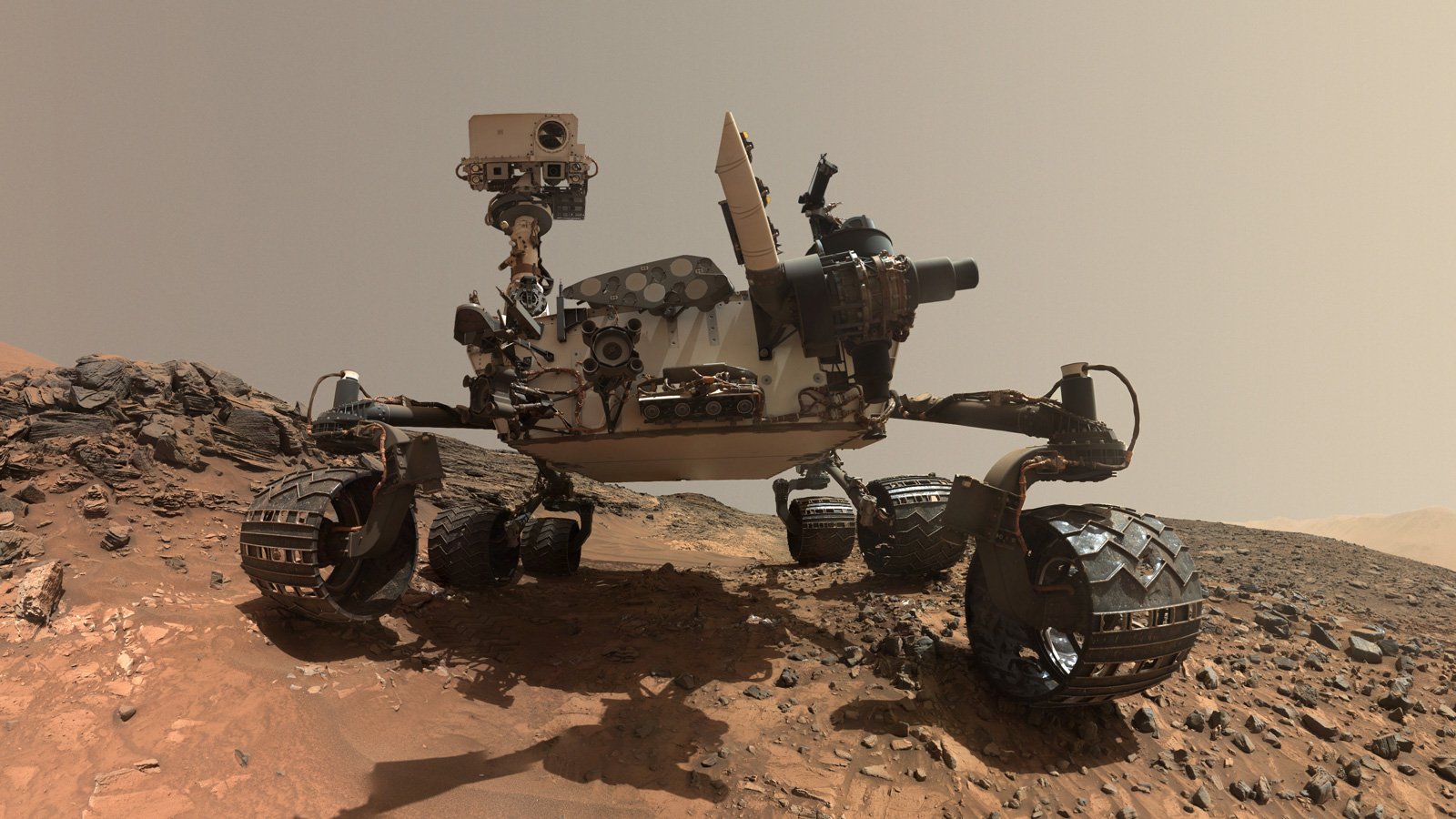
August 6th marks 10 (earth) years since Curiosity (AKA the Mars Science Laboratory or MSL, because space people love a good acronym) landed in Gale Crater on Mars. If you’ve been around the blog, you’ll know that many PVL-ers have had the chance to work on the mission (myself included) and there have been a plethora of posts over the years about what doing ENV operations is like, or what cool science MSL is doing, or other big mission events, like the 2018 global dust storm or passing 2000 sols on Mars. To add to this collection, and to celebrate 10 years of Curiosity (or 5 Mars years, a milestone reached this most recent January), I’m going to journey through some of my favourite pictures the rover has taken over the past decade.

First we have the above picture, a classic selfie. Curiosity regularly poses for MAHLI (the Mars Hand Lens Imager) to take these self portraits, which are actually mosaics of tens of MAHLI images. There’s a fantastic video of Curiosity’s arm moving around to get all the pictures that make up a selfie. This particular selfie was captured during the 2018 global dust storm, and you can see dust in the background obscuring the crater rim. This is the same dust storm that heralded the end of Opportunity’s mission, but Curiosity came through with lots of science (and nifty pictures) to show for it.

Going all the way back in time to 2012, this is a 360° panorama of Curiosity’s landing site, named ‘Bradbury’ for the sci-fi author Ray Bradbury. Right in the centre of the picture is Mount Sharp (or Aeolis Mons), the mountain in the centre of Gale Crater. Mount Sharp is made up of sediments laid down in Gale Crater over a long period of Mars’ history, and as Curiosity has climbed up it, it’s as though the rover has been travelling through that history. But first it had to get to the base of Mount Sharp, a trip which took around 2 years trundling through the remnants of ancient lakes and rivers. I love looking at this panorama because it gives a great idea of how far Curiosity has traveled – over 28 km and 600 m of elevation, now. It's also a great ‘big picture’ shot – every new location Curiosity visits is (in my humble opinion) stunning and unique in its own way, with so much new and exciting to look at. This image lets you take a step back and take it all in.

It would be remiss of me to not include a cloud picture, so here it is, my absolute favourite cloud shot. I may be slightly biased, as I was on shift when this image was planned, but it’s so dramatic, with the cliff face (called ‘Mont Mercou’) in the foreground and the glowing clouds behind. These are Noctilucent clouds, which means ‘night shining’, and were captured at twilight early this Mars year (which was actually March of 2021 – Mars years are long). These kinds of clouds are high up in the atmosphere, and are illuminated by the setting sun, even visible when the sun has gone below the horizon. This is what makes them appear to glow, still being illuminated while the rest of the sky darkens. These particular twilight clouds seem to form more readily in Gale crater near the beginning of the Mars year, something the team discovered in Mars year 35. At the start of Mars year 36 (the current Mars year) we started looking for them and were not disappointed. One of the great things about Curiosity having been on Mars for so long is the fact that we can see yearly repetitions like this and come up with a better idea of what the Martian environment is up to year after year.


Mars’ blue sunset is spectacular and well known to fans of the ‘red’ planet. But “what colour is the Martian sky?” is a question I’ve been asked more than once by those less familiar with Mars. And it’s a great question! Sometimes – like in this picture or the cloud picture above, the sky looks more blue, almost like earth’s sky. But at other times, like in the selfie or the Mount Sharp panorama, it looks more orange or yellow. There’s a few factors behind this – often images are colour-corrected (‘white-balanced’) to show what a scene might look like under earth-like lighting. This can help scientists interpret features within a scene, making them look more familiar to better compare to earth, but doesn’t accurately represent what you might see if you were standing on the surface of Mars, which would be more of a yellowy-orange sky.

Except when you get close to the sun, like in this sunset picture. Much like how earth’s scatters light, giving us a blue sky, so too does dust in the Martian atmosphere, but the blue wavelengths of light mostly scatter forwards, so the blue colour appears closer to the sun. As the sun sets, there is more atmosphere and more dust for the light to scatter through, so that blue effect near the sun becomes more pronounced. 


I’m going to finish with this absolute stunner of an image, which combines two NavCam (Navigation camera) mosaics of the same scene, one taken in the morning and one in the afternoon. They were combined to show different landscape features that are highlighted as the sun illuminates some regions and casts others into shadow. After talking about the colours of Mars, you may be wondering what gives this image its striking blue and yellow palette. The NavCams on Curiosity only take pictures in black and white – colour was added to this image after the fact to highlight the lighting changes, with blue showing morning features, yellow showing evening features, and their combination showing just that – a combination of the two. This picture is looking back down Mount Sharp towards the crater rim in the distance, and it seems like a fitting image to close this blogpost on, looking back over the last great 10 years with Curiosity.