Tuesday, February 16, 2021

Update on K2-141b

Above, some art commissioned by NASA to commemorate the mission of the Kepler Space Telescope. Even as the mission encountered technical issues with its reaction wheels near the end of its journey, good science was extracted. The K2 mission allowed the telescope some drift from its original pointing near the constellation of Cygnus. This permitted the telescope to examine a wider range of stars, though each could not be observed for as long as the original set. Still, close-in short orbital period planets like K2-141b could be detected. This week, Giang updates us on his work to model this lava planet.

By Giang Nguyen

As 2021 marches on, I, along with everyone else in the lab, are also chugging along amidst a global pandemic. However, I’m more fortunate than most as my work solely lies in virtual space. As long as I have access to a computer and some internet, my work on K2-141b progresses. Although the internet isn’t necessary to run my models, I always need to have 5 tabs of Google searches on how to python open.

As a refresher, K2-141b is a planet about 200 light years away located in the Aquarius constellation. Its orbit is so close to the star it orbits that its surface temperature can be hot enough to melt and vapourize rocks, creating a thin atmosphere. K2-141b is also tidally locked which means there is a permanent dayside and nightside on the planet. Almost half of the planet is covered by giant magma oceans that can be over 100 km deep.

My work, previously published in the Monthly Notices of the Royal Astronomical Society, assumed an optically thin atmosphere such that all of the star’s light will reach to K2-141b’s surface unhindered. But now, we are restricting that assumption to account for the radiative transfer that occurs in the atmosphere. This involves calculating how much infrared and UV radiation is absorbed by the atmosphere and the subsequent feedback on the surface’s energy budget.

Infrared, or long-wave radiation, accounts for almost half of the stellar radiation but UV accounts for less that 1%. Although IR radiates much more than UV, an SiO atmosphere is better at absorbing UV than IR, 10,000,000 times better. As the atmosphere and the surface themselves also radiate infrared waves, they can warm each other up which complicates things further. Nonetheless, I pressed on with what I had and crunched the numbers.

If you neglect UV absorption, our results wouldn’t differ much from the results of our MNRAS paper. The atmosphere would be a bit warmer for a larger area but eventually drops down to near absolute zero when approaching the night-side; the winds would be about 33% faster. This makes sense as more energy is absorbed initially but, through sensible heat and radiative cooling, the system finds an equilibrium and temperature drops. Next step, add UV radiation.

Although UV absorption is minuscule initially, the atmosphere's thick optical depth at UV wavelengths ensures that 100% of UV stellar radiation is absorbed almost everywhere. While IR absorption and emission drops exponentially, UV absorption stays steady. Just like the tortoise and the hare, slow and steady wins the race. There comes a point when UV heating becomes the dominant radiative term and IR emission is not strong enough to cool the atmosphere. From there on out, the winds get faster and the temperature gets even hotter.

As you approach the night-side, the temperature gets hotter and hotter, upward of over 13,000 K. The winds go up to 7 km/s (400% increase from the classic no radiative transfer scenario). Unlike every other simulation, the results with UV absorption stayed subsonic throughout the entire atmosphere since the temperature rises faster than the wind’s acceleration. These strange results seem counterintuitive physically…but within the mathematical axioms we’ve built for our model everything checks out.

For now, I am further analyzing these results. Atmospheres like the one we have on Earth are also very good at absorbing UV radiation. However, our stratified atmosphere relegates that job to the top, far away from the surface. This leaves Earth with a temperature inversion, and K2-141b should have one too. The adiabatic profile may no longer be accurate when we introduce complex radiative transfer schemes. But if the results are true, then K2-141b’s atmosphere becomes plasma and flies across the surface at 7 km/s speed, like exhaust from a rocket. That’s pretty metal but I don’t know what the results are yet. I’ll keep you updated when I do. Until next time.

Tuesday, February 2, 2021

Continuing my PhD Life with a Baby

 
Charissa Campbell, one of our PhD students here in PVL, returns to work this week from an extended leave to care for the new addition to her family. She asked to share her experience here in this post, which provides a great bookend to her pre-leave discussion, which can be found here. 
 
by Charissa Campbell

Well January has arrived, and it is time to return to work from maternity leave. It has been a turbulent but amazing past 8 months that I am glad I got to have off. I am proud to introduce my son, Arthur, who has been nothing but a blessing on our life. He came into this world on June 1st with less than 2 hours of labour, which I am very thankful for!

Due to York counting leave by semesters, I was able to take the last month of my pregnancy off which helped me relax as labour was probably the scariest part for me. If you recall in my previous post right before my leave (http://york-pvl.blogspot.com/2020/05/deciding-to-start-family-while-being.html), I mentioned that Arthur was due near the end of May but decided he was too cozy in the belly. By 8 days after my due date, the midwives suggested a stress test to see how the baby was doing as they recommend inducing labour 10 days after your due date. By the time of my stress test, I was ready to meet Arthur and get the scary part out of the way. I was relieved when they told me I was already in labour when I took the stress test and that I wouldn’t be leaving the hospital that day. It was so sudden that it was hard for me to process and get panicked. However, the stress test did reveal that whenever I had a contraction, my stomach would squeeze Arthur to the point where his heart slowed down significantly. This was nerve-wracking in itself. After this was monitored and then found that the umbilical cord was wrapped around his feet, the doctors decided an emergency c-section was necessary as his heart had fully stopped for a moment. My water broke at 2:30 PM and Arthur was born at 4:15 PM. I’ve read that labour can be hours to days for some women so for it to be that quick was relieving for me. Even though I didn’t give birth the “normal” way, it was normal for me or my baby would have died. The stress and emotions on that day are something that I will remember for the rest of my life and I hug Arthur hard every day knowing that.

I was quite blessed that York offered paid maternity leave as these past 8 months were definitely needed to figure out how to live a life with a baby. The worst part of it is probably the first 6-8 weeks when Arthur is trying to figure out how to be a human and you are trying to judge how to handle your newborn. I was also in recovery for 6 full weeks, with the first 2 almost confined to a rocking chair or bed due to my surgery. It was painful to walk anywhere, but I was lucky that my partner was home 24/7 to help. Slowly your entire house gets filled with baby stuff, including things that you either never use or he grows out of so quickly. We barely touched the 3-6 month clothes as Arthur grew tall so fast that by 4 months, he was the height of a 6-7 month old. I am quite short myself, so those genes definitely didn’t come from me! He is currently 8 months on February 1st and still tall and a good weight with blonde hair and blue eyes. He can sit up, loves food and is just an overall happy baby. We are so excited that we decided to take this path and not let my PhD studies get in the way.

Even though I was on leave, there was one important item that needed to get done. Right before I left, I submitted a paper that I co-wrote with a group at Curtin University in Australia about our Machine Learning project. I got an email indicating the first round of revisions were ready. I looked over them quickly and noticed that the majority of the questions were better suited for the Curtin group so I decided to do the revisions while on leave. I asked for an extension as they gave 2 weeks. Unfortunately, Arthur was 4 months at the time and still needed tons of Mom attention. Either way, my partner and I worked out a schedule so I could have time to work and I was able to get my revisions in on time. Just before Christmas I got another email expecting a second round, however, it turns out there were no more revisions needed and it was ready to be published. I am very proud that I was able to write a scientific paper while pregnant and get it published while still on leave. Feel free to check it out here: https://www.sciencedirect.com/science/article/pii/S0094576520307736

Now that I am back at work, I have found that I don’t have the same energy I used to. Some mornings Arthur wakes early so I am more exhausted that day than others. The pandemic has also made it a bit harder to work from home as I can hear Arthur downstairs. Whenever he cries it triggers a reaction that I must pick up my baby. However, by frequently going to see your baby when you are trying to leave them for the day makes it harder on the baby as you are constantly coming and going. I’ve been trying to mediate that by wearing headphones or playing music out loud to drown out the sound downstairs. I am currently in the midst of trying to figure out a good ideal schedule that can balance work and home without getting too overwhelmed. Even then, I am ready and excited to get back into work!

Overall, Arthur has been adjusting well to me being at work and even goes to bed without me on nights that I have to moderate a lab session as part of my Teaching Assistant section of my PhD. As time goes on, both Arthur and I will get used to the new schedule and I will become a full-time working Mom. It is a hard job trying to be a mother and doing PhD studies, but it will be worth it once I get my degree and can provide a good life for my family.

Thursday, December 17, 2020

What I’ve Learned Starting Grad School from Home


 This week Grace Bischof talks about the challenges of starting a research-based graduate degree from home during the pandemic. I look forward to meeting Grace and the rest of my new students (hopefully) in the summer or fall of 2020.
(image source: https://www.pexels.com/photo/silver-imac-on-white-table-4185956/)

 by Grace Bischof

Somehow, we are now 10 months deep into a pandemic. Pandemic fatigue has hit in waves, but with record-breaking new cases across Canada, it is still very much a part of daily life. Because of this, my first three months of grad school have looked a little bit different than normal. Today I thought I would share 4 things I’ve learned while beginning my Master’s degree from home.

1)    Setting a schedule is essential. This seems obvious, but it has been the most important factor for staying productive. One of my courses has live meetings on Wednesday at 10:30 am and 2 pre-recorded videos posted throughout the week. Making sure that I watch those videos every Monday and Friday by 10:30 am is the only way I can keep up with the course content. One week I decided I would watch a pre-recorded lecture at another time because I had other things to work on, subsequently falling behind for about 4 lectures and needing to scramble to catch up again. Sometimes it is hard to keep a schedule from home, but sticking with it creates much needed structure during a strange time.

2)     Keep in contact with lab members/coworkers. Starting grad school is difficult. Starting grad school without having met anyone from the lab in person or ever stepping foot on the school campus is even more difficult. I feel lucky that PVL is very encouraging about reaching out for help with any problems. As a naturally shy person, asking for help, especially from people who I have never met in real life, can be tricky. But the environment fostered within the group has made it easy to do so. So, while I can’t swing by someone’s desk on campus to ask for help, I’ve been able to solve problems by sending a quick message to other group members over Slack.

3)    The time normally spent commuting can be used for work, but doesn’t have to be. One of the main benefits of working from home for most people is cutting out the time spent on the road getting to campus. During my undergrad, it took about 40 minutes from the time I left my house to stepping into the building for classes. I didn’t realize how much I appreciate that hour spent commuting until it was gone. Because I couldn’t do work on the bus, I used that time to listen to music and relax. Without the commute, I have an extra hour in my day to work, which I’m often thankful for during busy weeks. I have also listened to less music than ever before. It is important to understand that the commute time can be added to your work day, but it also okay to keep that time for things that keep you sane. This point is still a work-in-progress for me, but I think I’m starting to find a balance.

4)    Make time for the things you love. This is a continuation off the last point, but extends further than commuting time. While working from home, it is very hard to separate work from leisure. With my desk set up in my house, I feel guilty if I’m not at my desk and focused for an absurd number of hours in the day. This isn’t practical. I make time for myself daily by taking my dog for a walk with my mom, reading every night before bed, and Zooming my roommates from undergrad every Tuesday to watch the Bachelorette together. This ensures that work hours are spent productively working and leisure hours are spent peacefully recharging my brain.  

     I’m really thankful for the time I’ve had so far in grad school. Despite the experience not being normal, I’ve gained a lot – both academically and personally. Although, if any future graduate students stumble across this blog post, I sincerely hope that you are back on campus and you don’t have to listen to a word of what I wrote.

Monday, December 14, 2020

Impacts of Stellar Flares on the Search for Habitable Exoplanets

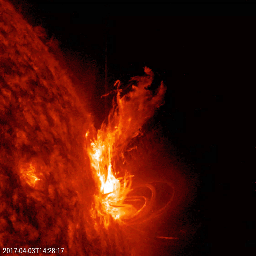
 This week, Justin Kerr examines the impact of stellar flares on the habitability of exoplanets. Of particular interest are M-dwarfs, whose habitable zone lies very close to the star. Much has previously been made of flare activity associated with these stars and the potential effect of that flare activity upon the atmospheres of any planets found within their habitable zone.
(to view a video of the flare above visit
https://photojournal.jpl.nasa.gov/catalog/PIA21584 )

by Justin Kerr

With the search for habitable exoplanets well underway, there has been much talk in popular science of the potential to find life-bearing worlds with telescopes such as Kepler and TESS. One of the most common points I have heard in the popular sphere against finding life with these missions is related to stellar flares. The argument is typically as follows: the transit method used to detect exoplanets with these telescopes mostly finds small stars (of spectral type M, to be specific); these M stars and particularly red dwarfs such as TRAPPIST-1 tend to produce frequent stellar flares; therefore the flares will cause planets to be incapable of maintaining an ozone layer and the life which depends on such a layer. While this is certainly true to some extent, it is not the case that all red dwarfs produce frequent flares and in some cases, stellar flares may even be required for their exoplanets to support life as we know it. In either extreme case, it is clear that an understanding of the possible effects of stellar flares and their frequency is important when evaluating the possibility of life existing on newly discovered exoplanets. 

First of all, are these popular accounts correct about stellar flares making life impossible? The most well-known consequence of stellar flares is their tendency to be accompanied by a Coronal Mass Ejection (CME), something that happens right here in our solar system. In a CME, plasma from the star is launched outwards by strong magnetic fields. The Carrington Event in 1859 was a CME associated with a solar flare which, while not strong enough to cause any atmospheric disturbances beyond intense auroras, did result in massive disturbances to the telegraph systems used at the time. A similar event in modern times would cause extensive problems in our electrical systems, but much stronger events must be considered for highly active red dwarf stars. Not only are these stars more active, but potentially habitable planets must be located much closer to the star than is the case with the Sun in order to receive enough heat to maintain liquid water. This makes them more likely to be hit by strong CMEs, as CMEs release their energy in a narrow and directed region. The main threat of highly energetic CMEs to habitability is their capability to “blow off” the atmosphere of an exoplanet over multiple events, similar in function to a very strong solar wind.

While CMEs are commonly discussed due to their threat to our modern technology here on Earth, the removal of the ozone layer by stellar protons from flares is much more concerning for exoplanets around small stars. Studies such as Tilley et al. (2019) have shown that flares with energies of about two orders of magnitude stronger than the Carrington event that occur once a month or more would be enough to make an exoplanet incapable of maintaining an ozone layer. This would lead to the sterilization of the exoplanet’s surface by the excess UV radiation, in an extreme version of the ozone layer hole on Earth which is only now beginning to recover after the Montreal Protocol stopped the widespread use of CFCs. A recent study by Günther et al. (2020) that examined 1228 flaring stars found in the first exoplanet hunting dataset released by TESS found that about 100 of the stars would meet the flare frequency requirements to eliminate the possibility of an ozone layer on their associated exoplanets. While this is certainly a concern, this still leaves a large amount of red dwarf associated exoplanets presumably without this problem. 

These negative aspects of stellar flares are not the only way in which flares can affect exoplanets. There are in fact multiple ways that flares may instead support or even be required for the development of life. Since red dwarfs have low UV output, some exoplanets within the habitable zone may not receive enough UV light to support the prebiotic chemistry that life as we know it is based on. Of particular interest is the reaction that produces the RNA, which is required by life, as it only occurs in the presence of UV light. Since stellar flares can produce extra UV light, they could fill in the missing energy to allow prebiotic chemistry to occur around stars where it would otherwise be impossible. In the same study of flaring stars from TESS, Günther et al. found 14 stars where this may possibly be the case. While this is less than the amount of exoplanets where flares would make life impossible, ignoring the positive benefit of flares could cause us to miss habitable exoplanet candidates. 

Stellar flares are certainly a danger to the habitability of exoplanets around red dwarfs, but we have seen that this by no means eliminates the possibility of life on all them and in some cases may even be necessary. Instead of dismissing flares as a negative, we must instead study their effects and frequency in order to better predict where we might find new life. So the next time you hear a YouTube video or see an online comment suggest that life around red dwarfs is impossible thanks to flares sterilizing them, make sure to do a bit more research!

Monday, November 30, 2020

Arecibo, A Giant in the Field

This week, Conor Hayes pays tribute the Arecibo Radio Telescope. You may know it in connection with SETI (or perhaps from movies!) but its ability to make observations along the ecliptic made it one of Planetary Science's most effective instruments. Unfortuately, the telescope recently experienced a structural failure which will require its demolition. 

Photo above:  The Arecibo Observatory as seen in June 2019. (CC BY-SA 4.0, https://commons.wikimedia.org/wiki/File:Arecibo_Radiotelescopio_SJU_06_2019_7472.jpg)

by Conor Hayes

On November 19, 2020, the astronomical community lost a (literal) giant. Following the failure of two support cables that made repair work dangerously unsafe, the National Science Foundation announced that they would be decommissioning the Arecibo Observatory. This 305-metre radio telescope has faithfully watched the skies for nearly 60 years, during which time it became perhaps the most well-known telescope on the planet, appearing in popular media like GoldenEye, Contact, and The X-Files. Its loss will be felt by all of us, most acutely by those who have dedicated their lives to radio astronomy. Given this, I felt it was appropriate to write a little bit about radio telescopes in general, as well as some of the notable discoveries made using Arecibo.

Why was Arecibo so large? When designing a new telescope, you need to balance the quality of the data it can output with how expensive it will be to build. The resolution of images taken by a telescope is covered by the following equation: R = λ / D, where R is the resolution, λ is the wavelength of the light you are observing with, and D is the diameter of the telescope’s primary mirror or objective lens.

From this equation, you can see the two-front war that radio telescopes are fighting. As with all telescopes, the larger your light collection area is, the higher resolution your data will be. However, radio telescopes face an additional problem, in that radio waves have the longest wavelengths of all electromagnetic radiation. Because the wavelength appears in the numerator of the resolution equation, observations done on, say, a 10-metre radio telescope will be significantly lower resolution than observations done on a 10-metre optical telescope. This means that radio telescopes must be significantly larger than those used to observe at shorter wavelengths if they want to achieve a comparable resolution. Fortunately, because radio waves are less impacted by small-scale imperfections in the telescope’s surface, we can get away with constructing them out of sheets of metal (or even a fine metal mesh!) rather than carefully-polished mirrors, greatly reducing the cost.

Of course, actually building and maintaining such a large structure is still massively expensive, to the point that Arecibo spent much of the last 20 years of its life under constant threat of being shut down due to funding shortfalls. To avoid this, many radio observatories, like the Very Large Array (VLA) in New Mexico, the Atacama Large Millimeter Array (ALMA) in Chile, and the upcoming Square Kilometre Array (SKA) in Australia and South Africa, use a technique called very-long-baseline interferometry (VLBI) to combine a large number of smaller telescopes into one telescope with a much larger effective collection area. VLBI was most recently leveraged to combine many radio telescopes across the planet into the Event Horizon Telescope, which took the first direct image of a black hole.

As the largest radio telescope in the world from its completion in 1963 to the construction of the Five-hundred-metre Aperture Spherical Telescope (FAST) in 2011, the Arecibo Observatory was at the forefront of radio astronomy and contributed to a number of important scientific discoveries.

In our own Solar System, Arecibo was used to determine that Mercury has a rotational period of 59 days, rather than being tidally locked as was previously assumed. Relevant to my own research into ice in the permanently shadowed regions (PSRs) of the Moon, Arecibo made some of the first radar measurements of ice in the PSRs of Mercury, observations that were later confirmed by the MESSENGER spacecraft.

Elsewhere in the universe, Arecibo was responsible for a number of other “firsts.” In 1968, scientists using Arecibo measured the rotational period of the Crab Nebula pulsar, which provided the first direct evidence of the existence of neutron stars. Just six years later, Arecibo produced its first Nobel Prize-winning research in the form of the discovery of a binary pulsar system. This system was found to have a gradually decreasing orbital period, which is consistent with energy loss in the form of gravitational waves (though gravitational waves would not be directly measured until 2016). Though the search for exoplanets has been popularized by space telescopes like Kepler and TESS, it was actually Arecibo that first found extrasolar planets due to irregularities in the measured rotational period of a pulsar. To date, one of these still holds the record for the smallest known exoplanet, with a mass around twice that of the Moon.

Finally, Arecibo played a key role in the Search for Extra-Terrestial Intelligence (SETI) and Messaging to Extra-Terrestrial Intelligence (METI) programs. Arecibo was one of the primary telescopes used by the SETI Institute to listen for possible communications from extraterrestrial life, and in 1974 broadcast a short message containing information about humanity and our location in the galaxy to M13, a globular star cluster located 25,000 light years away. Although seen as reckless and possibly dangerous by many, it is widely accepted that nothing will come of this message due to the vast distances involved.

 
The Arecibo Message, which was sent from the observatory towards the globular cluster M13 in November 1974. It contains information on the genetic structure of humans, our physical characteristics, and how to find us. Many felt this was a dangerous amount of information to be sending to a hypothetical alien civilization whose motivations were unknown. (CC BY-SA 3.0, https://commons.wikimedia.org/wiki/File:Arecibo_message.svg)

The Arecibo Observatory will certainly be missed, but it leaves behind a vast and rich legacy of scientific discoveries. With FAST now operational and the 100-metre Green Bank Telescope still in good working order, along with a number of existing and new interferometric arrays around the planet, the world of radio astronomy continues to be well-served. Though the end of this particular telescope’s career was perhaps more abrupt than some might have imagined, it is leaving us having done more than its fair share of the hard work of advancing our knowledge of the universe.

Friday, November 27, 2020

Mars’ Family of Rovers

In this week's post, Grace discusses the different rovers that have been to Mars in response to a query from her sister. One of the most important things we can do as scientists is to translate the excitement and meaning of what we do for the public. (above) Image credit NASA/JPL-Caltech.

By Grace Bischof

A few days ago, I received a text message from my sister asking for a fun space fact to tell the 5-year-olds she teaches who are “super into space”. I thought about all of the interesting things I’ve learned since joining PVL, from both my own and other lab members’ work, but was pretty certain that the seasonal variation of methane on Mars might not be very interesting to young children. Having just finished shadowing my first MSL shift, I had the Curiosity rover on my mind. I realized that Curiosity has been roaming the Martian surface for longer than the kids in her class have been alive. I told my sister to explain to the students that Curiosity is older than them; they might not have found it a very fun fact, but I sure did.


So what other rovers are there on Mars, and how old are they? Let’s work from youngest to oldest.


Assuming the landing goes to plan, the Perseverance rover should touch down in Jezero Crater on February 18th of 2021 as part of the Mars 2020 mission. If the age of the rover starts at landing, Perseverance might still be considered a zygote rover. Regardless of its infant age, Perseverance is set to be the largest rover to touch down on the Martian surface. Weighing in at 2260 lbs, Perseverance is approximately the size of an SUV. Perseverance is equipped with 7 instruments and has the ultimate goal of searching for signs of past or present life on MArs.


Curiosity is the second youngest rover that is currently on Mars. Landing on the red planet in 2012, Curiosity is set to reach its 3000th sol in early 2021. Curiosity resides in Gale Crater and has traveled more than 21 km in its 8 years of operation. The MSL mission had 8 main objectives, which largely centered around determining if Mars was ever hospitable to life. The rover is equipped with 10 instruments, including the Rover Environmental Monitoring System and the Sample Analysis at Mars, which help to understand the meteorology and atmospheric gases on Mars, respectively. Curiosity’s many cameras have captured interesting Martian features, such as the major dust storm in Martian Year 34. In its 8 years on the planet, Curiosity has been an indispensable asset to understanding the habitability of Mars.


Leaping back 17 years, the twin rovers, Spirit and Opportunity, landed at separate locations on Mars in January 2003. Smaller than Perseverance and Curiosity, the twins are about the size of a golf cart. Spirit and Opportunity are the fastest rovers to roam mars, moving at a neck-breaking speed of 0.16 km/hour. Primarily, Spirit and Opportunity were to identify rocks and soil from the Martian surface. Though originally planned as a 90-sol mission, Spirit traveled the dusty plains of Mars until May 2009, when it became stuck in soft soil. Attempts to free Spirit from the soil were carried out for 9 months, but were eventually abandoned. Spirit acted as a stationary instrument until it lost connection to Earth in March 2010. Opportunity stayed active until June 2018, losing its signal to Earth after its solar panels were covered in dust from the MY 34 dust storm. Opportunity holds the record for most distance traveled on a non-Earth world, having driven a total of 42.2 km during its 11 active years. 


Opportunity: Planetary Marathoner. The Opportunity rover has covered more ground than any other rover on an extraterrestrial surface.
Credit: NASA/JPL-Caltech - https://mars.nasa.gov/resources/6471/driving-distances-on-mars-and-the-moon/


The oldest rover to land on Mars is called Sojourner, and landed on the planet in July 1997 (which makes Sojourner older than me by one year). Sojourner is much smaller than its younger siblings, resembling a microwave-oven in size. Carrying only 2 instruments, Sojourner took hundreds of pictures of the Martian surface, and sampled Martian rocks and dirt. Sojourner operated for 83 sols, surpassing its original mission by 53 sols. By the end of its lifetime, Sojourner had traveled 100 m.


The family of Mars rovers has been growing since 1997 and is set to become a family of 5 once Perseverance arrives early next year. Through incredible science and engineering feats, we have been able to explore the surface of an entirely different planet from Earth for the past 23 years. I, for one, am excited for the next 23 years of Mars exploration – and maybe by then I can think of a cooler space fact to tell a bunch of 5-year-olds.


For more interesting information on the rovers, see: https://spaceplace.nasa.gov/mars-rovers

Thursday, November 26, 2020

K2-141b: I can see your halo


This week, PhD Student Giang Nguyen talks about his recent paper discussing lava planet K2-141b. This planet's extreme atmospheric conditions set up a stable ring of clouds just beyond the edge of a large lava ocean centered on the subsolar point. Examples of other large stable annular features on planets include the auroral ovals of the Earth and Jupiter. The photo above was captured by the Imager for Magnetopause to Aurora Global Exploration or IMAGE satellite.

By Tue Giang Nguyen

A few weeks ago, my paper on modelling the atmosphere of K2-141b was published. There was a press release and quite a few news organizations picked up on the story such as CNN and CBS. The public seemed excited by the idea of a scorching planet half engulfed in lava with supersonic winds and molten rock raining from above. Many have started to call K2-141b Mustafar, a fiery world Darth Vader calls his home as envisioned by George Lucas. Others, correctly so, shared how grateful they live on this blue Earth rather than K2-141b. Although K2-141b is described as a hellish landscape, from afar, I think there’s something to be admired from our little lava planet.


As K2-141b is tidally locked, there is a permanent dayside and nightside on the planet. This means that certain meteorological processes exist in only specific parts of the planet, mainly clouds. Near the sub-stellar point where it is hottest, the air is not saturated with mineral vapour so nothing condenses. Far away from the sub-stellar point, it is too cold and virtually all of the atmosphere has collapsed back onto the surface and nothing condenses. This means condensation, or cloud formations, can only exist in an annulus centered around the sub-stellar point.


In essence, when looking at K2-141b from afar, we should see a ring of clouds around the sub-stellar point. And if you adjust your perspective such that the star is directly overhead on K2-141b, the ring faces upward which makes it a halo! K2-141b has a halo of clouds which is made up of quartz-based gems, how cool is that? This should be the case for other lava planets as well where the planet’s crust, and atmosphere, is dominated by oxidized silicon. Although with this analogy, Earth also has a cool “halo” which is the aurorae (Borealis and Australis).


An "eye-ball" planet in which the heat of the star creates a large ocean centered on the subsolar point. In the case above, the working fluid is water and the solid ice, but if you get close enough to the parent star, rock will also melt and form an ocean, ringed by clouds. Image Credit: NASA/JPL-Caltech https://commons.wikimedia.org/w/index.php?curid=56552366


For atmospheric modelling, the cloud halo acts similar to the “eye-ball” icy Earth scenario where the sub-stellar point of the icy Earth is an ocean that slowly freezes as you move further away. The middle circular ocean resembles an eyeball that is surrounded by an icy surface that has a much higher albedo. A reflective cloud halo would behave similarly to ice as it reflects more light than then bare magma ocean of K2-141b. Although this is a classically hard problem in climate modelling, we can study some limiting cases that arise from K2-141b’s halo. The albedo of the clouds can be measured which helps us determine cloud properties such as particle size and back-scattering efficiency (dependent on cloud composition and crystal geometry).


Now that my work on K2-141b has expanded to include radiative transfer and cloud formations, I am also collaborating with more scientists. Among them are astronomers from the Max Planck Institute, climatologists from Oxford and Chicago. Their expertise on modelling and observing exoplanets will help to make much more accurate descriptions of the K2-141b’s meteorology, surface composition and interior dynamics. While what we predicted about the weather on K2-141b is frankly mind-boggling, I believe the planet has even more interesting things to tell us.