Monday, February 28, 2022

Penitentes: What’s Hidden In The Ice?

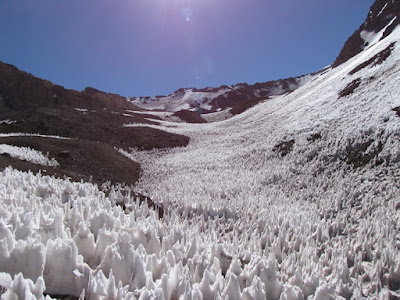
This week, one of our first year MSc students, Madeline Walters, considers the recent discovery that penitentes (pictured above) extend the altitude range of habitable environments for terrestrial bacteria. What implications could this have for other planetary environments within our solar system on the cusp of habitability?
[ Image Credit: dreamX ]

By Madeline Walters

One way to look for life beyond Earth is to see in which extreme conditions life already exists. Spread over the high altitude, extremely cold and arid wilderness of the Atacama Desert in Chile, are strange ice formations which may be important for future investigations of life beyond our planet. A study led by researchers from the University of Colorado Boulder found that these spire-like formations, called penitentes, act as a home to microbial life forms. This discovery is important for astrobiological research and implies that life may be able to form elsewhere in the solar system in similar extreme conditions.

Snow algae is commonly found in icy areas in the cryosphere, however, not so commonly at extreme elevations in hyper-arid environments. The harshness of these environments show life can form in extreme temperatures and altitudes, environments which are similar to areas on other planets in the solar system. Structures similar to penitentes found on Earth have been identified on Pluto, and perhaps on Jupiter’s moon Europa (currently a heavy debate), which points out the possibility they could exist elsewhere in the Solar System as well. In order to see if we can find similar formations on planets such as Mars, where similar extreme conditions exist, we have to understand how penitentes form.

Incoming solar radiation hits areas of lower density snow, which causes melting and sublimation-the process in which a solid directly transitions to a gas without passing through a liquid state. Once the sublimating areas begin to form, these bowl-shaped depressions which are made of very reflective ices concentrate the incoming light at the center of the depression, self-illuminating and deepening the depressions. It is within these formations that life can be found hiding from the sun.

In March 2016, Steve Schmidt, a microbial ecologist at the University of Colorado Boulder, and his team discovered red smudges on meter-tall penitentes at an elevation of around 5,300 meters. After analyzing DNA sequences of these red smudges, it turned out the samples matched that of snow algae Chlamydomonas nivalis, which was previously found living in extreme conditions on Mount Kilimanjaro, the Swiss Alps, and Antarctica.

This algae was found to be red due to the color acting as a protective barrier for the organisms-it helps to reflect some of the incoming radiation, which is re-emitted and warms the surrounding area around the algae creating liquid water. The discovery of this life living in such an extreme environment poses an important question- does this mean life can form in similar conditions off-planet? Knowing the limits and extremities in which this kind of life can exist is important for answering that question. How much radiation can this algae withstand, and to which altitude and temperatures can they survive? Although penitentes have not been conclusively found on Mars, we can model their formation on the planet using what we know about how and where they form, as well as our knowledge of Mars’ atmosphere and climate and its dust and ice interactions to perhaps one day conclusively find these structures, and perhaps more, beyond Earth.

To learn more:


UC Boulder study article:
https://eos.org/articles/microbes-spotted-on-blades-of-ice-high-in-the-andes 

Europa Debate:

Reply to: Penitente formation is unlikely on Europa | Nature Geoscience

Monday, December 13, 2021

James Webb Space Telescope on Track to Launch Dec. 22

When the James Webb Space Telescope (JWST) was conceived, the first exoplanet had only just been discovered. Now we have thousands of examples of these distant worlds. Luckily, it turns out that even though this instrument was designed for a different era to answer different questions, it is also an excellent tool for advancing exoplanetary science. This week, our newest recruit at PVL considers the upcoming launch of this greatly anticipated new space observatory.
(Above: JWST during testing. Image by Northrop Grumman)

 by Madeline Walters

The James Webb Space Telescope (JWST) is NASA's most powerful space science telescope ever constructed. In partnership with the European Space Agency (ESA) and the Canadian Space Agency (CSA), the telescope will provide improved infrared resolution over Hubble, and will give us a glimpse at some of the most distant objects in the universe, such as potentially habitable exoplanets. Unlike the Hubble telescope, the JWST observes in a lower frequency (higher wavelength) range, allowing it to observe objects that are too old and far away for Hubble to observe. The development for the telescope began in 1996, and the initial launch was planned for 2007, but this ended up being delayed due to cost and construction issues. Now, after many delays, the final launch date has been set for December 22nd. 

One important problem the JWST might help us solve is the issue in figuring out how a specific type of exoplanet, sub-Neptunes, are formed. These planets are larger than Earth and smaller than Neptune, though researchers have found it difficult to understand how they form. The key to understanding the formation of sub-Neptunes is their atmospheres, using a technique called transmission spectroscopy to figure out what an atmosphere is made of based on transmission spectrum patterns. 

Though transmission spectroscopy has been successful for other types of exoplanets, it's difficult to use on sub-Neptunes due to an abundance of aerosols which scatter the light from their stars, making the determination of specific spectra impossible. With the JWST, however, researchers will be able to get a clearer view of these planets, using the telescope's specific frequency sensors to more closely examine the atmospheres. 

One research team will use the JWST's Mid-Infrared Instrument (MIRI) to observe a sub-Neptune, GJ 1214 b, orbiting a nearby red dwarf star. The team plans on observing the system for a continuous 50 hours, around the amount of time it takes for GJ 1214 b to complete a full orbit, and then analyze the collected data to learn about the atmosphere. One way the team will analyse the data is by using transmission spectroscopy, as mid-infrared light shouldn't be scattered in the same way as near infrared light by any of the atmosphere's aerosols. Using the mid-infrared light emitted by the planet due to the absorption and release of radiation from its star, the team will also use thermal emission spectroscopy to learn about the planet's temperature and light reflectivity. Using a technique called phase curve temperature mapping, they will also be able to determine the average surface temperature with respect to longitude using the telescope's sensitive instruments, providing important information about the contents of the planet's atmosphere. 

Due to a delay caused by some vibrations, the launch date of the JWST was moved to December 22nd, though if all goes well, we should be able to watch the launch of the telescope in a few weeks. The revolutionary technology aboard the telescope brings us a new era of space observation and will shed some light on previously unknown cosmic history. Being able to learn more about exoplanets, and unravel secrets about the beginning of time; the JWST will be an extremely powerful tool that helps us answer important questions about the origins of the universe and our place in it. 

Tuesday, November 30, 2021

Applied CS & Space Science Research: An Undergraduate Perspective

 
One of my favourite parts of working in a research group is the opportunity to bring together a diverse set of students. Such a group has a tendency towards creative thinking that generates unexpected insights which propel our work forward. Not to mention the shear fun of working in this kind of an environment. In the past, we've had space engineers, geologists, physicists, atmospheric scientists and former history, political science, music and photography majors. Recently, Vennesa Weedmark, a Computer Science undergraduate here in Lassonde joined our lab. Read about their reflections on the experience below.
(Image via: https://www.csecoalition.org/what-is-the-typical-computer-science-curriculum/ )
 
by Vennesa Weedmark

As an undergraduate computer science student, the push to get an internship and/or co-op has always seemed paramount – partially because experience is “everything” in the industry and partially because an alternative avenue, a position working on a project in a research lab, for example, is rarely discussed. While I don’t deny the practicality of gaining experience in a corporate setting, a scholarly approach provides different kinds of challenges that in turn may allow broadening of a student’s horizons – an opportunity for creativity and a different take on problem-solving skills. 

Having started very recently in PVL, I was surprised at the reaction of many of my fellow CS students, who didn’t even realize that working on projects under the supervision of our professors was possible. Making the revelation even more fascinating was that my pursuit of a research assistant position was in a field outside our collective major discipline.

In a field as diverse as computer science, where we are constantly assured that the possibilities are endless, it would seem almost unremarkable for an adventurous CS student to pursue a scientific area in which they are interested under the umbrella of a research lab. The case for research assistant positions as an internship/co-op type of work experience is further strengthened by the science breadth requirement baked into our degrees; the possibility of working in a lab may encourage students who might otherwise see those courses as unnecessary to the industry. Taking my experience as an example: I have always been interested in programming in a scientific context but taking physics courses as part of my science-breadth requirement encouraged me to gain a deeper understanding of the type of field in which I might be interesting in working. As I’ve progressed through the years, I realized my curiosity went beyond the data-analysis discussions I've had in a classroom setting, which in turn led me to search for a way to pursue a deeper involvement in astrophysics-flavoured data analysis. 

These kinds of positions give an entirely different perspective when learning and applying computer science – creativity, responsibility, and communication skills (all valuable points on a resume) are given equal weight alongside coding ability and language skills. My current role at PVL is an excellent example of this: by analyzing a series of photos (read data) taken of the Martian surface, we hope to find evidence of triboelectricity. To do this, I am writing scripts to mask sources of light which can then be applied to the images; thus, allowing only those points of light relevant to the analysis to shine through. The creativity part comes in the use of 3rd party libraries: since only the end goal is known, and there is no guarantee that the supplementary code we are relying on will work in this case, errors become even more mysterious – were they the result of an error in the code itself, or in one of the many imports that are being used? How do you go about understanding code that may be based on incomplete or incompatible libraries? In applying our knowledge to our schoolwork as undergraduates, many examples of very similar problems are easily found online – in research, that foundation upon which to fall back, if it exists at all, is significantly reduced.

I in no way mean to diminish the importance of the concepts and methodologies we are taught to manipulate at the undergraduate level; these are just as necessary for the problem-solving process that is at the core of research. The elation of solving a problem is further heightened when there is no one on the other end with the answer and those intuitive leaps that are nigh impossible to teach in a classroom setting are, in my limited experience, the core of learning to code in the context of scientific analysis.

Wednesday, November 17, 2021

PVL's First In-Person Conference in over 2 years


For many academics, we can point to a moment when everything just clicked and we realized that this life was for us.  Often, that moment occurs at a conference. Conferences give you the chance not just to present your own work to others, but to learn what they are doing and to ask each other questions. There are social events and networking opportunities that can help your career. Even moments of inspiration. But most of all, it's about being immersed in the intellectual life of the field to which you have devoted yourself. I'm sorry, but virtual and on-line conferences just can't compare. The new MSc students, unfortunately, had spent their entire careers in the virtual world, at least until a few weeks ago.
(Image above courtesy of Conor Hayes and Western University Earth Sciences)

by Conor Hayes

With nearly all of my Masters spent online, my graduate school experience has certainly not been exactly what I imagined when I began applying during my last year of undergrad. The group here at the Planetary Volatiles Lab has played a big role in keeping me sane over the last 15 months or so (and was indeed a significant reason why I accepted John’s offer to join PVL in the first place!). Though we’re still not yet in the clear, it’s starting to look like there’s a light at the end of the tunnel. If all goes to plan, York will be transitioning back to in-person classes this January, hopefully bringing back some sense of normalcy to this very strange period in our collective history.

While some aspects of the “typical” grad school experience, like colloquia and journal clubs, have survived the online transition fairly well, one big part has not fared quite as well: conferences. Since starting at York, I have attended several online conferences, including the Physics and Astronomy Graduate Student Conference, the Lunar and Small Bodies Graduate Forum (LunGradCon), and the Europlanet Science Congress (EPSC). Though I lacked a proper reference, having never attended a conference during undergrad, these online conferences seemed a bit “hollow”, for lack of a better term, without the kind of “realism” that comes with face-to-face interaction.

For this reason, I was excited (and a little bit nervous) to learn that we would be attending the annual joint meeting of the Geological and Mineralogical Associations of Canada, more efficiently known as GAC-MAC. On its face, this might seem like an unusual conference for our group to attend, since we are neither geologists nor mineralogists. However, we had been invited to help contribute to a special session, titled “Remote Sensing of the Earth and Planets” (and contribute we certainly did).
 
I have been told that submitting an abstract to a conference can be a good motivator to get work done, and that was certainly the case here. The month leading up to GAC-MAC was a frenzy of activity as I prepared results to present, and I’m pretty certain that I was more productive in the last half of October than I was in the previous six months combined. I was assigned a poster presentation by the conference organizers, which was a new challenge for me. I wanted it to be relatively self-explanatory while not being stuffed full of tiny text, so I eventually settled on adding a QR code that linked to a website where I wrote up the details of my project in much greater detail than the poster’s limited space would allow. (Ultimately, only one person ended up scanning that QR code, but I still view the website as good practice for when I eventually have to write my thesis.)

The conference itself took place from November 2nd to November 5th at Western University in London, Ontario. It was a relatively small affair, with a few hundred in-person attendees. Oral presentations were organized into six themed tracks: Tectonics and the Precambrian, Geoscience and Society, Mineralogy, Earth and Planetary Processes, Resource Geoscience, and Life and the Environment. I, along with most of the rest of PVL, stuck with Earth and Planetary Processes, both because it was the track in which our presentations were placed in and it was the one with which we were most familiar. Perhaps it was a missed opportunity not to explore the other tracks, but I found that the presentations generally assumed a certain level of background knowledge that I definitely do not have in any of the other areas, so I probably would have been hopelessly lost.

A particular highlight were the three plenary lectures, which seemed to be geared towards a more general audience than the quick 15-minute oral presentations. Though they were quite lengthy, I did not find my attention wandering elsewhere, which was quite impressive given that I frequently have difficulty focusing on any one thing for an extended period of time. The Thursday lecture, which was given by Dr. Robert Hazen on his work developing an evolutionary system for mineralogy, was my favourite of the three, as it combined mineralogy (something that I have essentially no background in) with planetary evolution and the history of the universe (which I am much more familiar with) to create a unique way of classifying minerals in a more meaningful way than the current standards.

Going into my poster session Thursday evening, I didn’t really know what to expect. I was a bit nervous because, unlike an oral presentation where you have a quasi-captive audience, there was no guarantee that anyone would be interested in hearing what I had to say about my work, particularly given that most of the other attendees were doing very different work than I was. Despite this (and perhaps because of it), I still had lovely conversations with five or six people, most of whom admitted that they knew nothing about lunar PSRs and let me info-dump on them. In a way, it reminded me of my favourite outreach projects, where I get to talk about the things that I love with people who don’t necessarily immerse themselves in those things on a daily basis.

Unfortunately, outside of our respective presentations, there was not much interaction between PVL members and the other attendees. This could be blamed on the fact that most of the social activities were, due to COVID restrictions, held outdoors, where we were greeted by an uncomfortable and unseasonal chill. That did not stop us from holding our own events though, whether that be meals together (either inside or outside of the hotel) or just existing in the same room as a group.

I don’t know if I came away from GAC-MAC with a much more comprehensive knowledge of either geology or mineralogy than I went in with. I still think this was a successful conference though, and not just because of how well our presentations went. Even if it was just for four days, being able to see the other lab members as more than a head in a box on a screen reminded me of how much I miss being around other people. Going back to Zoom group meetings has been a bit melancholic as a result, but I am hopeful that we’ll all be able to work together again before I graduate.

7 out of 10 PVL Group members at GAC-MAC


Thursday, November 4, 2021

Is this the Best Time for Outer Solar System Missions?


Planetary missions can't launch at any point. Instead we must wait for the stars to align, literally! Low-energy trajectories to the planets which maximize the amount of science payload that we can take along for the ride are only available at certain configurations of the earth and the destination around the sun. However, by using flybys of other planets to provide gravity assists, we can start missions at a wider variety of times and, in some cases, can travel to the outer solar system even more efficiently.
Above: Illustration depicting Cassini’s trajectory to Saturn with multiple gravity assists
(Image Credits: NASA JPL)

By Ankita Das

A few days ago, I was speaking to a colleague of mine about outer solar system missions. We discussed how there are so many unexplored moons, each unique in its own way but only a handful of spacecraft have ventured into the depths of the outer solar system. In the conversation, my colleague, whose research involves studying the plumes of Saturn’s moon Enceladus, said in an upset tone “I don’t think we will have another Cassini anytime soon unless it is privately funded." So, when I was asked to write my first blog at PVL, this was the first topic that came to mind. 

I have always found the outer solar system to be an exciting place to conduct scientific investigations. When I was growing up, Cassini was the only mission that was actively orbiting and studying the Saturnian system. Previously, Galileo had studied the Jovain system in detail and the Voyager missions had flown past the gas giants. The data from these missions informed us about the diversity of the moons and the possibility of these moons having subsurface oceans, possibly indicating habitability. In relatively recent times, the New Horizons mission and Juno were added to the slowly growing list of outer solar system missions. Despite the data from Cassini and Galileo, as a young teenager I often wondered why we didn’t send more missions to explore these moons. Today, as a graduate student having studied interplanetary missions to certain depth, I can see why sending spacecraft to the outer solar system can be challenging. But, I am even more convinced that there is precious science that awaits us there. 

The first challenge that I could think about was the challenge of finding a good power source for the spacecraft. Most of the interplanetary missions within the inner solar system are solar powered. The issue with having a solar powered spacecraft in the outer solar system is that the power received diminishes drastically with distance and it gets harder to run an elaborate suite of scientific instruments with limited power. Mathematically speaking, it diminishes as (1/distance squared). Mars orbits approximately at 1.5 AU, while Jupiter and Saturn orbit further at ~ 5 AU and 9.5 AU. Thus, the solar power received at Jupiter is approximately 1/25 that of what is received on Earth. While, the power received at Saturn is almost 1/100th of what is received on Earth. It is due to this constrain that most of the existing outer solar system missions are powered by Radioisotope Thermoelectric Generators (RTGs). Simply put, RTGs are powered by the radioactive decay of heavier elements like Plutonium into relatively lighter elements. This decay produces energy which can be used to power spacecraft which have limited access to solar energy. So why aren’t we sending a whole bunch of missions powered with RTGs to the outer solar system? The answer is cost and limited availability of the Pu-238. Power from RTGs, however efficient, does come at a price. Another drawback of using RTGs to power spacecraft is that the power produced decreases over time as the abundance of the heavier element decreases. 

Keeping in mind the approximate distances mentioned above, while designing an interplanetary mission, we also need to take into account the vast distances a spacecraft needs to traverse in order to reach orbits beyond Jupiter. The larger the size of an orbit, the greater its energy. Therefore, such trajectories require higher quantity of propellant, which might result in a decrease of the mass budget of scientific instruments on the spacecraft. So, how did spacecraft like Cassini and Galileo make it to the outer planets? The solution is known as gravity assist where the gravity of a planet is used to increase the relative velocity between the spacecraft and the Sun. Typically, the trajectory employed is known as Venus- Earth Earth Gravity Assist (VEEGA). However, in the future, with the advent of more powerful launch vehicles like the Space Launch System (SLS), the number of gravity assist maneuvers required will be reduced, potentially leading to a shorter time spent in the cruise phase. 

The challenges arising from vast distances between Earth and Outer Solar System planets doesn’t end here. Communication with the spacecraft starts to become an issue at such distances. Although the communication between the spacecraft and receiving stations on the Earth happens through radio waves which travel at the speed of light, it can take hours for communications to reach these distances. This implies that operations of such missions must be planned carefully and requires an elaborate team operating round the clock to monitor and operate the spacecraft.

So why invest in such costly missions? Without doubt, the icy moons of the outer solar system show great potential when it comes to scientific discoveries and exciting research. The chances of habitability in the inner solar system planets (apart from Earth obviously) are thin. In contrast to this, the moons in the outer solar are promising candidates for a habitable environment to say the very least. Moons like Titan are rich in complex organics . Moons like Europa and Enceladus have possible oceans beneath the surface which could harbor life. In addition to this, such environments also provide exciting opportunities to study small body interactions – between moons and within the rings of Saturn.  Despite being investigated by missions like Cassini and Galileo, gas giants are still poorly understood. The interiors of these planets very much still remain a mystery. Understanding these gaseous planets will also improve our knowledge about mechanisms in the interiors of exoplanets and young stars. 

These are just few of the many reasons why we should explore the outer regions of the solar system more actively. With the given improvement in technology, we should invest more in missions like JUpiter ICy moons Explorer (JUICE), Europa Clipper, and Dragonfly which will be studying the Jovian system, Europa, and Saturn’s moon Titan, respectively, in the upcoming decade. Until then, we will keep wondering about these ice-rich and organics-rich worlds.

Wednesday, October 20, 2021

Seeking Knowlegde of Indigenous Astronomical Perspectives

 Recently, the members of PVL have been reflecting on Indigenous contributions to the fields in which we conduct research. Below, MSc student Grace Bischof describes some of the materials that she has encountered as part of her own reflections. As guests in this area, it is important for us to highlight and to respect the voices of Indigenous speakers in their own words.
(Image above: Artwork depicting Ojibwe cosmology.
CC BY-SA 3.0, https://commons.wikimedia.org/w/index.php?curid=2851171)

by Grace Bischof

On September 30th of this year, Canada held its first National Day for Truth and Reconciliation. This day serves to honour Survivors and those who lost their lives at residential schools, as well as their families and communities. It is essential to continue along the path of reconciliation, including acknowledgement of the ongoing trauma that residential schools cause on the Indigenous community. One aspect of the healing process is for those of us who are not Indigenous to learn about, and truly appreciate, Indigenous culture. 

As astronomy enthusiasts here at PVL, I thought this would be a good opportunity to reflect on astronomy within Indigenous culture and to take a look at the universe from outside the typical European-centered lens. I will provide links to this information below, as well as YouTube videos by Indigenous people, as it is important to hear this information from Indigenous people themselves. 

Many Indigenous cultures used the sky for both practical and spiritual purposes. The movement of celestial objects were used for time-keeping and navigation. Patterns were found amongst constellations and Sky Stories were developed from these patterns, often used as a way to ponder our place in the universe. In Anishinaabe culture, they refer to themselves as star people because of the belief of a cyclical life – humans come from the stars and will go back to them when passing on to the spirit world. Sandra Laronde, who is Teme-Augama-Anishinaabe, created a dance to capture this idea. The dance opens with Sky Woman, an important figure in Anishinaabe mythology, coming through a hole in the sky and bringing the gifts of life. 

Hilding Neilson is Mi’kmaw and a professor at the University of Toronto in the department of astronomy and astrophysics. Neilson incorporates Indigenous astronomy into his teaching because current astronomy curriculum ignores the knowledge acquired by Indigenous people. He uses “Two-Eyed Seeing”, which integrates both Western science and Indigenous teaching, resulting in a fuller understanding of astronomy. Neilson also reflects on current-day astro-colonialism. Large telescopes are built on Indigenous territories and their use comes with many ethical dilemmas. Neilson says, “In the end, it's just a matter of, we have to respect Indigenous rights first and worry about thirty meter telescopes later."

Wilfred Buck, known as “the star guy”, is a member of the Opaskwayak Cree Nation. Buck is an Indigenous star lore expert, working as a science facilitator at the Manitoba First Nations Education Resource Centre.  Similar to Hilding Neilson, Wilfred Buck emphasizes the importance of teaching the Indigenous perspective in astronomy. For example, the Cree name for the Northern Star is Keewatin (‘Going Home Star’) or Ekakatchet Atchakos (‘stands Still’). Having this perspective when teaching astronomy both educates and allows Indigenous children to connect to their cultural roots. Buck acknowledges that topics such as cosmology and quantum physics were reflected on by Indigenous people, emphasizing the complex understanding First Nations people had about the night sky. Buck now travels to schools, equipped with a planetarium dome, to share this knowledge with others.

Linked below are the articles which provided the information for this blog post

Articles:
Indigenous skies: https://science.ucalgary.ca/rothney-observatory/community/first-nations-skylore
Sandra Laronde: https://www.cbc.ca/radio/unreserved/we-come-from-the-stars-indigenous-astronomy-astronauts-and-star-stories-1.5861762/we-call-ourselves-the-star-people-trace-explores-anishinaabe-star-story-through-dance-1.5864935
Hilding Neilson: https://www.cbc.ca/radio/unreserved/we-come-from-the-stars-indigenous-astronomy-astronauts-and-star-stories-1.5861762/indigenous-astronomies-and-astro-colonialism-1.5865387
Wilfred Buck: https://www.cbc.ca/news/science/indigenous-astronomy-1.5077070
https://www.cbc.ca/radio/unreserved/from-star-wars-to-stargazing-1.3402216/cree-mythology-written-in-the-stars-1.3402227
 
Videos:
A video by Wilfred Buck explaining the Story of the Northern Lights:
https://www.youtube.com/watch?v=fd18NxiH_BQ
Hilding Neilson on Indigenous perspectives in astronomy:
https://www.youtube.com/watch?v=Gjj3UZc7GBc

Resources:
https://www.nativeskywatchers.com/

Tuesday, September 14, 2021

It's meteor shower season once again - but what actually are they?

Anyone who has spent time lying back and casually looking up at the sky has likely seen the fiery trail of a meteor which streak across the sky every few minutes on a typical night. During meteor showers, the rate can increase dramatically and all of the meteors appear to originate near a point called the radiant. This week Justin Kerr discusses the source of these fascinating features of the night sky.
(Image source: NASA/Bill Dunford)

by Justin Kerr

With another year of the Perseid meteor shower drawing to a close next week, many of us have been lucky enough to see quite the show while outside of the city. For those who haven’t, you still have until approximately August 24th to catch a glimpse of it – and if you can’t get a good view by then, there will be more opportunities to see a major meteor shower later in the fall. But what actually are these meteor showers, and why is it that each one appears at the same time each year like clockwork?

Meteor showers are events in which a large quantity of meteors are visible in the sky and all appear to be originating from a single point in the sky. This apparent singular origin is how each of the recurring showers derives it’s name, with the shower taking on a name based upon the constellation which contains that apparent origin of the meteors. The meteors themselves are caused when small pieces of rock (meteoroids) enter the Earth’s atmosphere while traveling at tens of thousands of km/h (tens of km/s) relative to the Earth and begin to burn up. Since the rocks involved in meteor showers are typically only around the size of sand grains, they completely burn up in the atmosphere and never impact the Earth as a meteorite. Even though they are so small, we can still see such bright light as they burn up thanks to the intense heating by friction with the air resulting from their high velocities. Some meteors even leave trails of ionized gases in their wake, giving us a glowing trail to see for a few seconds after the meteor has burned up. The reason they all originate from the same apparent location along with why they occur on a yearly schedule is linked to the origin of these small space rocks.

These large groups of meteoroids striking the Earth are not just bits of rock leftover from the birth of the solar system or visitors from the asteroid belt. They stay in very specific orbits, which gives astronomers a clear clue to their origin. The meteors we see during meteor showers are in fact the remains of comets, which fill their orbit with debris as the ice holding them together melts away each time they pass the sun until eventually they are all that is left. Due to conservation of momentum, the small rocks contained in the comets stay in the same orbit as the comet once breaking free. At this point, we then have an orbit filled with meteoroids ready for Earth to strike instead of one large comet.

The yearly recurrence of meteor showers is simply due to the astronomical definition of the year itself – the (approximate) time it takes for the Earth to complete a full revolution around the Sun. The orbit of the Earth crosses the orbit of each dead or dying comet only at one point. Every time the Earth reaches that point in the orbit each year, it swings through the cloud of meteoroids and gives us a beautiful show in the night sky. Each of the different meteor showers we are familiar with come from the remains of a different comet, and so occur at a different time of the year when the Earth reaches that intersection location in it’s orbit around the Sun. The currently occurring Perseid meteor shower comes from the comet Swift-Tuttle, while the upcoming Orionids are leftovers from the famous Halley’s Comet. There are two meteor showers which are thought to be caused by the remains of asteroids instead of comets, most notably the Geminids originating from 3200 Phaethon, but all others we know of are the result of comets.

While many of us may fear the impact of a whole comet or asteroid, the tiny pieces of them hitting us during meteor showers are an entirely different story. To see for yourself, keep an eye on the sky during the night up until August 24th to catch the Perseids. The best time for viewing meteor showers is typically just before dawn, but any time after dark when the constellation the shower is named after is visible will do. While you will have a much better chance of seeing a meteor if you are outside of the city, it is even possible to catch some here in Toronto – I have even been lucky enough to spot a few while taking my dog for a walk in the cooler weather after dark! For a much better show, you can check out various areas outside of the city with a much darker sky – for areas relatively near Toronto, I can suggest the Torrance Barrens Dark Sky Preserve or a camping trip to Long Point Provincial Park (pandemic restrictions permitting). While the Perseids are nearly finished for the year, some of the other best opportunities for viewing a meteor shower this year are yet to come with the Orionids peaking on the night of October 21st, the Leonids on Novermber 16th, and the Geminids on December 13th. Make sure to keep your eyes on the sky this fall and catch a glimpse of the fiery end of some tiny pieces of comet!