Sunday, October 8, 2023

Two Weeks in Killarney

Outreach is a key component of what we do at the PVL. So when PhD student Conor got the chance to serve as the Astronomer in Residence in Killarney Provincial Park they jumped at the opportunity.
Above: The Sun setting over the Killarney Provincial Park observatory.

by Conor Hayes


Earlier this summer, I spent two weeks at Killarney Provincial Park, located four hours north of Toronto, as part of the Astronomer in Residence (AIR) program run by the York Observatory. The AIR program is very new, having started just last year. I had considered applying last year, but ultimately decided against it given that I was very busy writing up my Master’s thesis at the time.  With that not being a concern this summer, I submitted an application to the program that was successfully approved. I had originally planned to head up to Killarney at the beginning of the summer, but that plan was foiled by me catching COVID for the second time three days before I had planned to leave. Although I felt normal by the time I was supposed to start, we decided to delay my term as AIR out of an abundance of caution.

My actual responsibilities as the AIR were not very heavy. Over the two week period, I was expected to help the park staff run six events: two public talks, two solar observing sessions, and two nighttime observing sessions. This schedule meant that I had a lot of free time to explore the park and the town of Killarney itself, which is about a 15 minute drive from the park. I got a lot of hiking in, which is something that I haven’t been able to do much of since moving to Toronto in 2020. The trails in the park were a bit more challenging than those I was used to, as they involved a lot of climbing up and down steep rock formations. The challenge was always worth it though, as I’d get stunning views of the surrounding area, including Georgian Bay and the La Cloche Mountains.

[Figure 1: Looking out over Georgian Bay from the Chikanishing Trail.]


Heading into the program, I was expecting that the public talks would be the most straightforward part of my time there, since I’ve given several in the three years that I’ve been here at York. The observing sessions were a little more intimidating because I haven’t done much visual astronomy recently and I wasn’t certain how well I’d be able to talk about the sky itself and point people around at interesting objects that they can see just by looking up. Instead, it very much ended up being the opposite.

Part of the reason for the difference between my expectations and reality may have been the fact that this was the first time (other than my Master’s defence) that I was giving talks in-person, rather than online. The mood of the audience can really make or break your confidence, and I was really challenged during my first talk (on our Curiosity cloud observation campaign) by the fact that it began at 8 PM, well after the Sun had set. This meant that I couldn’t actually see the audience at all, so it felt like I was just speaking into a void. The second talk, about the history of the search for lunar water, was almost derailed by a thunderous downpour that broke open the skies about five minutes after I started, but we gathered everyone under the roof of the amphitheatre stage, which turned it into a more intimate classroom-style presentation rather than a public talk given to a large space full of people.

The observing sessions were very different than the public talks. Obviously I did point out things on the sky like various constellations as well as Jupiter and Saturn, but they were more of an opportunity for people to ask me questions about whatever astronomy-related topics they were interested in. I had been expecting this,  but I will admit that I was a little worried that three years of focusing on a very small and specific set of subjects for my Master’s and the first year of my PhD had degraded my general astronomy knowledge. However, this didn’t seem to be the case, and the several hours I spent both weeks talking to visitors about any astronomy-related topics that they had on their minds were honestly probably the best parts of my AIR tenure.

While I did enjoy all of my interactions with the visitors and park staff, the real reason why the AIR program is hosted in Killarney is that it is a certified dark sky site, far away from any major population centres (something that you become acutely aware of when you realize that the nearest large grocery store is an hour away in Sudbury). Although I had been to some fairly dark sites (e.g. the Green Bank Observatory in West Virginia), I had never seen the night sky look like it did in Killarney. The familiar constellations, which are about all you can really see in Toronto, were drowned out by the sheer number of other stars. On several occasions, I just had to lie down on the ground and stare up at the Milky Way stretching itself across the sky. One thing that really surprised me was the number of satellites I could see during the night. In Toronto, it’s easy to see the ISS, but you’ll never really see any more than that. In Killarney, I would see one steadily marching across the sky about once every ten minutes for an hour or so after sunset.

[Figure 2: Close-ups of the Moon as seen through the Killarney 16-inch telescope, named Kchi Waasa Debaabing, Anishinaabemowin for “Seeing very far (as the eye can see).”


At night, when I wasn’t either staring up at the sky in awe or holding public observing sessions, I was engaging in astrophotography using the on-site 16-inch telescope. The weather during my time as AIR was phenomenal with only two nights clouded out, so I was out at the observatory every night, often until 2 or 3 AM. I came in with exactly zero astrophotography experience other than occasionally taking a photo with my phone’s camera through a telescope’s eyepiece. With 6+ hours of practice almost every night for two weeks (plus more than a few phone calls with Bruce Waters, the father of the AIR program), I improved quite dramatically, as can be seen below.

[Figure 3: Top row – views of Saturn and Jupiter at the start of my time in Killarney. Bottom row – Saturn and Jupiter again, now with two weeks of astrophotography practice.]


Having been back in Toronto for about a month now, there are some conveniences that I definitely missed up in Killarney, like cheap(er) groceries that I can walk to and cell service that’s better than a single bar of 3G connectivities. However, the sky here now looks depressingly bright and empty at night. If the AIR program continues into its third year, I will almost certainly be headed back to Killarney in the summer of 2024.

If you want to see more of the photos I took in Killarney, check out the AIR blog at https://www.yorku.ca/science/observatory/air/astronomer-in-residence-blog/

Wednesday, July 5, 2023

Completing an Internship at the Canadian Space Agency (CSA)

Last fall and into the winter term, PVL PhD student Charissa Campbell completed an internship with the Canadian Space Agency. Internships with industry, other academic labs and government are a key part of life at the PVL, giving graduate students the opportunity to get to know career paths close up during their studies.
(Above: CSA headquarters in St-Hubert, QC with the Agency's new logo in the top-left corner)

By Charissa Campbell

From September 2022 until April 2023, I was completing an internship at the Canadian Space Agency (CSA) on top of my grad studies. Being a part of the Technologies for ExoPlanetary Science (TEPS) NSERC CREATE gave me the opportunity to do an internship in another (or similar) area of space exploration. This could be with another researcher or with a company such as MDA who created the Canadarm that is on the International Space Station. However, one area of expertise in space missions that I was particularly interested to learn more about was how the government prepares for a mission through their space agency. Luckily, we were able to find someone at the CSA who connected me with someone who could teach me these skills.

Based on my experience with the Curiosity rover and surface missions, I was added to the team working on the Lunar rover. Even though my expertise is with Mars, it was great to learn on the differences between Mars and the Moon. One big change is that the Lunar rover will be at the south pole, while Curiosity is at Mars’ equator, so solar lighting is extremely different than what I’m used to. This lighting is not unlike what you would find on Earth if you were to travel far up north. There are even some parts of the year that do not see the Sun for several months. However, if you are at the equator then the amount of sunlight throughout the year is very consistent. When planning for a rover at the pole, knowing how the sun lights up your workspace is very important for understanding power conditions.

There are several objectives for the rover, but the main one is to find water-ice on the Moon. Water has been thought to be in Permanently Shadow Regions (PSRs) on the Moon due to the little-to-no sunlight these regions receive. Having water directly on the Moon would significantly help future crewed missions as not only do we need water to live, but the Hydrogen in water could be used as a source of energy for rockets launched from the Lunar surface. Knowing that finding water-ice is the main objective of the rover, 6 payloads will be added. Five will be Canadian and the other will be provided by NASA. Canadensys Aerospace Corporation was selected as the Canadian company to build the rover and develop the Canadian payloads. These payloads include:

    1)    Lunar Hydrogen Autonomous Neutron Spectrometer will detect Hydrogen to help indicate if water-ice is nearby.
    2)    Frozen Regolith Observation and Science Tools (FROST) imaging suite contains three specific payloads:
        i.    Lyman-Alpha Imager will identify surface water-ice by investigating lunar surface sunlight reflectance.
        ii.    Multi-Spectral Imager will identify minerals in the lunar soil
        iii.    Multi-Spectral Imager Macro is similar to (ii) but with much higher resolution
    3)    Radiation Micro-Dosimeter will measure the amount of radiation at the surface to help determine the safety for future human crewmembers on the Moon.

Even though the launch isn’t till 2026 at the earliest, it is amazing to see Canadian technology and knowledge being developed for scientific missions. It will be the first time that Canada will send something to the Moon. The announcement for the Canadian rover can be seen here: https://www.asc-csa.gc.ca/eng/astronomy/moon-exploration/first-canadian-rover-to-explore-the-moon.asp

Overall, I really enjoyed the internship and learned a lot that could help my future career prospects. For the first four months of my internship, I dedicated my entire time to the CSA and moved to Montreal to attend my internship in-person. Many interns were still virtual, but I wanted to fully experience what it was like working at an agency. This includes getting my own cubicle (with my name!) and my own badge that I had to scan multiple times to reach my office. The opportunity to do this in-person was too hard to pass up, even though it was relatively hard on my family as my husband and 2-year old son stayed back in Ontario. 


However, the CSA was extremely generous and allowed me to work-from-home every second Friday so that I could take the VIA train back home for that weekend to see my husband/son. I loved taking the train back/forth between Oshawa and Montreal and learned it was a great way to get some extra work done on the 4-hour one-way trip. At one point, my husband came down to Montreal with Arthur so he could see where Mommy was working for the past few months. 

One perk of working in-person at the CSA is the extensive library. They have a variety of books and offer weekly colloquium sessions. This was my son’s favourite part as he got to read and play with their space shuttles while I completed a meeting. Even though I did love being in-person and really getting to network (including meeting astronauts!) I decided to do the last four months part-time and virtual so that I could be home with my family and work on finishing up my PhD. 


Now that my time at the CSA is complete, I feel very happy with my decision to pursue this type of internship so that I could understand the finer details about how a mission goes from its early stages to being developed. It is rather a unique experience and I would recommend that if you are interested in an internship with the CSA to check out this webpage: https://www.asc-csa.gc.ca/eng/jobs/internships-and-student-jobs.asp. I look forward to watching the news in 2026 (or later) on the Canadian Lunar rover and its success on investigating water-ice at the Moon’s southern pole.

Friday, April 28, 2023

Coffee Cupping for the Novice


Ahh, coffee! It's practically a religion in science. Cups often fuel a late night working on a proposal or finishing a paper. Carafes are never far at research seminars and conferences. Chances are good that when you last made a new collaborator they were holding it in their hands. While some aren't picky about what they drink, others have very defined preparations and purveyors. For this week's post, PhD student Elisa Dong decided to take a deeper dive and reports back on a coffee cupping event that she recently attended. (see the bottom of the post for a description of the image above)

by Elisa Dong

The best description I have for the act and event that is coffee cupping, is to align it with the better known wine tasting. One sips at the drink at specific temperatures in standardized vessels, makes notes, and repeats this task to compare with another offering. Techniques vary a bit from taster to taster, but for coffee cupping, it is normal to have a shallow spoon that dips into the coffee, and suck it in quickly to aerate the liquid.

I went to my first (and to date, only) coffee cupping event some weeks back. The event details were forwarded from a friend of mine that I had introduced to pour-overs (a way to make coffee) some years ago. I reached out on my dusty instagram account (that definitely has a suspicious sounding fake name) asking to attend, and was informed that I was welcome. So, I showed up to a coffee machine distributor's workplace in the middle of the day and work week somewhere in the east end of Toronto. It took a few minutes to find my way through the building, which was partially office, partially showroom, and partially restaurant. There were maybe 25 of us, including the hosts of the event.

It became apparent very quickly that I was the only one who hadn't "cupped" before, so there was a brief explanation of the general process and what the plans for the day where. Here's what I got out of the process.

Prep:
-        there are 14 coffees on the table in similar sized and shaped vessels
-        each of the coffees had been ground minutes before, with the same mass and grind size

Sniff round:
-        we went around sniffing the freshly ground coffee and agitating the grains within the cups to get a deeper sniff 

Bloom:
-        each of the coffees was bloomed at the same temperature, and agitated with the same manner
-      the foamy surface was removed and we were left with coffee immersing in water, settling to the bottom of the cup
-        a water wash cup was available at each coffee to rinse off the sample spoon
 
Cupping:
-        we did three rounds of tastings.
-        The first was blind, shortly after the bloom (higher temperature),
-        round two/three took place when the coffees cooled to just above room temperature,
-      and after we were informed about what it was we were tasting (country, farm, origin, processing, extra details) 

Figure 1. Me with a spoon. Circles show placement of coffee cups on a very long table.

My takes:
-    I enjoyed samples 1-2 the most from sniffing the pre-soaked grounds, they had a "classic" coffee profile that I enjoy. Chocolatey and nutty
-    samples 3-5 smelled like tea and were barely distinguishable from the background
-    samples 8-14 smelled like various things, but generally fruity and floral, some more full bodied than others
-    unsurprisingly, the chocolatey smelling coffees fell a bit flat on tasting. The complex body and richness went away in the brew
-    sample 5 or 6 didn't remind me of cotton candy, as it did to another person, but it was bright and pungent
-    samples 7 and 8 tasted extremely similar, one more rounded out than the other in mouth feel. Both more dynamic and berry like
-    samples 9 through 12 were all variations on florals and stone fruits, one with a strawberry kick, and another with white florals
-    sample 13 was a more muted floral coffee
-    our wildhorse, sample 14, was predominantly silt by the time I got to it, but it was quite possibly the most flavourful coffee that wasn't a punch of acid in the mouth

Information (from memory):
-    samples 1-2 were Brazilian coffees from a large scale grower. These were grown and processed with the intent of being crowd pleasers. For purchasing purposes, they were the cheapest of the lots
-    samples 3-5 were from Rwanda (this was a surprise to many at the event). We received a brief political story discussing the origins of taking back parts of the coffee production from the government
-    samples 6 and 7 I have forgotten the origins of, but they were coffees that had undergone various types of microbial treatment as part of someone's PhD thesis. They might have been from Ethiopia
-    samples 8 and 9 were coffees from Mexico (another gasp) that had also received inoculation of sorts for various lengths of time
-    samples 10-13 were Geishas (alt: Gesha) from various regions in the world. Floral and fruity indeed. I confirmed I didn't see the hype, though I could see the appeal drinking in the range of coffee from time to time
-    sample 13 was sourced from Taiwan. The most expensive cup there due to the lack of desire to sell outside of the country
-    sample 14 was a guest brought coffee, allegedly from some producer that only sells to one roaster per country, and said roaster has to fly in to pick up the coffee (in Canada, it's Monogram). Regrettably, I cannot remember what farm it was (Elida perhaps, I'm sure someone can correct me)

I highly recommend giving cupping a go! Whether it's for coffee or for something else. Having two cups of liquid brewed under similar conditions and throughout cooling is a fun way to train the palate and perhaps your appreciation for various tasting notes. I, for one, am still on the hunt for the perfect chocolate/nutty/toffee combo that actually tastes like it smells. One day. I left the event only slightly caffeinated and with a list of shops to check out to reduce disappointment in the Toronto coffee scene. We also pulled shots of an experimental espresso that tasted like battery acid + mango. Good stuff. Perhaps unsurprisingly, I also found that some of the individuals there shared similar hobbies and had the same complaints about coffee. Spontaneously attending free events that sound fun is not as difficult as I thought it would be, though it does seem that they are mostly run through social media.

Shout-out to Stealth Coffee Systems and Forward Coffee for running the tasting! And all the nice roasters/buyers/hobbyists that were real friendly and happy to share their thoughts. For a future blog post, I might dig up an ancient report I made on coffee shops and their Yelp rating validity throughout San Francisco that I submitted as my work term report that year. A more detailed version of this post may be available later on my own blog at abstract-ED.me.

___

Caption for the image at the top of this article: In slightly unrelated content, I went coffee-hopping with someone I met at the event the next day. Look at this teeny tiny little Hario setup (can be seen at The Library on Dundas St.)! For scale, the carafe is less than 1 inch tall. Apparently you can buy these via gacha machine, or opened on ebay/etsy. If anyone is looking to send me gifts, you know where to go!

Sunday, April 23, 2023

James Webb Space Telescope Update


The James Webb Space Telescope is able to view the universe in a truly new light. Below, MSc student Madeline Walters takes a look at some of the recent discoveries this new observatory has made. Image above: https://images.immediate.co.uk/production/volatile/sites/25/2022/01/JWST-galaxies-ba2f7b8.jpg

by Madeline Walters

It’s been a while since my last Webb update, but since then the space telescope has been busy! To kick off 2023, NASA released a statement [1] about how the James Webb Space Telescope (JWST) was used to capture the shadows of starlight cast by the thin rings of Chariklo, an ice small body located around 2 billion miles away from the orbit of Saturn. As the JWST observed Chariklo passing in front of a background star, the expected obstruction of that star's light occurred- a phenomenon called occultation- which allowed for the observation of a spectrum of the body’s surface. This showed evidence of crystalline water ice, which was previously only a guess from ground-based observations.
 
However, what surprised astronomers was that the starlight dipped twice rapidly before Chariklo passed in front of it, and then twice again as Chariklo moved away. These rapid dips in light were caused by the two thin rings of Chariklo - the first to ever be detected around such a small body. Since Chariklo is so small and far away, the JWST isn’t able to directly image the rings, but with occultation and the JWST’s heightened sensitivity, there is a hope that the composition of the rings may be isolated from the main body, allowing for further study.
 
Along with being able to get a closer look at smaller and more distant bodies with higher precision, the JWST has been showing us other things at higher resolutions than before. Take for example the side by side comparison of the ‘Pillars of Creation’ photos taken by NASA’s Hubble Space Telescope and JWST:

Image caption: A side by side comparison of the Pillars of Creation taken by the Hubble Space Telescope (left), and the JWST (right). Each image shows the same region taken in different wavelength ranges. The Hubble image is taken in the visible light range with different colors representing different molecules, while the JWST image is taken in the near-infrared range, allowing us to peer through the dust. (https://stsci-opo.org/STScI-01GF44F9Y10HZB8SPV2NZ8H6TZ.png)

On the left we have the Hubble image. This incredible and iconic image of towering cosmic dust in the heart of the Eagle Nebula shows us the primary components of what makes up these pillars [2]. Different gasses are represented by different colors here to allow us to visualize it better: blue is oxygen, red is sulfur, and green is both nitrogen and hydrogen. While the colors aren’t what we would see in real life, the structure is similar, since this is taken in the visible light wavelength range.

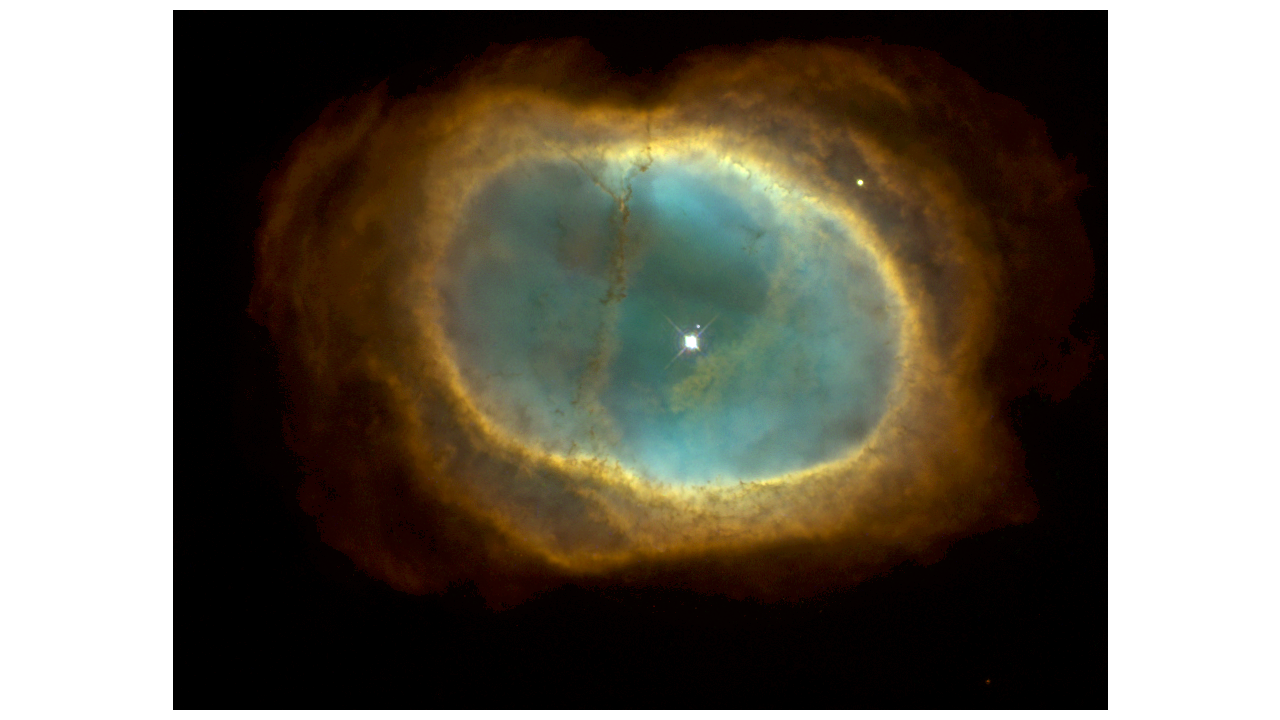
Now compare that to the image on the right of the same location taken by the JWST. Why is this different? It’s not just because the JWST has larger mirrors-it also comes down to the wavelength range between Hubble and JWST. Hubble observes in the ultraviolet, visible, and near-infrared ranges, while JWST observes in the near and mid-infrared range. This allows the JWST to pierce through obstructing dust and gas that shows up in the visible range, and show a view of the pillars we aren’t as familiar with, but isn’t any less stunning. More images reveal this difference between Hubble and JWST, such as these images of the Southern Ring Nebula, with Hubble on the left and JWST on the right:

Image caption: A comparison of the Southern Ring Nebula (NGC 3132) taken by Hubble (left) and the JWST (right)Each is taken in different wavelength ranges with different colors representing different gases, showing varying level of detail of the region. (https://stsci-opo.org/STScI-01EVVFSTZYZJJKAB41KA6AJ0HQ.png; https://www.nasa.gov/sites/default/files/styles/full_width_feature/public/thumbnails/image/main_image_stellar_death_s_ring_miri_nircam_sidebyside-5mb.jpg)

With the JWST, we can see in higher detail the rings of gas and dust thrown out by a dying star that we previously could not see in the Hubble image. Hubble has taught us some amazing things about the universe, but with the JWST, we can shed new light (in longer wavelengths) on objects in space previously unseen. Even just a few days ago, the JWST detected a dust storm raging on an exoplanet about 40 light years away [3]. The more we’re able to see, and the further back in time we are able to peer, the more we can learn about the universe and our place in it.

[1] https://blogs.nasa.gov/webb/2023/01/25/webb-spies-chariklo-ring-system-with-high-precision-technique/

[2] https://www.nasa.gov/image-feature/the-pillars-of-creation

[3] https://webbtelescope.org/contents/news-releases/2023/news-2023-105

Friday, February 10, 2023

The Next Generation of New Frontiers Exploration

NASA has several different space mission classes for exploring our solar system. These are arranged by funding level as well as by how quickly they can respond to new science. Discovery provides the least funding but is meant to respond to discoveries that may not have even been made at this point. The medium class, New Frontiers, consists of a list of exciting destinations set out in the planetary decadal survey, the latest of which was just completed last year. The largest missions are run directly by NASA and respond to deep and meaningful science questions that cannot be addressed under the other classifications.
Image caption: The four members of the New Frontiers family: The New Horizons mission to Pluto and beyond, the Juno mission to Jupiter, the OSIRIS-REx mission to Bennu, and the Dragonfly mission to Titan. In the next few years, they will be joined by a fifth member that currently only exists as an idea on paper. (NASA/JHUAPL/SwRI/GFSC)

By Conor Hayes

As a planetary scientist, proposals for new missions to explore the the Solar System are understandably  quite exciting to me, and I’ve recently become interested in understanding how those proposals are prepared and selected. This January, NASA released the draft Announcement of Opportunity (AO) for New Frontiers 5, the first major AO of my time as a graduate student. Although the final AO is not expected to be released until November, this is an excellent opportunity to take a look at what missions we will expect to be proposed over the next year or so.

New Frontiers (NF) is the middle tier of NASA’s three-tier Solar System exploration program, sitting between the low-cost Discovery Program and the flagship Large Strategic Science Missions Program. As the NF5 name suggests, there have been four previous NF missions: three that are ongoing (New Horizons, Juno, and OSIRIS-REx), and one under development for launch in 2027 (Dragonfly).  The mission selected in NF5 must be launch-ready by no later than the end of 2034. 

The science objectives laid out in the NF5 AO can be traced back to the 2013-22 Planetary Science Decadal Survey. The Decadal Survey is a document created every ten years through a collaborative effort of the planetary science community that outlines the highest-priority goals for the next decade. These priorities inform the selection criteria at all three mission levels, depending on what is felt can be accomplished with those levels’ respective budget caps. NASA aims to release two NF AOs for each Decadal Survey but has fallen short of that cadence in recent years, hence why the NF5 AO was released after the completion of the 2023-32 Decadal Survey despite being the second NF AO of the 2013-22 Decadal Survey. 

So what are the science objectives of the NF5 AO? There are six mission themes, each of which has its own list of objectives. To be selected, a mission proposal must address a “proponderance of the science objectives” listed for at least one of the themes. The AO specifies that its use of “proponderance” rather than “majority” is meant to reflect the fact that not all of the listed objectives are of equal importance. A successful proposal could target a small number of high-importance objectives or a large number of low-importance objectives.

The mission themes are as follows, with a brief explanation of some of the key objectives:


Comet Surface Sample Return

In recent years, there have been several missions to return samples from asteroids that were at least partially successful: Hayabusa (Itokawa), Hayabusa2 (Ryugu), and OSIRIS-REx (Bennu). One mission has returned samples from the coma of a comet: Stardust (Wild 2). However, there has not yet been a mission to return samples from the surface of a comet.  Cometary surfaces are interesting as they are rich in volatile organic molecules that have been modified during the comet’s journey through the Solar System. It has been suggested that Earth’s organics may have been delivered through cometary impacts, providing even more motivation to return surface samples. Although some in-situ studies of cometary surfaces have been conducted remotely (most notably Rosetta at 67P), these studies have been necessarily limited by weight and cost considerations that would not be present if samples were returned to be examined in labs on Earth. Organic molecules can be fragile, so it is critical that missions in this theme are able to transport the samples to Earth without destroying  the samples by subjecting them to conditions that would degrade their constituent molecules. A cometary mission should also be able to provide context information about the site the samples were extracted from.

Io Observer

Io is the most volcanically-active body in the Solar System, and missions in this theme will be focused on understanding why that is the case. From my reading of the objectives, an Io Observer has the widest range of science to choose from, and it is unlikely that any proposal would be able to cover them all. Once the mission proposals are finalized, it will be interesting to compare how different proposals in this theme prioritize the science to be returned. These could include determining what fraction of Io’s mantle is molten versus solid, examining the tidal heating mechanisms that are suspected to drive the volcanism, looking for potential tectonic activity, and studying the interactions between the materials ejected from Io’s volcanos and Jupiter’s extremely strong magnetic field.

Lunar Geophysical Network

The goal of missions in this theme should be to examine the Moon’s interior. This could include studying its minerology and composition, as well as its interior heat flow and the distribution and origins of the radioactive isotopes that create that heat flow. To more fully understand the Moon’s interior structure, I would expect to see proposals similar to the InSight lander, which probed the interior of Mars through seismometry. Although the Moon, like Mars, is geologically dead, it experiences Moonquakes like the Marsquakes measured by InSight. The most interesting part of this theme (at least to me) is the “network” in its name. Although none of the science objectives explicitly require it, the name suggests the deployment of several spacecraft across the Moon’s surface conducting coordinated observations. With multiple stations in place, such a system would not face the same kinds of challenges that InSight did operating as a solo seismometer. 

Lunar South Pole-Aiken Basin Sample Return

The South Pole-Aiken Basin is one of the largest impact structures in the Solar System, measuring approximately 2,500 km across and 6-8 km deep. It is also the oldest known lunar basin, having formed less than 500 million years after the Moon itself. Consequently, there is interest in understanding its geology as doing so would contribute to our knowledge of the processes that formed the inner Solar System by constraining the specific timing of the Late Heavy Bombardment. Key objectives include providing in-situ validation of remote sensing data, determining the sources of the radioactive isotopes that contribute to the Moon’s internal heat, and comparing the properties of basaltic rock samples returned from the basin with those returned by the Apollo and Luna missions. In addition to returning samples to Earth, a mission in this theme should also provide geologic documentation of the sampling site.

Ocean Worlds (Enceladus)

Although Jupiter’s moon Europa loves to take all of the media attention for its potential subsurface ocean, it is not the only moon that may be hiding liquid water beneath its thick, icy crust. Saturn’s moon Enceladus is particularly interesting due to the presence of over 100 geysers near its south pole that spray massive plumes of water vapor and other volatiles at velocities sufficient to escape Enceladus’ gravitational influence and enter orbit around Saturn. Exploration of these plumes is a priority because they provide us with an opportunity to examine the contents of the potential subsurface ocean without having to drill through the crust. The goals of such a mission would be to determine if the ocean is potentially habitable and, if it is, whether or not life currently exists within it.

 Saturn Probe

Although Cassini orbited Saturn for over 13 years, it did not include an atmospheric entry probe to perform in-situ measurements of the Saturnian atmosphere like Galileo did at Jupiter. A Saturn probe mission would rectify this by launching at least one probe into the atmosphere with the goal of studying both its physical structure and its elemental composition.


~~~~

Is there one mission theme that is more likely to succeed than any of the others? At this point, it’s difficult to say, given that no missions have been proposed. Although it may be my own bias as someone who studies the Moon speaking, I would guess that either of the lunar missions might have a slight leg up over the other themes, just considering the fact that you can do a lot more science by sending $900M to the Moon rather than the outer Solar System. The target date for proposal submission is currently April 2024, with initial Step-1 selections announced by the end of 2024, so the shape of the playing field will become much clearer over the next year.

Monday, January 23, 2023

My Summer Trip to MARS


This past summer, PVL PhD student Alex Innanen traveled up to the high arctic (on an expedition led by Prof. Haley Sapers) to test an instrument called MAGE which may someday fly to Mars. Ironically, the name of the research base at which they were stationed is itself named MARS! Given the harsh conditions, the name is perhaps merited and many space agencies use this area to test out technologies they hope to use in exploration activities. (Image above: MARS as seen from up on Gypsum Hill. You can see the edge of Colour Lake below, and Wolf Mountain rising above the ridge, with Crown Glacier beside it.)

by Alex Innanen

As part of my PhD work, I have been working with an instrument called MAGE (the Mars Atmospheric Gas Evolution experiment), which is intended to study trace gases in the martian atmosphere (including methane). The instrument is an off-axis spectrometer, which I won’t get into detail about here, but it is able to measure very small amounts of and changes in methane and other trace gases.

In July, I was lucky enough to be able to take a version of the instrument up to Nunavut for testing – specifically to Umingmat Nunaat (ᐅᒥᖕᒪᑦ ᓄᓈᑦ), or Axel Heiberg Island, where the McGill Arctic Research Station (MARS) is located. MARS is at 79° N and change, which is not quite as far north as you can go in Canada but is pretty darn close. There were three of us going up: myself, Haley, and Calvin, a grad student from CalTech. Up north, we were joined by two grad students from McGill, whose group was then amalgamated with ours.

The reason for going so far away to test the instrument is because of two sites near MARS that are potential martian analogues – Lost Hammer and Gypsum Hill. Both are hypersaline (very salty) cold springs, which are home to methane seeps. The polar desert also has lots of polygonal terrain, which is formed from the freeze-thaw cycle in the ground and has also been seen on Mars. Polygonal terrain can also show interesting methane dynamics, with the troughs acting as a source of methane and the centre of the polygon acting as a sink. 

Polygonal terrain on Umingmat Nunaat seen from the air. 

But before we could get to taking measurements and making sure the instrument worked in such a remote location, we had to get there. The first leg of our journey was from Toronto to Ottawa, from where our flight would leave. We spent a couple days in Ottawa doing last minute shopping and packing and repacking out many coolers and bags of equipment and food. We had to bring not only the personal things we would need for around three weeks in the north, but also all the scientific equipment for the MAGE experiment and biological sampling that would also be done, and food to last us for our time at MARS. Altogether we had nine pieces of luggage, most of which was oversized by the airline’s standards, as well as a 40-50 L backpack apiece.

From Ottawa, we took the Canadian North airline up to Iqaluit. Iqaluit is already above the tree line and, having never been in the arctic, as soon as we set down I was blown away by the landscape, which is absolutely unlike any other place I’ve ever been. We had three hours in Iqaluit, so we left the airport to do a little looking around before it was time to get on a (smaller) plane to our next stop,
Mittimatalik (ᒥᑦᑎᒪᑕᓕᒃ, Pond Inlet). We had a brief stop there, then a quick hop to Ikpiarjuk (ᐃᒃᐱᐊᕐᔪᒃ, Arctic Bay), and then finally on to Qausuittuq (ᖃᐅᓱᐃᑦᑐᖅ, Resolute). This is where the Polar Continental Shelf Program (PCSP) has a base, and from where we would be flying out to MARS. 

The plan was to spend a few days at PCSP before flying to MARS. However, this plan was quickly derailed by the weather. It was a very wet year, and aside from us, many other teams had not been able to get to their field sites because of a combination of fog, thunderstorms, and, at MARS, an inability to land the small twin otter planes because the ground was too wet. Being stuck at PCSP was not the worst thing in the world. We got to meet lots of other scientists and learn about what they were up to, go for many hikes and appreciate the beautiful arctic landscape, and pack and repack and prepare for when we eventually were able to go to MARS.

Our field team in front of the Twin Otter that took us to and from MARS. From left to right: Calvin, Haley, Louis-Jaques, Scott and Me. 

On July 13, 10 days after we got to PCSP, it finally happened. The fog had finally lifted enough for us to get out, and while the ground was still too soggy to land right at MARS, we were able to land a few kilometers down Expedition Fjord. From there, us and our piles of equipment were ferried up to MARS by helicopter. The helicopters were a very special part of our time at MARS. We had originally planned to have only one helicopter day to take us to Lost Hammer, which is one Fjord south of Expedition. However due to the problems with the twin otter flights and other factors, we ended up having a helicopter at MARS nearly the entirety of our trip. Between us and another group we also had plenty of pilot hours, so we were able to make not only multiple trips to Lost Hammer but also to Crown Glacier and the much nearer Gypsum Hill springs (which are within walking distance, but when you’re bringing a bunch of equipment with you it’s nice to get a lift).


MAGE near the foot of Crown Glacier.

MARS is on one side of Gypsum Hill, overlooking Colour Lake and a view down Expedition Fjord. Once again I was absolutely blown away by the beauty, especially since when we landed the sun had peaked out of the clouds on its way around the sky. Like Qausuittuq, Umingmat Nunaat is a type of region known as a ‘polar desert’, but it didn’t seem like it. Not only was the tundra soggy from so much unseasonal rain, but it was carpeted with all kinds of artic plants – saxifrage, arctic poppies and even a kind of tree, the arctic willow, which instead of growing upwards sends its branches along the ground. As I was taking measurements with the MAGE instrument in the camp, a bee buzzed past me, and I was surprised to see something that looked like a butterfly. It was a butterfly! One of the great parts of staying somewhere with so many scientists is you get to learn about their areas of expertise, and there was an entomologist at MARS who told us all about the kinds of insects we might see. 

The major goal for the MAGE instrument was to be able to bring it up to almost 80° N and turn it on – success! More success followed, and I managed to get readings at MARS, the two spring sites, the polygonal terrain near MARS and at the foot of Crown Glacier. I had a lot of fun figuring out where to put the instrument, how to best run it with its power limitations, and what might make an interesting set of readings. Not only did the instrument successfully collect data on methane abundance, but we also figured out how we might be able to improve the instrument and the data we collected. For instance, I was measuring wind direction by holding up a roll of flagging tape and seeing which way the dangling end blew. An anemometer would let us get much more detailed information about how the wind effects our methane measurements.

The MAGE instrument taking measurements with Lost Hammer spring in the background. The white cone-like mound is made of Gypsum, with the spring hiding inside.

Before I left for the trip, I was extremely nervous, not only because I had never undertaken field work like this before, but also because I’d be spending nearly three weeks in one of the most remote parts of the world and had no idea what to expect. But from the moment I set foot in Nunavut I knew I’d made the right choice to go. There were still difficulties, like when it seemed like we might never make it to MARS, or getting frustrated with the limitations of the instrument, but taken altogether not only did MAGE preform admirably but doing fieldwork helped me discover and strengthen skills I didn’t know I had. I’m so grateful to have had this experience.

Tuesday, December 6, 2022

Hitching a Ride to the Moon (and Beyond!)

 Above, a series of ten 6-U cubesats can be seen attached to the ring which interfaces between the top of the Space Launch System (SLS) rocket and the payload fairing. It's not unusual these days for spacecraft to use extra mass allowances for these sorts of ride-along launches. It would be very difficult to arrange a special launch just for those spacecraft, so these larger launches provide a vehicle to considerably increase the science return from a space launch and to provide access to (deep) space to others. Here at PVL, we're very excited about the coming small-space era in Planetary Science!

By Conor Hayes

The launch of Artemis I on November 16, 2022 was a highly-publicized event, and for good reason. It has been 50 years since the last time we left the Moon, and although the first crewed landing of the Artemis program is not expected to take place until 2025, Artemis I is still an exciting step towards our return to the Moon.

Much less well-advertised was the fact that the Orion Multi-Purpose Crew Vehicle was not the only spacecraft riding the SLS rocket to space that night. Accompanying Orion were ten CubeSat microsatellites. The CubeSat standard was established in 1999 and has primarily been used for technology demonstrations and other missions whose higher risks make larger, more expensive satellites challenging to justify. Of course, this means that CubeSats are almost never launched on their own, instead needing to hitch a ride along with some other mission.

The ten CubeSats launched along with Artemis I were all in a 6U configuration, meaning that they each consisted of six CubeSat “units” joined together. A CubeSat unit is a box approximately ten centimetres along each edge with a mass of no more than two kilograms. This extremely small volume means that CubeSats have a very limited ability to propel themselves, so they are typically launched along with a mission that has the same target object. In the case for the Artemis CubeSats, this means that five of the ten microsatellites are aiming for the Moon as well.

So, what were the ten CubeSats that Artemis I carried into space?

ArgoMoon
ArgoMoon is a collaboration between the Italian Space Agency and Argotec, an Italian aerospace engineering company. Its primary mission is to take images of the Interim Cryogenic Propulsion Stage – where all of the CubeSats are stored – and to confirm that the other CubeSats successfully deploy. This mission will demonstrate the ability to use a microsatellite to autonomously inspect and maneuver around another spacecraft. Once deployment of the other CubeSats is complete, ArgoMoon will test the resiliency of its communications equipment in the harsh radiation environment outside of Earth’s magnetic field.


BioSentinel
The BioSentinel CubeSat mission was created by NASA Ames to examine the effects on DNA of long-term exposure to the deep space radiation environment. This is critically important information to have as we prepare for extended missions to the Moon and Mars so that we can develop methods of mitigating DNA damage to reduce the likelihood of astronauts developing various cancers and other threats to their health. BioSentinel will use two different strains of yeast as an analogue for human cells. The health of the yeast cells during the 18 month mission will be assessed by monitoring their growth and metabolic activity and comparing it to the radiation doses measured by sensors onboard the spacecraft. The results will then be compared to three identical copies of the BioSentinel experiment, one of which will be exposed to the low Earth orbit radiation environment onboard the International Space Station.


CuSP
The CubeSat for Solar Particles (CuSP) is a technology demonstration mission developed by the Southwest Research Institute. It contains three science instruments designed to count the number of energetic particles ejected by the Sun, as well as to measure the strength and direction of the interplanetary solar magnetic field. If all goes well, CuSP could justify the creation of a fleet of similar small satellites positioned throughout the Solar System to form a space weather monitoring system. 


EQUULEUS
The EQUilibriUm Lunar-Earth point 6U Spacecraft (EQUULEUS) is one of two Artemis CubeSats provided by the Japan Aerospace Exploration Agency (JAXA). Despite its small size, much science has been packed into it. EQUULEUS carries three science instruments as well as an experimental propulsion system. Two of the instruments are designed to detect the presence of dust and micro-asteroids in the space between Earth and the Moon, while the third will characterize the near-Earth plasma environment. Rather than traditional rocket fuel-powered propulsion, EQUULEUS will use water thrusters to propel itself into a halo orbit at the Earth-Moon L2 Lagrangian point and to fly-by any micro-asteroids that it discovers.


LunaH-Map
The Lunar Polar Hydrogen Mapper (LunaH-Map) was provided by Arizona State University to map water ice at the Moon’s poles. It will use a neutron spectrometer to measure the flux of high-energy neutrons leaving the lunar surface. These neutrons are suppressed by the presence of hydrogen atoms, so areas where LunaH-Map measures fewer neutrons are likely enhanced in hydrogen-bearing molecules like water. This mission will build on results from the Lunar Exploration Neutron Detector (LEND) onboard the Lunar Reconnaissance Orbiter (LRO), building higher-resolution maps thanks to its lower-altitude orbit (5 km for LunaH-Map versus 20 km for LRO). Unfortunately, the satellite experienced a problem with its propulsion system shortly after deployment, meaning that it was unable to insert itself into lunar orbit. However, there are still several months left to diagnose the problem before its current trajectory will make the mission unrecoverable. If the LunaH-Map is able to diagnose and fix the problem and get the spacecraft into orbit, the mission is planned to last for 96 days, after which it will be launched into a polar crater. 


Lunar IceCube
As its name suggests, Lunar IceCube is another mission to search for ice on the Moon, developed by Morehead State University in collaboration with the Busek Company, the Catholic University of America, and NASA Goddard. It will hunt for water ice and other volatile molecules at the Moon’s poles from a 100 km orbit using an infrared spectrometer. 


LunIR
LunIR (formerly known as SkyFire), designed by Lockheed Martin Space, is another lunar mapping mission. Its primary mission objective is to test a low-cost thermal imager that could be used to characterize future landing sites on the Moon and Mars. It will also test the use of an electrospray thruster, in which electrically-charged liquid is expelled to provide thrust, for small orbital adjustments. The LunIR team have not provided updates on the spacecraft’s status post-launch, so it is currently unclear whether or not it is operating as expected. 


NEA Scout
The Near-Earth Asteroid Scout (NEA Scout) is a NASA mission that will use a solar sail to propel itself to 2020 GE, a near-Earth asteroid approximately 18 metres across. Because it is extremely difficult to identify and track objects of this size, not much is known about them, leaving a critical gap in planetary protection plans. This mission carries a single instrument – a camera that will be used to take high-resolution imagery of 2020 GE. Unfortunately, NEA Scout failed to make contact with the Deep Space Network after deployment, so the team is currently attempting to recover the spacecraft.


OMOTENASHI
The Outstanding MOon exploration TEchnologies demonstrated by NAno Semi-Hard Impactor (OMOTENASHI; some very creative acronym work!) is the second of JAXA’s contributions to the Artemis I CubeSat collection. It was designed to be a semi-hard lunar lander, using a combination of rockets and airbags to impact the lunar surface at 20–30 m/s. It would then use an onboard radiation detector to study the radiation environment at the surface. Shortly after deployment, communication with OMOTENASHI was lost. After five days of recovery efforts, the team concluded that the spacecraft’s solar panels had failed to find the Sun, leading to an unrecoverable shutdown of the spacecraft following battery depletion.


Team Miles
The final of the ten CubeSats is Team Miles, a technology demonstration mission by Fluid and Reason, LLC. Team Miles was developed to test new propulsion and communications technologies. It will fly past the Moon towards Mars, with a goal to travel at least four million km and possibly up to 96 million km.
These will certainly not be the last CubeSats launched towards the Moon as we enter the Artemis era of lunar exploration. Indeed, there are already three more prepared for launch that just missed the Artemis I integration deadline: Cislunar Explorers, Earth Escape Explorer, and Lunar Flashlight. Although they may not nearly be as flashy as larger missions like the main Artemis flights, the proliferation of microsatellites has provided excellent opportunities for groups with less available funding to get good science done without having to compete for space onboard a more expensive mission, making off-Earth research more accessible for everyone.