Saturday, March 6, 2021

How do you power a vehicle on Mars?


How is power generated for the vehicles that explore other worlds? This is a problem that PVL MSc student Justin Kerr is considering this term in his research. In the inner solar system, solar power tends to dominate, but once we move outward, electricity generated from the heat of nuclear decay in Plutonium is the only viable option. Even on Mars, however, the latter method can be attractive to guarantee a more stable source of power unperturbed by environmental factors such as the dust covering the Spirit Rover in the image above. (image by: NASA/JPL-Caltech/Cornell)

by Justin Kerr


With the recent landing of the Perseverance rover in Jezero crater, exploration of the Martian surface is now all over both the news and general scientific conversation. Perseverance is the latest in the ever-expanding list of vehicles successfully landed on Mars, and a large one at that. It weighs in at 1025kg and has dimensions of 3x2.7x2.2 meters, making it only a little smaller than the average car. But unlike a car, Perseverance obviously cannot just drive up to the local gas station for a refill. The amount of gasoline needed for a decently long mission would also be far too heavy and volatile to bring along for the launch from Earth and subsequent landing, so just how do we go about powering Perseverance and the vehicles before it while they explore the red planet?

Most past rovers and landers have utilized solar power to generate the electricity they needed to operate. Some recent examples of vehicles using solar power include the InSight lander alongside the Spirit and Opportunity rovers. While Mars is further from the Sun than Earth and thus receives less sunlight, solar panels on the surface can still produce enough energy to power a rover. They also have the huge benefit of never running out of fuel so long as the panels are still functioning, which allowed Opportunity to last for 14 Earth years, far longer than its expected lifespan. That being said, power outputs from the panels may themselves seem quite low compared to the usage of everyday devices on Earth. The panels on InSight are capable of an output of 600 Watts, and the Spirit and Opportunity rovers only 140W – a pittance compared to the 850W power supply in use on the computer on which I am currently typing this!  The Mars vehicles make up for this relatively low power generation rate by storing power in lithium-ion batteries much like those used in modern smartphones to use for larger expenditures or during the night – which brings us to some of the problems associated with solar panels.

The biggest problem with solar energy production is the inconsistent availability of sunlight with which to generate power. The most obvious source of this problem is nighttime, but there are others. Seasonal variations cause decreases in solar power output, with power generation being more difficult during winter. Solar power is most effective at the equator where the most sunlight is received, making it much more difficult to power vehicles closer to the Martian poles (you can actually expect a short paper related to this topic from me in the future!). Dust is a major problem on Mars, able to settle in a fine layer on top of vehicles we land there even during normal weather. Spirit had its solar panel efficiency drop to roughly 60% due to dust coverage in its first year – although the rover actually got lucky by having its panels cleaned off by a dust devil in early 2005. Of even larger concern are the global dust storms that can occur on Mars which put so much dust into the atmosphere that solar power generation becomes essentially impossible. You can see the extensive dust buildup on Spirit from one of these storms in 2007 at the top of this article. One such storm was famously responsible for the loss of Opportunity in 2018.   

While solar power may seem like the obvious solution for power on another planet and is indeed effective in many situations, it clearly isn’t perfect – so what else could we use? Perseverance, Curiosity, and the Viking landers of ages past instead utilized the radioactive decay of plutonium-238 for power generation. Specifically, the power is generated by a device known as a radioisotope thermoelectric generator (RTG). When the plutonium in the MMRTG (Multi-Mission RTG) decays into Uranium, it produces significant amounts of heat as the released radiation is absorbed by materials which can then be converted into electricity. In the Perseverance and Curiosity rovers, the excess heat lost in the conversion process can even be put to use keeping the delicate electrical components of the rover warm. This electricity production method gets around the issues of solar power not working at night, during winter, or when covered by dust – radioactive decay will occur regardless of the environmental conditions. 

 
A warm and glowing Pu-238 Pellet (image: US Dept. of Energy)

Nuclear power generation with MMRTGs still has some downsides compared to solar, such as the amount of power that can be generated by an appropriately sized RTG. Perseverance can currently only generate 110W of power, which is used to charge batteries in the same manner as the solar powered vehicles. This amount will also reduce over time as the amount of plutonium decreases as it decays. Plutonium-238 has a relatively short half-life of 87.7 years, meaning there will be a noticeable drop in the amount of available power by the end of the rover’s 14-year lifespan. There is also a concern with the amount of available plutonium-238 for future missions, as the United States only has enough left in their cold war era stockpiles for a few more missions. Thankfully there are plans to begin production of the isotope right here in Ontario at the Darlington nuclear power plant in the near future. In the end, neither RTGs nor solar power provide a perfect solution to the power requirements of the vehicles we send to Mars. We can expect to see a mix of these two methods in upcoming Mars missions, with the next two vehicles set to land (China’s Tianwen-1 and the ESA’s ExoMars) both utilizing solar power. Just like here on Earth, there seems to be no single best answer for power generation on Mars.

Friday, February 19, 2021

SpaceX, Starlink, and the Commercialization of Space

This week, masters student Conor Hayes tackles a thorny issue: how to balance the expansion of private actors in space and the benefits their work can have for those of us on earth with the needs of astronomical research. It's not inconceivable that such an expansion could change the night sky forever, not just for scientists working with sensitive instruments, but also for most of the world's city-bound population for whom a starry sky could be replaced by criss-crossing lights. Must we give up wonder to achieve a better life for each another? Image: 19 Starlink satellites unintentionally imaged by the Blanco Telescope at the Cerro Tololo Inter-American Observatory. (CC BY 4.0, NOIARL/CTIO/AURA/DELVE, https://nationalastro.org/news/starlink-satellites-imaged-from-ctio/)

by Conor Hayes

One of the consequences of the way that our economic systems are structured is an ongoing competition between public and private interests to exploit various resources. This competition rolled through astronomical Twitter like a bowling ball through a set of pins in November 2019, when the image above first made its way onto the internet.

Taken using the Victor M. Blanco 4-metre telescope at the Cerro Tololo Inter-American Observatory in Chile, it shows 19 bright streaks caused by a train of Starlink satellites passing through the telescope’s field of view. Unsurprisingly, this greatly reduced the quality of the data, leading to widespread concern about the long-term impact of Starlink on astronomical observations.

The mere fact that Starlink satellites are visible in telescope imagery isn’t the problem. Outside contamination of CCD images is nearly inevitable with a long-enough exposure time. If you ever get a chance to look at raw data from a telescope, you will probably see similar, though shorter, bright streaks caused by cosmic rays impacting the detector. Furthermore, artificial satellites have been occasionally ruining images for as long as there have been a significant number of them in orbit. So what is the problem then?

Part of what concerns astronomers about the Starlink constellation is the sheer number of satellites involved. SpaceX currently has authorization to launch 12,000 (!) Starlink satellites, and has submitted paperwork to approve another 30,000 (!!). For comparison, the United Nations Office for Outer Space Affairs currently lists about 10,400 objects launched into space since 1957. When the constellation is completed, the number of visible Starlink satellites may even outnumber visible stars in heavily light-polluted areas like Toronto. Given that the constellation is intended to surround the Earth at many different orbital planes, having a small handful of Starlink satellites streak across your telescope’s field of view may become a regular occurrence.

In addition to antagonizing astronomers who work in the optical, the development of Starlink has also worried radio astronomers. Ground-based radio astronomy is already hard enough thanks to the fact that many of our modern-day technological conveniences are constantly blasting radio waves into the environment. Consequently, much like how optical telescopes are located in dark areas away from major population centers, radio telescopes are often surrounded by “radio quiet zones”, large swaths of land where radio emissions are strictly regulated. But when those radio sources are passing overhead, as the Starlink satellites will be, those radio quiet zones may become significantly louder.

If nothing else, the conflict over Starlink shows how vital it will be for the scientific community and private businesses to communicate with each other to find a mutually beneficial way forward. Though SpaceX is now looking into ways to make their satellites less bright, including darker paint, sunshields, and shutting off transmissions when passing over radio quiet zones, these kinds of after-the-fact adjustments are not sustainable in the long term. Though I personally find the commercialization of space somewhat distasteful, I also recognize that as the barrier to entry gets lower, thanks in large part to the innovations championed by companies like SpaceX, it is almost inevitable that commercial interests will want to spread outward. Because astronomers have held a near-total monopoly on space for so long, learning to let other people in will be a difficult process, one that will require sustained, genuine cooperation from all interested parties.

I didn’t start writing this post with the intent to argue for the termination of the Starlink program. It’s a difficult needle for me to thread because on one hand, I am an astronomy grad student whose future career could be hindered by a poorly-managed privatization of space. On the other hand, I recognize that SpaceX’s goal with Starlink is an admirable one. The past year has demonstrated how global access to reliable, high-speed internet is now more of a necessity than a luxury, and demanding that Starlink be shut down just because of the challenges it presents for astronomy would be irresponsible and short-sighted. This goes both ways, of course. It was incredibly disheartening to scroll through some of the replies to the original tweet and see how many people were calling ground-based astronomy little more than a vanity project with no real worth to humanity (Elon’s tweets dismissing astronomers’ concerns out of hand and telling them that they were overreacting certainly didn’t help, either).

Though I don’t have any concrete solutions right now, it seems increasingly likely that, as is the case in so many other areas of our society, the responsibility for dealing with the monumental shifts in the way that the private and public spheres interact with each other beyond Earth will ultimately fall upon the next generation of astronomers currently working their way through their undergraduate and graduate educations. I do believe that we can eventually strike the right balance, but I hope that time comes before unregulated, antagonistic competition severely damages our ability to look up at the sky and wonder what lies beyond our home.

Wednesday, February 17, 2021

The Pros and Cons of Human Missions to Mars


It has been an active time for arrivals at Mars, with several spacecraft from different nations taking up position in orbit and the Perserverance Rover, the first step in sample return, due to land this week. The relationship between human and robotic missions has always been an interesting one. Strictly speaking, the two are managed by different divisions within NASA (The Science Mission Directorate and the Human Exploration Operations Mission Directorate) and it's a popular party topic to discuss the merits of each kind of exploration. MSc student Grace Bischof takes up this conversation in her post this week.
(Image Above: https://commons.wikimedia.org/wiki/File:Concept_Mars_colony.jpg)

by Grace Bischof

With Perseverance set to touch down on the Red Planet in less than 10 days, I’ve been thinking a lot about Mars exploration. In addition to the Mars 2020 mission led by NASA, the Hope Orbiter launched by the United Arab Emirates Space Agency and the Tianwen-1 orbiter, lander, and rover sent by the China National Space Administration will soon be arriving to Mars. In a previous blog post I’ve detailed the family of Martian rovers currently on the planet, but the list continues to grow with these new missions. There are more missions planned moving forward (ExoMars 2022, for example) but a topic that’s on everyone’s mind still remains unanswered: when will humans be sent to Mars?

There are many unique challenges that arise when imagining the idea of human missions to Mars. In this post, I’m going to highlight some of the pros and cons of sending humans to Mars, for both short-term missions and long-term colonization.

Pro #1:

While incredible science and engineering activities have been achieved by landers and rovers, humans may be able fill in some of the gaps left by robotics.  Humans can work faster than the technology currently on Mars, not needing specific commands sent from Earth to complete a task. Additionally, rovers and landers have very specific designs. For example, a rover may only be able to dig 1 meter into the surface because of the length of its robotics arm. Humans would be able to dig further, perhaps making discoveries that a rover could not.

Con #1:

An issue pertaining to both shorter missions and permanent settlement is that Mars could be dangerous. Firstly, the journey to Mars is not a quick trip. The Apollo missions reached lunar orbit nearly 52 hours after launching; Missions to Mars typically take upwards of 200 days. That is a very long time in the space environment, where radiation could have extremely adverse effects on the astronauts. Once humans are on the planet, the intense conditions could pose many problems. Notably, freezing temperature conditions, an unbreathable atmosphere, ultraviolet radiation, and massive dust storms all pose a threat to humans on the surface of the planet.

Pro #2:

The colonization of Mars has been a theme in many science-fiction works throughout the years, and many people are pushing for it to become a reality. Leading the pack on the Mars settlement goal is SpaceX, an American aeronautics company. The major push to move humans to Mars, according to SpaceX’s founder, is an attempt to avoid a future extinction event. It is no secret that human activity has greatly affected the Earth, and by starting a colony on Mars, we may ensure the survival of humankind for thousands or millions of years to come. Additionally, putting humans on Mars is a huge task (as outlined in Con #1), therefore by doing so, we would massively enhance our knowledge of technology, engineering, and science.

Con #2: 

To round out the list, it’s very important to discuss the ethics of human missions to Mars. One of the biggest problems with landing humans on Mars is potential contamination (known as Planetary Protection). This works both ways – there is a risk that humans may bring terrestrial contaminates to Mars’ surface or that scientists might bring Martian contaminates back to Earth. If microbial life does exist on Mars, the possibility of doing damage to that life has grave ethical implications. If Mars were to become the next habitat for humans, the environment would be completely changed, potentially ruining the opportunity for astrobiologists to learn more about the planet. Humans do not have a good track record for treating the Earth kindly. Using Mars as a backup plan for human survival only moves our problems further from the sun. Plus, to live on Mars people have suggested “terraforming” the planet to make it livable. Do we have the right to alter another planet so severely? 

The are no easy answers when it comes to the future of Mars exploration. Humans landing on Mars could lead to discoveries never thought possible using current technology. However, there are many logistical and ethical issues surrounding this idea. For now, all we can do is rewatch “The Martian” again while we wait. 

Tuesday, February 16, 2021

Update on K2-141b

Above, some art commissioned by NASA to commemorate the mission of the Kepler Space Telescope. Even as the mission encountered technical issues with its reaction wheels near the end of its journey, good science was extracted. The K2 mission allowed the telescope some drift from its original pointing near the constellation of Cygnus. This permitted the telescope to examine a wider range of stars, though each could not be observed for as long as the original set. Still, close-in short orbital period planets like K2-141b could be detected. This week, Giang updates us on his work to model this lava planet.

By Giang Nguyen

As 2021 marches on, I, along with everyone else in the lab, are also chugging along amidst a global pandemic. However, I’m more fortunate than most as my work solely lies in virtual space. As long as I have access to a computer and some internet, my work on K2-141b progresses. Although the internet isn’t necessary to run my models, I always need to have 5 tabs of Google searches on how to python open.

As a refresher, K2-141b is a planet about 200 light years away located in the Aquarius constellation. Its orbit is so close to the star it orbits that its surface temperature can be hot enough to melt and vapourize rocks, creating a thin atmosphere. K2-141b is also tidally locked which means there is a permanent dayside and nightside on the planet. Almost half of the planet is covered by giant magma oceans that can be over 100 km deep.

My work, previously published in the Monthly Notices of the Royal Astronomical Society, assumed an optically thin atmosphere such that all of the star’s light will reach to K2-141b’s surface unhindered. But now, we are restricting that assumption to account for the radiative transfer that occurs in the atmosphere. This involves calculating how much infrared and UV radiation is absorbed by the atmosphere and the subsequent feedback on the surface’s energy budget.

Infrared, or long-wave radiation, accounts for almost half of the stellar radiation but UV accounts for less that 1%. Although IR radiates much more than UV, an SiO atmosphere is better at absorbing UV than IR, 10,000,000 times better. As the atmosphere and the surface themselves also radiate infrared waves, they can warm each other up which complicates things further. Nonetheless, I pressed on with what I had and crunched the numbers.

If you neglect UV absorption, our results wouldn’t differ much from the results of our MNRAS paper. The atmosphere would be a bit warmer for a larger area but eventually drops down to near absolute zero when approaching the night-side; the winds would be about 33% faster. This makes sense as more energy is absorbed initially but, through sensible heat and radiative cooling, the system finds an equilibrium and temperature drops. Next step, add UV radiation.

Although UV absorption is minuscule initially, the atmosphere's thick optical depth at UV wavelengths ensures that 100% of UV stellar radiation is absorbed almost everywhere. While IR absorption and emission drops exponentially, UV absorption stays steady. Just like the tortoise and the hare, slow and steady wins the race. There comes a point when UV heating becomes the dominant radiative term and IR emission is not strong enough to cool the atmosphere. From there on out, the winds get faster and the temperature gets even hotter.

As you approach the night-side, the temperature gets hotter and hotter, upward of over 13,000 K. The winds go up to 7 km/s (400% increase from the classic no radiative transfer scenario). Unlike every other simulation, the results with UV absorption stayed subsonic throughout the entire atmosphere since the temperature rises faster than the wind’s acceleration. These strange results seem counterintuitive physically…but within the mathematical axioms we’ve built for our model everything checks out.

For now, I am further analyzing these results. Atmospheres like the one we have on Earth are also very good at absorbing UV radiation. However, our stratified atmosphere relegates that job to the top, far away from the surface. This leaves Earth with a temperature inversion, and K2-141b should have one too. The adiabatic profile may no longer be accurate when we introduce complex radiative transfer schemes. But if the results are true, then K2-141b’s atmosphere becomes plasma and flies across the surface at 7 km/s speed, like exhaust from a rocket. That’s pretty metal but I don’t know what the results are yet. I’ll keep you updated when I do. Until next time.

Tuesday, February 2, 2021

Continuing my PhD Life with a Baby

 
Charissa Campbell, one of our PhD students here in PVL, returns to work this week from an extended leave to care for the new addition to her family. She asked to share her experience here in this post, which provides a great bookend to her pre-leave discussion, which can be found here. 
 
by Charissa Campbell

Well January has arrived, and it is time to return to work from maternity leave. It has been a turbulent but amazing past 8 months that I am glad I got to have off. I am proud to introduce my son, Arthur, who has been nothing but a blessing on our life. He came into this world on June 1st with less than 2 hours of labour, which I am very thankful for!

Due to York counting leave by semesters, I was able to take the last month of my pregnancy off which helped me relax as labour was probably the scariest part for me. If you recall in my previous post right before my leave (http://york-pvl.blogspot.com/2020/05/deciding-to-start-family-while-being.html), I mentioned that Arthur was due near the end of May but decided he was too cozy in the belly. By 8 days after my due date, the midwives suggested a stress test to see how the baby was doing as they recommend inducing labour 10 days after your due date. By the time of my stress test, I was ready to meet Arthur and get the scary part out of the way. I was relieved when they told me I was already in labour when I took the stress test and that I wouldn’t be leaving the hospital that day. It was so sudden that it was hard for me to process and get panicked. However, the stress test did reveal that whenever I had a contraction, my stomach would squeeze Arthur to the point where his heart slowed down significantly. This was nerve-wracking in itself. After this was monitored and then found that the umbilical cord was wrapped around his feet, the doctors decided an emergency c-section was necessary as his heart had fully stopped for a moment. My water broke at 2:30 PM and Arthur was born at 4:15 PM. I’ve read that labour can be hours to days for some women so for it to be that quick was relieving for me. Even though I didn’t give birth the “normal” way, it was normal for me or my baby would have died. The stress and emotions on that day are something that I will remember for the rest of my life and I hug Arthur hard every day knowing that.

I was quite blessed that York offered paid maternity leave as these past 8 months were definitely needed to figure out how to live a life with a baby. The worst part of it is probably the first 6-8 weeks when Arthur is trying to figure out how to be a human and you are trying to judge how to handle your newborn. I was also in recovery for 6 full weeks, with the first 2 almost confined to a rocking chair or bed due to my surgery. It was painful to walk anywhere, but I was lucky that my partner was home 24/7 to help. Slowly your entire house gets filled with baby stuff, including things that you either never use or he grows out of so quickly. We barely touched the 3-6 month clothes as Arthur grew tall so fast that by 4 months, he was the height of a 6-7 month old. I am quite short myself, so those genes definitely didn’t come from me! He is currently 8 months on February 1st and still tall and a good weight with blonde hair and blue eyes. He can sit up, loves food and is just an overall happy baby. We are so excited that we decided to take this path and not let my PhD studies get in the way.

Even though I was on leave, there was one important item that needed to get done. Right before I left, I submitted a paper that I co-wrote with a group at Curtin University in Australia about our Machine Learning project. I got an email indicating the first round of revisions were ready. I looked over them quickly and noticed that the majority of the questions were better suited for the Curtin group so I decided to do the revisions while on leave. I asked for an extension as they gave 2 weeks. Unfortunately, Arthur was 4 months at the time and still needed tons of Mom attention. Either way, my partner and I worked out a schedule so I could have time to work and I was able to get my revisions in on time. Just before Christmas I got another email expecting a second round, however, it turns out there were no more revisions needed and it was ready to be published. I am very proud that I was able to write a scientific paper while pregnant and get it published while still on leave. Feel free to check it out here: https://www.sciencedirect.com/science/article/pii/S0094576520307736

Now that I am back at work, I have found that I don’t have the same energy I used to. Some mornings Arthur wakes early so I am more exhausted that day than others. The pandemic has also made it a bit harder to work from home as I can hear Arthur downstairs. Whenever he cries it triggers a reaction that I must pick up my baby. However, by frequently going to see your baby when you are trying to leave them for the day makes it harder on the baby as you are constantly coming and going. I’ve been trying to mediate that by wearing headphones or playing music out loud to drown out the sound downstairs. I am currently in the midst of trying to figure out a good ideal schedule that can balance work and home without getting too overwhelmed. Even then, I am ready and excited to get back into work!

Overall, Arthur has been adjusting well to me being at work and even goes to bed without me on nights that I have to moderate a lab session as part of my Teaching Assistant section of my PhD. As time goes on, both Arthur and I will get used to the new schedule and I will become a full-time working Mom. It is a hard job trying to be a mother and doing PhD studies, but it will be worth it once I get my degree and can provide a good life for my family.

Thursday, December 17, 2020

What I’ve Learned Starting Grad School from Home


 This week Grace Bischof talks about the challenges of starting a research-based graduate degree from home during the pandemic. I look forward to meeting Grace and the rest of my new students (hopefully) in the summer or fall of 2020.
(image source: https://www.pexels.com/photo/silver-imac-on-white-table-4185956/)

 by Grace Bischof

Somehow, we are now 10 months deep into a pandemic. Pandemic fatigue has hit in waves, but with record-breaking new cases across Canada, it is still very much a part of daily life. Because of this, my first three months of grad school have looked a little bit different than normal. Today I thought I would share 4 things I’ve learned while beginning my Master’s degree from home.

1)    Setting a schedule is essential. This seems obvious, but it has been the most important factor for staying productive. One of my courses has live meetings on Wednesday at 10:30 am and 2 pre-recorded videos posted throughout the week. Making sure that I watch those videos every Monday and Friday by 10:30 am is the only way I can keep up with the course content. One week I decided I would watch a pre-recorded lecture at another time because I had other things to work on, subsequently falling behind for about 4 lectures and needing to scramble to catch up again. Sometimes it is hard to keep a schedule from home, but sticking with it creates much needed structure during a strange time.

2)     Keep in contact with lab members/coworkers. Starting grad school is difficult. Starting grad school without having met anyone from the lab in person or ever stepping foot on the school campus is even more difficult. I feel lucky that PVL is very encouraging about reaching out for help with any problems. As a naturally shy person, asking for help, especially from people who I have never met in real life, can be tricky. But the environment fostered within the group has made it easy to do so. So, while I can’t swing by someone’s desk on campus to ask for help, I’ve been able to solve problems by sending a quick message to other group members over Slack.

3)    The time normally spent commuting can be used for work, but doesn’t have to be. One of the main benefits of working from home for most people is cutting out the time spent on the road getting to campus. During my undergrad, it took about 40 minutes from the time I left my house to stepping into the building for classes. I didn’t realize how much I appreciate that hour spent commuting until it was gone. Because I couldn’t do work on the bus, I used that time to listen to music and relax. Without the commute, I have an extra hour in my day to work, which I’m often thankful for during busy weeks. I have also listened to less music than ever before. It is important to understand that the commute time can be added to your work day, but it also okay to keep that time for things that keep you sane. This point is still a work-in-progress for me, but I think I’m starting to find a balance.

4)    Make time for the things you love. This is a continuation off the last point, but extends further than commuting time. While working from home, it is very hard to separate work from leisure. With my desk set up in my house, I feel guilty if I’m not at my desk and focused for an absurd number of hours in the day. This isn’t practical. I make time for myself daily by taking my dog for a walk with my mom, reading every night before bed, and Zooming my roommates from undergrad every Tuesday to watch the Bachelorette together. This ensures that work hours are spent productively working and leisure hours are spent peacefully recharging my brain.  

     I’m really thankful for the time I’ve had so far in grad school. Despite the experience not being normal, I’ve gained a lot – both academically and personally. Although, if any future graduate students stumble across this blog post, I sincerely hope that you are back on campus and you don’t have to listen to a word of what I wrote.

Monday, December 14, 2020

Impacts of Stellar Flares on the Search for Habitable Exoplanets

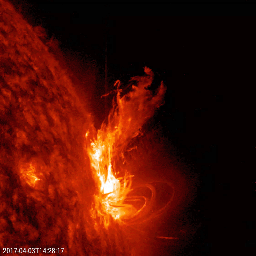
 This week, Justin Kerr examines the impact of stellar flares on the habitability of exoplanets. Of particular interest are M-dwarfs, whose habitable zone lies very close to the star. Much has previously been made of flare activity associated with these stars and the potential effect of that flare activity upon the atmospheres of any planets found within their habitable zone.
(to view a video of the flare above visit
https://photojournal.jpl.nasa.gov/catalog/PIA21584 )

by Justin Kerr

With the search for habitable exoplanets well underway, there has been much talk in popular science of the potential to find life-bearing worlds with telescopes such as Kepler and TESS. One of the most common points I have heard in the popular sphere against finding life with these missions is related to stellar flares. The argument is typically as follows: the transit method used to detect exoplanets with these telescopes mostly finds small stars (of spectral type M, to be specific); these M stars and particularly red dwarfs such as TRAPPIST-1 tend to produce frequent stellar flares; therefore the flares will cause planets to be incapable of maintaining an ozone layer and the life which depends on such a layer. While this is certainly true to some extent, it is not the case that all red dwarfs produce frequent flares – and in some cases, stellar flares may even be required for their exoplanets to support life as we know it. In either extreme case, it is clear that an understanding of the possible effects of stellar flares and their frequency is important when evaluating the possibility of life existing on newly discovered exoplanets. 

First of all, are these popular accounts correct about stellar flares making life impossible? The most well-known consequence of stellar flares is their tendency to be accompanied by a Coronal Mass Ejection (CME), something that happens right here in our solar system. In a CME, plasma from the star is launched outwards by strong magnetic fields. The Carrington Event in 1859 was a CME associated with a solar flare which, while not strong enough to cause any atmospheric disturbances beyond intense auroras, did result in massive disturbances to the telegraph systems used at the time. A similar event in modern times would cause extensive problems in our electrical systems, but much stronger events must be considered for highly active red dwarf stars. Not only are these stars more active, but potentially habitable planets must be located much closer to the star than is the case with the Sun in order to receive enough heat to maintain liquid water. This makes them more likely to be hit by strong CMEs, as CMEs release their energy in a narrow and directed region. The main threat of highly energetic CMEs to habitability is their capability to “blow off” the atmosphere of an exoplanet over multiple events, similar in function to a very strong solar wind.

While CMEs are commonly discussed due to their threat to our modern technology here on Earth, the removal of the ozone layer by stellar protons from flares is much more concerning for exoplanets around small stars. Studies such as Tilley et al. (2019) have shown that flares with energies of about two orders of magnitude stronger than the Carrington event that occur once a month or more would be enough to make an exoplanet incapable of maintaining an ozone layer. This would lead to the sterilization of the exoplanet’s surface by the excess UV radiation, in an extreme version of the ozone layer hole on Earth which is only now beginning to recover after the Montreal Protocol stopped the widespread use of CFCs. A recent study by Günther et al. (2020) that examined 1228 flaring stars found in the first exoplanet hunting dataset released by TESS found that about 100 of the stars would meet the flare frequency requirements to eliminate the possibility of an ozone layer on their associated exoplanets. While this is certainly a concern, this still leaves a large amount of red dwarf associated exoplanets presumably without this problem. 

These negative aspects of stellar flares are not the only way in which flares can affect exoplanets. There are in fact multiple ways that flares may instead support or even be required for the development of life. Since red dwarfs have low UV output, some exoplanets within the habitable zone may not receive enough UV light to support the prebiotic chemistry that life as we know it is based on. Of particular interest is the reaction that produces the RNA, which is required by life, as it only occurs in the presence of UV light. Since stellar flares can produce extra UV light, they could fill in the missing energy to allow prebiotic chemistry to occur around stars where it would otherwise be impossible. In the same study of flaring stars from TESS, Günther et al. found 14 stars where this may possibly be the case. While this is less than the amount of exoplanets where flares would make life impossible, ignoring the positive benefit of flares could cause us to miss habitable exoplanet candidates. 

Stellar flares are certainly a danger to the habitability of exoplanets around red dwarfs, but we have seen that this by no means eliminates the possibility of life on all them and in some cases may even be necessary. Instead of dismissing flares as a negative, we must instead study their effects and frequency in order to better predict where we might find new life. So the next time you hear a YouTube video or see an online comment suggest that life around red dwarfs is impossible thanks to flares sterilizing them, make sure to do a bit more research!