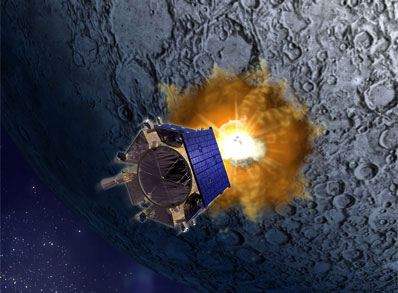
This week, Jasmeer Sangha talks about his work extending his simulations to include many different species of planetary volatiles bouncing around on the moon. While water was known to be present, it was LCROSS (depicted above in this artist's concept image from Northrop Grumman) that discovered a wide range of different compounds in the PSRs.
by Jasmeer Sangha
This semester I chose to extend
my research past just water molecules and shift focus towards results brought
back from LCROSS, the Lunar Crater Observation and Sensing Satellite. The LCROSS
mission launched in 2009 and scientists found more than just water on the moon.
The mission objective was to have the Centaur, a rocket stage, launch itself into
the moon. It was decided that Cabeus, a large crater near the lunar south pole,
would be the Centaur’s destination. Cabeus is a permanently shadowed region which
allows freezing temperatures to trap particles in a layer a frost. The debris cloud made by the impact would be analyzed by LCROSS, orbiting up above, to discern the frost's composition.
From this experiment, it has been shown that carbon, nitrogen, and sulfur compounds
were present in Cabeus, yet water was the dominant constituent, outnumbering
all other compounds 5 to 1.
Though
we know what is in Cabeus crater we are unsure as to how it got there. My
previous work focused on the mechanism of traveling water molecules along the
surface. The program randomly spawned particles on the surface of the moon and
followed there lives until they were trapped in a dark hole for eternity, cooked
by the Sun’s rays, or lost to space - what lovely ways to go out, right? The results would show us how water ice is
distributed on the surface.