Wednesday, August 2, 2017

Frozen Moons


This week, Keagan Lee, an Undergraduate Research Assistant working at PVL for the summer reports on some independent reading he has been doing on a fascinating solar system object: Europa. The image above is a well-known mosaic acquired by the Galileo Orbiter, which you can find on the Planetary Photojournal here.

By Keagan Lee

We like to think of Earth being in the “Goldilocks Zone” -- an area in a star system that is not too cold and not too hot so that liquid water can exist on its surface -- as if this is the ideal location in the solar system. We call Earth the “Blue Planet” because it has so much water. Ostensibly, yes. In our neighbourhood, we are the largest host of water; any water that made its way to Mercury (outside of the permanently shadowed polar traps) or Venus would be boiled off instantly, and it is too cold for water to exist in liquid form on Mars, at least currently. But water is much more likely to exist further out in the solar system where the effects of solar radiation are lessened because of the distance from the Sun and, as a consequence, is found in the form of ice. Europa, one of the moons of Jupiter, which is less than 1% the mass of Earth, is estimated to have more than twice the volume of water than Earth!

Tuesday, August 1, 2017

My Summer Internship

As part of the TEPS program, MSc Candidate Elisabeth Smith has spent her summer working at local space engineering firm MacDonald, Dettwiler and Associates, better known to us as MDA. She relates her experiences here.

By Elisabeth Smith

This past May, I started a part-time internship with engineering company MacDonald, Dettwiler & and Associates (or, MDA for short) in Brampton, Ontario – located not too far from York University. MDA was founded in 1969 by John S. MacDonald and Werner Dettwiler, and is likely best known for their development of communications and robotics systems. Perhaps their best-known product is the Canadarm, the robotic arm present on both the International Space Station and the Space Shuttles that is used to grab and move payloads from different spacecraft, especially for the assembly of the ISS.  It also has cameras on it that allows for the inspection of spacecraft.  After the Columbia Space Shuttle disaster in 2003, this became a very important step in future manned space missions. 


Being able to work for such a fantastic company with such an incredible position in the space industry was a very exciting prospect indeed. I would be helping develop a robotic arm that will be used in aircraft manufacturing – a very good fit for me, given my prior internship experience with business jet manufacturer Gulfstream Aerospace. I have always dreamed of working in the space industry, and being at MDA is a great way to achieve that goal. I am also very interested in robotics, and being able to combine my interests in space and robotics was perfect. 


Tuesday, July 11, 2017

Putting the Sky in Contrast


This image shows a test rig that Eric is using to examine the feasibility of LCD contrast enhancement of images. Such a system might be useful for future spacecraft which often must acquire scientific photos under challenging lighting conditions.

by Eric Shear

Several months ago, I agreed to take on a hands-on project for my masters’ thesis. I had been doing planetary mission design and it seemed like a nice change to do something experimental that might end up in future spacecraft cameras.

I picked up from where a former summer undergraduate had left off. She, with John's help, had built and tested an imager apparatus with a liquid crystal display (LCD) in front of a digital camera. The whole assembly had additional optics to sharpen the image and was bolted on a black aluminum bread-board (see the image above).

The goal was to make a sky imager that could selectively block out the sun in order to increase contrast and dynamic range in the image, allowing otherwise hard to see details to be easily picked out. An obvious application would be on Mars, where there are high altitude cirrus clouds that would be hard to see in bright daylight. The same thing could be accomplished with a physical shade, but it would be heavier and less flexible.

Sunday, July 2, 2017

The Exploration of Eboracum Planitia


This week, PVL Postdoc Christina Smith reflects on the youth outreach activity we completed in late may as part of our Ministry of Research, Innovation and Science Early Career Researcher Award. Both we and our guests had a great time and it's never too early to start thinking about next year! Image taken from: https://spaceplace.nasa.gov/mars-curiosity/en/ .

By Christina Smith

On May 27th, as per Brittney's blogpost, we at the Planetary Volatile Laboratory held an analog mission day for upper high school and undergraduate students. Missions like this, aimed primarily at education and outreach as opposed to technological proof-of-concepts, simultaneously give students a taste of what being part of a science operations team for a real-life rover mission is like as well as being fun for those involved. I had never participated in a rover analog mission, but when I was in high school in the UK, I had the chance to be part of a “Voyage to Mars," where we took the place of a crew traveling to Mars and I still remember it vividly (and fondly) to this day – especially the part where the oxygen tank sprung a leak and yours truly was in charge of life support for the mission... I hoped that the students coming to participate would enjoy their time on their first mission as much as I did on mine.

Wednesday, May 24, 2017

Analog Rover Missions: More Than Just Acting Out Your Childhood Dreams

 
PVL Undergraduate Student Brittney Cooper (right) driving the MESR Rover (left) in the Canadian Space Agency (CSA) Mars Yard following the end of a 2 week long analog mission put on by the Centre for Planetary Science and Exploration (CPSX) at Western, in conjunction with CSA, in 2014.   This weekend, students from the Toronto area will get their own opportunity to participate in a model or 'analogue' space mission.

By Brittney Cooper

      In just under a week, PVL plans to host its first analog rover mission on May 27th. It’s a one-day event for upper year high-school students, and I will be the acting “rover”. Don’t laugh, this is not my first analog mission but it is however my first one acting in the role of a robot. While each mission has its own unique goals and desired outcomes, the overarching reason for conducting this type of exercise lies in education, training and outreach.
      Acting on a real-life mission is a unique experience, and it is not easy to know what to expect based upon the experiences you’ve had in previous jobs or in other areas of your life. Analog missions serve as a great tool to train and provide examples of the operation processes, hierarchy and protocol. You get the opportunity to understand how important science decisions are made and rationalized against data and power constraints of your rover or spacecraft. It’s a unique opportunity to gain insight on how hundreds of people are able to work together to design a mission from the beginning. This includes formulating the science outcomes and payloads, and then actually acting out the structured long-term and tactical planning that is carried out regularly, to achieve those outcomes. 

Friday, May 19, 2017

Public outreach reminds scientists of the bigger picture

PhD Student Casey Moore prepares to give an hour-long public presentation at a meeting of the Toronto-Center Royal Astronomical Society (RASC). He is now the third member of the lab to do one of these talks in this venue!

by Casey Moore

A few months ago I was asked to give a public lecture to an audience of amateur astronomers – noting that they would probably enjoy hearing about my work with the Mars Science Laboratory (MSL). I agreed – hesitantly, as I have never given such a talk. The event went off without a hitch and was a nice introduction to giving a talk to the broader community where not everyone is a specialist in planetary science.

For those interested, a brief summary of what I discussed can be found at: http://rascto.ca/content/speakers-night-speaker-announced-2 , as well as a rather unflattering outdated photograph of myself.

Tuesday, May 9, 2017

One Mile Down, 93 Million to Go

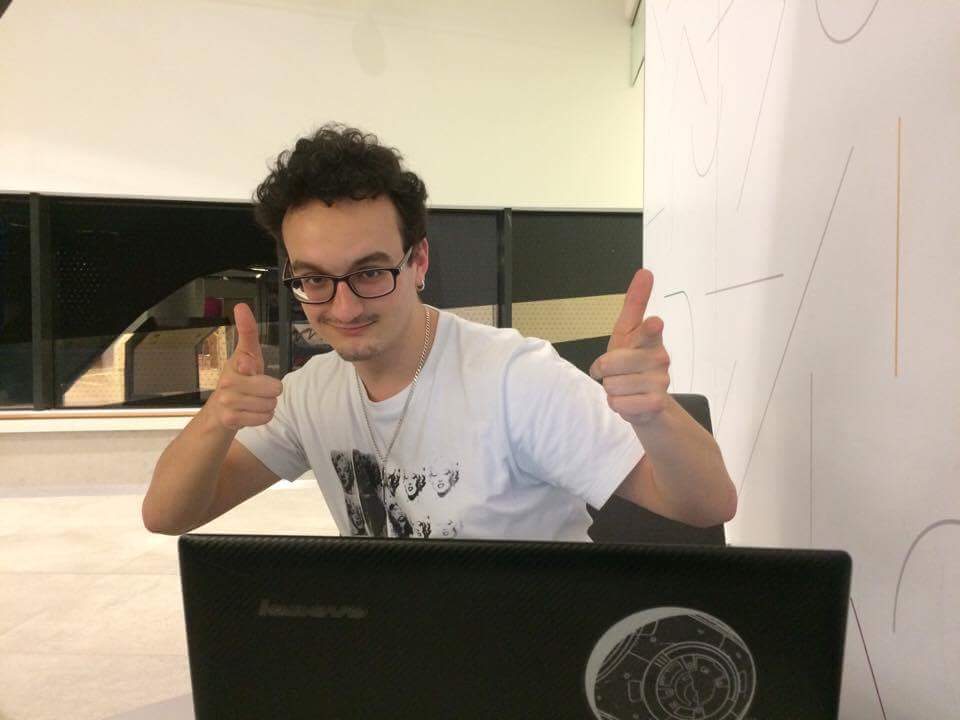
 One of our summer undergraduates in the lab, Alex Séguin, pictured above, (in the image he provided himself!) is this week's designated blogger for PVL. One of our strengths is that we have trainees from all levels working together in the lab.

By Alexandre Séguin

I have done it. I, Alexandre Séguin, have officially completed my first week of research as an undergraduate student here at the Planetary Volatiles Laboratory (PVL).  After such a new and exciting experience, some reflection is in order.

    There are many stories, myths, and legends surrounding this type of work and they shrouded my expectations in uncertainty and confusion. On Monday morning, I walked into York's science building painfully earlier than necessary not knowing how my day would unfold, unsure of the daily implications of a research position... yet more ready than ever to try it. After a calming coffee, the time came to get to work.