Showing posts with label PhD Articles. Show all posts

Wednesday, July 22, 2026

A Perspective on Analog Writing Implements

The motto of my favorite journal brand, Leuchtturm1917, is "Denken mit der hand" or thinking with the hand. I'm not the only member of my group with an appreciation of the analog. This week Elisa, one of this summer's graduating PhD students and our resident stylophile, shares her own love of tactile thinking. Her caption for the image above is: "Hastily scribbled text trying to capture the incessant flow of words coming from Elisa's mind. Only some of it is captured. Even less of it is legible. Somehow, she still manages to get the gist of it transcribed."

by Dr. Elisa Dong

Analog tools are often overlooked these days as more and more of our work shifts towards the digital space and collaboration shifts towards being hosted on the cloud. Most of this isn't necessarily bad per se, and typing is certainly faster than writing unless you know shorthand. I do feel like the act of writing is one best not forgotten, however.

Who am I to tell you what to do? My only credentials are that I love stationery. Functional, pretty, and just plain cool. Stationery will always excite me. Oh, and I used it extensively throughout my current academic career and attribute much of my successes of writing things by hand. If you like lists, there are lists in this blog post.

Perhaps it is best to start off with a side story regarding my love of note taking and documentation. My first ever purchase with my paltry $5 allowance was a notebook. It was spiral bound and the covers were made of a stiff foam. The cover had some sort of tropical bird on it made of overlapping pieces of foam. It might even had had a googly eye or two attached to the head. As you can imagine, it was immensely exciting to me. I purchased this notebook as guided by my parents to keep track of what I spent my allowance on, or note down when I received more. To this day, I still tally up my purchases by hand, though I'm certainly less vigilant than I used to be. Somehow, the number of my expenditures has also gone up. 

You might have not had the same experience of looking over your numbers and squishing a foam notebook, but I'm sure there will be something you can care about when it comes to stationery. 

Here's another, more recent story for you. During my defense last week, I asked the examination committee to pause right before the exam actually began in earnest (sorry Scott!) so I could grab my notebook.

    "I wanted to take notes," I explained.

    "Don't worry," said one of my supervisors, "We're taking notes."

And so they were, it was meant to be reassuring and a reminder that I would get a summary of requested feedback afterwards. In the meantime, I didn't have to simultaneously take down the questions and try to answer them. 

    "I wasn't (worried), I just think better with a pen in my hand." 

This is true! At least for me, I find my focus instantly sharpened when I have a writing implement in hand. I feel somewhat badly for those who do online exams now. Perhaps their brains have worked out the association with typing into blank boxes and forms. I know mine hasn't. 

The Joy of Writing

I also find my writing to reflect some things that I really enjoy. It's scribbling, yet flowy, and reminds me a lot of my mother's handwriting on the notes she'd leave out on the table for herself as a reminder. I have attempted such reminders, but it only works if I remember to look for them. Naturally, my handwriting is also far harder to decipher than hers. I also love the way ink flows on paper, whether it be a ballpoint or gel, though I'm particular to a smooth ink. Pencils can also be a lovely experience, with a touch of toothiness that reminds you that you're physically sheering away a layer of pigment to lay on paper. 

If you happen to enjoy a touch of colour in writing, it can be quite a delight to write in pencil crayon or fountain pen ink. I personally like fine-tipped felt markers. I periodically order a couple packs of the Zebra Sarasa vintage ink pens. They come in sets of 5 or so, and contain a suite of fairly standard colours, but deeper and more muted. These are far more economical than the clicky gel-pens I used to buy at the Waterloo bookstore to mark assignments or annotate my own work. What a delight it is to use a different colour on paper and see how variable (or invariant!) it can be. Different colours and strategic outlining can be so useful when narrowing down thoughts. Its like highlighters, but more subtle (on that note, I recommend Mildliners, I have some that are nearing a decade old and still function great without searing my retinas). 

Then, there is paper. Receipt paper, cheap paperback paper full of disintegrating fibers, 100 gsm toothy watercolour paper, paper with films or coating for a smooth texture that renders them water resistant but prone to skidding, craft paper... there are so many options out there. I found that the numerous packs of 10 cent sheets that are sold in massive packs at Walmart at the beginning of the school year always treated me well. I certainly went through thousands of those sheets. My biggest gripe with them at the time was that they didn't come in a 5 mm ruling, and instead came in 7 mm. I find 7 mm exceptionally difficult to read on, unless the writing is quite slanted and flowery, in which the extra space helps each word stand out without too much overlapping between lines. Back in elementary school (and for some part of undergrad), I would either opt to write two lines per ruling, or just freehand the lines. I do not think my teachers were impressed by this. I'll come back to this later, but I eventually moved into notebooks within finer rulings or using a grid pad with 5x5 mm grids. 


A Real-time(ish) Example and Things Elisa Likes

Right now (or when I originally drafted this post, see the photo at the top of the article), I'm writing on a discontinued 52 gsm Tomoe River paper notebook that has been printed over with a 3.7 mm grid. The binding of this notebook is excellent. I originally ordered this notebook years ago from Nanami Seven Seas and I think I got one of their cheaper offerings that had some defects, hence the lower price. Back then, the exchange rate of CAD to USD was also far more palatable as well. If you've ever read my personal blog, you'll know that I have a fondness for Hobonichi planner products which use the 52 gsm Tomoe River paper, and had been using them since 2018, but the paper is also now discontinued. Turns out there was only ever one factory that produced this paper and they had closed down. Oops. I believe the replacement is now Sanzen paper. Generally, I'm looking for incredibly thin paper that doesn't show through ("ghost") onto the other side too much so I can write on both sides, and carry around an enormous amount of paper with me at all times without adding too much weight to my already overfilled bags. 

This notebook has several nice features, but I especially appreciate the ability to lay flat (due to the binding method) and the incredibly sturdy binding overall. It has been tossed around in the bottom of my bags for 7 months at this point, and I expect it to hold up for another couple of years. (AN: I'm noticing right now that it’s actually taking longer to type this up than the original writing, perhaps I'm a terribly slow typer! Or perhaps it’s just difficult to transcribe my own writing). I also peeked at the website, and apparently the notebook IS still available, as is the paper. Huh. Perhaps they had a huge back-stock or aren't concerned about the changes in paper quality and there certainly were changes. Mind you, the CafĂ© B6 slim that I have is currently unavailable, and it does state that it uses the new paper. 
 

Paper Rankings

Let's say I've intrigued you a bit regarding paper, but you don't want to hunt down a discontinued old copy of the notebook I have. Here are some that I've enjoyed in the past and would happily repurchase:

  1. 1/2 year Stalogy notebooks in A6 or B6. These small pocket-sized notebooks use a similar binding technique that let you set the notebook fully flat. Because they can be a little small, you may have to push the pages down, but don't worry because the binding won't give out on you. The typical colours available year-round are black, red, and yellow. Limited edition colours are sometimes released. There is gold embossing along the spine for branding. I personally use the gridded paper version. It comes in 5 mm grid (or dot) and is the perfect size for doing math calculations by hand. What's not great about it if you get the printed grids is that they end quite far from the edges of the page, losing valuable writing space. On top of each page is also a calendar, lightly printed so you can mark in the date yourself. This too, takes up valuable writing space. However, one can certainly use it as a title section. I recommend the slightly larger B6 for actual writing or taking notes, and the A6 for more of a personal to-do list. The problem here is that its not always readily available in Canada, and there is quite a price bump buying it from a local business. I tend to do so periodically if I'm only purchasing one, but otherwise I'll get them straight from Japan if I am putting in an order for pens too. 

  2. Mnemosyne. These notebooks are super sturdy, spiral bound, have a sleek black cover and are perhaps best used for on the go writing when you need a sturdy surface. For an unknown reason, there is a stunning strong yellow page in each one of these notebooks. I find it incredibly eye-catching. I have only used the A5 size from this brand. Regardless of the page design, the back side of each page is blank. The individual sheets are quite sturdy and thick, with a lovely soft cream colour that's really quite close to white. Each page tears out neatly with the microperforations. This notebook is for those who like a bit of heft, but appreciate a slim build to tuck away. Or if you like to doodle and write notes on a rickety subway line. They also take wetter inks and markers quite well, and I find that pencil crayons shade nicely on this paper. I usually use it as my base paper for sending letters because I find the paper so satisfying to hold in my hands. I imagine the recipients appreciate it too, though I've never confirmed.

  3. Muji notebooks. The ones in the 5 packs with different coloured spines. I used these extensively in my undergraduate studies. One notebook colour per class. And I'd just purchase more if I was short on them. The paper texture was reasonably nice and smooth, and the price was definitely right for something so customizable. I've checked, and there are no Mujis close by to my new place! Looks like I'll have to swing by on my trips to Toronto. There was something exceptionally charming about the Muji shop encouraging people to stamp their notebooks in store to customize them. 

  4. Leuchtturm1917 notebooks. The paper quality of these is variable, but if you enjoy a thicker notebook cover and built in bookmarks, I recommend these. The cream colouring is excellent and easy on the eyes. These notebooks are A5-ish sized. Normally I'd argue that they're too large to be toting around. But since the cover is very stiff, it'll hold up against the other miscellaneous items rattling around in your bag no problem! It's also got an elastic to keep the pages shut to prevent dinging up and folding pages that might splay open. I found that these typically lasted about ¾ of a year for me. I do really appreciate that the pages are numbered if you like indexing your notes. 

All of the above, except for the Muji notebooks, have a coating on the sheets that let ink float on top and show off fun features. It also means that text can take some time to dry before you can close the pages without smearing. I've also found that if your hands are a bit oily/sweaty, it can ruin the coating on the paper leading to a very blotchy writing experience. This seems to vary across all the papers, with the original Tomoe River paper having the least amount of ruined coating. Mnemosyne is also pretty great about staying consistent, but I don't do enough writing on it to actually test it out. It does seem like a lot to care about when I write it up! Nice writing experience aside, I feel like there are some good reasons to give writing by hand a shot: 

  1. Improved memory of things you write down. I'm sure there are a few references kicking around for this. Have people done studies on typing as an equivalent? It does still take fine motor control to some extent (my motor control is less fine, if you ever hear me type, it sounds like I'm trying to destroy the keys).

  2. I imagine its generally good for the brain. Something about using both the more creative side and the fine motor control side at the same time. Perhaps there is also an equivalent perk when it comes to typing however, as stabbing at tiny keys can be quite difficult to do precisely!

  3. Processing of ideas, emotions, and the like. This mostly pertains to the value of journalling, but I also find it useful to write things out by hand when I’m looking for patterns. This can be notes on papers I’m reading, or a wrong variable in an equation I’m trying to track down. 

  4. Bonus - talking to other people who love stationery! One of my new colleagues recognized the pens I was using, and we ended up connecting over the brands we use for writing. I've promised to bring in fountain pen inks to the office. I also remember one of the first meetings with the PVL lab I went to, John saw that I had a rather unique looking notebook! Stationery lovers can identify each other from a mile away I feel. 

Discontinued notebook and paper aside, I also try to always have a booklet of regular letter-sized grid paper on a pad on hand. I find it super useful to work out problems, illustrate things to people if I don't want to check if the whiteboard markers are dried out, and mock up maps if there's some impromptu DnD about to happen. I used these extensively in undergrad for a while as an alternative to the Muji notebooks. I'd take notes continuously on the pad and flip them over so they wouldn't tear at the top, and just start a new page for each class I was going to. At the end of the term, I would compile all the sheets together. 

I wonder if there are many students who bring paper and pen to class these days. I can see the value in not losing your notes by maintaining them digitally, but it is nice to be able to shuffle sheets around and see the entire class represented all at once. I remember I mostly brought in my laptop to read manga during lectures, and occasionally annotated power point slides as they became more common later in my degree. Rarely did I feel it was worth the battery power consumption to bring a laptop to class though. About half of my classmates simply printed out the slides and filled them in by hand, later transcribing them onto a digital copy. Doing things twice might seem inefficient, but I imagine it meant things stuck in their heads more.*

I'm at somewhat of a loss as to what I'm going to do after I finish up my stash of notebooks (I accumulated a few from Hobonichi with their blank/undated pages a couple years ago, though I don't love the book size). I recently purchased one from Knock Thrice which had a fun trim, but the notebook itself seemed far to heavy to be lugging around. Since I don't love having separate books for different things, unless it's meant to be very one-off, I think I'll have to go back to the Stalogy. Maybe with my next bulk purchase of the Zebra Sarasa since I'm down to one now, I think. With Tomoe River gone, possibly forever, I may truly need to move on. 
 

On Pens and Friendships

In the past few paragraphs, I've been very "In my day...", but the the truth is that my stationery loving journey really accelerated when I found entire online communities that shared similar interests. Shortly after I had an explanation from my brother as to why he had a syringe in the bathroom that is (blunt-tipped, used to refill ink). He promised it was nothing nefarious, and gave me my first ever Platinum Preppy. Prior to that, I just periodically purchased rather pricey gel pens so that my hands wouldn't cramp when marking student assignments. After... well. Let's say I've been to pen meetups and regularly scope out stationery shops when I get the chance. The existence of the community has given me access to trying out pens that go for thousands of dollars MSRP, and sampling papers that I normally wouldn't have paid for, like those element themed bound notebooks that launched on a Kickstarter that I won during a giveaway that seems to have since vanished. 

I found that the (fountain pen) community was incredibly generous and welcoming, regardless of what price point you could handle, or what it was you enjoyed. Whether it be 18 K nibs, custom grinds, cheapie beaters, urushi, or the history of pens and paper. I was encouraged to test things out, swap inks, and simply chat about whatever it was on our minds. The community at the time was fairly small, and it was interesting hearing perspectives on new developments. I tried to give back where I could, and essentially gave away a prized Platinum Century 3776 that I had initially purchased second hand from the US. I'm also a big fan of distributing Platinum Preppy and Pilot Kakuno pens, which I find to be excellent writers in spite of their price point. They are currently my preferred pens, though I have cracked several of them. 

As it turns out, price does not correlate with quality when it comes to fountain pens. Typically, the writing end comes from one of a few companies, and the differences arise from the body of the pen. Urushi, a hand lacquring technique, is far more expensive than an injection mold. Explosive rods that were used for the gorgeous striping found in celluloid have been discontinued because...they are explosive. The technology for flex nibs seemingly has been lost over years. Pens with unique aspects tend to go for more than the standard counterparts. 

Some of the modern “grails” (sub $200) I've tried out! I enjoyed the writing experience of the Platinum 3776, but the number of turns to uncap the pen drove me nuts. I've also had a Pilot Vanishing Point, and upgraded to a vintage body. Unfortunately, I didn't purchase a vintage nib along side it, and it doesn't cap fully when retracted, leading to a messy experience. I also tinkered with the nib and lost most of its tipping. Oops. I also tried out the gorgeous Lamy 2000. What a nightmare that was. I found one on sale with exactly what I wanted, an extra fine nib. Well, with such a huge tolerance for EF, it was decidedly not extra-fine. Furthermore, the makrolon body cracked after a few months, apparently a well-known defect the Lamy team hasn't resolved. I quite enjoyed the taper of the pen, but clearly it was not the one for me. I'm still eyeing a Waterman Carene, but the Platinum desk pen is actually an excellent replacement that is actually fine, and tapered. I've also acquired a "vintage" Pilot pocket pen that posts and turns into a light-weight rounded pen. It has an engraving on it that I've never bothered to translate, but it was most likely a graduation gift for someone at some point. The nib is slightly bouncy, and allows for excellent variation across a single stroke. But it doesn't open so wide that it would be classified as a flex pen. I like this one for urban sketching. 

These days I use a mix of the Zebra Sarasa vintage pens and relatively cheap fountain pens (Platinum Preppy and Pilot Kakuno). I'm not too surprised if they crack in two years given my reckless treatment of them, but they last usually well beyond that length. I had a favourite Preppy with the most incredible nib last just over five years! 

More Reason to Carry Around Stationery

Anyhow, I do feel it is well worth trying to write things using pen and paper. There's something about the inability to edit and simply scratching out mistakes that is incredibly satisfying. Having a notebook on hand also gives you the freedom to doodle during boring meetings rather than browse unrelated websites, which might be more obvious. 

Related to writing, is also just drawing out your problems. I personally think my presentations are pretty decent! For the better ones, I almost always have something mocked up on paper first to show a story board. This is something I did for my defense (Fig. 2), and I had less than normal feedback on the specific contents and sequence of delivery as a result (I think). Instead, the feedback I got could focus on small details to really polish the final product (Fig. 3). When I start drafting something on Power Point (or equivalent software) right away, I often get stuck and feel uninspired, even if I have headers and points of what I want to present on each slide. Starting it out on paper feels more exciting and I can see the whole vision together with minimal distractions. No looking at my messy fingerprints on the screen, the annoying colour scheme of the software, or a reminder to log into my Microsoft account! Especially when I'm planning out a sequence that involves quite a long time to put together, I feel like its best to see it out on paper before the committing the several hours it takes to complete.

Figure 2. A draft storyboard in preparation for a defense. Elisa likes to think of them as movie scripts, with critical details in scenes shown as their own slides, and various arcs that need to be captured. The ellipses represent various content that are either methodology or results, which she likes to keep fairly simple, nothing too flashy. Some of these sections would borrow from previous slides, so any critical design elements didn’t have to be reproduced. The transition slides and ideas are shown on the far right. Key words are written in all caps for legibility.

 Figure 3. Simple notes that Elisa took during her second mock defense regarding things that could be improved. These pages are a mix of suggestions in illustration and animation upgrades, and text that covers things she likely wants to remember or reconsider for before the final presentation.


Conclusion?

I don’t really have one for you. I wanted to share a love of stationery and encourage that readers seriously consider trying out writing by hand. Even if you cannot read your own handwriting, there is a lot of value to putting your thoughts on paper.

---

*As a further aside, I lived in China for a year, and I recall the stationery there to be generally excellent unless you were purchasing scrap paper that was clearly quite rough and fibrous that was meant for practicing letters. Paper was pretty much always quite nice, regardless of whether or not it was cheap and had cute figures on the front. I definitely recommend purchasing random cute notebooks when in East Asia, generally everything is nicer feeling, even if it is cheap! 

Friday, February 27, 2026

Talking to Mars

This week, PhD student Diana Hayes takes a look at how we communicate with spacecraft dispersed throughout the solar system. Given the number of assets at Mars, the situation on the red planet is particularly complex and therefore particularly interesting. Like any infrastructure, maintenance is critical to enabling future science if we expect to continue to count on the capable systems we have in place today.

by Diana Hayes

Here on Earth, we’ve built a sophisticated global telecommunications network that allows us to talk to people on the other side of the planet nearly instantaneously with very little difficulty, whether that be through the internet, texts, phone calls, or video chats. It’s easy to take this interconnectivity for granted. For example, if I have data that I want to share with a collaborator in Europe, can upload it to a Microsoft server from my computer, send them a OneDrive link, and they can download it to their computer; unless something goes wrong somewhere along the way, there’s very little thought from either of us about the intricate complexities of the systems that make this possible.

But what if your collaborator is on another planet?

This is a question that every interplanetary mission needs to answer. For many missions, the answer is simple: the Deep Space Network (DSN). The DSN consists of 14 radio telescopes spread across three sites in Spain (Madrid), the United States (Goldstone), and Australia (Canberra). This spacing ensures that at least one telescope has a direct line-of-sight to every location in the Solar System further than about 30,000 kilometres from Earth. The data rates seem laughable compared to what we can achieve on the ground, as they’re limited both by the size and power of the DSN telescopes and the antennas that can be put on a spacecraft, as well as the distance between Earth and a given spacecraft. For example, as I write this, one of the DSN telescopes is talking to Juno (orbiting Jupiter) at 50 kilobits per second, while another is talking to the Mars Reconnaissance Orbiter at 550 kilobits per second. For comparison, the wireless internet connection here at York typically averages around 100 megabits per second.

A screenshot of NASA’s DSN Now page, highlighting a communications session between one of the deep space antennas in Canberra and the Mars Odyssey orbiter.


For orbiters and flyby missions, the DSN is good enough. You can put a reasonably large, powerful antenna on your spacecraft and talk directly to Earth with minimal difficulty. For landed missions, the situation is more complex. When landing on another planet, minimizing the weight and size of your spacecraft is essential, so you can’t really just use a big antenna unless you’re willing to sacrifice science instruments for it. The solution we’ve come up with is relay communications. Rather than talking directly to Earth, a rover or lander first transmits its data to a spacecraft in orbit, which then uses its more powerful antenna to transmit that data to Earth. Because the lander-orbiter distance is much smaller than the lander-Earth distance, you can get away with much smaller antennas on the lander. 

Over time, this strategy has led to the development of the Mars Relay Network (MRN), which consists of a number of Mars orbiters that rovers and landers on the surface can use to talk to Earth. At the moment, there are four orbiters in the MRN: the Mars Reconnaissance Orbiter (MRO), the Trace Gas Orbiter (TGO), Mars Odyssey, and Mars Atmosphere and Volatile Evolution (MAVEN). Relay communications is not the primary mission of any of these orbiters, but they all were specifically outfitted with the instruments needed to serve as part of the MRN.

There is one obvious limitation to using this method to communicate with our landers and rovers on Mars: data can only be transmitted when an orbiter is above the horizon. During rover planning, this means that we need to keep track of when orbiters are available to receive data, and to prioritize which data we want to receive first since we can’t always downlink all of the data on the rover during a single comms pass. Fortunately, because we understand the movements and capabilities of our orbiters pretty well, this is really only a minor problem. 

Top: The elevation of the Mars Reconnaissance Orbiter as seen from Curiosity during the first week of 2025. Most of the time, the orbiter is below the horizon, passing over Gale about twice a day. Bottom: A close-up of the highest-elevation pass of MRO on January 4, 2025, highlighting how the orbiter is only above the horizon  for a very short period of time, about 15 minutes, which limits the amount of data that can be transmitted.


Less avoidable is the motion of the planets themselves. Every few years, Earth and Mars pass on opposite sides of the Sun, an event we call “solar conjunction.” When this happens, interference from the Sun can cause data corruption in the signals sent through the MRN. Corrupted data received from Mars isn’t the end of the world, since the data aren’t deleted from the rovers’ computers until they are verified to have been received intact on Earth, so any missing data can just be re-transmitted. Of more concern is data transmitted to Mars, which usually consists of rover commands. We really don’t want to send corrupted commands to our rovers, so during conjunction, we stand down from operations until the apparent angular separation between the planets is large enough for data to be transmitted reliably.

The apparent angle between Mars and the Sun, as viewed from Earth between the start of 2023 and the end of 2026. About once every two years, this angle is so small that the Sun blocks data transmission between the two planets, a period known as “solar conjunction.”


The MRN has become a critical piece of infrastructure in the exploration of Mars, but it’s facing an imminent crisis: it’s aging. Odyssey, the oldest part of the MRN, was launched in 2001, while the newest (TGO) was launched in 2016. The fragility of this age was highlighted in December of last year when the DSN lost contact with MAVEN. Although recovery efforts are ongoing, NASA has admitted that it’s unlikely that communication with MAVEN will be re-established. MAVEN had the highest data transmission capabilities of any of the four orbiters, so its likely loss leaves a gaping hole in the MRN. The other orbiters can at least partially fill that hole, but it’s obvious that something needs to be done before we lose another orbiter. Some proposals have been made, such as the Mars Telecommunications Orbiter (MTO), which was cancelled in 2005 before being revived in NASA’s 2025 budget. Dedicated telecom orbiters are much less sexy (scientifically speaking) than science orbiters, which makes justifying their cost to national legislatures much more difficult, despite their importance. 

By the way, this isn’t limited to just Mars. For example, the Huygens probe, which landed on Saturn’s largest moon Titan in 2005, relayed its data through the Cassini spacecraft. Notably, Dragonfly, NASA’s upcoming rotorcraft mission to Titan, will not be using a data relay, instead opting for direct-to-Earth communication. To make this possible with any kind of appreciable data volume while not using the much larger antennas found on spacecraft like Juno, Cassini, and Voyager, Dragonfly will be taking advantage of the large amount of energy provided by its nuclear power system (similar to the one used by Curiosity and Perseverance), which will allow it to transmit much stronger signals with a much smaller antenna.

If you’re curious about what the DSN and MRN are up to right now, check out NASA’s DSN Now (https://eyes.nasa.gov/apps/dsn-now/dsn.html) and MRN (https://eyes.nasa.gov/apps/mrn/) websites. 

Thursday, December 18, 2025

[Insert Title Here]

Writing is a key part of being a researcher of any kind. It's not enough to do the work, take the data or make the discovery. It's not science until it is shared. This week, Alex reflects on their writing journey.

By Alex Innanen

I like to think of myself as a pretty good writer. Very young me harboured the wish to be a famous novelist when I grew up, and I probably still have old notebooks hidden somewhere in my parents’ house full of stories and attempted novels. There’s a lot about writing I like. I like putting words together in interesting and clever ways (I am a big fan of puns), I like figuring out how best to say something, and I really like the rules of language which feel a bit like a puzzle. In first year engineering we had a Technical Writing for Engineers course that many of my classmates groaned about but for me I was thrilled to have a whole class full of grammar quizzes. 

Moderate bragging aside, there’s one thing I struggle with time and again when I’m writing and that is choosing a title. Several of the posts I’ve written for this very blog have been sent to John with something like ‘I can’t think of a good title, HELP!’ at the top. I also write blog posts about once a month for the Curiosity Rover’s mission updates page, and there’s many a time I’ll have the whole post written, sitting in my inbox ready to be sent for approval and struggling to think of a title. 

It's not just blog titles either – short stories, journal articles, even my dissertation. And all these different kinds of writing need different sorts of titles! But this post is not just for me to complain about how hard titles are though. Having toiled in the title mines for as long as I have, I’ve developed some tricks and observations about choosing a good title. 

The job of your title is to give your audience somewhat of an idea of what they’re getting into, or at least to interest them enough that they might want to read what you’ve written. For something like a blog post, I try to keep it relatively short and clear. The title of this post, for instance, pokes fun at not being able to come up with a title while also giving an idea of what the post may be about. When I’m writing mission updates for Curiosity I tend to go one of two ways: some wordplay or reference to a well known phrase (for example, “New Year, New Clouds”), or succinctly describing something important from the plan (like “On Top of the Ridge” – three guesses where we were). 

Writing a title for a paper is a bit different. You can assume that whoever is reading your title has a bit more familiarity with the subject so you can be a bit more specific. Sometimes this leads to marathon-length titles. The title of my first research note, for example, “Minimum Mars Climate Sounder Retrieval Altitudes Reveal Cloud Altitudes at Aphelion and Stranded High-altitude Dust Following the MY34 Global Dust Storm on Mars” is twenty three entire words. This may seem a bit excessive, but you cannot deny that it tells you exactly what’s in the note. We’re also big fans of the humble colon in academia. My master’s thesis was titled “Aphelion Cloud Formation and Swiss Cheese Sublimation: Martian Atmospheric Water Vapour Processes”. The first bit of the title tells you the two subjects of my thesis, the second part ties them together. Sometimes, Journals will have guidelines for paper titles. Acta Astronautica, for example, has a 15 word limit. My research note above wouldn’t fly, and in fact the title I proposed for the paper I submitted there (which I posted about here) was too long and I had to figure out how to fit what I wanted to say in their word limit (I think I changed ‘Canadian Arctic’ to ‘Arctic’). 

So maybe I actually do know a bit more about this title thing than I thought when I started writing this blog post. In fact, I feel confident enough to offer some things to think about when you’re coming up with a title: 

  1. Consider your audience. Will they recognise what Aphelion means? Will they enjoy a good pop culture reference? 
  2. What is/are the main takeaway(s) of your piece? Are there different subjects you need to link?
  3. Is there a word limit? Should there be a word limit? How can you be more concise?
  4. How are you going to get people excited to read what you’ve written? 

As with most things, though, practice helps. The more I write, the more titles I need to think of and the less daunting it gets each time.  

Wednesday, July 2, 2025

Swapping Mars for Exoplanets: My Time at Harvard University

Providing graduate students with a range of experiences is a key part of helping them figure out what they want to do and where they want to do it once they have completed their degrees. Sometimes that means visiting another university lab, or working for a government agency or finding out what it means to join a team in the industrial sector. For much of the year, PhD student Grace Bischof has been investigating these questions in the lab of Robin Wordsworth at Harvard University.

by Grace Bischof 

Last summer, I received an email telling me that I was eligible to apply to the Michael Smith Foreign Study Supplement, funded through the Natural Sciences and Engineering Research Council of Canada (NSERC). This supplement designates money for graduate students to partake in research internships at institutions abroad to help build global connections. Immediately after receiving the email, I excitedly emailed John to ask if we could talk about possible researchers that I could reach out to about this opportunity to see if they would be interested in having me in their lab for a few months.

At the top of the list of researchers I was interested in connecting with was Dr. Robin Wordsworth at Harvard University. During my time interning at JPL, one of Robin’s papers formed part of the basis for the work I was doing there, so I became familiar with some of his research. About a year later, I saw Robin give two fantastic talks about the environment of Mars at LPSC and the 10th International Conference on Mars. Ironically, though the two talks I’d seen by Robin had been about Mars, and my research at York for the past ~5 years has been about Mars, Robin does not primarily do research on the Martian atmosphere. Though Mars makes up a portion of his research, he also works extensively on modelling the atmospheres of exoplanets. So, for the first time, I wrote and submitted a proposal for research outside of the solar system, characterizing the atmospheres of rocky exoplanets through Lyman-alpha transit spectroscopy.

I learned in late December that my proposal was successful and by the first week of February I was on a plane, flying to Boston, Massachusetts. Unlike the winter of 2023 that I spent in sunny Pasadena happily skipping the cold Toronto winter, Boston has a similar climate to home. Upon landing, I was greeted with below zero temperatures and several inches of snow on the ground. I took a cab to my new home in Cambridge (where Harvard is located), which is just across the Charles River from Boston, feeling equal parts excited and anxious about the next few months ahead of me.

Luckily, I soon learned that I had I little to be anxious about. Though I had never researched atmospheres other than Mars’, I loved the project I was working on (and will write a blog post detailing it later on!). At the beginning of the internship, it felt like I had a mountain of literature to read and understand to even grasp the basics of the project, but I chipped away at it slowly, finding a new love for exoplanetary science. Everyone in Robin’s group was extremely friendly and thoughtful – I learned a lot listening to them talk about their research. Going into this experience, I didn’t think I could enjoy an area of research as much as I love Mars, but I am very pleased to have discovered something new that I find so fascinating. 

One of the best things about working at Harvard is the stunning campus, with its gorgeous centuries-old buildings. A favourite location of mine on campus was the Harvard Museum of Natural History, which also encompasses the Geological and Mineralogical Museum, the Museum of Comparative Zoology, the Harvard University Herbaria, as well as the Peabody Museum of Archaeology and Ethnology. My office was on the upper floor of the Geological Museum, so I was greeted by walls of gorgeous rocks and minerals every day. With a student ID, I was able to get in for free and roam around the floors of these museums. I took lots of pictures of the dinosaur fossils and bones for my 3-year-old nephew, Tate, who is a dinosaur fanatic. My favourite part of the museum was the comparative zoology section, where there are taxidermized animals of every kind you can imagine from all over the world – I kept finding it so fascinating to think that people in Australia would think seeing a kangaroo is as mundane as we find seeing a squirrel in Toronto. 


Under the bones of a Steller’s sea cow, while admiring the giraffe on my right

Since it was my first time in Massachusetts, I spent some time exploring the Boston area with friends and family who came to visit. We walked the Freedom Trail, visiting historic Boston sites like the Paul Revere House, Granary Cemetery where some of the American Founding Fathers are buried, and boarded the U.S.S Constitution, which is the world’s oldest commissioned warship that is still afloat. When my dad visited, we rented a car and spent a morning wandering the streets of Salem, learning more of the Witch Trials that plagued the town in the 1600s. That afternoon, we drove to Concord and visited the Orchard House, where Louisa May Alcott wrote and set the novel Little Women. The 2019 film adaption of Little Women is one of my favourite movies of all time, so exploring the home that inspired the novel was an experience I won’t forget!


 Outside of the Orchard House where Louisa May Alcott wrote Little Women 

Before I knew it, it was June 1st, and I was packing my bags to fly back home to Toronto after four incredible months at Harvard. One thing to know about my academic journey while reading this blog is that getting to grad school was not necessarily the easiest for me. Though I loved the content of my undergraduate degree in physics and I worked hard at it, my grades were certainly not the best. When John accepted me into PVL in 2020, he was taking a real chance on me. All that to say: I never thought I would spend any time at an institution as prestigious as Harvard, let alone feel like I belonged there and was proud of the work I was doing. This internship helped me grow confidence in myself both personally and professionally. Five years ago, when I started grad school, I wouldn’t have believed I would gain that confidence, so I am beyond lucky and grateful for this experience – and especially for my experience in PVL which got me here in the first place.

Monday, June 9, 2025

Unravelling Martian Methane Mysteries in the Canadian Arctic

An image of our ABB methane detector deployed at Gypsum Hill on Axel-Heiberg Island in Nunavut. Alex's work here showed that the variability in a measured methane signal might be able to tell us more about our distance from the source than the total amount of methane does. This is important for how we might prospect for methane seeps on Mars. 

Oh, and look at that view!
Sometimes it's not just the results of our investigations that take our breath away.

by Alex Innanen

Almost three years ago now (and wow, time really flies) I spent three weeks in Nunavut, which you can read all about here. I talked a little in that post about why I went up and what sort of work I was doing there. But the work did not end when I landed back in Ottawa (or got back to Toronto after an extended weekend at the cottage). No, I then spent the next several months going “I guess I need to write this up in a paper somehow.” This was complicated by a few things – the fact I hadn’t ever written a paper based on fieldwork (nor read many), the fact that the results were not super clear cut, and some good old fashioned procrastination. But I ended up presenting the work a few times, including at my yearly research evaluation meetings and at a couple conferences, and it started to come together into some kind of story.
 
When I took methane measurements, I let the instrument ingest the air passing over for ten minutes, and the instrument took a measurement every second over this time period. This meant I ended up with what I took to calling a ‘spiky plot’ of hundreds of methane measurements over that ten-minute period. I noticed two things in these ‘spiky plots’. The first was that I could find the average methane concentration over that period, and that the average methane concentration tended to be highest right next to the source of the methane and drop off as I moved away downwind – typically the way you expect methane (or any gas) to work, which if nothing else meant the instrument was working. The other thing I noticed was that the variation in how spiky the spiky plot was was also higher right next to the methane source. That is to say, the methane signal varied over a much larger range when I was closest to the source, and had a much smaller range further away or upwind of the source. You can see this in the three graphs below which I took at one of the springs.

Three spiky plots. You can see that the upwind measurement has not only a lower average concentration (dashed line) but also is much, much less spiky (solid line) than the other two. Note that the y-axis is much larger on the 'Inside Wolf Spring' measurement because I saw such huge spikes of methane!

I saw this same phenomenon with the variability getting higher closer to the source even when I wasn’t moving in the exact same direction as the wind. At Wolf Spring I only moved in a (mostly) straight line in the wind direction, but at Gypsum Hill I took two sets of measurements – one along the wind direction, and one at a diagonal to the wind direction. This second set of measurements suggested that getting more data at various locations around the methane source could give us a clearer understanding of how methane behaves in a two-dimensional grid around such a source.

To that end, I sent the instrument back up to the arctic last summer in the company of an MSc student from McMaster with detailed instructions to get me a grid of measurements around Wolf Spring. My procrastination had achieved one thing – I was able to add this new dataset into my paper. And I’m glad I was! From the 2024 measurements I was able to see to impact both distance from the source and the angular distance I was from the wind direction had on the methane signal. (I’ve visualised the geometry simply below in case it’s not clear what I mean, where Î¸ is that angular distance from the wind direction.)


Now, in 2022 I did not have any way of accurately measuring the wind direction. Instead I used a technique which is actually similar to how the Phoenix Lander did it, wherein I held up a roll of flagging tape and watched which way the wind blew it. In 2024 we were a bit more high-tech: the master’s student had access to a small weather station which gave me actual numbers for my wind direction. Knowing the position of the instrument at each measurement and the wind direction at the time of the measurement, I was able to get the distance from the source (d) and the angle of the instrument to the wind direction (θ) and combine these (d/cos(θ)) and compare this value to the average methane concentration and the variability in the measurements. I found that both fell off with increasing d/cos(θ) (or distance from the center of the methane plume), but that the variability actually fell off in a slightly more predictable way.  

Okay, you may be thinking, this is all mildly interesting but what does this have to do with planetary science? Well, as has been discussed on this blog before, there’s a lot we don’t know about martian methane. One of the unanswered questions is where it’s coming from – both in the sense of what is producing it, but of more interest to this work, the actual location from which it is being emitted. We know that we see methane plumes on Mars, but we don’t know how long they last, how the behave or, again, where they’re coming from. If we did send an instrument to Mars to investigate this, we could use what I learned in the arctic to determine what that instrument should look like and also how we should use it to find the source of these methane plumes.

I learned that the variability is a better indicator of how close we are to a methane source. The variability I saw in my spiky plots is over very short timescales, thus our hypothetical instrument should be able to make high frequency measurements to capture changes over these short timescales. I also learned that knowing the wind direction is pretty important, so our instrument should be combined with some kind of wind sensor. My measurements were taken from various locations around the methane source, so having our instrument on something that can move like a rover (or even a drone!) may be more useful than if the instrument just stands still.

There’s more I could say about this, but I don’t entirely want to spoil my paper (coming soon to an Acta Astronautica near you!). Even though it took nearly three years, it turns out there was quite a bit to learn from a few slap-dash methane measurements in the very distant north. 

To read the paper, visit: https://www.sciencedirect.com/science/article/pii/S0094576525003212

Sunday, June 8, 2025

Poster Sessions and All That

An image (Figure 1, courtesy of Elisa) of one of the many buildings which housed the 2024 American Geophysical Union Conference in December of last year. The conference is massive, overwhelming even! Yet, it provides a venue where even disciplines with small numbers of scientists can meet and discuss their science. From Elisa: "There was no mistaking this was the place. So many poster tubes and people piled up waiting for the light to change."

 by Elisa Dong

Going to conferences… is fun! 

The attendance at conferences is a significant part of a graduate student experience. These are the places where we showcase our work, get feedback, and check out what’s up and coming in the field. Sometimes, conferences take place at exotic locales, and sometimes, they may be as mundane as “the place near the airport that is extremely inconvenient to take public transport to.” AGU 2024 fell somewhere in between, in Washington D.C., capital of the United States of America.

Given that the flight time and drive time were not too dissimilar, my boyfriend and I opted to drive down to save on costs, a very real consideration for going to conferences! While unplanned, we drove through some fascinating geological features going through Pennsylvania, dotted with various electoral signs on the way down. We stopped at a fairly mediocre cash-only brunch place, and saw snow and horses for most of the way down. Entering the city, the traffic went from a quiet one lane drive to cars changing lanes without signals, and mysterious roundabouts with confusing signage. Once at our hotel, we spent half an hour figuring out the parking situation, grabbed some food downstairs (with the best free bread we had ever had), then promptly went to bed. 

AGU is about a 5 day conference (see Day 1 in Figure 1!), and I had a poster on the first day and a presentation on the third. My presentation went well, and I was able to touch base with a coauthor of mine to confirm a few key concepts for a paper I was writing (I did this by tapping his shoulder to say hello). I had thought I would have the entire last day off to wander the city. As it turns out, there was an entire session dedicated to planetary defense and impactors that I had missed in my schedule, so I slunk back into the conference center to hear about the modelling work that was ongoing (Figure 2 shows once of the very few photos I took at the museum). 

Figure 2. Ducks at the museum! I also took photos of many many rock displays, but the local fowl section was also very cool!

It’s worth noting I met up with several other colleagues who do similar things – checking on some scientific concepts that were their specialties, sharing ideas for future works, and generally touching base. Despite running around to sessions, visiting random posters, picking up free ducky keycaps, the networking and chatting with more distant coworkers and future collaborators is one of the best things about a conference for me. Getting on a zoom call or sending an email is just not the same. 

The collaborative and productive nature of conferences was really highlighted by the poster I had up. I made the questionable choice of wearing heels that first day, anticipating being able to sit and walk around. Unlike some other conferences I had attended in the past, this poster session was huge. Having mine on the first day, I didn’t realize just how well attended it would be! 

So instead of being able to kick back and look at other posters during my session, I was glued at my poster well past the closing time and completely missed seeing an old colleague just a few posters down the aisle. I received a large amount of feedback, including kind critiques and thoughtful questions that have lingered as I consider the limitations of my work. Folks stopped by to offer resources and model simulations, encouraged me to bring up my work to a larger group (this has happened! I gave a presentation and received more positive feedback and further suggestions), and all the good stuff. I met many new people, whose names I wish I had taken down, including some who might be future reviewers of my work that gently pointed out the critical questions that I might want to consider as I continued working on the project. I explained a few concepts to a child attending the conference with family, and shared in their excitement over the awesomeness - that modelling that can help us explain our real-world observations. 

I was also happy to meet up with my previous supervisor and bring him up to speed on what I was working on, and to hear his assessment of the current state of his field and view of the conference.
Some cool things I got out of AGU 2024:

  • An invitation to ask about a summer internship position (this didn’t end up working out, but it definitely expanded my thoughts)
  • Meeting undergraduate students! It’s always a delight to see what cool things they’re working on, and we’ve spoken again since about work related matters
  • A suggestion to present my work at an internal MSL meeting despite not working on data from the team directly
  • The potential for writing a paper for a special edition (this also didn’t work out, but the procedure has been established and might be something to touch up again in the future)
  • A visit to NASA Goddard! I’ve never been to a NASA Centre before, and I was able to plan it with one of my coworkers based out of there and get approvals just in time! It was great to see what folks are doing behind the scenes, the huge clean rooms with possibly over a hundred HEPA filters installed (Fig. 3), and the old-fashioned, yet extremely functional, measuring tools they used
  • A late night ice-cream hangout with an online friend who forewarned me about the roundabouts
  • More ice-cream and a super toasty paper fill menu on a busy Friday night when every other place was packed
  • An experience (and the post-experience) at Coffee Republic. I have never enjoyed ads in my inbox so much before. The food was delightfully greasy, the coffee solid, and it was fun to hear the workers chat about their relationships candidly
  • Going to the Christmas market! Two of them even!
  • Barrel and Chuck, the two plushies I picked up on the way back at a Cracker Barrel. (Barrel is the lab’s new emotional support capybara, and has a lavender scented heat pack inside him! All of us in the office where he lives happen to like lavender, so it works out great. He occasionally moves from desk to desk to provide extra support)
  • And, an incredible amount of useful feedback for my own work + inspiration from other projects in the future!

Figure 3. The HEPA filter wall. Incredible. What else can you spot in the room?

AGU is one of the stranger conferences out there. It is a huge conglomeration of what is really 30+ conferences that are distantly related all mashed into one location. While it makes it easy to pop into a session about say, climate change or quantum physics, it’s not necessarily planned out in a way that potentially related sessions don’t interfere. Add on thousands of attendees, and you might be feeling a bit claustrophobic and getting more exercise than planned as you trek from one building to another. Something to keep in mind. It may be better for some folks to target more niche conferences to get the same return.

We drove back as well. My eyes are still recovering from being blasted with 8 hours of dry air.

Friday, April 25, 2025

The Art of Collaboration

I can't emphasize this enough: Science is a team sport! Collaborations are key to all that we accomplish at PVL. Often, the effort of trying to develop a better understanding of our solar system can be difficult or frustrating. Working with others not only makes this more fun and social, but those connections can often get you unstuck or send you down a path of discovery you didn't even know existed. All it takes is the right conversation to spark something new! Above: A view from the NydeggbrĂĽcke, a 19th century bridge over the Aare that connects the old and new parts of Bern.

by Conor Hayes

I’ve now been with the PVL for almost five years. In that time, I’ve really come to appreciate the power of a collaboration, particularly with people outside of the lab. I first got a taste of this following the annual meeting of the Division for Planetary Sciences (DPS) in 2022. There, I was presenting some of the work that I had been doing as part of my Master’s thesis. In that work, I was examining how small-scale terrain may influence surface temperatures in the Moon’s permanently-shadowed regions (PSRs) in ways that we can’t currently observe from orbit. To do so, I was using a “Gaussian rough surface” to represent the interior of a PSR. While Gaussian roughness is a decent model for planetary surfaces over smaller regions, it’s a simplified model as it ignores larger structures like craters.

After my presentation, I got a DM on the conference’s Slack workspace from David Minton, an Associate Professor in the Department of Earth, Atmospheric, and Planetary Sciences at Purdue University. In his message, he told me that he had been developing a Cratered Terrain Evolution Model (CTEM) that can create realistic lunar terrains at small scales, and asked if I would be interested in collaborating. Over the next several months, we merged his CTEM outputs with my illumination and temperature models to create a paper that was significantly better than the version that was in my Master’s thesis.

This past February, another collaboration offered a new experience to me. During my PhD, I’ve been spending a lot of time looking at the transport of volatile molecules like water across the lunar surface. One of the more popular models for doing so assumes that molecules undergo a series of thermally-driven jumps across the surface until they are either destroyed or trapped by cold temperatures. The temperature required for one of these jumps to begin is determined by a parameter known as the “desorption activation energy.” It is arguably the most important component of the model, but its value is not well understood, particularly if you want to look at molecules other than water.

There are several ways that one can attempt to determine the value of a molecule’s activation energies, but nobody at PVL has the expertise or the equipment necessary to do so. We could just use the values in the literature while making note of their limitations, but I didn’t feel like that was the right approach. Instead, we’ve been working with Liam Morrissey and his team at Memorial University on molecular dynamics (MD) simulations of desorption, which can be used to estimate the activation energies for various molecules on different surfaces without having to put together a complex experimental setup.

As part of this collaboration, I was invited to participate in a workshop at the International Space Science Institute (ISSI) in Bern, Switzerland. This workshop was the first meeting of ISSI’s Multi-Scale Understanding of Surface-Exosphere Connections (MUSEC) International Team. At this point in my graduate career, I’ve been to many conferences, so I thought that I knew what I was getting into. It didn’t take long for my expectations to be proven entirely incorrect.

What rapidly became apparent was that a workshop is a much more collaborative environment than a conference. Rather than a rigid schedule of short talks and even shorter Q&A sessions, each presentation was more like a conversation between all the attendees. About half an hour was given to each person, not because they were expected to speak for that long, but to give ample time for discussion during and after each talk.

I had been worried because I was coming in without many actual results. Instead, the presentation I had prepared was mostly a listing of open questions that I would like to address in the final version of my model. Not exactly the kind of content that would attract much attention at a conference, but I had been assured that it was appropriate for a more informal venue such as this one. Still, I was haunted by the ever-present specter of imposter syndrome, particularly as a last-minute addition to a group of people who were already familiar with each other.

After the week’s agenda had been updated to include me, I noticed that 45 minutes had been allocated for me. Before I began, I joked that I we would definitely be taking our afternoon coffee break early, as I couldn’t imagine a world in which my set of questions could possibly consume that amount of time. As it turns out, if you start listing unanswered questions in a room full of people with the expertise to answer those questions, it inspires a lot of discussion. I was told afterwords that my presentation was exactly the kind of content that this workshop had been designed to focus on, which was very reassuring to hear given my initial uncertainty about whether I should be there at all.

Outside of the workshop itself, the MUSEC leadership made an effort to foster a sense of community with group lunch and dinner outings, which allowed everyone to get to know each other outside of our work. It didn’t take more than a day or so before I stopped feeling like an outsider. Bern itself is a beautiful city, and I hope to be able to explore it more during the next in-person MUSEC workshop next year (if writing my dissertation isn’t consuming too much of my time by then!). 

 The aftermath of a successful workshop: a completely inscrutable whiteboard.


Monday, November 11, 2024

Au Revoir and Until Next Time, my Fellow PVLers

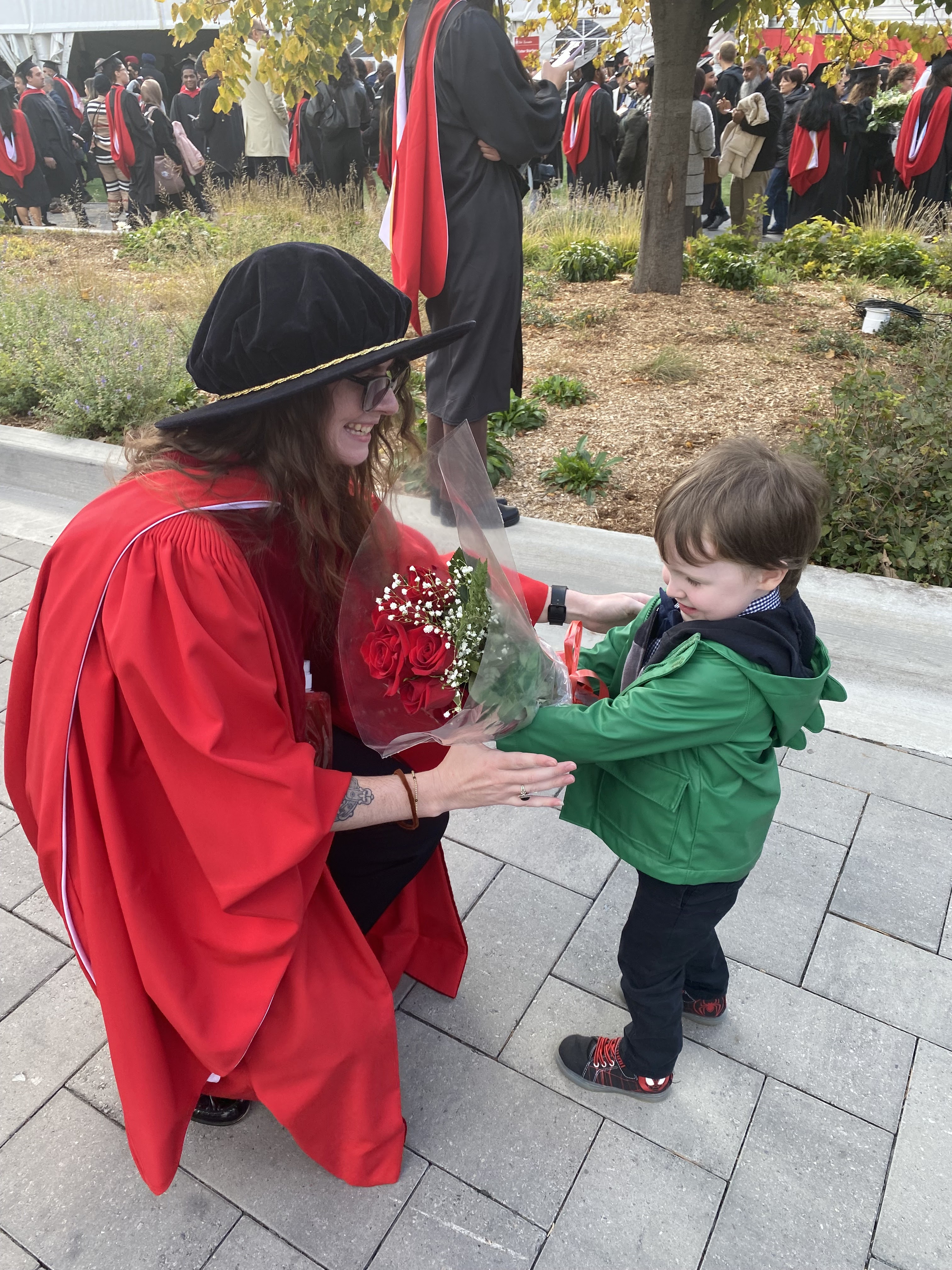
 Dr. Charissa Campbell, at York University's fall convocation with a member of the PVL class of 2050.

by Dr. Charissa Campbell

Well, after many years with the PVL team where I completed both my MSc and PhD, it is time to say goodbye. I just finished my walk across the stage at convocation in mid-October. Even though I may not be there in-person any longer, I don’t feel like my time is fully done with the PVL crew as I’ve made amazing friendships and collaborations. I’ve learned a lot about myself during these times and I am grateful for the opportunity to pursue my degrees with the group and how that work granted me my dream job where I live now, Maryland, USA. I’ve been fortunate enough to land a postdoctoral research position at the NASA Goddard Space Flight Centre continuing work on the Martian atmosphere. But here, I am looking at a unique type of dust storm rather than the clouds I studied at York.


Recently I was asked about my favourite memory with the PVL group and to be honest there were just too many to pick one. My work with the Curiosity team helping to manage environmental operations was high on the list (see: So Long and Thanks for All the Clouds)  but so was developing an outreach event for the Ontario Science Centre (see: The Rover Exploration Challenge). All the travel I got to do to places like Geneva, Switzerland; Paris, France amid others was where the real networking happened so I could feel like a true Martian with other scientists while also practicing my public speaking skills. I also got the amazing opportunity to visit the Canadian Light Source in Saskatoon Saskatchewan and not only do lab experiments at this amazing facility, but got to brave the -40 C weather that I grew up with and do not miss (see: The Continuing Adventures At the Canadian Light Source). I managed to use all this traveling to complete an item on my bucket list; visiting every Canadian province. I completed this when my colleague, Grace, and I traveled to Newfoundland to complete field experiments for the MAPLE instrument (see: There and Back Again, A MAPLE Tale ). Lastly, my time working on an internship at the Canadian Space Agency was also a big highlight and a dream of mine that I am still in shock in came true (see: Completing an Internship at the Canadian Space Agency).  I could go on and on about the amazing experiments and experiences I’ve had with this group. I’ve had an amazing 20s and now I am ready for my 30s and my career.


Even though I walked the stage in mid-October for my PhD, I actually left Toronto for Maryland back in November 2023. I was able to complete my dissertation revisions while also doing work here at NASA Goddard so that I could ensure a good salary for my family and a new opportunity for them to explore life here in the USA. My son is now in Pre-K in a wonderful school (oh how the time flies by!) in the Annapolis Maryland area and we’ve also gotten lucky at being able to afford a wonderful house with a big backyard with lots of birds and trees. Some of my best work here in Maryland is sitting outside in the backyard with my laptop and enjoying the fresh air. The climate here in Maryland is a lot warmer than what I grew up with in Edmonton, Alberta but I am grateful for experiencing the weather of Ontario to prep me for what we are experiencing here in Maryland. From May till August temperatures were hot and humid like a swamp. However, now in October/November it is very mild with wonderful colours in the tree for Autumn. Last winter was quite mild in comparison to Canadian winters, which felt like a nice change. The one tidbit about Maryland winters that made me laugh is that elementary kids don’t have recess when the temperatures go below 0 degrees Celsius. That is basically all of Canada’s winters, especially where I grew up in Edmonton, so Arthur has gotten lucky! My year here in Maryland has been great and I am hoping to turn it into our long-term home so that I can find some stability for my son and our family while exploring my career.


I feel like I've come a long way in not only being a scientist, but as a person and I’ve learned a lot of lessons and knowledge that I will take with me into the future, all thanks to my time with PVL. Luckily, I am able to keep my postdoctoral position for a longer term if I can keep putting through proposals to convince scientific committees to fund my salary to do research. It can be a bit daunting to have to constantly ask for funding for work but at the same time it allows me to be an individual scientist and try proposing my own ideas. Through learning how to develop experiments, instruments, writing papers, or mentoring others I feel very prepared after my time with PVL to become a true scientist here at NASA Goddard.


Once again, I want to thank the PVL crew (past and present) for the amazing memories and our leader John Moores for creating the opportunities for us so that we can learn and thrive in our individual scientific way. Toronto has been a unique experience for me after having grown up on the prairies in a smaller city, but I am glad I was able to conquer Toronto and the horrendous traffic. I wish everyone the best at the PVL team and I’m sure I will see y’all at the next conference where I will accidentally hang out with you as I feel like I will always be a PVLer.

Tuesday, March 26, 2024

De-mystifying Martian Clouds


 Two of the lab's PhD students have just published analysis on how Martian clouds interact with sunlight in companion papers over in the Planetary Science Journal! The results represent work on thousands of images of the sky taken by the Curiosity Rover over more than ten (Earth) years and describe the thickness of the clouds we saw and give information on the crystals that make up those clouds. How can you use pictures of clouds to figure out what they are like on the scale of less than a thousandth of a cm? Read on to learn more!

by Alex Innanen & Conor Hayes

Here at PVL, we’re a big fan of Martian clouds. For over eleven (Earth) years, we’ve tasked our favourite PVL-er, the Mars Science Laboratory (MSL) Curiosity rover, with staring up at the sky for a handful of minutes every few sols to capture the clouds drifting over its home in Gale Crater. Recently, we had two papers accepted that discuss some of these cloud observations. Our papers are very similar – both look at how light interacts with water-ice clouds during the same time of year (the Aphelion Cloud Belt, or ACB, season) using the same cameras (Curiosity’s Navigation Cameras, or Navcams). Between our papers we have 33 figures and over 15 000 words. Reading through that much material can be a daunting proposition! So, presented below for the cloud-curious is a brief and hopefully engaging summary.

Over the years, clouds have made frequent appearances on this blog, but as a quick refresher, yes, there are clouds on Mars! Some are made of dust, some are made of carbon dioxide, and some are made of water-ice. The water-ice ones are the ones we’re interested in, particularly those that form as part of the ACB. Every year, when Mars approaches its furthest point from the sun, it sees an increase in water-ice cloud formation around the equator. Gale Crater, where Curiosity lives, is just five degrees south of the equator, so it sees the southern edge of this belt of clouds. This is really great for those of us on the environmental science team – we get an opportunity every year to study these clouds and look for patterns in their behaviour from year-to-year. 

ACB clouds above Gale crater tend to be fairly tenuous – think of those wispy cirrus clouds you might see on Earth (shown above). Like cirrus clouds, they’re made of tiny crystals of water ice. (On Earth we don’t tend to specify what kind of ice, but on Mars the atmosphere can be cold enough for both water and carbon dioxide to freeze, so it’s helpful to differentiate between the two.) These crystals form when water vapour in the atmosphere condenses on some kind of nucleus – usually dust particles.

On Earth, atmospheric water vapour tends to freeze into a certain set of shapes depending on the specific conditions present when the ice crystals are forming.  These shapes have been catalogued thanks to the fact that we can actually fly into and directly sample our clouds taking close-up pictures of the ice crystals. While it may be possible that the ice crystals in Martian clouds have similar shapes to those in terrestrial clouds, we unfortunately cannot (yet) directly image them like we can here on Earth. Instead, we have to rely on some physics tricks. One of these tricks is looking at how light interacts with the clouds. These light interactions can produce a myriad of cool optical effects, but more importantly can give us information about the size and shape of these particles. This information is captured by what’s called a ‘phase function’. The phase function is a mathematical description of how much light is scattered by some particle at different angles from 0 to 180°, visually represented by a curve. The exact shape of that curve depends on the shape and size of the ice crystals in the clouds, so we can attempt to determine the nature of martian ice crystals by comparing our phase function measurements to those that have been made for ice crystals on Earth.

To see how light is scattered by the clouds across different angles, former PVL member Brittney Cooper came up with the phase function sky survey: Curiosity takes a series of 9 small cloud movies looking in different directions all around the rover, like you can see in the gif below.

From this we get information about how sunlight is scattered by the clouds at different locations around the rover and put together an average phase function for the clouds we observe throughout the cloudy season at Gale Crater. We’ve been doing this observation through four Mars years so far, which means that we can compare different Mars years to see if there’s any change in the phase function. The ACB is a very stable feature – it doesn’t change much from year to year. Likewise, the average phase function at Gale doesn’t change much either. Nor does it show much difference between morning and afternoon observations. So, what does that tell us? Mostly it’s just that – the phase function doesn’t change much from year to year, or from morning to afternoon. But this could also suggest that the water-ice crystals that make up the clouds aren’t changing.

Which brings us back to the question of what those crystals look like. This problem has been tackled a number of ways in the past, often by comparing an observed phase function with one for a known ice crystal shape. Brittney took this approach, as did Alex in their Master’s work. However, we found that none of the modeled ice crystal shapes fit our curves very well. This could be for a couple reasons – the particles Brittney looked at were much bigger than the water-ice particles that we tend to see on Mars. It’s also likely that the water-ice crystals are not forming the same shapes they do on earth.

In the phase function paper, instead of forging along directly comparing our curves to known water-ice crystal shapes, we took a slightly different approach. It turns out you can make a simple approximation of a phase function mathematically using what’s called a Henyey-Greenstein (or HG) function. There are two values that go into making an HG function – the creatively named ‘b’ and ‘c’.  Helpfully for our purposes, the b and c values also give information about the particle shape. If we look at the b and c values we see in the Gale Crater phase functions, they’re close to b and c values for rough, irregularly shaped particles – not those relatively simpler geometries we see in Earth clouds. It’s not as exciting as actually having a picture of what a martian water-ice crystal looks like, but it is still a solid starting point.

The phase function is important not just because it gives us information about the shapes and sizes of the ice crystals in the clouds, but also because it is a critical input into various models. These include Martian global climate models (GCMs), which must include the effects of clouds on the amount of light that is transmitted through the atmosphere. It is also important for the topic of our second paper: the opacity of the ACB.

A cloud’s opacity basically describes how thick it is. An opacity (or “tau”) of zero means that there are no clouds and all light passes through.  As tau increases, more and more light is blocked, either through absorption or reflection into new directions (also called elastic scattering). In theory, tau can be arbitrarily high, but at a certain point so much light is blocked that it can barely be measured. During the Mars Year 34 global dust storm in 2018, Curiosity measured a tau as high as 8.5, meaning that about 99.98% of the Sun’s light was blocked by atmospheric dust (hence why the solar-powered Opportunity rover did not survive the storm).

We use a fairly simple model to determine the opacity of water-ice clouds. The math is not particularly exciting, but in essence it takes the amount of sunlight reaching Mars at the top of its atmosphere and determines how much “stuff” there has to be between the top of the atmosphere and the ground to explain the amount of light that Curiosity measures. The phase function is important here because it tells us how much of that light is being indirectly scattered towards the rover by the clouds.

The opacity of ACB clouds has been the topic of a number of PVL papers before this one, most recently by former member Jake Kloos in 2018. That paper covered the first two Mars Years of measurements. When we began writing this paper, we had just passed five Mars Years at Gale, so we were very much due for an update! We had initially hoped that this would be a fairly straightforward paper to put together. Because our model had already been well-established in our previous papers, we thought it would just be a matter of running the new data through the old model. Unfortunately, once we did so, the results pretty obviously made no sense. As previously noted, the ACB doesn’t change much from one year to the next, so we’d expect that the opacities would stay pretty much the same from year-to-year. Instead, the opacities output by our model for the new data were all over the place! They were neither consistent with each other nor with the old data, so we had to go hunting for a reason why.

It didn’t take much digging to find the cause. When we plotted the opacities as a function of each measurement’s distance from the Sun on the sky, there was a sharp increase as we got closer to the Sun. There’s no physical reason why clouds near the Sun should be thicker than those elsewhere, so our model was clearly breaking down in this area. The culprit, as it turned out, was the phase function. All of our previous opacity papers had assumed that the phase function was flat, taking on a single value of 1/15 at all angles. The results from the phase function sky survey have shown that this is very much not the case near the Sun, where the value of the phase function rapidly increases.

By assuming that the cloud opacities shouldn’t change very much over the ACB season, we were able to derive another phase function for ACB clouds, one that is reasonably similar to the one found using the phase function sky survey (which is good since we're all looking at the same clouds using the same cameras on the same rover!). After adding this new phase function into our opacity model, we were finally able to take a proper look at how ACB opacities have changed over five Mars Years.

In short, much like the phase function itself, they don’t really change at all, which makes sense given the consistency of the ACB between years. Notably, these new results invalidated one of the findings of Jake’s 2018 paper: that ACB clouds in the morning tend to be thicker than those in the afternoon. Although thicker clouds do appear more frequently in the morning in our new data, it doesn’t seem that this is the case generally. In fact, we found that observations in the morning tend to be taken closer to the Sun than those in the afternoon, which was artificially increasing their opacity values when using a flat phase function. Why didn't Jake include this in his paper? Without access to as much data as we have now, he simply didn't know that martian clouds behaved this way! (no one did) Therefore, while it can feel a little awkward calling out a former labmate’s paper as incomplete, science ultimately moves forward through incremental methodological improvements.

Just for fun, we also compared our opacity measurements with those taken by two cameras orbiting Mars: the MARs Colour Imager (MARCI) onboard the Mars Reconnaissance Orbiter (MRO), and the Emirates Exploration Imager (EXI) onboard the Emirates Mars Mission (EMM) Hope probe. Our methods did feel a little cyclical (assume the opacities don’t change much to derive a phase function, then use that phase function to conclude that the opacities don’t change much), so if we can match our ground-based measurements with those taken from orbit, we can have more confidence in our results.

Happily, the agreement between the MSL and MARCI/EXI measurements ended up being excellent, matching almost exactly with a few differences that can generally be explained by regional dust storm events that aren’t accounted for in the orbital data’s models. Thus, we can confidently say that our results reflect reality and probably aren’t a consequence of any assumptions that we made.

And don't forget to check out the papers themselves, available open-access at

Hayes et al. (2024)
Five Mars Years of Cloud Observations at Gale Crater: Opacities, Variability, and Ice Crystal Habits
&
Innanen et al. (2024)
Three Years of ACB Phase Function Observations from the Mars Science Laboratory: Interannual and Diurnal Variability and Constraints on Ice Crystal Habit