Showing posts with label MSc Articles. Show all posts

Wednesday, September 23, 2026

Field Work Ahead: "Uh, I Sure Hope It Does"

Ahh, remote fieldwork! Though we are not a field-focused group, we have participated in several campaigns over the years (mostly to the Canadian Arctic). I can't recall a single one of them having gone off without a hitch - there is always at least one major challenge. This week, Izzy describes her experience this past summer visiting the Scotty Creek Research Station, near Fort Simpson in the NWT. 
You can find some of her photos above. Caption: "Top left: a bison by the side of the road, bottom left: float plane flown by the lovely Sergei, right: ferry ride across the Liard during extremely high river levels!"

By Isabelle Marincic

Throwing it back to June 2026, my supervisor and I went to Scotty Creek Research Station (SCRS) in the Northwest Territories to conduct some field work! I love the outdoors and getting to do my job while being surrounded by nature, so if conducting field work during my masters is a possibility you bet I’m gonna do what it takes to make it happen. Aka beg John to figure out somewhere for me to go and something for me to do. Field work can be extremely expensive and time consuming, and sometimes you don’t even leave with the best results (foreshadowing). But for me, getting to do the physical work connects me with the science even more, with the bonus of getting to breathe in fresh wetland air while I do it.

Why might a planetary scientist who primarily studies Mars need to go to a wetland you may ask? Wetlands are actually a major source and sink of global methane. To test an instrument we have in the lab and are continuing to develop, we took it to SCRS to measure methane fluxes within a wetland that consists of different terrain types and likely multiple methane sources. The hope is to develop a methane spectrometer that can go to Mars and measure methane there (for more work on this see Summer Trip to MARS), as current methane measurements are seriously infrequent. A lack of methane measurements on the planet Mars inhibits people like me from learning more about sources and sinks of that molecule on the planet. 

So off we went, despite multiple hiccups including flight delays and a rental car check engine light, we made it to SCRS. The 7 hour trek to Fort Simpson required 3 modes of transportation. This included sight seeing by car, a gnarly ferry ride, and finally a float plane flight from Fort Simpson over to SCRS (all pictured above). 

Once settled into camp, the real work began. On a Thursday in June, John and I took methane measurements at an area spanning two bogs with a hummock separating them. We selected this location with the hopes of potentially seeing some concentration changes due to bogs being wet and hummocks being dry, therefore they may emit methane at different rates. After taking the time to carefully map out the grid area we took measurements for around 5 hours. Upon returning to camp to check the data retrieved after a long day in the field, I found nothing had actually recorded. Turns out, the USB I was using accidentally gave the spectrometer's internal computer a virus that prevented the full start up sequence from being carried out. Instead, that programming only partially executed, which made it sound like it was on and running without taking any data.

After briefly crashing out and contemplating if I should quit and give up on being a grad student, John helped me lock in and realize that these things happen. Especially in the field. To quote John Steinbeck (different John) from his book “The Log from the Sea of Cortez” (1951): 

For many little errors like this, we have concluded that all collecting trips to fairly unknown regions should be made twice; once to make mistakes and once to correct them.” 

Thankfully due to a supportive supervisor (and camp members I had just met), I ended up fixing the error in the code by politely harassing an employee from the company who manufactures the spectrometer. To Bob from ABB, I owe you my life. 

So after all was said and done, I got about a third of the data I initially wanted out of this trip. But almost most importantly, what I got out of this trip is a better understanding of how to approach field work and what to do if something goes wrong. It was a really tough lesson to learn but I think I am better for it. Nothing worth doing is easy.

Finally, I would like to thank the Łı́ı́dlı̨ı̨ Kų́ę́ First Nation community who lead and support ongoing research at SCRS. The community was extremely welcoming to us as new researchers to the site, and I sincerely hope to be back soon! 

Thursday, April 2, 2026

One Year In


It's an adjustment, starting grad school. Even if you've already done research work, becoming a teaching assistant, taking on more responsibility in the lab or even lecturing to a class can be daunting! But fear not - these are challenges that all academics have overcome in their careers and so will you. This week, MSc student Isabelle Marincic reflects on her first year experience.

by Isabelle Marincic

It’s official! I am one year into my masters, yet I am feeling dumber than ever before. Well, not really, but being in a constant state of learning makes me feel like I never actually know anything for certain. After a slight crash-out with my supervisor (shout out John), I am finally starting to feel like I belong, and that maybe I can actually get through this degree. I want to dedicate this blog post to things I’ve learned, skills I’ve gained, and things I am still working on. (This blog post topic was inspired by Grace’s wonderful enrichment exercise at the last group meeting.)

What have I learned (seriously!)

Throughout a masters, learning comes in many forms. This can be academic or personal, in that while I have definitely gained scientific knowledge I have also gained knowledge about how I am able to effectively conduct research. A hard lesson learned was how self-regulated a masters degree really is, and as it turns out, I needed to come to terms with the fact that I am really bad at self-motivation sometimes. Most days my schedule is completely up to me, which sounds ideal in theory but in practice allows for the perpetuation of bad habits, such as doom-scrolling on reels. This combined with the crushing weight of impostor syndrome leads to quite the unproductive day. I quickly realized that I needed to change my mindset, mostly regarding my impostor syndrome. For a while doing research felt like; “Why even bother if I know some other masters student out there is way smarter than me?” I bother because I love research, I love what I am researching, and this is the place I know I want to be. On top of my difficulty in an academic setting, the negative self-talk was seeping into other areas of my life, into things I also simply love doing. So, while having learned a lot about remote sensing techniques and methane measurements on Mars, one of the most important learning experiences was learning how to speak nicer to myself. Self-motivation can be really difficult - and it is currently a work in progress - but it is most definitely progressing in the right direction. Thankfully, I work with an amazing group of people who always offer the best and most comforting advice :) 

Have I even gained any skills?

You bet I have. Again, skills can be separated into academic and personal. The academic skills I have gained are small but mighty. For instance, I can read better now. And by this I mean I can better approach a research paper rather than having absolutely no clue where to start. A good place to start is the abstract, though. Then I like to read headings and assess the flow of the paper. Sometimes I accidentally end up just reading the entire paper depending on how cool the research is, but this is often a waste of time </3 

Earlier this year I had the opportunity to give a lecture on Martian methane (see image above)! I was really excited to work on my public speaking skills as this skill is crucial when attending conferences and presenting your research. I also hope to continue down the academic track to obtain a professorship (in a thousand years) so giving a lecture fit right in with that goal.  

Finally with regards to a personal skill that I’ve gained, I realized that in order to complete work I HAVE to allot hours in my day to specific tasks. Otherwise, I will literally not complete anything. Perhaps I acquired this skill a little late in the game but better late than never!

Some more room to grow

There will always be room for a person to grow, which is what makes life so fulfilling. Although, it can be hard to admit you need to grow, hence my crash out. I was in denial for a couple of months about the severity of my issues, resulting in such a build up of feelings that they all came out in a teary mess. So, moving forward, I plan on maintaining a positive internal dialogue, and to simply keep trying new things despite not feeling 10000% confident. This holds true for my academic endeavours, like writing my first paper, or my athletic endeavours, because my climbing gym is sandbagged and I keep falling off the wall. But like most things in life worth doing, you have to suck before you can get better!


Friday, February 6, 2026

DPS/EPSC 2025: Izzy’s First Masters Conference


One of the best parts about being an advisor is that you get to see growth in your trainees. Not only is is satisfying to see those students succeed, but you are also reminded of the early times in your own career. There is no more reliable occasion for such moments than a masters student's first conference. This week is Izzy's turn to talk about this evergreen topic on our blog!
(Above: Izzy at the Airport. Image credit: Izzy's father)

By Isabelle Marincic

From the title, you probably have been able to deduce the topic of today’s blog post. What you may not have guessed is that I am going to recount to you in chronological order the events of my first conference during my masters degree!


Step one was getting to the airport (YYZ, Rush). My father graciously drove me to the airport for my 4:30 pm flight on September 5th, 2025. Pictured above is my father embarrassingly sending me off while he waited outside of security. Naturally, I was about 2.5 hours early for my flight. 


Feeling under-packed and tired, I bought a delicious panini to tie myself over until they fed me dinner on the plane (yum!). I think I slept most of the flight to the layover location: Frankfurt. Upon arriving at the Frankfurt airport, I took the world's longest bus ride to the other side of this ginormous airport hoping I would magically arrive at my terminal. Which I did! Long story short, I accidentally gave the German government my fingerprint, and waited in a very long line for security. One final flight later, I arrived in Helsinki, Finland. Very excited to take European public transportation, I trained to the city center, and meandered my way to my hotel on foot. First impressions of Finland: grey.


Fast forward to Sunday, September 7th after Milena and Abby arrive. We took this day to peruse areas near our hotel before the conference began the following day. Abby and I guided a ship to shore, and got some steps in. 


With this being my first conference attended during my masters, I was extremely excited to learn about tons of new science, to meet other scientists interested in the same things as I, and to present the work I had completed so far since arriving at York. There was an immense amount of information being relayed throughout the conference, it was so much all at once that I had trouble remembering most of it. This was a lesson for me to take notes at the next conference I attend. But, the programme included talks on terrestrial planets, outer planet systems, small bodies (comets, asteroids, etc), exoplanets, origins of planetary systems and astrobiology, and outreach, diversity, and amateur astronomy. The talks I primarily attended were those in my general field of astrobiology, along with talks given by members of my lab.  


One of the highlights of the conference with regards to my professional development was the poster I presented during the Exoplanet and Astrobiology poster session. Tragically, I only attracted a single visitor to my poster. While it was slightly awkward to stand by my poster for about an hour without being able to talk about my research, I still firmly believe in the writing and presenting of poster presentations. It is a necessary segue into academic writing, which is a very difficult skill to master. I have yet to do so. So, writing short abstracts that explain your work to a relatively broad audience is good practice for advancing your academic writing skills in the long run, especially for undergraduate students.


Overall there were two lessons learned during this conference: (1) take notes, and (2) talk to more people! I was insanely nervous as this was my first time interacting with a large group of intelligent people, so it was quite intimidating. I know Abby and Elisa have no problem with this part of the job, so maybe I should ask for some tips. I personally enjoy collaborating and sharing ideas with people in my field, as I believe this helps improve my science by hashing things out-loud. Now that I am a whopping 4 more months into my degree, I think I will have more ideas to share during AbSciCon 2026 :)
 

Lastly, below are some images of Helsinki during the touristy part of the conference trip! Helsinki was a 

very inviting and pleasant city, especially with the availability of public transit which the North American mind could not comprehend.


Thursday, November 13, 2025

Baby’s First Conference Talk

Public speaking: it's a critical part of communicating your science. But, apocryphally, most people would rather do almost anything else, even something unpleasant. I can tell you that even for me, the anxiety is real. It's there, any time I'm giving a talk or delivering a lecture. That can be a good thing, pushing you to refine your technique and your content. Some can even harness the nervous energy in their delivery! Fortunately, I've found most audiences to be understanding - our colleagues remember feeling that way too. Below, MSc student Abby discusses her first experience delivering a scientific presentation at a conference.

by Abigail Newton

To be perfectly clear before we begin: I am not a public speaker. I don’t consider myself to be good at presentations, I certainly haven’t had much practice with large crowds, and my brain stops working the moment I open my mouth. For all these reasons, I signed up for a 12-minute oral presentation at the International Meeting for Planetary Missions 6 (IPM) conference. The moment I saw the email pop-up in my inbox indicating that I received a presentation slot, I regretted all my previous decisions. But it was too late – I had no choice but to get prepared. Though I couldn’t have expected it, this presentation ended up being one of the best decisions I could have made.

The topic of my presentation was a cloud sensor, designed to turn on a camera when it detects Martian clouds are overhead. However, mere weeks before the conference, my sensor prototype was still unfinished, and I had another presentation at a different conference a month after IPM. It was a busy summer to say the least. Gathering my results just 5 days before my presentation – at a time when wildfire smoke concentrations were at the highest level they would be all summer – I found that my sensor could separate smoke from clouds. This was an unexpected, but welcome discovery. IPM itself is unique in that it’s attended by primarily engineers and was completely instrument-focused – completely up my alley.


Once I had gathered my results and wrapped my mind around the implications for my instrument concept, I decided to tackle the presentation itself. I practiced – wrote and rewrote, stumbled through a rocky presentation within the department, redid the presentation, got a class-A lecture from my airplane seat-mate on how I should “just relax”, practiced some more, anxiously sat through presentation after presentation on instruments with MILLIONS of dollars in funding, all before it was finally my turn. I wanted to vomit.

After 12 minutes of complete blackout, I found myself back in my seat. I came to and realized: it went well! I got a laugh out of the audience at the very beginning that allowed me to loosen up and relax through the rest of it. Did I make some small mistakes while speaking? Yes. Was I perfectly engaging every corner of the room? No.

Unfortunately, my worst fear came true.  I got stumped by a question that was perhaps less than relevant to my presentation in front of a room full of world-class scientists I was desperate to impress. I did not give an answer that could in any way be described as coherent, but the moderator stepped in and shut it down. 

Seasoned scientists and engineers continued to ask interesting questions about my presentation for the rest of the conference – the kindest people, treating me as a peer. My results showing the detection of amounts of wildfire smoke significant enough to override the thick cloud cover above caught attention and brought questions about making a similar version of the sensor for dust – something I had already been considering. Even better, my presentation was on the first day, so I was able to take a deep breath and enjoy the rest of the conference stress-free. 

Lots of hiking and learning was done in beautiful Boulder over the rest of the week. I was inspired by both presentations on the future of instrumentation and the gorgeous landscape. I would massively recommend giving conference presentations to any grad student terrified of public speaking – exposure therapy is the way to go.   

Tuesday, October 28, 2025

Say Yes to the Lab Group

It's an interesting exercise to look back from time to time. Can you make out the pathway that brought you to where you are today? No matter whether the decision at any particular juncture was good or ill in retrospect, as the song (and Mary Schmich column) goes: "your choices are half chance." But why not improve those odds? Today, MSc student Milena Markovich offers some advice for those thinking about returning to university for graduate school.

By Milena Markovich 

In December of 2023 I found myself with that annoying, undeniable and incurable itch. The itch to go back to school. Only six months after graduating from five arduous years of an engineering undergraduate program, complete with all-nighters, co-op terms and oceans of coffee, I had vowed that industry was the place for me. I wanted a break – a simple 9-to-5, no working on weekends (most weeks at least), no worrying about assignments or exams.  However, after only a couple months as a full-time engineer, I knew that this was not what I wanted my future career to look like. I had always paved my path through engineering with the goal of one day working in the space industry – and, after all, what was I waiting for? I decided “one day” had to become “today”. Now that I had made up my mind to pursue graduate school, I began the hunt every little scientist dreams of – the hunt for the perfect lab group.
 

Here we get to the crux of this blog post: an easy (in theory) how-to guide for finding the perfect grad school program for you. Step number one: “thank you, next” – meaning, establish your dealbreakers. For myself, the past 5 years of my life had been spent laboring over an engineering degree, and I was hesitant to throw that all away. I wanted my MSc program to be a low-stakes introduction to the world of research. From this principal objective, I could establish two requirements. First, the program or research must have some relation to engineering, whether it be with engineering courses or instrument-based research. Second, I needed to graduate from this program debt-free, such that I could later choose whether to remain in academia or return to industry, without the pressure of financial stressors. This led me to limit my search to graduate programs within Canada, both for the proximity to friends and family and to avoid hefty international tuition fees.


Step number two: “so tell me what you want, what you really, really want” – or, set your core values. Seriously answer the dreaded question from every behavioural interview: “where do you see yourself five years from now?”. No one stays in grad school forever (at least I hope not), and as such you need to tailor your graduate program to the career you want. No doubt priorities shift, interests evolve, and you can finish grad school with an entirely different goal. But based on your aspirations right now, you can start your hunt for a supervisor. For myself, I knew I wanted to retain the engineering mindset I had built from my undergraduate program. I also knew I valued the novel approach of my program – integrated engineering at UBC, which allowed me to learn multiple disciplines of engineering, informing a systems-based approach. These values were what initially made Dr. Moores’ career, and the Planetary Volatiles Laboratory, stand out to me. Having completed an undergraduate degree in engineering science at U of T, John has built his career bridging engineering and science interests in space exploration missions.


Step number three: “you’ve gotta have faith”. When it comes to grad school applications, a myriad of factors play into a supervisor’s ability to accept you as a student. When I first reached out to John, I initially received the dreaded “sorry, no vacancy”. However, as I continued connecting with various supervisors across Canada, a couple months later I opened my inbox to find a follow-up response. As luck would have it, a spot had opened up and I was able to meet with John to talk about potential thesis projects.


Step number four: “how deep is your love?” – I fear I must age myself and establish that this refers to the Bee Gees song, not Calvin Harris. Of equal importance as a supervisor or program, is your thesis project – namely, how much you can commit to this project. This is what will “take over” your life for the next, at minimum, two years. As such, you want to make sure that this project aligns with your goals beyond grad school. Imagine yourself sitting in an interview, discussing your work over the past couple years. Will this project help you impress your dream company and land the dream job? Will it help you take steps towards the path you want in academia? Is the project feasible to tackle with your skill set? Does it help you build a new skill set which you need to be a competitive candidate? When I first spoke to John, we discussed a modelling-based project which had me very hesitant to join the lab. I was steadfast in finding a project that would suit my engineering skills and which I could use to market myself to future employers in industry. Once again, in another blind stroke of luck, only a couple weeks after re-connecting with John he attended a conference which kickstarted renewed interest in a Lyman-alpha camera he has been working on for lunar ice prospecting from within permanently shadowed regions. Instrument-based? Check. Relevant to space industry interests? Also check. With this project aligning better with my goals, I was nearly sold on the Planetary Volatiles Lab.


Step number five: “I’m pickin’ up good vibrations”. If you are like me and have relocated for grad school, this step is likely of equal importance to everything else. Living in a new city, trying to make new friends while overwhelmed with the workload of research, taking courses and teaching assistantships can feel impossible. You want to establish what the lab culture is before you make this big jump. Ensure that the lab aligns with your personal expectations outside of research – a social, welcoming and warm atmosphere can help ease the transition to a new city. John happily connected me with Alex and Grace, both of whom helped confirm my decision for me. As numerous blog posts have detailed before, our lab makes time for social activities throughout the year and during conferences, facilitating a friendly environment. Establishing a support system within the lab has been the biggest factor in my success in moving to Toronto and starting graduate school. Research can be difficult in its own right, choosing a lab where you never feel alone helps to brighten both the tough times and the celebrations.


“Goodbye, everybody, I've got to go” – and that’s all folks. Following your own values, goals and passions will result in a foolproof strategy for picking the right lab group. These decisions are not one-size fits all, and at the end of the day only you can make this decision. So, think about these steps, write some pro’s-and-con’s lists and take the leap into the wacky world of graduate school. Whether this guide leads you to us at the Planetary Volatiles Lab or elsewhere, I wish you luck in your new adventure. 

Tuesday, July 22, 2025

Athletics + Academics = A Balanced Life

A challenge for many of us who do science professionally is knowing when to take a break. The engrossing feeling of diving into an all consuming problem can make it hard to remember to come up for air. But scientists are human beings too and we need other interests, connection and to take care of our physical bodies as much as anyone else. This week, our newest lab member Isabelle Marincic writes about how she strives to achieve that balance in her research career.

by Isabelle Marincic

Hello Lab Blog! My name is Izzy, and I’ve just joined the PVL as an MSc student in May 2025. I am so excited to be a part of this amazing group of scientists. I technically began working for Professor Moores in January as an RA, so I have been with the group for around 6 months. Within these first few months, I’ve begun working on projects related mainly to astrobiology (my favourite subject), including biological methane production on Mars and the feasibility of bacteria inhabiting Martian penitentes. I have also begun TA’ing which has been a new and exciting experience that I honestly have really enjoyed. On top of all of this, I am currently writing my first paper with the lab that will hopefully be submitted by the end of the summer! 
 
The reason for sharing all of this is not only to introduce myself, but to lead into the main topic of this blog post. I am an athletically motivated individual, and I strongly believe in a work-life balance. While I deeply enjoy academics and am grateful to be in the position I am, I always make sure to have an outlet that is separate from academia. After the long days of writing and reading papers, all I want to do is get on my feet and go do something that uses mainly my body rather than my brain. Ever since I was young, I’ve always been really athletic. I played soccer, volleyball, ran track and field and cross country, and just enjoyed being active in general. Now that I am a busy adult, finding time to be active is difficult, but it makes my quality of life so much better that I make sure to find time most days of the week to do something that moves my body. For a few years now I have been into weightlifting, which I aim to do three days a week. When I am not lifting in the gym, I am in the climbing gym 3x a week! I have been climbing for just over two years, and I am so thankful I found this sport. Climbing is fun and relaxing but also has such a strong community that I really enjoy being a part of. I have been able to meet so many people and make so many friends because of this sport, and it is extremely important to me to have spaces to meet people as it becomes increasingly difficult as an adult to do so as I get older. Human connection is something I seriously value in my life, and I can foster this through the athletic activities I participate in. 
 
For some reason, people in the climbing community constantly recruit their non-climbing friends to join climbing. I am one of those people. Since joining PVL I was repeatedly asking my lab-mates to come climbing with me. Some of them were eager to climb, while others I eventually wore down <3. This marked the first official PVL climbing outing. Those from the group able to make it out to Basecamp in downtown Toronto got to experience a fun evening of climbing, specifically bouldering! Bouldering is a style of climbing that does not involve ropes or harnesses where routes are set around 15 ft off the ground at their highest point. Mats cover the floor to break your fall, but proper falling technique is still a must-know before getting on the wall! Routes are organized by level of difficulty and use a V-grading system. Often, V0 is the easiest climb, with climbs getting progressively more difficult as the number increases. My lab mates absolutely rocked (pun intended) at our climbing session! While climbing obviously involves strength and endurance, it is 100% a mental sport as well. I have had to overcome mental blocks when attempting a problem which has only made me a stronger climber, and a more confident person. 
 
Getting to enjoy my favourite sport with my new lab mates was a really fulfilling experience as it allowed me to share something I love, and I had the opportunity to build stronger relationships with people I work alongside every day! Please enjoy the group picture from the evening above :)

Thursday, April 17, 2025

Rodeos and Regolith: A Week at LPSC 2025

The PVL crew at LPSC 2025 in The Woodlands, Texas. From left to right, we have MSc students Milena and Abby followed by PhD students Conor and Alex. There's nothing like your first scientific conference! (I still remember LPSC 2004 fondly.) Below, Milena Markovich, one of our new MSc students reflects on their experience this past March.

 by Milena Markovich

Running through Toronto Pearson Airport a punctual three hours before my flight, I could hardly focus on where I was going. Making my way through security, I placed all my items and luggage on the conveyor belt, running on autopilot. My mind was racing with anticipation, a perfect storm of excitement and anxiety. When I finally arrived at my gate, I double checked the display by the desk – destination: Houston, Texas. I settled into my seat and began some last-minute marking before I would eventually arrive at the Lunar and Planetary Science Conference. 

Once Abby arrived at the gate, we began discussing the conference in an excited flurry. What would it be like? Would our poster sessions go well? Which sessions and speakers were we most excited for? In a coincidence which perfectly exemplifies the small world of planetary science, sitting across from us was a former colleague of our supervisor: Dr. Livio Tornabene. After some friendly conversation, I asked Dr. Tornabene if he had any advice for a first-time conference goer like myself. His advice echoed in my mind for the entire week ahead – remember to take breaks, there’s so much going on that you can’t possibly “do it all”.

Although this was fantastic advice, after my first day at LPSC 2025 I realized I would certainly have a problem following this piece of advice. Sitting in on sessions exploring the icy moons of Jupiter, the minerology of Mars and astrobiology, I knew this was a learning opportunity of which I could not miss a single second. What followed was a week of 7AM mornings, quick jogs across the Macy’s parking lot to make it to the first session of the day, and long evenings spent meeting other graduate students, exploring The Woodlands and even Houston.  

The welcoming nature of everyone I met was a warm embrace into the planetary science community. In Texas of all places, so far from home and campus, I encountered other graduate students from York University. Through quick chats between sessions and social bar nights with loud “cheers!” going around, I gained a deeper sense of community. I met other students and scientists from across the world – offering friendly conversation at lunches, fascinating discussions about their research and helpful doses of career advice and mentorship.

In between the lecture presentations, bonus workshops and poster sessions I spent many hours walking the canal by the conference hotel with lab-mates, exploring local restaurants (failing miserably to order a sufficient amount of barbecue for three people), even managing an excursion to the Houston rodeo. From experiencing Cracker Barrel for the first time or exploring the wacky food booths at the Houston rodeo with my newfound friends, I gained so many wonderful memories outside the conference hall. This attitude of never saying “no” to a restaurant, extra session, or fun field trip allowed me to develop friendships with York students I had hardly seen around campus, and with other scientists from across the country, continent and world.

Thus, it seems I went directly against Dr. Tornabene’s advice. That is certainly not to say that his advice was not perfectly sound – however, as a first-year graduate student surrounded by the passionate, excited and welcoming nature of this community for the first time, this advice seemed equally impossible for me to follow.

Following discussions of LPSC 2025 being the last LPSC conference in this capacity, I knew I had done the right thing by trying to soak up as much of the experience as I possibly could. While career paths can be winding – starting and stopping at different destinations than we may expect – my time spent immersed in the planetary science community has been both professionally fulfilling and has provided me with many treasured moments with friends. I am so grateful that I had the opportunity to participate in this conference, both by presenting my research at the poster session and absorbing all the fantastic work being done in planetary science, while building meaningful relationships and connections within the community. 

Throughout my week at LPSC 2025 I learned much more than I could have hoped. From presentations on the geophysics of Mars and icy moons to lunar volatiles and minerology. Of equal value, I learned what a country steak is, had fried okra for the first time and experienced the epic highs and lows of a Texan rodeo. At the end of the day, there are indeed times when we all make the mistake of not following perfectly good advice. Returning home from Houston exhausted, yet full of knowledge, inspiration and fond memories, I’m glad I made that mistake.

Sunday, April 23, 2023

James Webb Space Telescope Update


The James Webb Space Telescope is able to view the universe in a truly new light. Below, MSc student Madeline Walters takes a look at some of the recent discoveries this new observatory has made. Image above: https://images.immediate.co.uk/production/volatile/sites/25/2022/01/JWST-galaxies-ba2f7b8.jpg

by Madeline Walters

It’s been a while since my last Webb update, but since then the space telescope has been busy! To kick off 2023, NASA released a statement [1] about how the James Webb Space Telescope (JWST) was used to capture the shadows of starlight cast by the thin rings of Chariklo, an ice small body located around 2 billion miles away from the orbit of Saturn. As the JWST observed Chariklo passing in front of a background star, the expected obstruction of that star's light occurred- a phenomenon called occultation- which allowed for the observation of a spectrum of the body’s surface. This showed evidence of crystalline water ice, which was previously only a guess from ground-based observations.
 
However, what surprised astronomers was that the starlight dipped twice rapidly before Chariklo passed in front of it, and then twice again as Chariklo moved away. These rapid dips in light were caused by the two thin rings of Chariklo - the first to ever be detected around such a small body. Since Chariklo is so small and far away, the JWST isn’t able to directly image the rings, but with occultation and the JWST’s heightened sensitivity, there is a hope that the composition of the rings may be isolated from the main body, allowing for further study.
 
Along with being able to get a closer look at smaller and more distant bodies with higher precision, the JWST has been showing us other things at higher resolutions than before. Take for example the side by side comparison of the ‘Pillars of Creation’ photos taken by NASA’s Hubble Space Telescope and JWST:

Image caption: A side by side comparison of the Pillars of Creation taken by the Hubble Space Telescope (left), and the JWST (right). Each image shows the same region taken in different wavelength ranges. The Hubble image is taken in the visible light range with different colors representing different molecules, while the JWST image is taken in the near-infrared range, allowing us to peer through the dust. (https://stsci-opo.org/STScI-01GF44F9Y10HZB8SPV2NZ8H6TZ.png)

On the left we have the Hubble image. This incredible and iconic image of towering cosmic dust in the heart of the Eagle Nebula shows us the primary components of what makes up these pillars [2]. Different gasses are represented by different colors here to allow us to visualize it better: blue is oxygen, red is sulfur, and green is both nitrogen and hydrogen. While the colors aren’t what we would see in real life, the structure is similar, since this is taken in the visible light wavelength range.

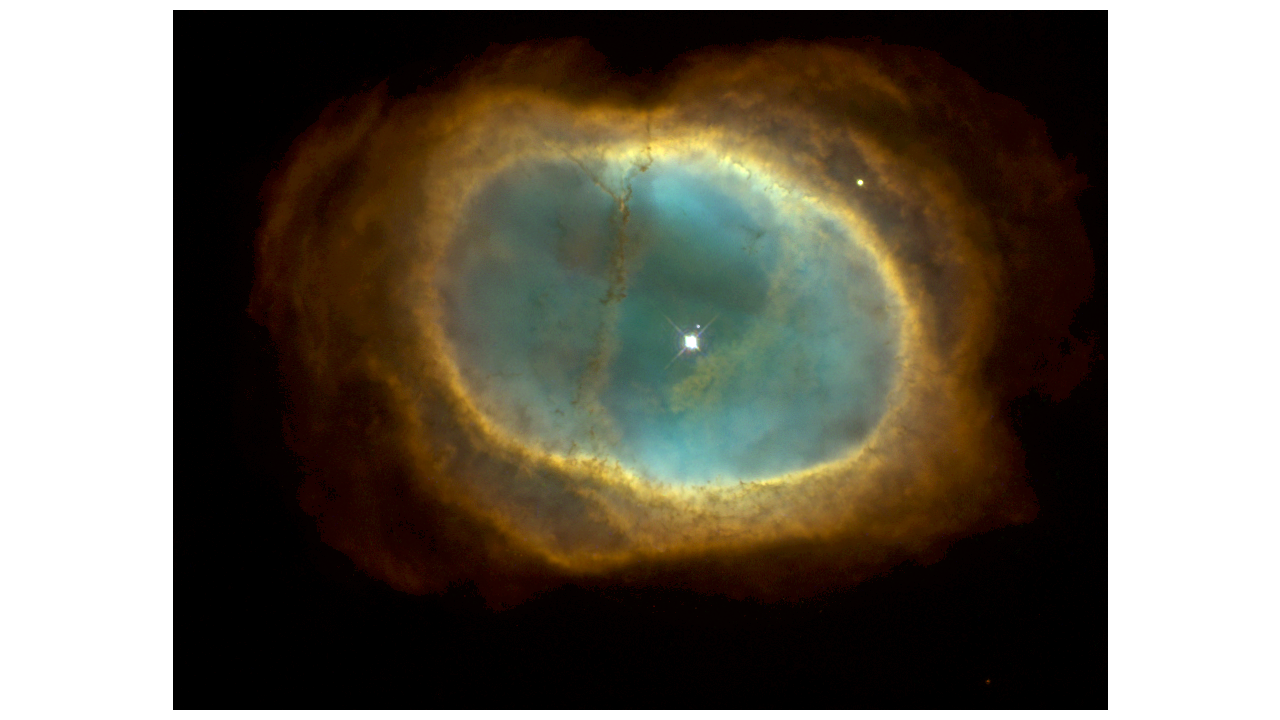
Now compare that to the image on the right of the same location taken by the JWST. Why is this different? It’s not just because the JWST has larger mirrors-it also comes down to the wavelength range between Hubble and JWST. Hubble observes in the ultraviolet, visible, and near-infrared ranges, while JWST observes in the near and mid-infrared range. This allows the JWST to pierce through obstructing dust and gas that shows up in the visible range, and show a view of the pillars we aren’t as familiar with, but isn’t any less stunning. More images reveal this difference between Hubble and JWST, such as these images of the Southern Ring Nebula, with Hubble on the left and JWST on the right:

Image caption: A comparison of the Southern Ring Nebula (NGC 3132) taken by Hubble (left) and the JWST (right)Each is taken in different wavelength ranges with different colors representing different gases, showing varying level of detail of the region. (https://stsci-opo.org/STScI-01EVVFSTZYZJJKAB41KA6AJ0HQ.png; https://www.nasa.gov/sites/default/files/styles/full_width_feature/public/thumbnails/image/main_image_stellar_death_s_ring_miri_nircam_sidebyside-5mb.jpg)

With the JWST, we can see in higher detail the rings of gas and dust thrown out by a dying star that we previously could not see in the Hubble image. Hubble has taught us some amazing things about the universe, but with the JWST, we can shed new light (in longer wavelengths) on objects in space previously unseen. Even just a few days ago, the JWST detected a dust storm raging on an exoplanet about 40 light years away [3]. The more we’re able to see, and the further back in time we are able to peer, the more we can learn about the universe and our place in it.

[1] https://blogs.nasa.gov/webb/2023/01/25/webb-spies-chariklo-ring-system-with-high-precision-technique/

[2] https://www.nasa.gov/image-feature/the-pillars-of-creation

[3] https://webbtelescope.org/contents/news-releases/2023/news-2023-105

Sunday, November 20, 2022

What’s going on with methane on Mars?

This week, Madeline discusses a critical component of her research into how methane is vertically distributed in the martian atmosphere. Read on for some details about the present state of the ongoing debate about Methane on Mars.
(Image source: https://mars.nasa.gov/system/feature_items/images/6037_msl_banner.jpg)

by Madeline Walters

On Earth, we’ve often heard of methane being produced as a result of living beings-microbes that help with livestock digestion. Though when we found methane on Mars, we were puzzled by its origins. Are there microbes helping the digestion of Martian cattle? Most signs point to no, however, we are still unsure of what may be producing the gas on Mars. Besides biogenic sources, methane can also be produced by geological processes, so being able to identify the sources of methane is a tricky yet interesting problem.

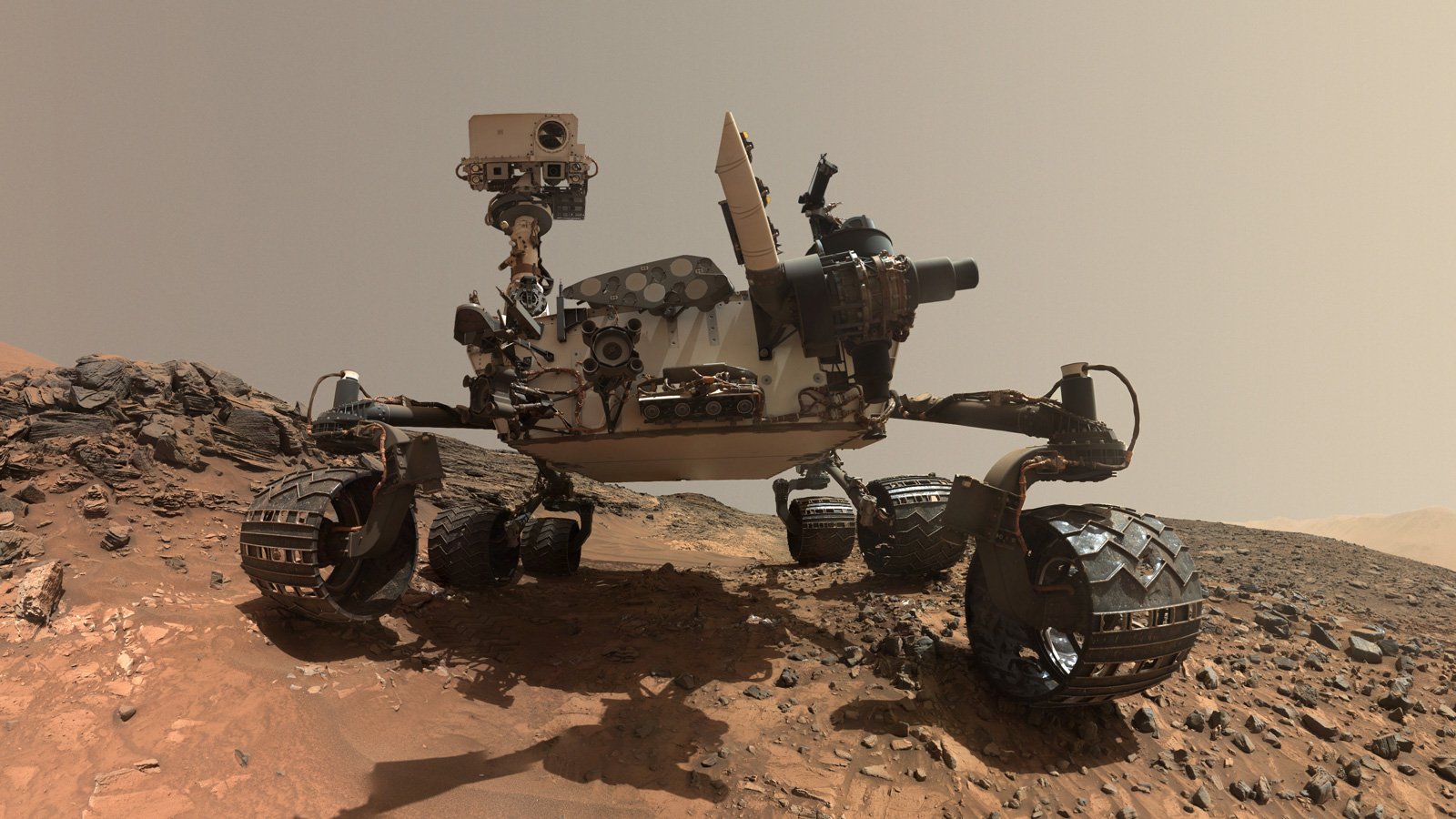
The issue with identifying the sources of methane is finding the methane in the first place. Since landing in Gale Crater in 2012, the Tunable Laser Spectrometer (TLS) instrument onboard NASA’s Curiosity rover detected background levels and a few higher spikes of methane from the surface, however, ESA’s ExoMars Trace Gas Orbiter (TGO) wasn’t able to detect any methane from higher up in the sunlit atmosphere. 

TLS lead scientist Chris Webster [1] comments: "When the Trace Gas Orbiter came on board in 2016, I was fully expecting the orbiter team to report that there's a small amount of methane everywhere on Mars, but when the European team announced that it saw no methane, I was definitely shocked.

The results were certainly unexpected after other detections of methane from other instruments, leading to new questions about whether the detections from TLS perhaps originated from the rover itself. Some scientists suggested the rover detected methane after crushing rocks, or perhaps wheel degradation, not willing to rule out any possibilities. However, the Planetary Fourier Spectrometer onboard the Mars Express (MEx) spacecraft observed higher levels of methane in 2013, after Curiosity also reported a methane spike, bringing back the question of how to make sense of these detections.

So why are some instruments reporting methane while others aren’t? This is something that is puzzling scientists almost as much as the source of the gas itself. Because of the conflicting reports of detection from different instruments, the key is observing how methane diffuses through the atmosphere at different times of day and through different seasons to see if perhaps the reports of methane from different instruments can still make sense.

Moores et al. [2] suggests a small amount of methane seeps out of the ground continuously such that during the day, it mixes well with the atmosphere, which results in very low levels of methane further up. Meanwhile at night, the methane can build up near the surface from the lack of convection. From this approach, we can make sense of both the ExoMars and Curiosity observations. While this could explain the discrepancies in methane detection from different instruments, we still have yet to determine the origin of the gas itself and if that origin perhaps can explain how the gas is being destroyed much quicker than it should. Because solar radiation and oxidation should be destroying the produced methane after a lengthy 300 years, the excess methane buildup should be detectable by TGO. This points to some destruction or sequestration mechanism that is getting rid of the methane quicker than expected such that the detected amounts make sense. 

"We need to determine whether there's a faster destruction mechanism than normal to fully reconcile the data sets from the rover and the orbiter," says Webster. 

One possible explanation for this is the gas’ reaction with the surface components. A chemical compound called perchlorate, which has been detected by Mars landers, may be acting as a sink for methane due to oxidation reactions [3]. When exposed to ultraviolet radiation from the sun, perchlorate accelerates the destruction of methane-from over 300 years to just days or hours. However, scientists are still exploring this possibility and as of right now, there’s still no way to be sure this is the reaction responsible for the gas’ quick destruction. While there are still many questions surrounding Martian methane, we are getting closer to explaining the mysteries of the gas.

___

References:

[1] https://www.jpl.nasa.gov/news/first-you-see-it-then-you-dont-scientists-closer-to-explaining-mars -methane-mystery
[2] Moores, J. E., King, P. L., Smith, C. L., Martinez, G. M., Newman, C. E., Guzewich, S. D., et al. (2019). The methane diurnal variation and microseepage flux at Gale crater, Mars as constrained by the ExoMars Trace Gas Orbiter and Curiosity observations. Geophysical Research Letters, 46, 9430– 9438. https://doi.org/10.1029/2019GL083800

[3] Zhang, Xu & Berkinsky, David & Markus, Charles & Chitturi, Sathya & Grieman, Fred & Okumura, Mitchio & Luo, Yangcheng & Yung, Yuk & Sander, Stanley. (2021). Reaction of Methane and UV-activated Perchlorate: Relevance to Heterogeneous Loss of Methane in the Atmosphere of Mars. Icarus. 376. 114832. http://dx.doi.org/10.1016/j.icarus.2021.114832.

Sunday, May 29, 2022

Science is for all of us!


 This week on the PVL Blog Post, MSc student Ankita talks about citizen science, a way by which anyone can participate in scientific research and discovery.
Image Above: YorkU Galaxified Generate your own text at: http://writing.galaxyzoo.org/

By Ankita Das

Being someone who developed a keen interest in science at a very early age I was always looking for new ways to learn and contribute to the science happening in the world. By the time I was in my early teens, citizen science projects were my favorite way to spend time when I was not involved in academic work. I spent my winter of 2010 sending my friends and family a personalized season’s greetings. Except, there was something special about these messages – the text was “galaxified” using GalaxyZoo’s special tool where each letter was a galaxy from the Sloan Digital Sky Survey (SDSS). These were the little ways I would incorporate space into my daily life. But my love for science at that age went beyond generating cute galaxified texts.


Citizen science is often someone’s first introduction to hands-on science. Personally, my first citizen science projects were in Galaxy Zoo and Planet Hunters by Zooniverse. The Galaxy Zoo project involved classifying galaxies into categories by looking at its shape - something even a child can do but holds valuable science behind the activity. A lot can be revealed about a galaxy just from its shape. For example, an elliptical galaxy is usually an old galaxy where no active star formation takes place and spiral arms in a galaxy imply a rotating disk of stars. The shape classification were according to Hubble’s classification scheme shown in image 2.


Image 2: Hubble’s Classification Scheme for galaxies (Source: Wikipedia Commons)

Apart from classifying galaxies imaged by SDSS, my other favorite go-to project involved looking at light curves from distant exoplanets being discovered by Kepler. Kepler’s launch in 2009 marked the beginning of some very exciting exoplanetary science which continues till date. The task at hand was again simple: to look at the brightness of a star over time and determine if there are any periodic dips in the brightness indicating the possible presence of an exoplanet around the star. The excitement I felt as a young teenager “analyzing” data from a telescope launched just a year before, possibly discovering new alien worlds was unparalleled. Participating in citizen science initiatives back then gave me a sense that I was doing something important for the scientific community even as a kid. 


Image 3: Example of Planet Hunters task
(Source: https://www.zooniverse.org/projects/nora-dot-eisner/planet-hunters-tess)

Citizen science has become an important facet of research in the scientific community today with it having evolved into more creative and interesting projects as new troves of data are generated. Citizen science projects can range from activities as simple as locating constellations with your naked eye monitoring light pollution (Globe at Night) to projects that involve amateur astronomers, photographers, and programmers equipped with certain level of hardware or skill to carry out the science. In this way, citizen science involves diverse groups from our society ranging from kids to amateurs to take part in various citizen science initiatives. For the younger section of the public, citizen science projects can become their introduction to scientific projects whereas it can be a leisure activity for the relatively senior members of our society. To me, citizen science initiatives are a powerful and effective tool for scientific outreach. Not only do members of the public learn about the science that is being carried out, they also actively contribute to it, developing a deeper interest over the years in such projects. Irrespective of the diversity in participation, one thing remains the same, all these groups contribute to our growing scientific knowledge about the world around us. 

But can the general public really contribute to the cutting-edge fields in science from their homes or backyards? Yes of course! Over the years, citizen science has churned out an interesting list of discoveries which have made it to scientific journals after being reviewed by scientists. One of the most notable discoveries in the field of space science which comes to mind is the discovery KIC 8462852 or more colloquially known as Boyajian’s star (named after Tabetha Boyajian, other names include Tabby’s star and WTF star). In 2015, citizen scientists who were part of Planet Hunters came across a star exhibiting odd levels of dimming (22%). Upon closer inspection by astronomers, the object’s odd behavior continued to baffle them leading to many people calling it by its nickname – the WTF star which is apparently a reference to the paper’s subtitle: “where’s the flux” (very misleading nickname, I know!). Scientists came up with various hypotheses to explain the star’s observed light curve which included possibilities of obstructions around the star occurring from a ring, planetary debris, or dust clouds. More farfetched hypotheses included the presence of large-scale artificial structures around the star being responsible for the unnatural dimming of the star’s brightness, hinting at the existence of intelligent civilizations. Scientists continue in their attempts to fully understand this bizarre star and hence Boyajian’s star is still being studied and monitored by subsequent telescopes and projects. 

I think most of us would agree science has changed a lot since ancient times. Science which started off as independent endeavors taken up by philosophers centuries ago today presents a different picture. The days of sitting under a tree and pondering on the mysteries of the universe and scribbling down equations are long gone. Most science carried out today is in large groups, relying on observed and measured data retrieved from instruments such as telescopes, particle accelerators, and robotic spacecraft. Hence, a huge amount of data is generated and will continue to be generated as next generation telescopes come into operation. Citizen science initiatives are a fantastic way of tackling this big data problem astronomy and space science is to expected to face soon. Thus, citizen science is not only valuable for outreach but also valuable in processing huge chunks of data and making meaningful contributions to the scientific community. A complete list of active and inactive citizen science projects in all scientific fields can be found at: https://en.wikipedia.org/wiki/List_of_citizen_science_projects

Read more at:
https://www.zooniverse.org/projects/zookeeper/galaxy-zoo
https://www.zooniverse.org/projects/nora-dot-eisner/planet-hunters-tess
https://www.darksky.org/globe-at-night-2021/
https://science.nasa.gov/get-involved/citizenscience/five-extraordinary-citizen-science-discoveries
Boyajian’s star discovery paper: Planet Hunters X. KIC 8462852 - Where's the Flux? Available at https://arxiv.org/abs/1509.03622

Sunday, May 1, 2022

I know what you did last summer: Grad School Edition

With May having just begun, undergraduate students are looking forward to the summer, but the situation is different for Professors and graduate students. Though few grad students take courses during this time of the year, it is nevertheless one of the busiest times of the year. Below, MSc student Justin Kerr explains why and describes some of the rhythms of graduate student life.

By Justin Kerr

“So, you are a student right? When does your summer break start?” It’s only April, and I’ve already been asked this question dreaded by graduate students everywhere three times. At least it’s not as bad as when I was on the hunt for an apartment! When you first become a grad student, you quickly realize that most people outside the realm of academia don’t understand what research based graduate school in the sciences entails. In reality, we are typically enrolled in few if any classes and most certainly do not get a multi-month vacation in the summer months. Course-based graduate programs do exist, but are much less common in the sciences and are typically excluded from receiving most of the normal funding. So, what do research-based grad students in physics actually do?

While grad students do take some courses, they typically make up the smallest portion of our time commitments throughout the degree. Here in the Physics and Astronomy program at York University, Master of Science students have the choice of pursuing a degree by thesis or a research project. In the case of a research project, students are required to take five one-semester courses throughout their two-year program. This type of degree is more common in physics programs for students looking to pursue a PhD at the same university in order to reduce course load during their PhD. It gives more variety in topics studied but allows less time for research. By the end of the degree, students are expected to have completed an original research project presented in the form of a large written document (although often somewhat shorter than a thesis). This type of degree is more common in some specific fields than others; for example, it is almost always used in particle physics, but is a rare choice in our own lab group. Personally, this is the option which I chose in order to expand my expertise in different areas of physics to support my future goals in academia. While this is the high course load option, it still means taking very few courses – the equivalent of a single semester in undergrad over two years, at least without compensating for enhanced difficulty of the material.

The thesis option instead requires only three courses be taken over the same two-year period. This allows students more time for research and development of a more intensive project. A thesis is typically longer than a research project and may involve more multiple smaller projects rather than the single one described in a master’s research project submission. Theses are also presented in a formal defense process instead of a simple submission to a supervisory committee. Completing a thesis gives a more complete research experience to students, which is more heavily valued in certain fields. In straight physics degrees, this can also be used as an option for students who are not intending on continuing in academia to provide a more complete education prior to moving to industry. Some universities other than York have very strict preferences for which type of degree is completed for moving forward in a PhD program, such as physics programs at the University of Toronto. When completing a PhD, the only option available is a thesis, and it will be much more intense than the MSc version. At York, a physics PhD requires the completion of six graduate courses, including any taken during the MSc – meaning a student who used the thesis option will take three courses throughout their four-year degree, and research project students will only need to take one. This means that thesis and PhD students are often not taking any courses at all in a given semester, and usually only one at a time if they are.

The main goal of a graduate degree in the sciences is to perform the research that will become the research project or thesis. To properly do this, we need to first perform literature searches and read many scientific papers pursuant to our planned project. We also keep up with relevant new research in our fields by reading new publications, with most graduate students often reading through several scientific publications per week. The bulk of our work is to perform our research tasks. In physics, this usually means coding, lab experiments, or some combination of the two. This is the portion of our responsibilities that means we don’t have a summer vacation! When other responsibilities do not get in the way, we are working on our research. Producing publications is also an important aspect of graduate education, which when combined with thesis requirements ensures that a good portion of our time is spent writing. We are generally expected to work roughly full-time hours (although deadlines often have something else to say about that!), with research and the associated writing taking up most of that.

The final portion of a graduate student’s responsibilities is teaching assistant duties. As part of our admission agreement and making up about half of our yearly funding are contracts to be teaching assistants for courses offered by our department or that of Natural Science, which covers science electives for non-majors. These can include grading assignments, teaching/demonstrating in a lab course, or leading tutorial sessions in undergraduate classes. The standard requirement for TAing is 270 hours per year, which usually averages out to about 10 hours per week during the Fall and Winter semesters while leaving the summer free to focus on research. In reality, much of that often ends up being concentrated into a few very busy weeks around midterm and exam grading time.

While a good portion of our funding comes from the relatively small portion of our work that is TAing, the truth is that the vast majority of our time spent on research is in fact still work. Since any of the few courses we do take usually occur during the Fall and Winter semesters along with our TAing, our summers are left free not for a summer vacation as it might for undergraduate students, but instead for a large focus on our research work. This is particularly important for those of us graduating in August such as myself who are likely to have some of the busiest months of our degrees ahead of us while we try to perfect our research projects and theses ahead of submission deadlines and defenses. The start of the summer is no better, with the start of May meaning research evaluations for all of us; these are where we must present our current work and future plans to our supervisory committee in a form of oral exam. The next time you are chatting with a grad student, make sure not to assume that they are looking forward to their nice summer vacation to take a break from the courses that they are likely not even taking!

Thursday, April 28, 2022

What Has the James Webb Space Telescope Been Up To?

PVL MSc student Madeline Walters has been following the launch and deployment of the James Webb Space Telescope with bated breath. This observatory will be a boon not only to the astronomical community, but also to the planetary science community. Above: the telescope's alignment evaluation image catches not only the target star, but myriad faint galaxies in the background.

by Madeline Walters

Since my last post about the James Webb Space Telescope (JWST), the telescope has reached its observing point and made some initial observations. The Webb is currently in orbit around L2, the second sun-Earth Lagrange point which is a gravitationally stable point about 1.5 million kilometers away from us. Since its launch, the spacecraft has gone through a few metamorphoses in preparation for its eventual observations. From testing a key antenna, to deploying its sunshield, each movement and maneuver has been integral to the telescope’s success. After successfully deploying the structure that binds the Webb’s two halves together, there was enough room to begin unfurling the massive sunshield that protects the telescope from harsh radiation. 

Soon after the sunshield was fully unfolded, the Webb deployed its two sunshield mid-booms, which stretched the sunshield out to its full length. This process requires the membranes to stretch to their proper tension, taking up to two days to tighten the sunshield. "As photons of sunlight hit the large sunshield surface, they will exert pressure on the sunshield, and if not properly balanced, this solar pressure would cause rotations of the observatory that must be accommodated by its reaction wheels," writes NASA public affairs specialist Alise Fisher in a blog post on December 30 after the launch. "The aft momentum flap will sail on the pressure of these photons, balancing the sunshield and keeping the observatory steady." It is a lot of very intricate and detailed steps that are necessary for every step of the operation-and for good reason. Every part of the unfolding must work in order to get the Webb to start observing. 

The next crucial part of the mission was the mirrors. On January 5, the telescope deployed its secondary mirror, unfolding a series of booms that hold the mirror out in front of the main mirror. This secondary mirror allows light to be collected and focused into a beam, which is then pushed down through the center of the telescope to a third mirror and other smaller ‘fine-steering’ mirrors which allow light to be properly allocated into the scientific instruments. 

Several days after the secondary mirror was deployed, the main mirror’s side panels were deployed, gearing up for the alignment of all 18 individual mirrors that make up the entire main mirror. And if you don’t think the word ‘mirror’ has been said enough so far - the observatory team spent about ten days working to move each mirror segment out of their preliminary launch alignments, and a lot longer for more precise alignment after that. However, for an instrument that will bring us observations for perhaps up to 20 years, a few months of alignment is worth it. 

Now at its destination for its science mission, the Webb has woken up, turned its instruments on, and has looked out into space to provide us with its first images. Its first telescope alignment evaluation image, made to only focus on the bright star in the center for alignment evaluation, shows background stars and galaxies due to the telescope’s optical sensitivity. Although there are still many months left before the JWST delivers its first full view of the cosmos, the telescope has already gone through an incredible journey made possible by an incredibly patient group of engineers and scientists.

Tuesday, March 29, 2022

Exploring Active Planetary Defense & the DART Mission

One strong motivation for learning more about asteroids is to understand their potential for colliding with the earth. In this week's post, MSc student Ankita Das considers the Double-Asteroid Redirect Test, or DART, Mission. (Above: Asteroid Didymos and its moonlet Dimorphos taken by the Arecibo telescope is radar taken in 2003 Source: Arecibo Observatory/NASA)

by Ankita Das

With the launch of the Double Asteroid Redirection Test (DART) mission, the age of active planetary defense has formally begun. The DART mission is the first interplanetary spacecraft testing an asteroid redirection method to better prepare humankind for a potential mass extinction event due to the impact from a planetary body or asteroid fragment [1]. The spacecraft, launched in November 2021, is intended to crash into Dimorphos, a moonlet of asteroid Didymos, in September 2022, to see how much the speed and path of the moonlet can be altered.

Although this is the first dedicated spacecraft to be sent to an asteroid to study planetary defense techniques, ideas of such a mission have been around for decades.  In 1977, at NASA Ames Summer Study on Space Settlements, Dr. Brian O׳Leary, a former NASA astronaut candidate, proposed using mass drivers to move Earth-approaching Apollo and Amor asteroids to Earth’s vicinity during opportunities when the required velocity change to redirect them was low [2]. A critical development in this area occurred when a 2010 NASA study proposed the Asteroid Redirect Robotic Mission (ARRM) to use high-power solar electric propulsion technology to capture, and return an entire, very small (~10,000 kg), near Earth asteroid to the International Space Station [3]. In this article we reflect on how active planetary defense missions can safeguard us from a catastrophic impact events and if it is worthwhile to invest in a defense procedure.

The idea of protecting the planet from asteroid or cometary impacts emerged when researchers gained more knowledge about the small bodies of the solar system and investigated the impact history of the Earth. Upon investigation, scientists found multiple impacts from the Earth’s past, which have now been masked by erosion, geologic activities, and vegetation. The early discussions on planetary defense started once it was found that asteroid impacts most likely led to the mass extinction event that wiped out the dinosaurs. In the meantime, we also gained more knowledge about the small bodies of the solar system, informing scientists about the likelihood and frequency of potentially catastrophic impacts on the Earth. These studies also helped identify how past events from the Earth’s history could be linked to impacts from outer bodies [4].

For example, the infamous Tunguska event of 1908 involved an explosion equivalent 12 megatons of TNT, attributed to a meteor air burst, where a stony meteoroid of more than 50 m in diameter entered the Earth’s atmosphere at a speed of about 27 km/s and disintegrated near the Tunguska river in a sparsely populated region of Siberia in Russia. It was estimated that about 80 million trees over an area of 2150 sq. km. perished due to the impact [5]. More recently, an event that occurred in the city of Chelyabinsk, Russia in 2013 drew attention from the scientific community where a small asteroid - about the size of a six-story building - broke up over the city of Chelyabinsk. The asteroid, about 17 m in diameter and weighing approximately 10,000 metric tons, hit the Earth’s atmosphere at about 18 km/s. The energy of the resulting explosion exceeded 470 kilotons of TNT. The blast was so strong that it triggered detections from monitoring stations as far away as Antarctica [6].

Assessing Potential Threats

The Earth Impact Database [7], maintained by the University of New Brunswick, currently identifies as many as 190 confirmed impact structures on Earth’s surface. They range from small (tens to hundreds of meters in diameter) impact craters to large ones like Vredefort in South Africa measuring 160 km in diameter, dating back to 2023 million years. It is also true that not all impacts from outer bodies would result in terrestrial craters (i.e., they could explode in the atmosphere causing only air burst like the one at Tunguska), not all impact structures on the Earth’s surface have been identified [8]. Therefore, we may consider that these events are common and frequent on geologic timescales and the fact that our awareness of the population of potential impactors in the Solar System has been improving, how much of a threat do asteroids and comets really pose? 

Imagine the possibility of an asteroid with a diameter of more than 300 m heading towards a critical infrastructure like a nuclear plant. While the probabilities of such an event may be extremely low, it is essential that we develop our understanding of the risk associated with the entry of planetary bodies, considering the potential damage even a smaller asteroid (with diameter of less than 300 m) may cause to our civilization. Potentially hazardous asteroids and comets are categorized by NASA [9] and researchers [10]. The threat and potential of an impact primarily depend on the size and composition of the object, the surface being impacted, and the angle of impact. As of today, more than 28 000 near-Earth asteroids (NEAs) have been identified with majority of them having diameters in the range 30 – 100 m [11]. Smaller objects burn up in the atmosphere harmlessly as they approached the Earth. Larger objects, even if they burn up before hitting the ground, cause air burst or explosion, leading to severe damage.

To assess the potential damage and probability of impact, first, we need to detect these objects, and then we need to monitor their orbits. This is done from ground-based and space telescopes. By applying Newton’s laws and N-body simulations (i.e., modeling equations of motions for N objects interacting gravitationally), the orbits of most of these objects are predictable for at least 100 years into the future. Only the asteroids whose orbits cross that of the Earth are potentially dangerous. However, as mentioned earlier, not all asteroids are of the same size, and the larger the object, the higher is the threat. At the same time larger objects are rarer. Events like the Tunguska and Chelyabinsk were caused by smaller bodies compared to the events that caused the mass extinction approximately 66 million years ago due to an impact from as asteroid of diameter of about 10 km [12].

Thus, although the Solar System is populated with small bodies like asteroids and comets, only a fraction of these objects are of sizes that can be damaging and can potentially go on a trajectory that will coincide with the Earth to cause an impact. Asteroids that follow orbital trajectories within Earth's "neighborhood" (i.e., within 7.5 million km of Earth's orbit) around the Sun and that are more than 140 m in diameter are potential hazard to Earth and identified as Potential Hazardous Asteroids (PHAs) [13]. Ongoing research has enabled us to come up with a special classification of asteroids and objects which are closer to Earth’s orbit [14]. Not all near-Earth objects (NEOs) will impact the Earth at some point, but it is more likely that if an impact does happen, it will be an NEO.

Our Options for Defense

So, what are our options for defense as a species if an asteroid were to head our way? There are a few popular ideas. The first one is sending a spacecraft to the asteroid that can fragment the asteroid into smaller pieces. This idea sounds great but is not practical since the smaller fragments can also cause harm to the planet. Think of it as breaking down a big problem into 100 tiny chunks and having to deal with these 100 tiny chunks of the same problem. An alternate and favored line of action currently being investigated by the scientific community is deflecting the asteroid into a new orbit so that it misses the Earth completely. This can be achieved in a few ways. One would be to crash a spacecraft into the asteroid itself to gently nudge the asteroid into a newer orbit. This is what the DART mission is set to test on the asteroid Dimorphos, a small (160 m diameter) asteroid  in orbit around a larger orbit of the asteroid Didymos (780 m diameter). DART’s LICIACube spacecraft will crash on Dimorphos to create a kinetic impact that will change the orbit of Dimorphos around Didymos.

Image: Schematic of LICIACube attempting to change the orbit of Dimorphos
Image Source: Johns Hopkins Applied Physics Laboratory /NASA

Although Didymos is not a threat to Earth, this will be a demonstration of how effective the kinetic impactor method is when it comes to changing the course of an asteroid, called redirection.

Another idea involves the gravity tractor method that exploits the gravitational attraction of a spacecraft with the asteroid to cause continuous minuscule changes in the orbit, which would, cumulatively, over time result in a more visible change of the trajectory of the asteroid. The only downside to this method is it is a long process that involve several years [15], and hence we will need to know about the asteroid well in advance from the date of potential impact. This brings us to the question, what happens if we discover an asteroid heading our way and we do not have sufficient time to send a spacecraft to the asteroid to deflect it? Such a scenario will call for a damage control strategy where the trajectory of the asteroid is monitored, the potential places on the Earth where the asteroid is expected to impact is calculated, and measures are taken to minimize the damage that could be caused to life or infrastructure.

To conclude, planetary defense is an exciting field of study which is necessary for the safekeeping of the planet. In 2016 NASA established the Planetary Defense Coordination Office (PDCO) to manage its ongoing mission of planetary defense. NEOs and NEAs need to be monitored constantly, in addition to the continued identification and discovery of additional potential impactors capable of significant damage so that we can prepare for a potentially catastrophic impact event. The DART mission is a critical mission that will be our first step in equipping ourselves better in the event of a hazardous asteroid coming Earth’s way.

___

Sources:

[1]  https://www.nasa.gov/specials/pdco/index.html 
[2] Mazanek, D. D., Merrill, R. G., Brophy, J. R., & Mueller, R. P. (2015). Asteroid redirect mission concept: a bold approach for utilizing space resources. Acta Astronautica, 117, 163-171.
[3] https://authors.library.caltech.edu/86061/1/Asteroid_Redirect_Robotic_Mission.pdf
[4]  Sleep, N. H., Zahnle, K. J., Kasting, J. F., & Morowitz, H. J. (1989). Annihilation of ecosystems by large asteroid impacts on the early Earth. Nature, 342(6246), 139-142.
[5] https://www.sciencedirect.com/science/article/abs/pii/S0019103518305104?via%3Dihub
[6]  https://www.space.com/33623-chelyabinsk-meteor-wake-up-call-for-earth.html
[7]  http://www.passc.net/EarthImpactDatabase/New%20website_05-2018/World.html
[8]  https://www.boulder.swri.edu/~cchapman/crcepsl.pdf
[9]  https://cneos.jpl.nasa.gov/about/neo_groups.html
[10]  http://www.boundarycondition.com/NEOwp_Chapman-Durda-Gold.pdf
[11]  https://cneos.jpl.nasa.gov/stats/size.html
[12]  https://agupubs.onlinelibrary.wiley.com/doi/pdf/10.1029/97JE01743
[13]  https://solarstory.net/asteroids/near-earth-asteroids
[14]  https://space.nss.org/national-space-society-planetary-defense-library/
[15]  https://iaaspace.org/wp-content/uploads/iaa/Scientific%20Activity/conf/pdc2015/IAA-PDC-15-04-11.pdf